Showing posts with label macro photography. Show all posts

Saturday, July 18, 2020

Alyssum

I planted alyssum five years ago. It still comes back, year after year, and blooms until the snow falls. A white froth beside the wall, tiny four-petalled flowers from up close.

Sweet Alyssum, Lobularia maritima

~~~~~~~~~~~~~~~~~

Sembré esta planta, Lobularia maritima, conocida como alisón fragrante, hace cinco años. Vuelve a crecer cada año, sin cuidado alguno, y produce flores hasta que la cubre la nieve en invierno. Parece una espuma blanca al lado de la pared, pero de cerca (muy de cerca) son pequeñas florecitas con cuatro pétalos.

Thursday, April 30, 2020

So small

I found a few more tinies among my forgotten photos.

A jellyfish and bubbles in fine, hair-like sea lettuce. In my tank.

On a blade of kelp, a white dot turns out to be a small colony.

Zooming in. It looks like a patch of bryozoans.

A baby grainy hand hermit, in my hand. Going by the lines on my palm, he's about 7 mm. long.
~~~~~~~~~~~~~~~~~

Entre las fotos olvidadas, encontré estas criaturas miniaturas. Primero, una medusa entre algas marinas "Ulva', en hilos finos. Luego, en una hoja de kelp, vi un botoncito blanco, que visto de cerca resultó ser un grupo de briozoos, animales que se hacen una cajita donde viven y de donde extienden sus tentáculos para capturar su comida del agua. La última foto es un ermitaño "de mano granosa", en la palma de mi mano. Mide aproximadamente 7 mm. de largo.

Wednesday, August 02, 2017

Wednesday, December 28, 2016

Red-tipped reindeer lichen

I had so much fun taking photos of Cladonia lichen at home, that I brought home a stick populated with reindeer lichen to add to my collection.

Up close, it turns out to have red tips (apothecia, or fruiting bodies) to each branch.

The branches split two or three ways, then split again, and again at the very tip.

And the stalks are speckled with green scales (squamules).

Up to about 5 stalked fruiting bodies at the tip of each branch.

Out in the field, the lichen is such a pale green that it almost seems white in the sunshine, and the red tips are invisible.

Reindeer lichen on a log with Cladonia. Some clusters of reindeer lichen in this area grow up to a foot deep and would fill an armload.


Sunday, December 18, 2016

Windowsill lichen

Photographing lichen usually means getting down on my knees in something wet and usually muddy, on slippery slopes, in the semi-dark under logs and cliffs. I gave up and collected a handful of Cladonia, brought it home and hot-glued it to a rock. It seems happy enough on my cool windowsill, with a frequent spray of filtered water.

And I can look at it in the light!

Cladonia pyxidata, Pebbled pixie cup, perhaps.

From up close, I can see that the thalli (the leafy structures) are more like oddly-shaped scales, called "squamules". They grow at the base, along the stalk, and in the cup itself. (Cup and stalk together are called "podetia".) The dark brown dots along the rim of the cup are apothecia, fruiting bodies containing the spores for the next generation. The miniature squamules can also break off and sprout vegetatively; like taking a cutting from a friend's geranium and sprouting it in water for your own garden.

(Knowing the names helps me to see better. I don't know how that works, but it does.)

Podetia, stacked. This growth pattern is called "proliferating".

More proliferating podetia. And the fat, green squamules at its base.

Backing off. The whole mini-garden.

Over the course of the day, as the lichen dries, the squamules shrink back, become greyish. A good soaking brings them right back; within a minute or so, they're fat and green again.

And now, as soon as the rains come back and the snow melts, I think I'll go and collect more species; there's a nice patch of reindeer lichen half a block from my door.

Friday, September 23, 2016

With my nose to the glass

I've been watching some of the smaller life in my aquarium.

Like this female Calanoid copepod carrying her egg sac behind her.

The copepod is the basic food group for many marine organisms, including my anemones.

Some scientists say they form the largest animal biomass on earth. ... copepods almost certainly contribute far more to the secondary productivity of the world's oceans, and to the global ocean carbon sink than krill, and perhaps more than all other groups of organisms together. (Wikipedia)

In my tank, the copepods are about 1 mm. long, and visible only when the light hits them against a dark background.

The sand dollar was trying to climb the wall, pushing with the stripy spines until he was almost vertical. But there was nothing to eat on the wall, and he gave up and crawled back into the sand.

A tiny piece of broken crab shell, with the remains of a barnacle.

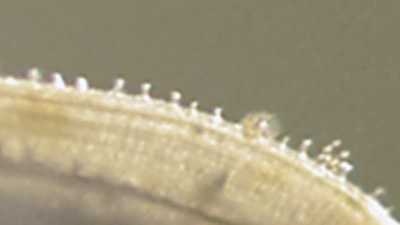
When the lined chiton came close to the glass, I was able to see the tiny hairs on its girdle.

I brought home two stones with big barnacles for the leafy hornmouth snails to eat. Once they were in the tank, the sand that came along with them got up and started to walk about. With a lens, I could see that they are snails, as small as fine sand grains. And in short order, they had all crawled down and merged into the sand on the bottom of the tank.


Saturday, February 27, 2016

Blowing his own trumpet

I had promised to try to get a photo of the tiny tubeworm's "trumpet", so this afternoon, I propped the camera an inch away from the worm, and got him to sit for his portrait.

Red trumpet calcareous tubeworm, Serpula columbiana, back view of the mouth.

The worm ("Red, for short) wasn't the least bit shy; I kept taking a few photos, picking him up and repositioning him, trying again, moving him again ... "Red" would hide in the tube while I moved things around (wouldn't you, too, if a monster the size of a skyscraper picked you up?) but by the time I'd got back to the camera, there he was, waving his tentacles around enthusiastically.

And I finally got a clear shot at that tiny "trumpet".

It still looks like a badminton birdie to me. On a stem.

This is the door of the tube. When Red goes back into his tube, he pulls the feeding tentacles in, then the "trumpet", which he spreads across the opening, locking it down.

I noticed, in my photos, many even tinier plants or critters, like those white pinheads to the left above, or little green shrubs, too small for my eyes alone to see. I wonder if I can zoom closer in, to get a good look at them, too. It's turtles, or at least critters, all the way down!

Saturday, January 04, 2014

He never stopped running

I fed my carpet beetle larva generously with prime wool hairs from my carpet, and a filet of dried fish tail from the hermit crabs' treat shelf. And he looked happy enough in his pill bottle, wearing a red wool scarf and stuffing himself with fish.

But the minute I tipped him out, riding on his piece of fish, he abandoned it and took off running. The only time he slowed down was when he hit a little wall around the lid I'd moved him to. A few seconds later, he was up and over and racing for shelter.

I gave up.

Fat carpet beetle larva, momentarily paused.

I'm happy with my new flash gizmo, though; the whole length of the larva is evenly lighted, and there are no deep shadows, which I always got using only the ambient lighting and the on-camera flash.

Now, to find a critter more willing to sit still for me.

Wednesday, November 06, 2013

Tiny, tinier

Springtail on mini-snail:

The snail is the size of a pinhead. I didn't even see the springtail.

Monday, March 11, 2013

Coffee break photography

I've been working late; I took on a project that is turning out to be much more involved than I imagined, and I've had my nose to the grindstone day and night since Friday.

I took a couple of quick breaks to play with the camera. In the comments, a few days ago, Ceratina has been encouraging me to try recording in RAW, so this evening I took a few sample shots. And this morning (after 1:AM; time to be quitting, anyhow), I looked at them.

Wow! What a difference!

I've grabbed one at random, given it a quick shakedown to clean up the glass that I neglected to polish, and resized it. And here's the result:

Val, the burrowing anemone; detail of her column. She sticks pieces of shell and sand to it, but doesn't quite hide the warts.

Could be better, but that's the best photo I have seen of her yet, (check out the full size photo: right click/open in new tab) and the original is untouched, so I can re-process it when I have more time. The jpeg of the same shot was faded and noisy, and the colours were flatter.

And now, to bed. More grindstone work tomorrow.

Wednesday, March 06, 2013

Name this long-nosed beast!

Still learning how to manage the macro lens:

A mud snail, cleaning the glass wall.

Looking over the foot to see what that flashing light is.

That face! It looks, at this angle, as if it belongs to some large ungulate. A camel, maybe? Or a camel/zebra cross?

Tuesday, March 05, 2013

The secret beauty of carpet beetles

Sometimes the old and familiar takes you completely by surprise. Something you took for granted turned out to be completely wrong. Case in point . . .

I settled down this afternoon to practice taking macro photos again. For subjects, I had a small green worm, a hitchhiker in the eelgrass I collected for my hermits; and a carpet beetle.

The worm was fairly co-operative, given a tiny pebble to cling to for security. But there's not much to him; a long tube, green on the bottom, brown on top. A green spot at the head end. That's it.

Full length, stretched out, about 1 inch. A ribbon worm.

The carpet beetle was another story. After being incarcerated overnight (6 months in beetle years), he had one thought on his little mind: escape. I got dozens of shots of his retreating rear end. I gave him some grains of sugar, which did slow him down some, but only enough to gather energy for another run for freedom. Eventually I capitulated and put his glass plate over ice. Time slowed down. I got a couple of passable head shots.

Facing his captor. Defiant.

Even on a 1 mm. long beetle, coming in that close for a macro leaves a narrow band in focus. If I get the eyes, I get a blur for the body, and vice versa.

And at this distance, the flash works, but the beetle is in the shadow of the lens. I'll have to get a slave flash for better lighting.

Same photo, processed in a different program, (free Picasa), with sketch lines added. They give definition to the scales and facial features, but fade out the colours.

Now, here's the surprise. I've examined, fed, housed, cajoled, and photographed dozens of carpet beetles. I think they're pretty, with the orangey-brown, black, and white pattern. And they're available. They keep volunteering by sitting on my drapes or kitchen wall until I collect them. But other than the patterned back, the rest is done in a dingy battleship grey. Or at least, that's what I've seen.

But now I'm zooming in a bit closer, and the colours appear. In every photo from that distance, the legs show up green. The antennae are a reddish rust colour, the outer mouthparts green, the next ones in, white.

The camera overdoes the colours, so I desaturated them for the photo above; he's still wearing red, white, and green. I compared his colours to the worm's taken in the same spot. The worm is as I saw him, even at full saturation. Should I trust the camera? I'm not sure.

Now I'm sorry I released Mr. C. into the garden once the photo session was done. I need another carpet beetle! And a better light. What other glories have these critters been hiding all these years?

Wednesday, February 27, 2013

Knobby

A couple of days ago, I posted a photo that included the edge of a limpet shell, without comment. Several of these tiny limpets, from pinhead size to about a quarter inch across, patrol the glass wall of the aquarium, scrubbing off the algae and hydroids that grow there. The shells are patterned in cream and brown, and look very smooth. Not so from close up, though; they're toothed.

Limpet sliding about, eating as he goes. The edging turns out to be tiny, more or less equally spaced protrusions with a knob on top.

Zooming 'way in.

And the limpet mouth, wide open. The eyes are at the base of each antenna. I wonder what they see, clamped down tight to their food source, mostly rocks.

Thanks for mentioning this, Sara.

Monday, February 25, 2013

Tiny discoveries, and a mysterious bubble beastie

One of the anemones was getting itchy feet, wandering about, so I cranked up the camera to take his photo in transit. And got sidetracked by a few things I hadn't seen before.

First, the usual:

Hermit crab, with a tiny frozen shrimp. Nom, nom, nom!

Then, to smaller beasties:

A periwinkle snail. I keep trying to get photos of them eating.  This is the best so far, but a video would be better. 'nother day.

An amphipod, clinging to a blade of eelgrass, legs every which way. There are both green ones and brown in my tank.

Cropped down to show his marvellous compound eyes.

Amphipod eyes are compound as in other arthropods, and sessile, that is, unmovable.  Each eye consists of several hundred individual ommatidia, each of which has its own lens system, light-sensitive retinal cells, nerve leading to an optic ganglion, and each is thought to produce a single image.  Visual fields of adjacent ommatidia overlap, presumably producing good motion detection, but possibly less good resolution . . . it is probably safe to assume that they have good resolution and motion detection, and probably see in colour.  Hallberg et al. 1980 Zoomorphol 94: 279. (From A Snail's Odyssey)

And then I discovered a snail I didn't know was in my tank:

1/8 inch long, climbing on one of the thinnest eelgrass blades. I haven't identified him yet.

Smaller still; I went chasing limpets, to see if I could catch them eating. All around them, the copepods were cavorting:

Female copepod, carrying her egg case at the rear. She has one red eye, in the center of her forehead. (And when she is good, she is very good . . .) About 1 mm. long.

Something half the size of a copepod crawled off a limpet shell and went hiking up the glass wall.

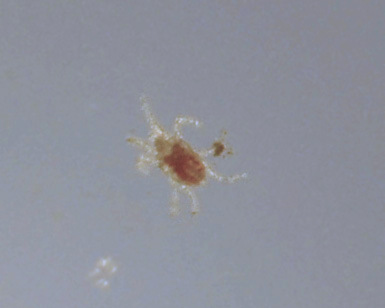
A marine mite, about 0.5 mm.. I found 4 of them, all near limpets. The mess on its right middle leg is made up of diatoms and other debris.

Unlike the few insects and spiders which may be found in marine habitats but must breathe air, mites are able to absorb oxygen from the water so they can live at great depths. (From WallaWalla.edu Halacaridae.)

I didn't know this, so it seemed really weird to see this spider-like thing walking about underwater. It has 4 pairs of legs, like a spider, but holds one pair out in front as if they were antennae. Confusing little beastie.

Some marine mites are phytophagous (suck from plants/algae), some are predators, and some are parasites.

And while I tracked down these mites, with my hand microscope jammed up against the glass wall (and my neck twisted at an impossible angle; they insisted on hanging out on the wrong side of the tank), I noticed many even tinier groupings of bubbles on the glass. This was strange, because I'd scrubbed down the inside wall before I started taking photos. Where did these come from?

Two collections of bubbles and a copepod beside a limpet.

I thought I saw one group of bubbles move, so I zoomed in on it. But no; it was just there, not moving. And just as I was giving up, thinking maybe it was some sort of algae, it suddenly convulsed, waving 4 separate groups of bubbles about, like legs, for a moment, then settling down to rest again.

Other groups I checked showed the same behaviour. They come in different sizes and number of nodes or maybe branches, and they're all over the wall where the light is good, but not on the front (where my neck would be happier) with less direct light.

I haven't the faintest clue what they are. Help!

And I never did get a decent photo of the anemone. And now he's gone and jammed himself into an impossible corner. I hope he doesn't like it there.


Tuesday, February 19, 2013

More macro lens work

So much to learn! I've been working on focus.

I tried using the tripod, but it didn't seem to help. Tried manual focus. That works, so far.

The burrowing anemone, in the tank, through slightly algaed glass.

One of the three orange striped anemones, waving gently in the current.

These were taken hand-held, the first because I couldn't get the tripod around that side of the tank, and the second to be able to follow the swaying eelgrass. Not too terrible for a first attempt at Manual focus.

I'm having fun!

Saturday, March 10, 2012

One eye, one wing.

I've had rather an exciting day, in spite of being shut in by heavy rain. First, I've been testing out a new camera, a Nikon CoolPix P7000; we bought it for Laurie because he wanted something small that would fit in a pocket, so he'd always have it handy. In the field, though, he wasn't too happy with its zoom. So I'll be using it for a desk camera, now that there's sand in the lens of my poor little Sony.

I tried it out on a few dead bugs I had on hand, alternating with the Sony for comparison. And I'm happy! It can use the home-made macro lens that I made to fit the Sony, with only a little adjustment. It's fast and sharp, and zooms in closer than the Sony. It has a shoe, so it can take the big flash, which gives better coverage. I haven't tried that yet; I will soon.

I've tried to get those wonderful compound eyes of some insects many times. It never works, and I've been wondering if I should invest in one of those arm-and-a-leg cameras with an extra macro lens. Maybe I will, some day. Not now; look what the CoolPix gave me on the first trial!

Eye of a fly I found on my car.

I hadn't figured out how to set the white balance yet, so the tiny squashed fly* I worked on didn't turn out too well; the Sony did better. It picked out the detail on the one surviving wing; look at this; I've never seen veins like these before:

Each vein is feathered, and the whole wing fringed.

I don't know if it will be possible to identify the fly, since the whole front end is battered, but maybe that wing will do the trick.

And just when I was putting away the cameras and bugs, I happened to notice my spider-in-residence acting strangely. He was just starting to molt, and I got to watch the whole process from start to finish; it took about 4 hours. Story tomorrow ...

*Looks like a mosquito. Thanks for the correction, Christopher!

Monday, October 24, 2011

Hopalong

Laurie brought me a sprig of pine in a plastic sandwich bag. I wondered why; just a few inches of pine? I had to look very closely to find the spider on one of the needles. It was tiny, tiny, and almost transparent.

I've kept it for a couple of weeks in a jar with the pine and all the fruit flies I could collect. And he's grown; he's big enough to see even through the glass, a bit darker, and active; far too active. I haven't seen one like this, so I'll send some photos to BugGuide, but with any disturbance of his web, he panics and starts racing up one needle to the tip, back down, up the next, down ... BugGuide will get fuzzy photos; the best I can do.

But I did manage to capture his personality.

Hopping right along, so fast all his feet are in the air.

He's so tiny that his legs are mostly transparent.

Caught at the tip of a needle, as he turned to run down.

He's got two dark stripes down his back, divided by a broad yellowish, oak-leaf shape, stripes on the legs, a yellow belly and eight eyes. I'm glad I got a head shot; the placement and number of eyes helps to identify a spider. (Some have eight, some six.)

In the morning, I'll send these and a couple more to BugGuide.

Friday, June 10, 2011

How to stop a weevil in its tracks

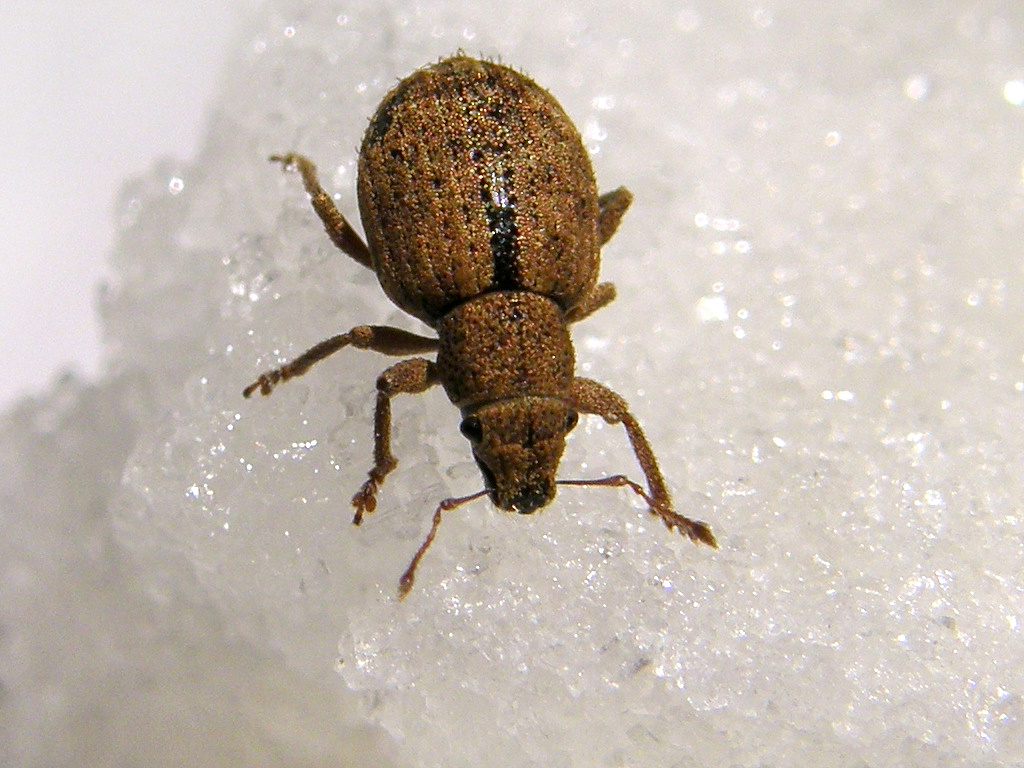
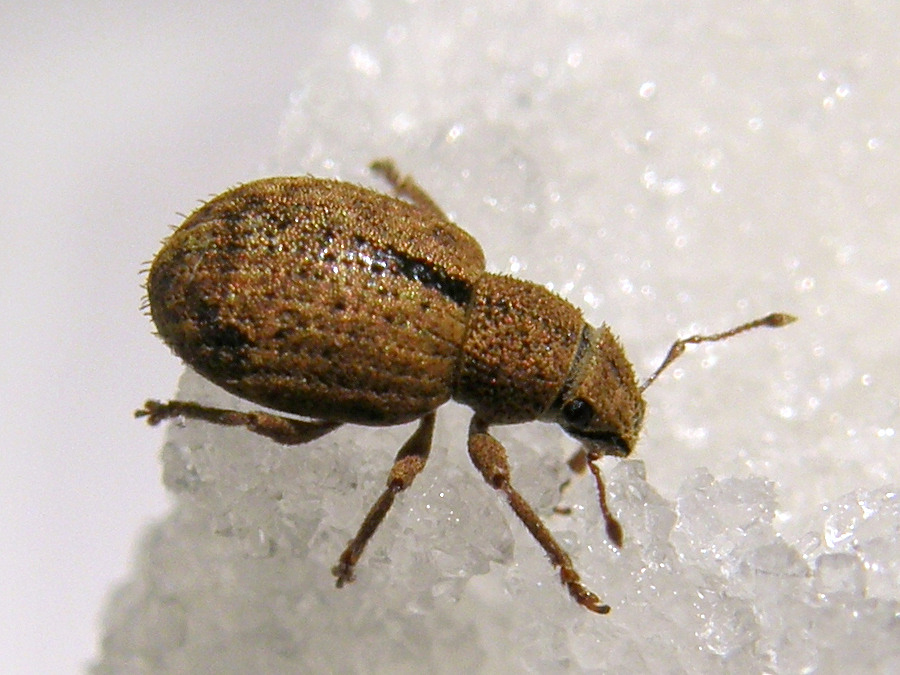
I discovered a new trick yesterday. I found a very small weevil on my countertop, and tried to get his photo. He kept moving, and turning his back on me, changing direction if I thought I would anticipate him ... hopeless. I tempted him with strawberries, to no avail. I was going for a few grains of sugar, and saw the sugar cubes. I dampened one, just a bit, and gave it to him. Just the thing! He clambered up, checked out the corners, and settled down to load up on carbs.

"This tastes better than your old strawberries!"

Staying put.

I took all the photos I wanted. He never attempted to leave. He stayed there while I went about my business, and was still there half an hour later. And the sugar cube is easy to turn or move into better light. It makes a decent background, too; not too busy, not too white.

I'll have to try this with ants.

Sunday, June 05, 2011

Of bugs, flowers, and muddy lenses

I came home from hours of driving in the hot sun, in the front door and straight out the back to the shady garden. So cool! So green! So easy on the eyes! So buggy! I went back in for the camera and macro lens.

Fly on London Pride flowers

Delicate bloom of London Pride. Taken with macro lens.

American House spider. One of Fat Momma's great-greats.

While I was up on a ladder taking this photo, I dropped the camera. It was on a cord around my neck, so no harm done, but the macro lens fell off, landed in the damp mud of the garden, and split in half. This isn't as bad as it sounds; it's a home-made stack, which cost me nothing but work. I can fix it, given a slow, rainy day.

But I needed it for bugs. Or maybe not; I went in and brought out my old Olympus (SP55OUZ), which I had almost stopped using, because it got dust inside the lens. (At London Drugs, where I bought it, they told me the repair would cost more than the camera.) Sometimes, especially if I use the flash, the spots show up on the photo. But it takes good macro photos, as long as I remove the spots later.

I decided to experiment; take the same photo with the little Sony (Cybershot) and with the Olympus, then compare them.

Petunia. With the Sony. The Olympus needs more light.

Dutchman's Breeches. With the Sony.

Harvestman on hydrangea leaf. Sony

Harvestman under hydrangea leaf. With the Olympus. Almost enough light.

Tiny Cross spider. With the Olympus and flash. I couldn't get close enough to focus with the Sony without scaring the spider away.

Rhododendron buds. Sony. The Olympus doesn't like extreme lighting.

Ant in center of rhododendron. Sony. Not enough light for the Olympus. It doesn't allow flash with Super-Macro.

Bee on rhodo bud. Note the yellow pollen sac on his leg. Sony. The Olympus was 'way too slow.

Rhododendrons in the shade with sunlit trees behind. Almost looks artificial. Sony, again.

The upshot of all this is that I am still happy with the little Sony; it's fast, it's light, and it handles contrasts well. I can take photos one-handed, which helps when I'm up ladders. On the downside, it doesn't focus if the surroundings are too busy, and the flash is unpredictable. When it all works, it's great. But I need to keep using the Olympus; given enough light and time, it does much better on tiny bugs, as long as they're sitting still.

And maybe, when I rebuild the macro lens, I can adjust it more carefully to the Sony. I think I'll put it on a strap, too.
Powered By Blogger