Showing posts with label Batillaria. Show all posts

Tuesday, September 14, 2021

Lovey doveys

In my aquarium there are always a good number of snails, mostly the invasive Asian mud snail that now inhabits all our beaches, and whelks. In the last few weeks, a couple of tiny patterned snails has shown up. They wander about, on the glass, on the eelgrass, plowing along the surface of the sand, mostly together. Where one is, the other is usually nearby.

They are tiny! They may grow up to 1 cm. long. Here they rest between two whelks with an amphipod for company.

They probably arrived on a handful of eelgrass I brought home for the hermit crabs to climb on and clean up. They also hang out on kelp, but the kelp I brought home that week had been tossed well up on the beach and was dried out.

Alia carinata, the carinate dovesnail. The pattern of the shell is variable, the flesh and siphon mottled.

Zooming in.

The Asian mud snail, with amphipods. Compare the size; the amphipods are 1/3 to 1/2 the length of the dovesnails.

One of the whelks, with attendant amphipods and copepods.

Here he is again. The corner tape on the aquarium serves as a good ruler. It is 8 mm. wide. That makes this snail just under 5 cm. long, tip to tip.

I just passed the aquarium a minute ago. Both of the dovesnails were near the corner, a few millimetres apart.

~~~~~~~~~~~~~~~~~~~~~~~~~~~~~~

En mi acuario siempre hay un buen número de caracoles marinos, por la mayor parte el caracol invasor Batillaria attramentaria, que ahora se encuentra en toda la costa, los bucinos. En las últimas semanas, han aparecido unos caracoles muy pequeñitos, con conchas pintadas en café y crema. Andan de aquí para allá, en el vidrio, en la hierba Zostera, en la superficie de la arena, casi siempre juntos. Donde hay uno, el otro está cerca.

Fotos:

  1. Aquí están entre dos bucinos y con un anfípodo. Son muy pequeños; los adultos pueden crecer hasta 1 cm. de largo. Probablemente llegaron entre un manojo de hierba marina que traje de la playa para mis ermitaños; les gusta treparse entre las hojas y comerse lo que crece allí. También estos caracoles se encuentran entre los quelpos, pero el quelpo que había traído a casa esa semana lo recogí en la parte superior de la playa y ya estaba seco.
  2. Son el caracol paloma, Alia carinata. El diseño de la concha varía, y la carne y el sifón llevan manchas negras.
  3. Haciendo zoom.
  4. El caracol marino asiático de lodo, Batillaria attramentaria con anfípodos. Compara los tamaños; los caracolitos paloma miden de 2 a 3 veces el largo de un anfípodo
  5. Uno de los bucinos, con sus anfípodos y copépodos.
  6. Y otra foto del mismo bucino. La cinta que cierra la esquina del acuario sirve como regla. Mide 8 mm. de ancho. Eso marca este bucino a un poco menos de 5 cm. de largo.
Acabo de pasar por el acuario hace unos minutos. Los dos caracoles paloma estaban cerca de la esquina, separados apena por unos milímetros.

Saturday, March 20, 2021

Wanderlust

 Anemones are supposed to be sedentary. They're supposed to glue themselves to a shell and stay put. It's in their genes.

But one of my pink-tipped anemones is a vagabond, born, like me, under a wandering star.

I first noticed it when it detached itself from the wall when I dared to clean around it. It floated to the sand, and I collected it and put it in a safe bowl while I washed the tank. Then I carefully placed it on a shell, so it could settle in comfortably. My idea, not the anemone's. Next time I saw it, it was on the far side of the tank. Then riding on a hermit's shell. Then on the other end of the tank, on the sand. Then here:

The poor snail!

It hitched a ride on one of the mud snails, bringing as carry-on baggage an old periwinkle shell and a stone. The snail had no choice, really, but there was relief in sight. Later that day, the snail was free, and the anemone had travelled to the far side of the tank, nestled in beside the burrowing anemone.

It didn't stay there; at the moment, it's on a shell near the back of the tank. It moves quite quickly; I have yet to catch it in transit. Does it swim? Does it crawl? I don't know.

By the way, those extra blobs floating around; they're snail poop.

~~~~~~~~~~~~~~~~
Las anémonas son animales sedentarios. No acostumbran moverse del sitio escogido; allí se pegan y allí se quedan. Es su programa genético.

Pero una de mis anémonas no recibió el mensaje. Le gusta viajar.

La noté por primera vez cuando, mientras yo hacía la limpieza del tanque, con cuidado para no molestar a las anémonas en la pared, esta se despegó y se fue flotando a la arena. Yo la recogí y la puse en un recipiente hasta que terminé de limpiar las paredes, y luego la coloqué con cuidado encima de una concha, donde podría establecerse cómodamente.

Esa fue mi idea, no la suya. La próxima vez que la vi, estaba hasta el otro extremo del acuario. Luego, se había subido a la concha de un ermitaño, aprovechando las exploraciones del animalito. Más tarde se había bajado, y estaba hecha una bola en la arena. Y luego la vi, adherida a un caracol, paseando por las paredes otra vez, esta vez llevando consigo como equipaje de mano una concha de caracolillo y una piedra. ¡Pobre del caracol que tuvo que cargar con todo eso!

Pero más tarde, se aburrió y soltó el caracol, para luego esconderse al lado de la gran anémona Anthopleura elegantissima.

Por un rato. Ahora, está sentada en una concha vieja en el fondo del acuario. Se mueve bastante rapidamente; todavía no la he visto en camino. ¿Nada? ¿Gatea? No sé.

(Mirando la foto: ¿esas masas amarillentas flotantes? Son excremento de caracol.)


Monday, March 01, 2021

Because you asked

I was asked a few days ago about the microscope I am using. Mark thought I had done a post on this before (I think I did, ages and ages ago), but it's time for an update. I'll include the camera and lens info, too.

My equipment is basic, bare-bones, not expensive. The camera I'm using now is the Nikon D7500, upgraded recently from the old D7000 that was becoming increasingly temperamental.

I have several lenses, but mostly use the basic kit lens, 18 - 55 mm, for outdoor photos, because I never know if I'm going for a scenery shot or a mushroom, and I will not change lenses on the go; I'm sure to get dust inside. Inside, for casual shots, I'll use this lens, too.


Oyster Bay, long-range shot. 18-55 mm., shot at 18 mm.

I usually have the camera set to automatic everything; again, I want to be able to switch from a look at a flower to swivel and attempt to catch a bird before it dives, and have the camera adjust for the constantly changing light direction and strength. I usually keep moving, so I don't have the time to sit down and wait with the camera on fixed focus; sometimes I try it, although with poor results; the diving birds absolutely refuse to come up in the spot I've focussed on.

Chia in a bag. 18 - 55 mm, shot at 28 mm.

For aquariium photos, I switch to my 40 mm. lens. Although the kit lens will do 40 mm., the fixed lens allows me to get up to within an inch or even less of my subject. For unplanned shots, the camera and lens are on autofocus, because my critters are constantly in motion. For real close-ups I set the camera to manual and zoom in the view screen to focus on smaller points. Mostly, I take dozens of shots to get one decent one; did I mention that these beasties are constantly moving?

Sometimes I do a minor focus stack, when two or three photos manage to get a critter in one position, with different areas in focus.

I have a tripod. I rarely use it.

Asian mud snail, Batillaria attramentaria, in aquarium. 40 mm., manual focus, with flash, two shot stack.

The 40 mm. lens is greedy for light. I use all the light I can get: flashlights, daylight from the window, house lights, tank lights. Sometimes I use the flash, with a second flash slaved to it, but at really close ranges, the lens itself casts a shadow just where I want the light. I keep telling myself I should buy a ring light, and never get around to it.

The microscope is a cheap hobbyist toy, the Celestron MicroCapture Pro. It zooms to 200x, is a bit difficult to focus, but connects to the computer, which my other handheld did not.

Mud snail operculum, under the microscope.

I use Photoshop Elements to process the photos. I shoot in RAW, to be able to make sure the colours are as close to what I see as possible. The camera's JPEGs are widely variable.

Basically, I correct the colour and lighting, reduce noise, and sharpen. Sometimes I take out a bit of extraneous material, like the plastic bottle I left in yesterday.

Moss on a rock. 18 - 55 mm. 55 mm. bright sun. Two-shot stack, with minimal editing.

On aquarium shots, I also have conflicting algae spots on the glass, bubbles and speeding copepods, a messy background, uneven lighting, a shallow range of focus. Sometimes I have to spend more time cleaning these up.

One thing I've noticed. I'm getting older. My hands shake more than they used to. I get tired sooner. I find it harder to balance on rocking logs or slippery seaweed; then it's not only my hands that are shaking; it's all of me. I lose more photos because of the shakes.

But my eyes are still good. And the world around me is still as beautiful and fascinating as ever.

~~~~~~~~~~~~~~~~~~~~~~~~~

Me preguntaron la semana pasada qué microscopio estoy usando. Mark pensaba que había escrito sobre eso en algún tiempo (creo que sí, pero hace siglos); ya era hora que me pusiera al corriente. Voy a incluir también los datos de la cámara y las lentes que uso.

Mi equipo es muy básico, económico, sin extras. La cámara que ahora tengo es el Niikon D7500, una nueva para tomar el lugar de la vieja D7000, que ya operaba cada vez más de mala gana.

Tengo varias lentes, pero uso principalmente la del kit original, de 18 a 55 mm., para fotos tomadas afuera de la casa, porque nunca sé si voy a estar tomando fotos de montañas o de honguitos, y me rehuso a cambiar lentes fuera de la casa; seguro sería que se me metiera algo de arena dentro de la cámara abierta. En casa, para fotos al azahar, uso esta lente también. 

Primera foto: Oyster Bay a marea baja, una distancia larga. La lente es la 18 a 55 mm., enfocada a 18 mm.

Casi siempre tengo la cámara puesta en modo automático, para todo; enfoque, luz, color, porque quiero poder cambiar instantáneamente de tomar una foto de una flor a voltear y tratar de capturar un pájaro antes de que se desaparezca, de mirar hacia la luz a dar la vuelta hacia las sombras. Casi siempre estoy en movimiento; no acostumbro sentarme con la cámara puesta en modo de enfoque manual. Algunas veces hago el intento, casi siempre con malos resultado porque los pájaros malcriados nunca salen a la superficie en el punto hacia donde estoy enfocando.

Segunda foto: la gata Chia en una bolsa de papel. La lente es 18 a 55 mm., enfocada a 28 mm.

Para fotos en el acuario uso la lente fija de 40 mm. Aunque la lente del kit podría enfocar a 40 mm., la lente fija me permite acercarme hasta a 2 cm. del sujeto. Si no tengo foto planeado, está puesta a enfoque automático, porque mis animalitos están en movimiento continuo. Para acercarme más, cambio a enfoque manual, y aumento la vista en la pantallita. Y saco docenas de fotos así para salir con una más o menos útil; ¿habré mencionado que estos bichos siempre se están moviendo?

A veces hago una unión de dos o tres fotos cuando un sujeto se queda casi sin moverse por unos minutos, así logrando tener enfocada una mayor parte del animal.

Tengo un tripode. Casi nunca la uso.

Tercera foto. Una caracol marino, Batillaria attramentaria en el acuario. La lente es 40 mm., enfoque manual, dos fotos con flash.

La lente de 40 mm. pide mucha luz. Uso todo lo que sea posible: luz del dia, luz de lámparas, luz del acuario, linterna. A veces puedo usar el flash, con un auxiliar que dispara al mismo instante, pero para fotos tomadas muy de cerca, la lente misma añade su sombra justo donde necesito la luz. Me digo siempre que debo comprarme una luz redonda para la lente, pero por alguna razón, siempre se me olvida.

El microscopio es casi un juguete, un microscopio "hobby", el Celestron MicroCapture Pro. Hace zoom hasta a 200 veces el tamaño natural, enfoca con una poca de dificultad, pero se conecta a la computadora, lo que no hacía el microscopio que antes usaba.

Cuarta foto: Otro caracol, mostrando su opérculo (la tapa que la encierra para esconderse).

Uso el programa de Photoshop Elements para procesar las fotos, porque saco fotos en formato RAW, para asegurar que las fotos salgan con los colores y la nivel de luz tal como las vi. En formato JPEG, las fotos salen muy variables.

Corrijo el color, la luz, bajo el nivel de ruido (manchas producidas por la cámara), y ajusto en enfoque un poquito. A veces borro un detalle que no debe estar en la foto, como la botella de plástico que no borré de la foto de ayer.

Quinta foto: musgo en una roca. Lente 18 a 55 mm., enfocada a 55 mm. Luz natural, dos fotos unidas, con modificaciones mínimas.

En las fotos en el acuario, también hay puntos de alga creciendo en el vidrio, burbujas, y copépodos nadando alrededor, un fondo algo enredado, niveles de luz variables, y una profundidad de enfoque limitado. A veces tengo que pasar más tiempo limpiando estas fotos.

Una cosa que se me ha presentado: me estoy haciendo vieja. Las manos me tiemblan más que antes. Me canso más. Se me hace más difícil balancearme sobre troncos inestables o sobre algas marinas resbalosas; en estos momentos no solo son las manos que tiemblan; me tiembla todo el cuerpo. Pierdo más fotos por estos temblores.

Pero los ojos todavía me sirven. Y el mundo alrededor es tan bello y fascinante como siempre.


Thursday, February 01, 2018

Deep throat

I scrubbed the glass aquarium wall, but left a few faint spots of algae. A mud snail, looking for a meal, had to open wide to scrape off the leftovers.

Mud snail, Batillaria attramentaria, and copepods.

Looking closely, down his throat, a few ridges are visible. As far as I can tell, this is the radula, the file-like ribbon that peels his food off the surfaces where it grows.

Saturday, January 06, 2018

Blue teeth

This I haven't seen before: on the rim of a shell of a mud snail in my aquarium, there are tiny, bright blue dots.

Batillaria attramentaria, about 1/2 inch long.

A description on the WallaWalla.edu site mentions that the lip of the shell has teeth inside it. Would these be the teeth?


Friday, November 24, 2017

Beast of burden

It's all about location; find a perfect site and settle in, and you can thrive. Hide off in a corner, and life's a struggle. The pink-tipped anemones in my aquarium know this, so they're always moving about, searching for the ideal spot, where the food is plenty and the diet varied.

This one seems to have the right idea. But the poor snail!

Heavy load

The snail, here browsing among the algae halfway up the wall, is one of the mud snails, Batillaria attramentaria, about half an inch long. And he's been completely encased in the base of the anemone, twice his size. And to add to his burden, the anemone has brought along its pet rock, and couple of pieces of clamshell; together the anemone's decor must weigh more than the snail.

And yet, the snail goes about his business, tranquilly scraping up the algae, moving on to the next patch; what doesn't kill you makes you stronger, he says, flexing his weight-lifting muscles.

(I've cleaned the algae off the glass in the photo, for visibility. It's still there, where the snail and his burdens are: those yellow-brown patches between the rock and the glass, for example.)

Saturday, April 25, 2015

Why is it

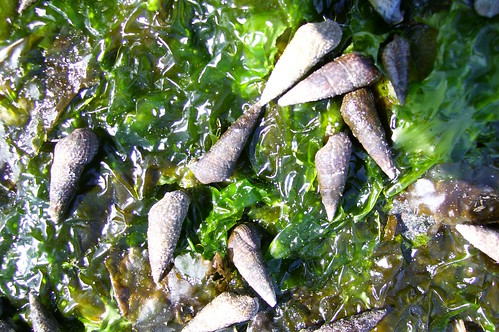
... that when the tide goes out, all the sensible little beasties head for deeper water, or bury themselves in the sand, or hide under stones and logs; anything to keep from drying out. Except the Asian mud snails; they look for places to sunbathe, high and dry.

On stones,

On logs.

Note the tidepool in front of the log; very few snails remain there, and they're scrambling for the edge. Behind the log, on higher ground, the snails are so thick that in places they hide the stones.

They do the same thing in my aquarium; they spend at least half their time clinging to the walls above the water level, and sometimes leave the tank and go for walkies on the counter. Sometimes I find one behind the tank, dry as dust, completely sealed in, looking dead. I drop him back in the water, and he wakes up - and heads for the top again.

They don't eat out of the water; just sleep.

Why?

Wednesday, December 10, 2014

Texture and pattern in the mud

The mud-coloured, mud-loving, mud-slow Asian mud snails everywhere underfoot on our beaches are usually ignored. Frankly, they're boring; billions of half-inch cones, half buried, doing nothing while the tide's out, and not much when it's in.

Occasionally, to reset my sense of wonder, I need to get down nose to nose with one or two.

Two mud snails; the foot of one, the nose of the other.

Two feet and the underside of a chin.

The third shell, on the right, is an empty, of a species not often seen here any more. The mud snails have taken over.

Monday, December 09, 2013

I blinked first

A major part of the cleanup crew in my aquarium is made up of mudflat snails, Batillaria attramentaria, those invasive snails that crunch under our feet on the beaches of Boundary Bay. They probably would be invasive here, too, were it not that the big burrowing anemone eats all she can catch.

Most of them spend their time under the sand; when they venture out, usually to climb the walls scrubbing off the algae, all that can be seen of them are the shells and a hint of dark flesh at the lip. Rarely, one decides to look me in the eye (or camera lens). One of those curious ones was cleaning off a shell right beside the wall the other day.

Striped face, striped tentacles. And a staring eye.

These eyes can see some shapes, but they don't have a focussing lens, so things are blurred. And it seems that they don't see colours. Still, they can detect light and dark, day and night. For the rest, they don't have to chase the algae, nor could they dodge predators if they saw them; the eyes are good enough.

And they don't blink.

The three curves in the shade under the body almost look like crawly-type feet, but that effect is either from the pattern or the folding of the one fleshy foot.

Full-face view. The eyes are at the base of the tentacles, and bulge outward. The one on the right is barely visible from here.

A couple of years ago, another snail consented to be photographed. I blogged about it here.

Big foot, patterned in green and grey, folded.

And doesn't this critter, if you ignore the shell, look like a cuttlefish? Well, except that the cuttlefish eyes are on the forehead. And the nose is really a mass of tentacles. And it changes colour. And ... Well, you'll see what I mean if you look at this Common cuttle, from the Monterrey Bay Aquarium. (It's copyrighted, so I can only provide you with the link.)


Wednesday, March 06, 2013

Name this long-nosed beast!

Still learning how to manage the macro lens:

A mud snail, cleaning the glass wall.

Looking over the foot to see what that flashing light is.

That face! It looks, at this angle, as if it belongs to some large ungulate. A camel, maybe? Or a camel/zebra cross?

Tuesday, June 28, 2011

Look me straight in the eye and say that!

The Asian mudflat snail is an invasive pest. A million or so of them make a beach crunchy; they wipe out native snails and discourage birds. It's easy to learn to grumble at them, easy to miss their beauty. To appreciate that, you have to get down, eye to eye with them, one at a time.

Mudflat snail, in a matching coat and shell, with barnacle scar cap.

Shimmering grey-green and black coat, an observant eye.

Of course, it helps if they're in a clean tank, out of all that mud.

Monday, February 07, 2011

"The latest trend in fine dining"**

The tide at Crescent Beach was almost at its maximum. We walked close to the incoming waves, where the water licked at our boots. Laurie flipped a rock to watch the crabs scuttle for new cover. Small snails coated the shaded part, on and around a mass of tapioca-pudding jelly. Snail eggs, probably.

So we turned more stones and rocks. Many of them held their smear of jelly, surrounded by snails.

Tapioca jelly and periwinkle snails. If you look closely, you can see the individual eggs in the jelly mass.

These snails live only in the upper levels of the beach. They have laid their eggs in shady spots, where they will remain moist, even at low tide, and where they will find just the right mix of algae to eat, once they hatch.

Most of the jellied rocks held more than parent snails, though:

Three or four different species of snail, and other party-goers.

The fat, round snails are periwinkles, probably Sitka periwinkles, Littorina sitkana. There are a few Asian mud snails, Batillaria attramentaria, and quite a few small, pointed snails that I think are probably Bittium. Several little Japanese Nassas have come to the feast, too. All but the parents are eating periwinkle eggs.

When I looked closer, at the beach, I found that most of the smaller snail shells held hermit crabs. And when we looked over the photos at home, we saw a pair of flatworms that somehow had escaped our notice, even as we focused the cameras on them.

Zooming in on the flatworms. Two different species, I think. And three hermits. lower left.

Arrows point at a flatworm, a mother periwinkle, and two tiny isopods.

Twenty seconds later, the flatworms were halfway across the jelly mass, and almost completely hidden. In the clear centre of the jelly, a pair of tiny worms, or maybe isopods are feeding, too.

I brought home two small stones, each with its blob of jelly. When I put them in the tank, the hermits and crabs leapt on them and started cramming big handfuls into their mouths. So much for baby snails, I thought, but this morning, about a quarter of the eggs were still in place, and now they're being ignored; snail caviar is good for a treat, but good old detritus is what sticks to a crab's or hermit's innards.

It seems a waste, really, for a snail to nurture all those thousands of eggs, just so that most of them can be eaten. It's the same with Ma Crab*; a bellyful of berries, which she carefully tends, only to serve as food for barnacles and anemones. But there are a pair of tiny, tiny crabs in the tank, eating and growing rapidly; the lottery winners. The strategy works.

*Turn about's fair play; Ma Crab eats snails' babies, anemones eat hers.
** Quote from snail-caviar.com.

Wednesday, January 26, 2011

Snail and hermit mystery

I can never keep enough small snails in the aquarium. The crabs eat them; so do the big trophon snails. I'm always bringing home a few more, and always finding only one or two actually doing their work of keeping the walls and floor clean. The rest are reduced to empty shells lying on the sand, or new outfits for the hermits.

So when we went to Boundary Bay a few days ago, I planned to pick up a good handful of snails. The mud flats around Centennial Beach are loaded with them, starting a few steps below the high tide line. They're mostly the mud-flat snail, Batillaria attramentaria, spread so thickly that at every step I can hear the "crunch!" of a few more.

But this time, for variety, we went to the south end of Beach Grove and walked down to the US border. The tide was coming in, but there was still some flat sand. But no snails. Not one. There were clams in abundance, lying in groups on the sand at the edge of rocky patches. There were worm casts and worm tubes sticking up out of the sand. No crabs, no hermits, no snails.

Just a few metres north of the border, we passed two rotting logs buried deep in the sand. Here there were barnacles and crevasses packed with mussels and mudsnail shells.

Hollowed logs make great hideouts.

Deep in a crack.
I started collecting snails. Each one I picked up, I inspected; I didn't want any more hermit crabs. The aquarium held 11 at that point, more than enough for a small tank.

And each snail, as I turned it over to look for the glossy operculum, waved hermit pincers at me. I put them back on the log, and checked another. And another, and another ... They were all hermits. All around the first log, all around the second one, down the in the innards; hermits, hermits, hermits. Finally, I found 3 very small ones that seemed to have the right dark brown glossy lid on the opening; snails, at last. I dumped them in my bottle, with a few barnacles and mussels for the trophons to nibble on, and brought them home.

And once I'd left them a few minutes in a bowl, out crawled the hermits. Out of 3 "snails", I got 5 hermits. The last two were really tiny, and must have been hitchikers on the barnacle clumps.

The more I think about this, the stranger it seems. There were no snails to be seen in the vicinity of these stumps. And all the snail shells there housed hermits. Where did they get the shells? Why did I find no surviving snails?

Did the hermits invade a colony of snails and wipe out every single one for their shells? But hermits don't usually do that; they use empty shells, or take them away from other hermits. They ignore live snails.

So did something else, crabs maybe, kill the snails and leave them piled into the logs for the hermits? Where are the crabs, then? Why only on the logs?

Or did the hermits immigrate, shells and all, from far down the beach? Why? Why were there none scuttling across the sand, or under the nearby rocks?

Hermit, one of the 11. See how his shell is broken? That's how a crab gets at the tasty snail meat.

I wish hermits could talk. We'll have to take another walk down that way next time the tide is a bit lower, to look for the missing snail population.

And now I have 16 hermits in my tank. At least the newest residents are tiny.

(More about these snails - before the hermits get them - om Dave Ingram's Island Nature blog.)

Thursday, September 09, 2010

Abstract in sand

"... ephemeral art asks that we appreciate the art work now in the present moment, for it may not be there tomorrow." (Sheri Klein)
Or even when the tide comes in. And who's to say snails can't participate?


Snail art, Centennial Beach

The artists are resting along the bottom edge, except for the one putting finishing touches on the upper right corner.

(And, by the way, remember International Rock Flipping Day, this Sunday. All about it, here.)

Thursday, July 09, 2009

Water from the Aral Sea

We were at Maplewood Flats, on the North Shore (more about this later), and I took a photo of this ship near the Chevron Oil Refinery on the far shore. I didn't see the water spraying out of the stern until I blew up the photo at home.


Is she unloading ballast water preparatory to loading fuel? (This article includes a photo of a similar ballast discharge pipe in operation.)

Whether it's that, or some other reason for spewing water (wastewater?) into the Burrard Inlet, it worries me.
Cruise ships, large tankers, and bulk cargo carriers use a tremendous amount of ballast water, which is often taken on in the coastal waters in one region after ships discharge wastewater or unload cargo, and discharged at the next port of call, wherever more cargo is loaded. Ballast water discharge typically contains a variety of biological materials, including plants, animals, viruses, and bacteria. These materials often include non-native, nuisance, exotic species that can cause extensive ecological and economic damage to aquatic ecosystems, ... (Wikipedia)
Some of those "biological materials" are listed in a NOAA page:
...minute jellyfish, larval mussels and barnacles, marine worms, tiny shrimp-like copepods and juvenile fish. These creatures share their confines with an assortment of single-celled plants and even smaller bacteria and viruses.
The Japanese mud snail, Batillaria attramentaria, that covers the mud flats in Boundary Bay, probably arrived here in ballast water.

An article in E-Fauna BC, Exotic Introductions into BC Marine Waters: Major Trends has a table of 31 introduced marine plants and animals, not including the Japanese mud snail. Puget Sound Partnership adds three species of Tunicates.

The ship is the Aral Sea, under a Singapore flag. More about her, here. Worrisome.

.

Tuesday, April 21, 2009

A trio of snails

Pink snail found next door:


Striped mauve and black snail found on my bergenias:


These two are probably both Cepaea nemoralis, the grove snail, which comes in many colours and patterns.

And a yellow snail, found at an antique fair, last Sunday:


No identifiable species for this one.

And, a little more sensibly, a couple of interesting links:

A six-kilometre trek on the back of a snail: from Not Exactly Rocket Science.
For long journeys, the shell of a snail hardly seems like the ideal public transport. That is, of course, unless you're an even smaller snail...
And Aydin Örstan, of Snail's Tales, writes about Battillaria minima, sea snails, and their social behaviour, in Clustering of the intertidal snail ... He says,
"the distributions of these snails were often patchy: there would be areas 2-3 meters wide where I would see none of them and then there would be a cluster of 50 or 100 snails."
And then does a simple experiment to watch them congregate.

Laurie was just commenting on this last week, watching our local Batillaria attramentaria at Boundary Bay. It's interesting that it doesn't seem to be just an effect of water currents, etc.

I wonder if it's mating behaviour, spring fever and all that; or do they hang out in groups all year round?

More experimentation is needed.

.

Wednesday, February 25, 2009

Red in radula and proboscis

Well, maybe not red, exactly, but you get the idea; it's a cruel, cruel world out there.

I was admiring the snail-like spiral of barnacles on this little rock, when I noticed the upside-down "ice-cream cone" shell combo on the left:


It's a mud snail jammed down inside a barnacle. "Eating the barnacle," was my first impression. Do Batillaria do that? I searched through other photos to see.


Here we go. A bunch of barnacles that are now empty shells. Barnacles with mud snails inside, with little periwinkles, with small whelks, even a barnacle with two different snails crammed into the tiny space. But ... I thought periwinkles were vegetarian!

They are. So are the invasive mud snails. And the Tegula, the black turbans. They feed on algae.

But the whelks, the whole lot of them, are carnivorous predators on barnacles and mussels. Wikipedia also mentions tube worms among their prey.

Using the radula, a scraper/drill/file arrangement (There's a good diagram here.), the snail drills a small hole into a mussel, then injects a paralizing or digesting enzyme. Once the mussel flesh is soup, the snail inserts a long proboscis and slurps it up. With barnacles, the technique varies a bit;
"The snail uses the radula to drill a hole in the barnacle shell at the seam between two plates, and then extends its proboscis through the hole to scrape out the soft tissue. The preferred barnacle is Balanus glandula ..."
From U. Washington.
I gather from this, that the other snails, the mud snail and the periwinkles, are simply feeding on the leftovers or the algae that grow on the leftovers.

Nobody's safe here; the mud snails, in turn, become prey. In this next photo, down on the left, in an empty clam shell (probably smashed by seagulls), a mud snail lies dead, with a small circular hole in the shell. Whether this was Nucella's doing, or some other snail's, I don't know. The moon snail makes larger holes (and are not on this beach, so far as I know).


While you're at it, open the photo full size, and look at some of the other snails. In the opening of several, you can see a small white claw. The original tenants are gone; the current residents are hermit crabs.

And on the outside of a snail just above the centre of the photo, look for a pinkish spot; it is possibly a slipper snail. There was another in one of our other photos. These are filter feeders; they do not drill holes.


A whole congregation of hermits. (Do hermits congregate?) And a few snails "peeled" by crabs.


Hermit crab, out looking for a solitary cave.

A few steps down the beach, I came across another breed of "voracious predators".


These are Paranemertes peregrina, the Purple ribbon worm. They looked almost black on the beach, but they are really a greenish, purplish, dark brown. The belly is creamy.

They are also called proboscis worms, because they shoot out a long proboscis to catch their prey. (Like a frog, maybe? But not as cute as frogs.) They are able to catch and kill polychaete (bristle) worms bigger than themselves. (WSU has a photo of a purple ribbon eating a polychaete.)


Another view. Note the green isopod to its right. The beach hopper, Traskorchestia traskiana, possibly.


And still another green isopod. I thnk this is the Rockweed isopod, Idotea wosnesenski.


Photo lightened considerably, to show two more beach hoppers.

These little guys crawled over and around the worms the whole time I was watching. The worms ignored them. They're looking for more challenging prey.

.

Monday, February 23, 2009

"Endless forms ..."

"... most beautiful and wonderful ...," Darwin wrote. We looked over a small corner of that almost infinite variety on Crescent Beach last Friday.

In previous years, we have found millions (one small bay to the south of us has been estimated to hold 1.4 billion) of the invasive Asian snail, Batillaria attramentosa. That, and not much else; the native snails had been overwhelmed.

Not this year. Variety is in again. Here's a bit of what we found: (It helps to blow up the photos to full size.)


The stripy, pointed snails in the centre are Batillaria. They come in a variety of patterns and colours, from brown to grey to black and white, checkered to striped. But there, just below the pale brown invader, see that orange, curvy snail? It is one of the Nucella*, probably N. lamellosa. And over at the far left, on the clam shell, a tiny, black, globe-shaped snail could be one of the periwinkles, or maybe a young Tegula. Up on the point of the angular rock, a grey snail has longitudinal ridges. I am not sure what it is.

About Nucella. This snail boasts as many names as patterns and colours. Its colour varies from site to site; so does the pattern and even the thickness and smoothness of the shell.


This collection of Nucella comes from Port Hardy, at the northern tip of Vancouver Island. The photo is the first one from Dan Yoshimoto's page about this species; he has samples from locations up and down our coast, all different. At the bottom, he lists 21 alternate names. One of them, Thais, is the one I found in my Kozloff's "Seashore Life". (It's an older edition; maybe the name has been changed in the newer one.)

More on this snail later, in another post.


Limpets. We found two or three species of these. A couple of periwinkles, Littorina sitkana. Off to the right, an extremely indented fat snail, possibly a Tegula funebralis. Small barnacles, Balanus glandula. Assorted jelly-like organisms; green algae, blood-red algae, possibly a small patch of tar algae, and those yellow masses. (I'll deal with those in another post.)


A pair of snails, on the prowl. One green and ridged, the other black and white, much smoother. But the body, what shows of it, seems similar; licorice tentacles, with white tips, a black and white spot (Is that an eye?) at the base.


These barnacles are Chthamalus dalli. I can tell by the cross-shaped joint of the "mouth". Balanus glandula has a straight line, and another local barnacle, Balanus cariosus, has a squiggly line.


Aren't these pretty? Batillaria and a checker-board, ridged limpet. Colliselta pelta? Maybe. The barnacles are B. glandula, again.


Another pair, green and purple, although I think the green is a coating of algae. Here one is showing off the creamy body, as well as the black tentacle and eye spot.

And aren't those tiny barnacles pretty? They look almost like marzipan candies. Yum!

*I could be wrong on any of these identifications. Or most of them. To be more or less sure, I would have had to bring samples of them all home.

.
Powered By Blogger