Showing posts with label intertidal snails. Show all posts

Sunday, November 06, 2022

It's a big world out there.

 It was raining steadily, and had been all day; clouds and fog hid the hills. A good day to stay home. A good day to visit the community in my little aquarium.

I wanted a photo of my big, beautiful worm. I'm still hoping to get a face shot, showing his 4 eyes. So I cleared away some of the seaweeds and laid down his favourite food, dried roasted seaweed. Meant for humans, but I don't mind sharing.

I sat there with the camera for an hour. Would the worm show his face? No. The hermits ate his seaweed.  And I took photos of any tiny critter that came close to the aquarium wall.

Sometimes it looks as if they were posing for me.

It's a big world out there. Periwinkle snail, checking out an empty snail shell.

One of the tiniest hermits. The smaller ones were elusive.

At the corners of the aquarium, a line of tape seals the join. It collects speckles of algae at the edges. And the smallest hermits climb up it, holding on to slight irregularities.

That same empty snail shell, now holding a small hairy hermit.

An amphipod, coming out from shelter underneath a mussel. Those white blobs are the anchor points on the glass of the mussel's byssal threads.

More aquarium photos tomorrow.

~~~~~~~~~~~~~~~~~~~~~~~~~~~~~~~~~~~~~~~~
Estaba lloviendo, había llovido todo el dia. Los bosques se escondían tras nubes y neblinas. Era un buen dia para quedarme en casa. Un buen dia para pasar el rato con la pequeña comunidad que vive en mi acuario.

Quería una foto del gran poliqueto que vive bajo la arena. Sigo con el propósito de sacarle una foto de la cara, con sus 4 ojos. Quité algo de las algas que tapaban la vista, y le ofrecí su comida favorita, algas secas tostadas. Comida de humanos, pero podemos compartir.

Me quedé allí sentada con la cámara en la mano por una hora. ¿Y se dignó el gusano a aceptar mi ofrenda? No. Ni siquiera se le ocurrió extender un tentáculo fuera de la arena. Los ermitaños se comieron sus algas. Y yo, pues, le saqué fotos a cualquier animalito que se acercara al vidrio.

A veces parece que se ponen en pose a propósito.

Fotos:
  1. Un caracol marino, un bígaro, viendo una concha de caracol vacía, enorme en comparación.
  2. Uno de los ermitaños más pequeños. Los muy muy chicos no se permitieron fotografiar.
  3. En las esquinas del acuario, una cinta sella la junta y se le pegan granitos de algas. Los ermitaños más pequeños se trepan a estas cintas, agarrándose de las arrugas.
  4. La misma concha vacía de la primera foto, ahora con un ermitaño.
  5. Un anfípodo sale de su escondite debajo de un mejillón. Las bolitas blancas son los puntos de adhesión de los bisos del mejillón.
Mañana subo más fotos de los residentes del acuario. 


Tuesday, September 14, 2021

Lovey doveys

In my aquarium there are always a good number of snails, mostly the invasive Asian mud snail that now inhabits all our beaches, and whelks. In the last few weeks, a couple of tiny patterned snails has shown up. They wander about, on the glass, on the eelgrass, plowing along the surface of the sand, mostly together. Where one is, the other is usually nearby.

They are tiny! They may grow up to 1 cm. long. Here they rest between two whelks with an amphipod for company.

They probably arrived on a handful of eelgrass I brought home for the hermit crabs to climb on and clean up. They also hang out on kelp, but the kelp I brought home that week had been tossed well up on the beach and was dried out.

Alia carinata, the carinate dovesnail. The pattern of the shell is variable, the flesh and siphon mottled.

Zooming in.

The Asian mud snail, with amphipods. Compare the size; the amphipods are 1/3 to 1/2 the length of the dovesnails.

One of the whelks, with attendant amphipods and copepods.

Here he is again. The corner tape on the aquarium serves as a good ruler. It is 8 mm. wide. That makes this snail just under 5 cm. long, tip to tip.

I just passed the aquarium a minute ago. Both of the dovesnails were near the corner, a few millimetres apart.

~~~~~~~~~~~~~~~~~~~~~~~~~~~~~~

En mi acuario siempre hay un buen número de caracoles marinos, por la mayor parte el caracol invasor Batillaria attramentaria, que ahora se encuentra en toda la costa, los bucinos. En las últimas semanas, han aparecido unos caracoles muy pequeñitos, con conchas pintadas en café y crema. Andan de aquí para allá, en el vidrio, en la hierba Zostera, en la superficie de la arena, casi siempre juntos. Donde hay uno, el otro está cerca.

Fotos:

  1. Aquí están entre dos bucinos y con un anfípodo. Son muy pequeños; los adultos pueden crecer hasta 1 cm. de largo. Probablemente llegaron entre un manojo de hierba marina que traje de la playa para mis ermitaños; les gusta treparse entre las hojas y comerse lo que crece allí. También estos caracoles se encuentran entre los quelpos, pero el quelpo que había traído a casa esa semana lo recogí en la parte superior de la playa y ya estaba seco.
  2. Son el caracol paloma, Alia carinata. El diseño de la concha varía, y la carne y el sifón llevan manchas negras.
  3. Haciendo zoom.
  4. El caracol marino asiático de lodo, Batillaria attramentaria con anfípodos. Compara los tamaños; los caracolitos paloma miden de 2 a 3 veces el largo de un anfípodo
  5. Uno de los bucinos, con sus anfípodos y copépodos.
  6. Y otra foto del mismo bucino. La cinta que cierra la esquina del acuario sirve como regla. Mide 8 mm. de ancho. Eso marca este bucino a un poco menos de 5 cm. de largo.
Acabo de pasar por el acuario hace unos minutos. Los dos caracoles paloma estaban cerca de la esquina, separados apena por unos milímetros.

Sunday, December 29, 2019

Micro beasties

I bought myself another microscope. A cheap one, for students, with low magnification, but like the even cheaper one I'd had a few years back (that didn't last long), with the ability to take photos. The one I had been using up to now was for my eyes only.

Tonight, I set it up and collected some stuff from my aquarium; a teaspoonful of sand, a fragment of seaweed, a few empty (or so I thought) shells, and one of the smaller hermit crabs. Arranged them on plastic lids, since they needed to be kept in water, shoved them under the 'scope, and tried to focus. It's a bit difficult when your target keeps running away; even the seaweed was carrying mini-critters on the move.

Pacific rose seaweed, Rhodymenia pacifica. With worm and snails.

This delicate (but oh, so durable in my tank) seaweed is a sheet with one layer of cells. Here, each cell is visible. The fragment was about 3 mm wide. The worm, that looked like a hair, but crawled about slowly, is about as wide as one seaweed cell. Even through the microscope, I didn't recognize the dark patches, but once I blew up the photo, I see that they're all snail shape. No wonder I always have a batch of new tiny snails climbing the walls!

Another snail. Shell only, abandoned in the sand.

This was in the teaspoon of sand. The snail shell is about as large as the larger sand grains. Still tiny. With everything under a film of water, the microscope LED lights produce glitter. I edited out what I could without destroying what is underneath, but the tiniest white specks are moving critters, all constantly in random motion, sort of like a swarm of midges. Some of the brighter patches of light were pulsating, squirming something-or-others. I managed to see a couple of worms and something with legs before they hid under the sand grains again. Some of the sand grains were bouncing; there was something busy underneath.

On an old cluster of empty barnacle shells, a colony of orange-striped green anemones has settled in.

One of my smaller hermit crabs.

I've been wanting to get a good look at these hermits for a while. They look like hairies (Pagurus hirsutiusculus), but never seem to grow up to the expected size. Maybe I'm not giving them enough time. This one certainly looks like a hairy; banded green antennae, blue marks on the legs. But those two rows of lumps on the pincer arm look interesting: I'll have to examine more of these little guys.

A couple of periwinkles.

And a tiny snail, half the size of the smallest periwinkle, on the move. With sand grains for size.
This is fun! Let it rain!


Thursday, October 17, 2019

Forgotten beasties

From the "hold" folder, a few beach critters:

Wosnesenski's isopod. I think I held this photo because I wanted to id the tentacly bit near the isopod's rear. I still don't know what it is.

Three snails. Shell road beach, September, 2018. Half the snails I see turn out to be hermit crabs; I think the one on the left may have a hermit in residence; see the tips of her toes.

Three crabs; red rock, green shore, and a hermit. I like the pie-crust look of the red rock crab's carapace. April, 2018

Unidentified polychaete, stretching out of its tube.

A thin slab of wood, riddled with teredo clam burrows. The white bits are remains of the clam's burrow lining.

Monday, April 16, 2018

And a few more rocks on the shore

They intrigue me. I wish I knew their history.

Stripes on a large rock. With tiny barnacles in the cracks.

Peeling rock.

Trying to imagine how this came about: a solid core was bathed in sediment, which hardened into a smooth coating, and now, after a pounding by waves bearing pebbles and alternately frozen and heated, the coat is peeling off. Just a guess, probably not quite correct.

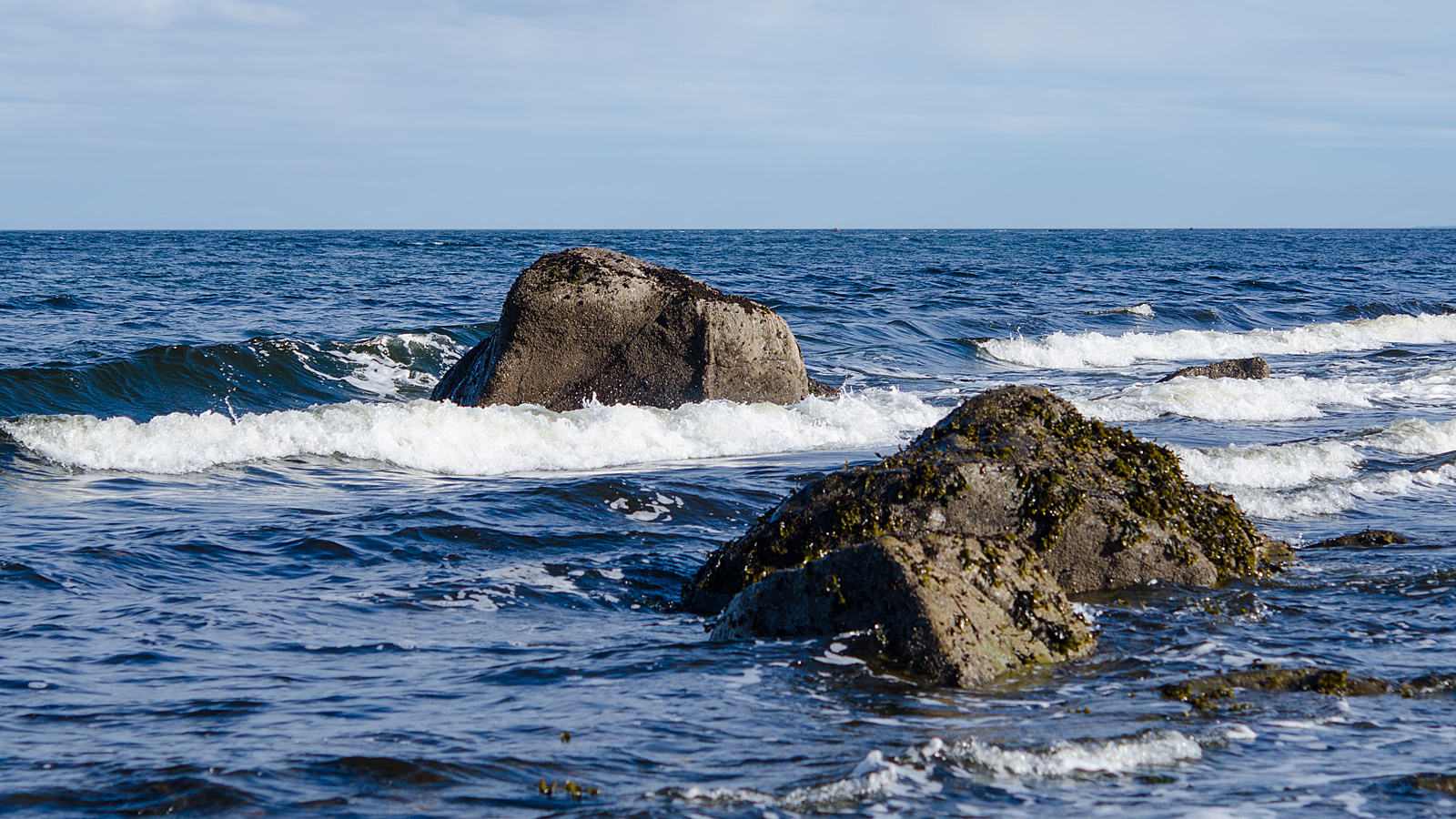
The snails like to bask in the sunshine at low tide, like tourists on a tropical beach.

A small clump of sea lettuce washed up, adding a touch of softness and colour.

Seaweed on rocks that are usually underwater.


Sunday, April 15, 2018

Thoughts on a rocky shore

I love a rocky beach.

Polished rocks, a sprinkling of barnacles

The current runs strong along the eastern shore of the Georgia Strait, and the tides pound in and drain out quickly. Many of the rocky areas are like this; water-polished rocks, with very little life visible. Turning over stones at low tide, I find more smooth stones. No crabs, no hermits, no worms. They must be there, but have retreated to deeper, safer hideouts.

Sometimes there are barnacles, in flatter areas thickly covering the stones, in other spots clustered on the sheltered sides and bottoms of the rocks. There are spots where none are to be seen, where the rocks shine as if they were waxed and buffed.

Down near the lowest tide line, seaweeds cover the rocks. It's dangerous walking; the weeds are slippery, and the rocks move underfoot. No matter how carefully I step, I'm always a twisted ankle away from a spill. But here, the crabs and other critters find a refuge. From the waves, from hungry gulls, and also from me, as I usually gingerly skirt the greenest areas, keeping an eye on the water's edge, ready to hurry towards land when the tide turns; I don't want to be caught in seaweed over stones as the water races in. Too risky.

A flatter spot, in the lower intertidal zone, with small erratics and tide pools. More barnacles here.

Coming towards a tide pool, I see ripples and splashes at the surface. By the time I get there (and sometimes I sneak up from the far side of the rock) there is nothing. The pool looks empty, just more clean stones with clear water. Even the tiny fish have hidden underneath the stones.

But there are always snails. Tiny, and tinier snails, dotting the rocks, basking in the warmth or resting in a tide pool. Most are pinhead size, some as "big" as a grain of rice. They hold on tight, or don't provide enough resistance to the waves to be washed away. Maybe their shape helps; smooth and rounded, with a sharp tip.

Under an inch of water in a tide pool, rice-grain snails and a few limpets choose the warmest rock.

Everywhere else, where I find tiny snails, a good half of the shells house miniature hermit crabs. Not here. I think I saw one leg poking out of a shell; otherwise, every snail shell is full of snail. Hermits can easily be bowled over by a wave and swept away.

The tiniest snails are a worry for me. In some spots, every decent-sized stone is covered with them, like sprinkles on a donut. I can't put my foot down without stepping on some. I try to brush them aside, but risk tripping myself up as the stone shifts. I am glad my shoes have deep ridging; at least some of my footprint is safe for tiny critters.

Sand is safer, for the snails, and for me.

Tuesday, March 27, 2018

Whelk

Live, on drenched sand.

What she finds to eat in this barren (at least visibly), mostly sandstone shore, I can't imagine.

My camera's empty, the weather is wet. I've taken photos of dripping deer through the car window. And deleted them; too dark, too blurred. But the deer are out trimming back the new spring greens. I'm going out to look for more.

Thursday, February 01, 2018

Deep throat

I scrubbed the glass aquarium wall, but left a few faint spots of algae. A mud snail, looking for a meal, had to open wide to scrape off the leftovers.

Mud snail, Batillaria attramentaria, and copepods.

Looking closely, down his throat, a few ridges are visible. As far as I can tell, this is the radula, the file-like ribbon that peels his food off the surfaces where it grows.

Tuesday, January 30, 2018

Following his nose

The Japanese nassa snails that live in my aquarium spend most of their days plowing through the sand at the bottom; I see them only when I clean the tank and sift the sand. But at times, for reasons of their own, they stop digging and head for higher ground. (At the moment, there are four climbing the walls.) Spring fever? Maybe, because they find nothing to eat up there; they're not algae eaters.

Japanese nassa, Nassarius fraterculus, siphon extended, hurrying.

Nassa snails have sturdy sensory siphons. Sometimes they bury themselves in the sand, with only the siphons poking out, waiting for food. Travelling, they follow their nosessiphons, sniffing the water for interesting goodies. Or maybe, for potential mates.

Yesterday, one of the climbers was on top of the moon snail shell, surveying the territory from there.

The eyes are small and inefficient. The sensitive siphon makes up for the lack.

A few seconds after I took this photo, a hermit crab ran up from behind. As soon as she touched the snail's shell, it retracted the siphon, then the body, and clamped itself down on the moon snail.

"Who's that?" 10 seconds later; siphon half-way down. Hermit barely visible in back.

The mud snails, algae eaters, have an oval opening, with a slight notch at both ends. These Nassas, carnivorous scavengers, have to travel longer distances to find food, hence the need for a sensitive water taster. The shell mouth has a separate notch or canal at the front end, to support and protect the siphon, which is the first thing retracted in case of danger; a siphonless Nassa will starve to death quickly.

Parts of a carnivorous marine snail. (From U. of Iowa.)

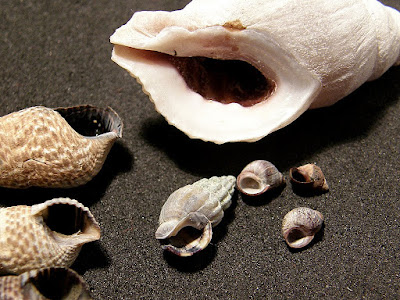
Comparative shell openings. J. Nassa in the centre. L to R: 3 mud snails, Battillaria attramentaria; unidentified whelk; 3 periwinkles. The whelk and the Nassa have siphon canals and fat lips. And siphons, of course. 2009 photo.


Saturday, January 06, 2018

Blue teeth

This I haven't seen before: on the rim of a shell of a mud snail in my aquarium, there are tiny, bright blue dots.

Batillaria attramentaria, about 1/2 inch long.

A description on the WallaWalla.edu site mentions that the lip of the shell has teeth inside it. Would these be the teeth?


Tuesday, September 26, 2017

Eggs in urns

The whelks are laying eggs.

A small collection of egg cases. Each one holds about 20 to 100 eggs. Of these, only a dozen or two will mature into baby snails.

These egg cases are new; as the eggs develop, they show up as slowly moving dots inside the translucent casings. One has already been broached by a predator, probably a crab looking for an omelet.

The same eggs, with their blurry mother, a whelk. (Species not identified.)

The clear dot at the top of each egg case is a "cork" of gelatinous material. Over the incubation period, this gelatin dissolves, finally leaving an open passage for the baby snails' escape to the big world out here. (See A Snail's Odyssey; Whelks and relatives, for more info.)


Saturday, May 06, 2017

No two alike

Whelks.

Wrinkled dogwinkle, Nucella lamellosa. (Probably) Stories Beach.

These snails are extremely varied, both in colour and shape.

A most peculiar species because of its ability to vary so much in shape, color, and texture from one individuals to the next. ... It is one of the most common intertidal whelks in the Pacific Northwest. (From Wallawalla.edu)

A fan of this species, Dan Yoshimoto, has a page of shells found on both coasts of Vancouver Island, and on the mainland, from California to Oregon: over 200 shells, not counting the group photos at the bottom of the page, and so variable that it is difficult to believe they are all the same species. Go see.


Monday, March 13, 2017

Home-grown barnacle eater.

I haven't been bringing snails home to the aquarium since I moved to Campbell River, but somehow, they show up here anyhow. This pretty purple dogwinkle (what a name!) has been fattening up on barnacles and the occasional mussel.

Nucella canaliculata
Channelled purple dogwinkle, Nucella canaliculata.

The shell sculpture consists of many well-defined spiral ridges of approximately equal size.  The whorls are set off from one another by a deep groove.  Small individuals ... may be orange; older individuals are often yellowish brown or light gray. (WallaWalla.edu)

There is also another one, somewhat smaller, in the tank; it is bright orange.

Since there are two snails, I'll start watching for egg capsules and later, baby snails.

The famous purple dye from the city of Tyre that colored royal Roman robes, was made from a relative of Nucella.  The snails were ground up in a stone mortar; different combinations made different shades of purple.  The dye should be fixed with lemon juice as a mordant.  The American species produce a much less brilliant purple than do the Mediterranean species. (WallaWalla)

I didn't know that. This shell would possibly produce a bluish-purplish grey. But the snail is safe; I'm not going to swipe his shell. When he's done with it, a few years from now, the hermit crabs will want it.


Friday, August 26, 2016

Testing, testing. Experimenting with colour control.

I've been learning more about the controls on my camera. (There are so many, and the manual is so confusing!) An article on Digital Photography School alerted me to the Picture Control settings, and I've been experimenting with them. The author recommends using a Flat setting for landscapes; it reduces blowouts or too dark areas, but needs careful processing later.

I took a few photos on Flat. They turned out flat. There was too much guesswork involved on tiny things where I didn't already know what colours they should be.

I switched back to Standard, and then, on a whim, to Vivid. This setting emphasizes colours and contrast, not really my style in landscapes, especially the grey-green landscapes of the Pacific Northwest. But it never hurts to experiment.

I turned to the aquarium; here, a vivid setting might help. Colours fade underwater, especially when the photo is taken through algae-covered glass. And here are the first sample shots, some good, some not so good.

A mud snail, Batillaria attramentaria, eating algae off the glass. Lightened, background noise despeckled out, and sharpened.

A grainy hand hermit, Pagurus granosimanus. The vivid setting shows up the blue bumps on his legs and chelipeds.

A carnivorous snail eating an inoffensive algae eater. I saw it first on the glass, prying the tiny snail off. Once the little guy was captured, the predator let go and dropped to the sand.

A nude hermit, recently molted, resting before he goes looking for a new shell. This was well back in the tank, where usually everything is greyed out. Post processing was only needed to reduce noise and sharpen.

Turned around and heading down to look for a shell. Despeckled and sharpened only.

And one photo that didn't quite work:

Orange-striped green anemone, Halliplanela lineata, on the glass.

The anemone was surrounded by extreme pollution; bubbles and swimming thingies, luckily behind the critter, but still confusing. The vivid setting highlighted them all, so the background had to be cropped out and re-worked; a long, slow job. But I'm impressed by the pattern in the base, so I've included the photo.

I went to Brown's Bay in the sunshine, with the camera set to Vivid. Bad idea; I've deleted all of the landscape photos. But I got a few critters under the docks, where the setting seems to have been helpful. I'll process those tomorrow.


Powered By Blogger