Showing posts with label siphon. Show all posts

Tuesday, January 30, 2018

Following his nose

The Japanese nassa snails that live in my aquarium spend most of their days plowing through the sand at the bottom; I see them only when I clean the tank and sift the sand. But at times, for reasons of their own, they stop digging and head for higher ground. (At the moment, there are four climbing the walls.) Spring fever? Maybe, because they find nothing to eat up there; they're not algae eaters.

Japanese nassa, Nassarius fraterculus, siphon extended, hurrying.

Nassa snails have sturdy sensory siphons. Sometimes they bury themselves in the sand, with only the siphons poking out, waiting for food. Travelling, they follow their nosessiphons, sniffing the water for interesting goodies. Or maybe, for potential mates.

Yesterday, one of the climbers was on top of the moon snail shell, surveying the territory from there.

The eyes are small and inefficient. The sensitive siphon makes up for the lack.

A few seconds after I took this photo, a hermit crab ran up from behind. As soon as she touched the snail's shell, it retracted the siphon, then the body, and clamped itself down on the moon snail.

"Who's that?" 10 seconds later; siphon half-way down. Hermit barely visible in back.

The mud snails, algae eaters, have an oval opening, with a slight notch at both ends. These Nassas, carnivorous scavengers, have to travel longer distances to find food, hence the need for a sensitive water taster. The shell mouth has a separate notch or canal at the front end, to support and protect the siphon, which is the first thing retracted in case of danger; a siphonless Nassa will starve to death quickly.

Parts of a carnivorous marine snail. (From U. of Iowa.)

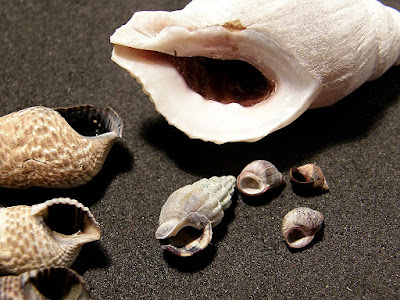
Comparative shell openings. J. Nassa in the centre. L to R: 3 mud snails, Battillaria attramentaria; unidentified whelk; 3 periwinkles. The whelk and the Nassa have siphon canals and fat lips. And siphons, of course. 2009 photo.


Monday, March 17, 2014

Snail, out hunting

A week or so ago, I wrote about a two-tone trophon snail from Boundary Bay. At the time, I had been trying to get a photo of the siphon he extends through the canal at the tip of his shell, but he wasn't co-operating.

He finally showed up near the wall a couple of days ago, and let me get a few photos.

Trophonopsis orpheus, on an abalone shell against the wall. The tip of the siphon is just visible at lower right.

Climbing over a blade of eelgrass. The eyes are near the tips of his tentacles. The siphon is visible, extended through the siphonal canal.

How much he sees with those little eyes is debatable, but his main guidance system is the siphon. He's "breathing" in the water through the tube, and also "smelling" his way. A few hours later, he had found the barnacles on a stick on the far side of the tank, and was busy emptying the biggest.

And now he's back buried in the sand, digesting.


Tuesday, January 29, 2013

Failed rescue attempt

For a few days, I hosted a pair of small clams that I found abandoned high and dry on the beach, probably dropped by gulls, then left because they didn't break. The treatment had been too much for them, though; they didn't survive.

But they tried their best. Here's one, showing his teeth.

With a hermit almost small enough to enter that tunnel.

A clam has two siphons, which it extends up to the top of the sand to feed. (This clam did not burrow into the sand, a sign that it wasn't feeling all that well.) Water enters through the one towards the front, away from the hinge, (the incurrent siphon), food and oxygen are filtered out, and the waste water is pumped out through the rear siphon (excurrent).

Since the clam is a filter feeder, straining out microplankton and organic "dust" from the water, the hermit crab is in no danger; he's not going to be sucked in by the gentle current the clam generates.

Nor will he be bitten by those "teeth" around the opening of the siphon.

I couldn't find a name or a function for these tooth-like structures.


Powered By Blogger