Showing posts with label Nassarius. Show all posts

Tuesday, January 30, 2018

Following his nose

The Japanese nassa snails that live in my aquarium spend most of their days plowing through the sand at the bottom; I see them only when I clean the tank and sift the sand. But at times, for reasons of their own, they stop digging and head for higher ground. (At the moment, there are four climbing the walls.) Spring fever? Maybe, because they find nothing to eat up there; they're not algae eaters.

Japanese nassa, Nassarius fraterculus, siphon extended, hurrying.

Nassa snails have sturdy sensory siphons. Sometimes they bury themselves in the sand, with only the siphons poking out, waiting for food. Travelling, they follow their nosessiphons, sniffing the water for interesting goodies. Or maybe, for potential mates.

Yesterday, one of the climbers was on top of the moon snail shell, surveying the territory from there.

The eyes are small and inefficient. The sensitive siphon makes up for the lack.

A few seconds after I took this photo, a hermit crab ran up from behind. As soon as she touched the snail's shell, it retracted the siphon, then the body, and clamped itself down on the moon snail.

"Who's that?" 10 seconds later; siphon half-way down. Hermit barely visible in back.

The mud snails, algae eaters, have an oval opening, with a slight notch at both ends. These Nassas, carnivorous scavengers, have to travel longer distances to find food, hence the need for a sensitive water taster. The shell mouth has a separate notch or canal at the front end, to support and protect the siphon, which is the first thing retracted in case of danger; a siphonless Nassa will starve to death quickly.

Parts of a carnivorous marine snail. (From U. of Iowa.)

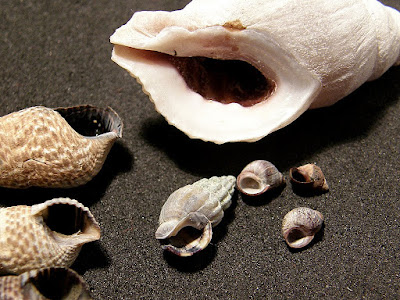
Comparative shell openings. J. Nassa in the centre. L to R: 3 mud snails, Battillaria attramentaria; unidentified whelk; 3 periwinkles. The whelk and the Nassa have siphon canals and fat lips. And siphons, of course. 2009 photo.


Saturday, February 28, 2015

Flash mob

Baby crabs love the light. Swarms of them jitterbug on the aquarium wall by a side light. Here they are, dancing attendance on a visiting Nassa snail.

She may be eating a few as she goes.

When I collect an eyedropper-full of these and look at them under the microscope, most of them are the wriggly, leggy crab zoea. Some will be copepods, and there is a certain amount of detritus; floating bits of shrimp, snail poop, shreds of algae and the like. I wash off the slide in the water, and within minutes, the critters are dancing in the light again.

Friday, September 12, 2014

A never-ending supply

Val, the big burrowing anemone eats snails. Eats them and spits out the shells for the hermit crabs to wear. Or glues them to her column.

But it's not just any snail that she likes; she prefers the upper intertidal periwinkles that climb to the top of the tank and occasionally drop straight into her mouth. One gulp, and they're gone.

She'll reject the Asian mud snails, as if the longer, sharper shell gets stuck in her throat. Or maybe she just doesn't like the taste.

And I've never seen her eat a little Nassa, but somehow there's always a supply of new empty shells; she must nibble on them at night, when I'm not watching.  And somehow, although I don't bring Nassas home with me, when I clean out the tank, I find dozens of these snails plowing through the sand. They're breeding here.

The Japanese Nassa, Nassarius fraterculus.

I've watched them mating often; one snail chases down another. When he catches up, there's a quick writhing and twisting interaction, and then they both hurry away. I've never seen their eggs; they lay them in the sand, in small capsules containing two or three eggs each, and the juveniles are as small as the sand grains. (Here's a video of mating Nassas, the eggs, and emerging juveniles.)

The recent pump disaster didn't seem to worry them at all; they're as active and numerous as ever.

This may be Nassarius fostatus. Or maybe not.


Sunday, February 10, 2013

A clammy aphrodisiac

It was going to be a busy day, and I was rushing in the morning to get ready. But whatever the rush, the critters need to be taken care of.

In a quick pass, I checked the water level, added ice (more on that, later), and dropped in a chunk of frozen clam, still on the quarter shell, for the day's meal. Ten minutes later, holding my morning coffee, I looked to see how they liked it. Each little piece of shell had a hermit on it, busily carving it up.

Another ten or so minutes; breakfast was on; I checked the tank while it cooked. Now the largest section of clam had one hermit and five Nassa snails, gathered from their usual hiding places under the sand.

Before I left, I had time for one more stop. The hermits were still at it. No sign of the snails, at first, but when I looked around the tank, there they were, six of them, all happily mating. Seems that clam meat is a love potion.

Nassa, alone again.

There was a row of fresh, creamy eggs on the eelgrass tonight.

(I hooked up the macro lens this evening. This was one of the first experimental shots. Very shallow depth of field, and I should be using a tripod for these. Hard to manage, when the snail won't stop snailing. I like the bokeh.)

Thursday, November 03, 2011

A multi-species community

These are a few of the larger intertidal critters from the aquarium, photographed in the course of a tank census:

Three different shells; from right to left, Nassa snail, Asian mud snail, and barnacle.

Barnacles usually live attached to rocks or other solid materials. When they break off, the base gets left behind and the barnacle dies. Occasionally, one detaches from the rock without breaking. This one has most of the base intact, so it is still alive and feeding. Look closely to see the pale tentacles at the mouth.

The Nassa shell, on the right, has several round holes drilled through it, the work of a carnivorous snail, such as a whelk. Once the hole penetrates the flesh, the whelk injects paralyzing and digestive enzymes, which dissolve the snail inside. Often, once the shell is vacant, I discover the tentacles of worms waving from these holes.

Rockweed isopod, about an inch long. The flash makes the red seaweed glow in neon reds. Under normal lights, it is a bit paler than the burgundy Turkish towel that the isopod is feeding on.

The second isopod. Look closely; on the back, it is carrying a small shelled animal, probably a limpet.

Head of a polychaete worm, out looking for a meal. They rarely leave the sand completely, and retract almost instantaneously at any disturbance..

One of the round algae-eating periwinkles, with an amphipod taking a short break.

At least four species of snails live in my tank: Nassas, mud snails, periwinkles, and the tiny lacunas; these last may be so small that even with a lens, I am hard put to determine whether they are snails or sand grains until they move. Their eggs often come home with me on blades of eelgrass.

Underside, through the glass, of a very small anemone. 

This anemone sat for weeks on a stone, and then went wandering about. It has now hidden itself. I have never seen that "petal" effect on the base before.


The youngest crab, raised in the tank from babyhood. 

And my new mascot, found in a thrift store. $0.50; I couldn't resist.


Wednesday, November 02, 2011

Mussels are evil.

They are so deceptive, just sitting there, opening their mouth a bit sometimes; otherwise, just sitting. Looking harmless and innocent.

They're not.

Let me backtrack a bit here. My little aquarium is recovering nicely from the summer disaster, becoming the biodiverse environment that the animals are accustomed to. The crabs are as calm, now, as crabs get; the big anemone is feeding more often than not; the snails are plowing through the sand and polishing the walls. I have provided a variety of seaweeds for food, gym equipment, and shelter: sea lettuce, turkish towel, rockweed, eelgrass and kelp. A few tiny greenmark hermits and a pair of big isopods moved in with the last batch of seaweed. There's at least one polychaete worm in the sand. Green amphipods zip busily about.

And then there are the water cleaners. The barnacles (lots of those) and a handful of mussels.

The biggest mussel, Mytilus trossulus, on a scratchy bed.

With his mouth open, filtering the water. One of the tiny hermits watches.

Mussels are filter feeders; they don't need to move about, although they do at first, until they find a place that suits them. Then they lie there, letting the current bring them food. They capture plankton, other microscopic life, and floating leftovers from the crabs' meals or decomposing seaweed. A mussel can scrub up to two and a half litres of water per hour per gram of body weight. That's the contents of my whole small aquarium, given the handful of mussels working there.

The problem - and I never considered it in that light before - is their habit of choosing a spot and tying themselves down. A mussel excretes a liquid that hardens immediately on contact with the water, producing strong hairs, called byssal threads. At the tip of each thread is a dot of glue. Where it touches, it holds.

(Young mussels use these to "walk"; they extend a thread, let it stick and reel it in, pulling themselves up to the contact point. Then they dissolve the connection, let the thread float free, and produce another.)

These threads are incredibly tough. They are made up of a core of collagen, coated with a harder protein bonded with iron ions, (NPR), and may have the tensile strength of five of our Achilles tendons. A mussel will attach itself with 50 or more threads, enabling it to bond to rocks and other mussels. Anchored like this, it can't be swept away even by stormy seas.

The threads have another use, too. Like all creatures, mussels have predators; starfish, birds, crabs and some fish. And whelks, those voracious hole-drillers. Tying themselves down to the rocks and in large groupings helps to protect them from the birds and crabs, but whelks will attach themselves to the shell, drill into the meat and dissolve it. To stop them, a mussel will throw out a few threads, entangle the whelk, and anchor it to the rock, where it will starve to death.

I was looking for hermits, counting them to see if they had all settled in ok, when I noticed a small Nassa snail jabbed into the sand upside-down, point buried. Odd.

When I looked next, it was still there, but had moved slightly. Still alive, then. But why was it in that position?

It was jammed against a stone, still upside-down the next time I looked. In the morning it wasn't moving, so I decided to investigate; I reached in and picked it up. It came along with the stone and the mussel on top, tied down securely. When I broke the threads that held it and left it alone, it woke up and hurried away (at top snail speed). Probably hungry.

I collected all the mussels and examined them. They had glued down another snail and one of the hermits. This would not do!

Well, I can use thread, too. In a double piece of cheesecloth, I wrapped the whole clump, and tied it in a loose net. There! They have water circulation, but the snails and hermits can't get through to them.

Small handful of mussels, with two attached stones and a clamshell. More mussels have been added since, as I found them.

Biological filtration unit. Netted mussels, in the back of the tank.

So far, this has worked. Hermits pick at the cheesecloth, but then walk away, untethered.

Nassa snail, cleaning the glass.

Freed Nassa, still wearing the remains of the byssal threads and a pebble caught in the glue.

Greenmark hermit, now safe from the clutches of the mussels.


Friday, February 26, 2010

A tale of two hermits

Total amazement!

Every time I pass my little salt-water tank, I stop for a few seconds to see what the critters are up to.  Not much, usually; eating, sleeping, digging. The hermits prowl around idly, picking up invisible scraps with the smaller claw, and popping them into their mouths. Limpets on the glass just sit there. So do most of the snails.

Yesterday was different. In the morning, a tiny hermit crab was up at the front, rolling an unattached barnacle over and over. While I watched, he found the mouth, and started digging out the good meat inside. Poor little barnacle!


Half-inch hermit in a Batillaria shell.

A minute later, a Japanese Nassa showed up. These are tiny snails, smaller than the shell the hermit was in. Usually they steer clear of the hermits, which can be aggressive when food is an issue, and are well armed. This time, the snail ignored the danger, slid right over the hermit, and glommed onto the barnacle, rolling it over so that the mouth faced the snail.


Nassaria, with siphon for smelling good food.

The hermit struggled to hold the shell, but lost his grip, couldn't get at the meat anymore, and wandered away. The snail returned to the sand, carrying its catch.

I was amazed; the hermit has big pincers, sharp claws on all its feet. And it's not afraid to use them; these little guys will even take on a crab twice their size, and chase the crab off. And the snail is all soft flesh, and that vulnerable siphon; I expected it to be injured, at least, after that confrontation. But the operation was smooth, practiced, economical, the snail sliding over the back of the hermit and onto the barnacle without facing the pincers. An accomplished thief, this one is.

These snails normally hide under the sand, with only the tip of the siphon exposed to catch the scents of fresh food. When they smell something good, they surface. They eat detritus; whatever falls to the bottom, any dead or dying meat, the remains of other critters' dinners. They are often introduced to marine aquaria to help with the cleaning, and to aerate the sand, plowing through it.

That was the morning's excitement. In the afternoon, I noticed Hermit Rex sitting on a rock, acting oddly. He was holding all his legs and pincers close together in front of his face, and scrubbing at them, as if he were itchy.  As I watched, wondering, I saw the reason; below the face of the rock, there was a ghost, a pale, shadowy copy of Rex.


Hermit Rex's old skin.

Rex had just finished molting, and was getting his limbs limbered up. I watched him until he turned and left, then I retrieved the husk he'd left behind.


Here's the old Rex.

The old carapace was intact, except for a small, round hole at the back of the thorax. Rex had pulled himself, eyestalks, antennae, pincers and legs, through that hole. It is about half the diameter of his big pincer. The abdomen is missing; hermits don't wear a crust there, substituting it with a borrowed shell. So there was no need to shed the skin of the abdomen. It stretches just fine. It's the crusty part that gets too tight when the hermit grows.

More amazement; the eyes are still there, still glassy. All the various appendages are in their proper places. Even the various joints and angles of the mouth parts and legs are intact. And he had pulled long antennae out of the centre of the old antennae without breaking either; how was it possible?


Front view. Eyestalks with glass windows, perfect antennae, hairy legs. The little, short legs at the back are two of the four used to hold onto the chosen shell.


Rex, a few minutes after the transfer. Even the hair had developed underneath the old carapace. Maybe he really was itchy.

I only wish I had stopped to look a few minutes earlier. I would have loved to watch the process. Maybe next time.
Powered By Blogger