Showing posts with label molting. Show all posts

Friday, July 09, 2021

Old suit, new suit

 A few months ago a small kelp crab hitchhiked a ride home hidden in a clump of rockweed. He is thriving in my tank, and has molted three times already. I caught him in the process this time, although he was as well hidden as he could be, with glass walls all around. Once he was done with his old carapace and the hermits had cleaned it, I fished it out of the tank.

The carapace, out of water.

With a ruler. It measured under 3 cm.

Crabs molt when their outer structure is too small for the growing critter inside. They must feel squeezed, like when you're trying to cram yourself into your teen-aged jeans. As soon as they're free, they expand; legs, carapace, antennae, eyes and all.

Here's the newly-liberated crab:

He's not too happy, because I just stole the piece of red alga he was hiding behind.

With a ruler against the tank wall. And a limpet.

I later managed to get the ruler down into the tank beside the crab. His carapace now measures just a tad under 4 cm. long. As an adult, he can get to 9 cm. across the carapace. That's across, not lengthwise, as I have measured him, so about 3 times his present size.

While we're at it, here are a couple of lines of hooks over the head. Is this what he hooks his hats on?

~~~~~~~~~~~~~~~~~~~~~~~~~~

Hace algunos meses, un cangrejo kelp llegó a mi acuario, escondido en un ramo de algas "Fucus distichus". Le gusta la vida en mi tanque, y hasta el presente, ha mudado tres veces. En esta muda, lo pude observar, aunque hizo lo posible para esconderse, algo difícil en un tanque con cuatro paredes de vidrio. Cuando había terminado con su caparazón viejo, lo saqué del agua para examinarlo.

Primera foto: el caparazón.
Segunda: mide un poco menos de 3 cm. de largo.

Los cangrejos mudan cuando su estructura exterior es demasiado restringido para el animal en desarrollo adentro. Se han de sentir apretados, como cuando nosotras nos tratamos de meter dentro de nuestros jeans de nuestra adolescencia. Los cangrejos, en cuanto se sienten libres, se dilatan; las patas, el caparazón, las antenas, los ojos: todo.

Tercera foto: el cangrejo recién mudado. Un tanto enfadado conmigo porque le quité la hoja de alga roja tras de la cual se estaba escondiendo.

Cuarta foto: en el tanque, con una regla junto a la pared afuera. Y una lapa en la pared, en el interior.

Más tarde pude meter la regla dentro del tanque y al lado del cangrejo. Su caparazón ahora mide casi 4 cm. de largo. Como adulto, puede llegar a medir hasta 9 cm, cruzando el caparazón en el punto más ancho. (Esto es a lo horizontal, mientras yo lo he medido verticalmente.) Si llega a esa medida, sería casi tres veces lo que ahora tiene.

Cuarta foto: mientras tenía el caparazón a mano, me fijé en los ganchitos en la parte superior a la cabeza. ¿Serían estos los ganchitos en donde fija sus sombreros?


Wednesday, January 13, 2021

Brand new legs

My kelp crab molted last week. The first thing I noticed was that the rose seaweed he had been wearing as a hat, and which by now had grown to almost his full length, was gone. He was hatless.

When he came up to the glass the other day, all clean and now wearing a tiny new hat, I saw another change.

Newly molted kelp crab

He has all his legs. For the last couple of months, he has been missing the second to the last legs on either side. Now, with the molt, he has grown them back. They seem to be a bit smaller than the others; usually they decrease in size front to back. That should be fixed with the next molt. If he keeps out of fights.

Closer. Those eyes!

The eyes are on stalks, like all crab eyes; these are round, with a slightly astonished look.

~~~~~~~~~~~~~~~~~~~~~~~~

Mi cangrejo kelp hizo una muda la semana pasada. Ahora lleva un caparazón y extremidades nuevos. Lo primero que vi es que el "sombrero" que llevaba, hecho de algas color de rosa, y que ya había logrado un tamaño casi tan grande como el del cangrejo mismo, había desaparecido. Andaba sin gorro.

Cuando pasó cerca del vidrio el otro día, noté que ya trae su nueva decoración. Y hay otro cambio.

Tiene todas sus patas. Durante los últimos meses, le faltaba una de cada lado; la penúltima, contando desde la cabeza. Ahora, con la muda, las ha regenerado. Son un poco más cortas que las otras; normalmente, disminuyen en tamaño, empezando con las primeras, que son las más largas. Después de la próxima muda, habrán recuperado su tamaño normal. Si es que se porta bien y no se mete en más pleitos con sus vecinos.

Los ojos se llevan en pedúnculos, como los de todos los cangrejos; estos son redondos, con una mirada tal vez un poco asombrado.


Tuesday, November 21, 2017

A size too small

Spider kids grow out of their clothes, too.

Young cellar spider's cast-off leggings and T-shirt, hung out to dry.

Immature spiders molt frequently; they've got a lot of growing to do, from pinprick spiderling size to fat adult. This one was about half-grown, a spider teen. Well-fed, so he grew out of the leggings while they were still new-looking.

To shed the old exoskeleton, the spider has to bust out from the inside. It increases its heart rate to pump a lot of hemolymph (the spider's blood) from the abdomen into the cephalothorax. The pressure expands the cephalothorax, which pushes on the old exoskeleton until it cracks. The spider flexes its muscles until the old exoskeleton falls away. (HowStuffWorks)

One of my crabs molted this morning, too; I found the old carapace and legs up against the glass. When I returned with the camera, after morning chores, it was gone. The hermit crabs collect these, break them up, and clean out any edible remains. The remaining chitin is eaten by bacteria; starfish and certain fish can also digest it.

I don't know what, if anything, eats old spider molts. Something must; in nature, nothing is ever wasted.

Thursday, July 30, 2015

Leftover legs

A barnacle lives his entire adult life standing on his head, glued to something hopefully solid. He has one eye, which he never gets to use***, locked down there inside his castle. His two tentacles are barely there, and glued down, besides.  He never leaves home.

Barnacle community. Photo from last April.

He* does have sensitive hairs on his legs, and he waves them about in the water, so he's not completely out of the world. He has to eat, somehow.

He's a crustacean, like the crabs and my hermits and shrimp. And crustaceans molt. They discard the suit they've grown out of, and grow a whole new one. Crabs and shrimp back out of their old carapace, pincers, legs, eyestalks and all. Hermits, living in a borrowed shell, have to leave the shell first, then back out of the old skin.

But the barnacle; does he molt, down there in his dungeon? How does he manage?

Every so often, I see a transparent barnacle body floating in the aquarium. Today, one got stuck on the wall, where I could get a photo.

Shed barnacle molt

The barnacle can't back out; he's glued in place. So instead, he has pushed his outer casing off, as we would take off a pair of pants. Inside a one-person tent. Sitting on the tent floor. And once he had it off, he tossed it out the door and let the current wash it away.

And then he swells up a bit, grows a size, and somehow - explanations vary - pushes or erodes the inside of his walls to make his tent** fit until the next molt.

A crab leaves behind a recognizable crab, carapace, legs and all. A hermit molts and leaves his head and thorax and all those legs and tentacles and flags, but the abdomen is always just a shred. The barnacle's leftovers are a bit harder to identify,

This may help. Image from University of Southern California

The long, feathery appendages in the second photo are the legs, or cirri, which is all we usually see, waving about, fanning food bits towards the mouthparts; those smaller spiky things. The rest is body, but it doesn't conform to the usual head, thorax, abdomen; everything is simplified and rearranged. And then shredded, as the barnacle yanked it all off, splitting it open at the head end, where he is nailed to the floor.

* "He" is really s/he; a hermaphrodite. But "he" is easier to say.

** Castle, dungeon, tent, suit, trousers, nails: whatever metaphor works at the time.

*** Update: except as a sensor for his garage door opener.

The University of Puget Sound museum has a good barnacle page.


Tuesday, May 26, 2015

Aquarium sampler

The beasties in my aquarium have been busy these last few days, happy with a new batch of fuzzy eelgrass, cleaning barnacled clamshells, and taking care of their family responsibilities. (Mating, laying, and toting eggs.)  I had a list of photos I needed to take: a shrimp eating bubble shell eggs, the one-sided crab cramming food into his mouth with one pincer, a huge, dark green amphipod, the leafy hornmouth snail growing wings, a three-armed starfish, and Barney, in his brand-new outfit.

Two out of six ain't bad.

Barney wasn't co-operating; he went and hid at the back of the tank, but I only needed his jacket, after all.

"Look, Ma, no barnacles!"

It must be nice to be able to slough off old skin, and get an all-new, younger complexion again. Here's Barney, as he was a month ago:

Barnacles and algae on his back

And just look at him now!

Inside one of the barnacled clamshells that I  brought for the leafy hornmouth, I found a baby starfish with only three arms. I don't know if he's sick, and has detached the damaged arms, or if something tried to eat him. But he has a new, growing stub of a fourth arm, and seems contented in a hospital tank. If he survives, I'll take him back to the beach; we need all the immune starfish we can get.

He's an inch across.

I watched a mid-size shrimp eating bubble shell eggs. She seemed to like the jelly they're encased in; every so often, she'd spit out a whole yellow egg, and it would drift away. The hermits eat the eggs, jelly and all.

Eggs in aspic?

And to make up for the missing amphipods, etcetera, here are a few other critters:

Nassa snail, balanced on the tip of a barnacled clamshell

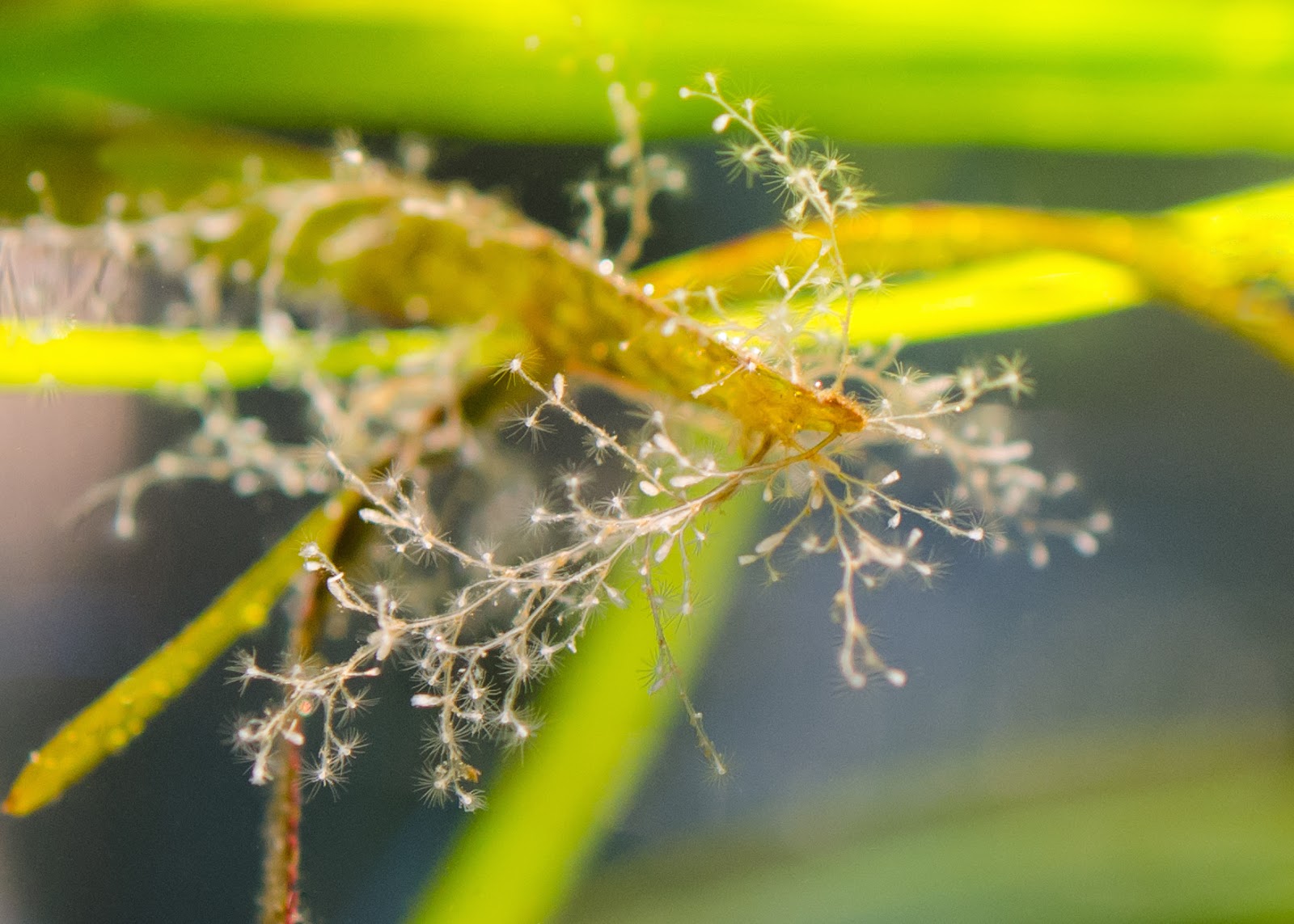
Hydroids, Obelia sp. The hermits eat these as soon as they finish the diatom masses.

"Cheese!"

And I still have four photos on my list. I'll try again tomorrow.


Monday, October 27, 2014

Suicidal hermit?

Life would be a lot simpler if the animals could talk. Take my small community of intertidal critters, for example. I keep a close eye on them, checking their water quality and temperature daily, making sure they're enjoying their food, they're happy and healthy. Are the hermit crabs all busy; are they waving their flags about, not fighting? Is the big anemone open for business? Are the bubble shell snails still mating? How about the leafy hornmouths; do they have enough barnacles to eat? And so on.

But if something changes, how do I know what's gone wrong?

There are currently 38 hermits in the tank. That means that every few days at least one of them molts. The usual procedure, then, is that the newly-soft hermit climbs up into the seaweed, out of the range of hungry crabs, until he hardens off. An hour or two later, he comes down again and selects a new shell, slightly larger than the last one he was wearing.

I found a mid-sized hermit in the eelgrass a few days ago. His leftover molted legs and carapace were on the weeds below.

New, fresh, clean skin and hair. Now he needs a new shell.

A few hours later, he was still on the eelgrass, still nude. That wasn't right. It's not safe; the crabs were already patrolling beneath him. A freshly-molted hermit belly is a highly-prized delicacy, and they weren't planning on missing out.

I shooed the crabs off to the other end of the tank.

Later, finding the hermit still naked, I caught him and put him in a bowl with a selection of shells. In a couple of minutes, he had selected one and climbed inside. Good! I put him back in the tank.

In the evening, there he was back up in the eelgrass, without the shell. Why? That's asking for trouble!

I found him a different assortment of shells and gave them to him in a bowl. Again, he got dressed immediately. Maybe the last shell was just a bit too small. Back in the tank.

In the morning, he was in the eelgrass, nude. The crabs were back, watching him.

Three more times, over two days, I took him out and presented him with good shells. Each time, he put on a shell, then discarded it as soon as he was back in the tank. Why, why, why? Talk to me, Hermie!

His abdomen is reddish purple; some have green bellies. The barbs at the end hold the shell in place.

Laurie said that maybe he was itchy. Maybe he'd got fleas. (Copepods and/or mites? Possible.)

Then Val, the big anemone, started shutting down, pursing her mouth disapprovingly. She does that if the water's not quite up to her taste. I've been changing it regularly; the last change was only two days before, but if there were too many mites . . .

I took everything out of the tank, scrubbed the walls (goodbye copepods) and triple-rinsed the sand. Cleaned the pump, discarded old eelgrass, scraped off invading orange-striped anemones, removed two big worms and washed off their slime. Filled the tank with new water, well chilled; replaced everything. Hermie went back last, in a nice new shell.

Fingers crossed.

Two hours later, Val was happily feeding, and Hermie was still in his shell. Tonight, he's still ok.

Yay!

The little blue anemone, on clean eelgrass. Eats hermit food; likes shrimp.

But it would have all been sorted out earlier, if he'd just thought to tell me he had an itch.

Saturday, December 14, 2013

Not feeling too good

No, not me; I'm fine.

It's poor Hermie, here. He just molted, and is feeling the stress. His shell is too small now; it's too tight around his mid-section. Besides that, he's exhausted from crawling backwards out of his old skin. That's hard work!

He spent the afternoon and the next morning hiding in a corner behind a rock (but facing the glass), moping.

Doesn't he look miserable?

Not to worry; this afternoon he was back to his old happy self.

Detail of those wonderful, fiery "flags".


Monday, September 16, 2013

Faded glories

Male mallards are always scruffy this time of year. They're molting. They will be losing their brilliant breeding plumage, even dropping the wing feathers, which will leave them unable to fly for a couple of weeks.

Splotchy male. He will retain some green on the head all winter, and the yellow bill.

This one still has his sleek summer wings and a blue-purple head, but it's starting to fade.

Ma mallard can afford to look smug; she maintains her tidy coat year-round.


Tuesday, March 13, 2012

Can we say a spider is courageous?

I'm back! Now, about that spider ...

Laurie brought me a small, fat spider a couple of months ago. As far as I can tell, it is a male false black widow, Steatoda grossa. (I could be wrong; I often am.) I was getting ready to clean out old duff and add a few tasty morsels to his cage the other day, when I noticed that he was hanging oddly in a mess of catkin fluff.

Seen from the belly, against the light.

Usually these spiders sit in an elegant pose, with the legs arched high above the body, "toes" spread wide. Now he (answers* to "Spotty") was hanging belly-up, with each pair of legs meeting at the tip. I thought he might be sick, or unhappy with the catkin fluff, which bothers some spiders, so I touched him with the tip of my tiny paintbrush. He didn't move. I gently pulled the catkins fluff away, leaving him hanging by his own web. He promptly let go and dropped to the bottom. So he was alive and responding. I let him rest. The housecleaning could wait until he was ready.

Half an hour later, I checked back. Spotty was lying upside-down on the bottom of his box, twitching feebly. I looked closer; what was wrong?

Nothing wrong, at all. He's molting. 7:14 PM.

He seemed to be still connected to the old skin, by the tips of his legs; it moved when he twitched. He looked exhausted, pale and wan; his cephalothorax and legs were almost transparent.

I notice, looking and measuring the photos, that his new legs are about 1/3 longer than the old ones.

6 minutes later, 7:20

I watched for the next 35 minutes, as he struggled, weakly - oh, so painfully weakly! - to disengage from the old exoskeleton and to turn himself upright. At times, it looked as if he were about to give up and just let himself die; it was hard to let him suffer and not try to help.

Over half an hour later. 7:57 PM.

He finally righted himself and struggled over to a pile of duff. There he rested for a long time. He didn't have the use of the legs on the left yet; they lay together, stretched out; at least the joints were working on the right.

An hour later, as I watched, he dragged himself upright, and climbed an inch up the duff. Another rest. Next time I looked, he was hidden.

By the next evening, he was up and about, hunting, looking like his old self. But a bit bigger.

The legs are still tranbslucent; by the next day, they'd darkened and developed their old sheen.

BugGuide has a series of photos of another small spider molting; comparing with mine, I realized better what was happening to Spotty, here.

In the first BG photo, the lynx spider is hanging in the same position; upside-down, toes together.
Typical position assumed by most spiders before shedding.
Good! Now I know, for next time.

Here, the legs are half in, half out of the old skin. 
Stretching. This is performed by most spiders as soon as they are free of the old skin.
This is the first time I've seen a spider molt. The whole process, from start to finish, where he could actually walk away, took about 2 hours. It looks extremely stressful, sort of like childbirthing in reverse. And to think they go through this every few months!


Wednesday, December 07, 2011

Hopalong, how you've grown!

Two  months ago, Laurie brought me a spider on a tip of a pine branch. It was so small, so nearly transparent, and so active that it took two weeks to get a photo; it must have been about 4 millimetres long by then.

Hopalong, on a pine needle.

I kept it, and a second like it, in a jar for a month, then transferred them to an old, scratched-up aquarium with a fresh batch of pine tips and the latest crop of fruit flies from my trap in the kitchen. They've been hard to see, hiding among the needles, mostly.

Hopalong, not hiding too well at the moment.

But yesterday, one was out on the side wall. She had just molted, and was resting above the abandoned exoskeleton, stretching herself out into her fresh skin, still soft.

Growing up.

The old molt. She splits the body, then shucks it like a coat, pulling the 8 legs out last.*

And now she measures about 8 mm fangs to spinnerets.

(I had to photograph her through the scratchy glass; she's just as excitable and hoppy as ever. I edited out most of the scratches, but didn't touch her in the photo.)

*I found this YouTube time-lapse sequence of a tarantula molting. This can take from an hour up to 12 hours, including the drying time, when the spider is too soft even to right itself.


Sunday, July 10, 2011

Growing pains: a tiny crab molts

A young crab molts every couple of months. With three youngsters in my aquarium, that means that every few weeks I find the discarded shell and legs of one of them. Usually, though, they hide themselves away during the process, because their new shells are soft, making them vulnerable to predators. Last night, however, I was cleaning the tank, and I had removed the upside-down clam shell my tiniest crab was using for shelter. He had to hide in a mussel shell; not big enough.

And I just happened to be looking his way when he started to struggle wildly, and fell out of the mussel onto the sandy bottom. There, out in the open, he squirmed and twisted, and slid out of the back of his shell; he was molting!

In the weeks before this, he had been partially dissolving his shell, using the calcium carbonate to build himself a new shell inside it. When it was ready, he started taking in extra water, swelling himself up enough to crack open the old shell at the back, where the top shell joins the belly plate. Then he pushed his way backwards out of the old shell, pulling each leg and pincer, the head and all its appendages out in their new skin.* This is possible because the new shell is as soft as wet paper.

This final stage of the molt can take 15 minutes, according to Alaska Fisheries Science Center. My little shore crab managed it in about 5.

Except that there was a problem; he didn't detach himself completely, and the old shell stayed stuck to his rear end.

Green shore crab, about 1/2 inch across the carapace, with reluctant molt.

I don't know how he managed this, after backing out, and he moved too fast to see what happened.

When a crab molts, he leaves behind the ends of his digestive system: his esophagus, his stomach lining, and the last bit of his intestine. He takes his gills, but leaves a mold ("ghost gills") behind. Somewhere, some part of this old equipment didn't separate cleanly, and it left him with his rear end trapped.

Struggling crab. I don't know if the triangular abdominal plate belongs to the new shell or the old one. The new pincers are noticeably larger than the old ones.

If a newly-molted crab is vulnerable, this little guy was doubly so. His legs were still soft at first, and he pushed feebly against the old shell with them, to no effect. He found it difficult to walk; the empty shell swayed in the current, and sometimes flipped him over on his back.

Eventually, he stiffened up a bit; his pincers seemed to grow, and he used those to push at the shell. Then he clambered over things, jamming the old shell into cracks and pulling. No luck. One of the other crabs, much bigger than he, came over and picked at him, but without hurting him. This went on for two hours. I felt so much like reaching in and "helping", but I knew I would probably damage him, so all I could do was cheer him on from the sidelines.

Still working on it. A bit more detached; progress.

I replaced the shells and seaweed in the tank while I waited, and the crab scooted under a clam shell to work in privacy, so I turned out the light and left him to it.

In the morning, I looked for him; he was mostly hidden under a rock, but his molted shell was left under the clam. Good! He will have to hide for a couple of days, until his shell finishes hardening up, and the ends of his intestines rebuild themselves. I think he'll be ok.

Crab molt left behind on the beach, showing part of the inner structure left behind.
*Laurie said that this is like a woman giving birth. That's exactly the way it felt, watching.

Update, July 13: The crab was out for supper tonight, so he's made it ok.

Friday, January 07, 2011

Spring fashions have arrived!

Still playing with my new camera.

One of the smallest hermit crabs molted the other day. I saw his (her?) old carapace floating in the current. A couple of days later, I found him, high up in the eelgrass, clinging desperately to a swirling blade. He was still out of his shell, possibly because he'd grown too much after the molt to fit back in. These are hermits that like to wear their shortsshells skin-tight. After a molt, while the carapace and legs are still soft, they absorb water and grow visibly. A new, bigger shell is often necessary.

So here was little "Jade", all alone, unable to hang out with the others, where he would be in danger of a quick swipe from the big crab's pincer, and needing a shell. He would have to go down to get one eventually.

All hunched over, holding on tight.,

The next day, when I checked, he was still at the top of the tank, still bare naked. I wondered if maybe he hadn't been able to find a big enough shell. I looked , and couldn't find any either, so I dug out a handful from my dry storage; different sizes, different species; should be something there to fit!

A few hours later, he was down on the bottom, feeding happily, wearing the biggest of the shells I had provided, a long, pointy mudsnail shell. Good! So from now on, I'd be able to recognize him. That makes two of the small ones identifiable.

One step forward, one step back. This afternoon, I noticed that the little heap of substitute shells was gone. And sitting where it used to be, was the cute, peek-a-boo, pearl-lined shell that "Teeny" had been wearing. Two of the other small hermits had changed shells, too; gotta keep up with the season's new styles.

Which one is Teeny? I have no idea. At least, I know Jade, for now.

Friday, February 26, 2010

A tale of two hermits

Total amazement!

Every time I pass my little salt-water tank, I stop for a few seconds to see what the critters are up to.  Not much, usually; eating, sleeping, digging. The hermits prowl around idly, picking up invisible scraps with the smaller claw, and popping them into their mouths. Limpets on the glass just sit there. So do most of the snails.

Yesterday was different. In the morning, a tiny hermit crab was up at the front, rolling an unattached barnacle over and over. While I watched, he found the mouth, and started digging out the good meat inside. Poor little barnacle!


Half-inch hermit in a Batillaria shell.

A minute later, a Japanese Nassa showed up. These are tiny snails, smaller than the shell the hermit was in. Usually they steer clear of the hermits, which can be aggressive when food is an issue, and are well armed. This time, the snail ignored the danger, slid right over the hermit, and glommed onto the barnacle, rolling it over so that the mouth faced the snail.


Nassaria, with siphon for smelling good food.

The hermit struggled to hold the shell, but lost his grip, couldn't get at the meat anymore, and wandered away. The snail returned to the sand, carrying its catch.

I was amazed; the hermit has big pincers, sharp claws on all its feet. And it's not afraid to use them; these little guys will even take on a crab twice their size, and chase the crab off. And the snail is all soft flesh, and that vulnerable siphon; I expected it to be injured, at least, after that confrontation. But the operation was smooth, practiced, economical, the snail sliding over the back of the hermit and onto the barnacle without facing the pincers. An accomplished thief, this one is.

These snails normally hide under the sand, with only the tip of the siphon exposed to catch the scents of fresh food. When they smell something good, they surface. They eat detritus; whatever falls to the bottom, any dead or dying meat, the remains of other critters' dinners. They are often introduced to marine aquaria to help with the cleaning, and to aerate the sand, plowing through it.

That was the morning's excitement. In the afternoon, I noticed Hermit Rex sitting on a rock, acting oddly. He was holding all his legs and pincers close together in front of his face, and scrubbing at them, as if he were itchy.  As I watched, wondering, I saw the reason; below the face of the rock, there was a ghost, a pale, shadowy copy of Rex.


Hermit Rex's old skin.

Rex had just finished molting, and was getting his limbs limbered up. I watched him until he turned and left, then I retrieved the husk he'd left behind.


Here's the old Rex.

The old carapace was intact, except for a small, round hole at the back of the thorax. Rex had pulled himself, eyestalks, antennae, pincers and legs, through that hole. It is about half the diameter of his big pincer. The abdomen is missing; hermits don't wear a crust there, substituting it with a borrowed shell. So there was no need to shed the skin of the abdomen. It stretches just fine. It's the crusty part that gets too tight when the hermit grows.

More amazement; the eyes are still there, still glassy. All the various appendages are in their proper places. Even the various joints and angles of the mouth parts and legs are intact. And he had pulled long antennae out of the centre of the old antennae without breaking either; how was it possible?


Front view. Eyestalks with glass windows, perfect antennae, hairy legs. The little, short legs at the back are two of the four used to hold onto the chosen shell.


Rex, a few minutes after the transfer. Even the hair had developed underneath the old carapace. Maybe he really was itchy.

I only wish I had stopped to look a few minutes earlier. I would have loved to watch the process. Maybe next time.
Powered By Blogger