Showing posts with label hydroids. Show all posts

Friday, February 19, 2021

Furry snail shells?

There's always something new ...

In a comment on my last post, a photo of two hermit crabs, blogger Sara Rall asked about snail fur. Snail fur? I'd never heard of it!

I had already spent several hours examining shells under the microscope, wondering about the multi-coloured algae growing on the hermits' shells, but it all seems to grow as if it were painted on the shells.

Pink and greens on an old shell.

Different shell, more pinks, with purple.

Pink and green, with matching anemone, on moon snail shell.

After Sara asked about snail fur, I headed for Google. Yes, there is such a thing! It's a hydroid that grows on old snail shells used by hermit crabs on both coasts of the Atlantic. Does it live here on the shores of the Pacific, too? Google didn't tell me. Only one way to find out; look for it.

Hydractina echinata, snail fur. Plate by George James Allman, Wikipedia.

Hydractinia echinata forms pinkish-brown (when alive) or plain brown (when dead) patches on gastropod shells that are occupied by a hermit crab, often near the aperture of the shell. The horny mat or hydrorhiza is about three millimetres thick. It consists of thick jagged spines that reach three millimetres in height. (Wikipedia)


I spent the day going through all my old hermit photos, then examining all the hermits in my tank, taking their photos and hauling old shells and one live, very annoyed hermit out to pin them under the microscope. Was there snail fur? Well, maybe. Or at least, something that looks like it.

Hairy hermit, with worm and bryozoans. Or are they hydroids? 2016.

Hermit with fuzzies. 2017

I found a photo of a whelk with fuzz that looks like the stuff on yesterday's hermit and on another hermit I found today in the tank.

Whelk with snail fur. Photo: By H. Zell - Own work, CC BY-SA 3.0, https://commons.wikimedia.org/w/index.php?curid=33445475

Grainy hand hermit, with fuzzy shell, and an anemone in the tip.

I read that whelks also carry this hydroid, so I looked at my whelks, and found this:

White fuzz on a whelk.

Zooming in. White hairs. I don't see hydroid structures.

So: do my critters have snail fur? I don't know. But they sure have something similar. I'll look again.

~~~~~~~~~~~~~~~~~~~

Siempre hay algo nuevo ...

En un comentario sobre el último post, Sara Rall me preguntó si teníamos "pelo de caracol" aquí en la costa del Pacífico. ¿Pelo de caracol? ¡De eso, no sabía nada!

Ya había pasado varias horas viendo conchas bajo el microscopio, porque me llamaba la atención las algas de varios colores que lucían. Pero más bien parecía que estaban pintadas, con algo como algas incrustantes.

(Siguen tres fotos de conchas pintadas.)

Después de la pregunta sobre pelo de caracol, lo busqué en Google, y resulta que sí hay tal cosa. Es un hidroide que crece en conchas viejas usadas por cangrejos ermitaños alrededor del oceano Atlántico. ¿Se halla aquí en el Pacífico? Google no me dijo nada. La única manera de saber: buscarlo.

(Dibujo del hidroide Hydractina echinata.)

"Hydractina echinata hace manchas color de café rosado (en vivo) o de café (cuando está muerto) en conchas de gastrópodos ocupadas por cangrejos ermitaños, frecuentemente cerca de la boca de la concha. La capa córnea (hydrorhiza) está cerca de 3 mm. de grueso, consistente en espinas gruesas, dentadas, como de 3mm de alto." (Wikipedia)
Me pasé el dia revisando todas mis fotos viejas de ermitaños, luego examinando todos los ermitaños en mi acuario, tomándoles fotos y sacando conchas viejas y un ermitaño vivo (y no muy contento) para fijarlos bajo el microscopio. Había pelo de caracol? Tal vez. O por lo menos, algo parecido.

(Dos fotos viejos de ermitaños con algo peludo, o tal vez bryozoos.)

Encontré una foto de un buccino con pelo de caracol y se parece a lo que vimos en el ermitaño de ayer, y ahora en uno que encontré en el acuario hoy.

(Foto de Wikipedia, y foto de un ermitaño en mi tanque.)

Leí que los buccinos también pueden tener este hidriode, así que miré a mis buccinos, y esto es lo que vi:

(Fotos de un buccino con pelaje blanco.)

Entonces; ¿tendrán pelo de caracol mis animalitos? No sé. Pero sí que tienen algo parecido. Seguiré buscando.


Wednesday, April 29, 2020

Hydroid eater

The problem with digital cameras is that they are too easy. And too cheap. Well, not the camera itself, those are never cheap, but the photos are. I go out for a walk and come home with 300 photos to sort. With film, each film had only 24 photos, and each one had to be developed in a lab, and each one cost a fair amount; we couldn't just click, click, click, without thinking. So a day or two after we'd taken our photos, we sat down and looked them over; there were never more than 20 or so "good" ones, and only one or two would really be worth keeping.

When there are 300, even if half are duplicates, and another quarter are horrible, there are still 50 or more to look over carefully and to process. No wonder some get left behind to check out "tomorrow". Which of course, means 10 years down the line.

I found this one in a batch from 2010; photos of hydroids, almost microscopic hairy plant-like animals growing on eelgrass. On one of the branches, a sea slug was feeding.

Tiny nudibranch, lower left.

The lumpy, greenish appendages along the back are the cerata. They contain branches of the digestive tract, and the colour depends on what they are eating. Sometimes they contain stinging cells; the nudis are soft and look tasty; the stingers are there to discourage predators.

Towards the front there are two upright rhinopores, which dectect odors. The eyes (two tiny dots) are rudimentary, and probably distinguish only light and darkness. The two appendages in front are oral tentacles; more sensory organs, for taste and smell, and only the nudis know what else.

Most of the nudibranchs I've seen are between one and two inches long. Here's one that hitchhiked a ride to my tank, back in 2015.

The opalescent nudibranch, Hermissenda crassicornis. About 1 inch long.

Here you can see the cerata (Hermi has many), the rhinopores, and the oral tentacles in front.

~~~~~~~~~~~

El problema con las cámaras modernas, digitales, es que son tan fáciles de usar, y baratas también. Bueno, las cámaras no son baratas, pero las fotos que sacan sí lo son. Salgo a caminar y regreso con 300 fotos para revisar.

Con las cámaras antiguas, de película, cada rollo tenía solamente unas 24 fotos disponibles, y esas se tenían que mandar al laboratorio, que nunca salía barato. No hacíamos "click" sin pensarlo antes.

Y luego recogíamos nuestras fotos, unas 20 que el laboratorio había decidido que eran buenas. Y no lo eran; nos quedábamos con una o dos.

Ahora, con 300 de un solo paseo, aunque la mitad son dobles, y otra cuarta parte son horribles, todavía me quedan cincuenta o más fotos para revisar. Y resulta que muchas se dejan para procesar "mañana". Tal mañana puede no aparecer por 10 años o más.

Encontré esta en un grupo de fotos de hidroides, animales que parecen plantas miniaturas (casi como pelos), sacadas en 2010. En una de las ramas, descubrí un nudibranquio. (También se les llama babosa de mar, en inglés.)

Véase la primera foto: las ramas verdes en la espalda se llaman cerata, y contienen el sistema digestivo, lo que les da el color. También pueden contener células venenosas: los nudis son suavecitos y muchos animales los quisieran comer, si no fuera por esa protección.

Hacia adelante, se erigen dos "rinoporos", que sirven para percibir los olores. dos ojos (apenas visibles) que pueden distinguir la luz de la oscuridad y no mucho más, y en frente hay dos tentáculos bucales, para probar sabores, olores, y solo los nudis saben qué más.

La segunda foto es de un nudi mucho más grande que vino a pasar algún tiempo en mi acuario. Es el nudibranquio opalescente, Hermissenda crassicornis, y mide más o menos 2 centímetros de largo. Aquí se ven claramente las ceratas, de las cuales, "Hermi" tiene muchas, los rinoporos, y los tentáculos bucales en frente.

Monday, October 21, 2019

Mostly tentacled tinies

Still rescuing forgotten photos: these are from the aquarium. The tinies.

A barnacle, fishing.

I've long since forgotten what seaweed this came from. Just a snippet, zoomed as close as I could get.

Hydroids growing on a blade of old eelgrass. With one of the orange-clawed hermits, and a snail. Good eating on old eelgrass! The hermits usually clean all the hydroids and other growing things off overnight.

Orange-striped green anemone. In an empty barnacle shell.

Another orange-striper.

Down in the sand at the bottom, a tiny worm stretches up to the surface and unrolls it single tentacle.

When a snail shell is too old and broken to be useful to a hermit crab, the worms move in. I think these are the two-tentacled worms, and there are at least 6 living inside the shell.

Most of these were taken with the old Nikon and the 40 mm. lens, all but one (the snail) using flash with a now-defunct slave flash to even out the light. The slave no longer works, and the tank is now too scratched to permit a close-up. So all my recent photos have been deleted.

I need to buy a new tank and transfer everything there. Not an easy job, with a large colony of pink-tipped anemones attached to the glass of the present tank. A project for the grey and rainy months ahead.

Monday, September 05, 2016

Eelgrass flower garden

I brought home a couple of handfuls of hydroid infested eelgrass, to the great delight of my hermit crabs. They have been working on cleaning it off all day, feasting on hydroids and budding red algae.

Luckily, a blade drifted close enough to the glass before the goodies were all gone.

Hydroid feeding polyps, Obelia sp., along the edge of a blade of eelgrass.

The tiny button top is a young polyp.

Garden on the top of a blade, with red algae edging.

I looked for reproductive polyps, like little goblets, and without tentacles, but didn't find any, possibly because these are all young colonies; single stalks with sometimes one or two branches. (Photo of older colonies here.) If there are still any left tomorrow, I'll look again.*

Two small hermits on a blade of eelgrass, to show the relative size of the hydroids. The eelgrass blade is 1/4 inch wide.

*Update: In the morning, all the eelgrass was clean. The hermits had been working all night.


Monday, December 21, 2015

More or less

Winter solstice. Almost.

Sunrise, such as it was on a grey, rainy day this morning, was at 8:17 AM. And we will have 8 hours, 4 minutes, 6 seconds of daylight; 5 seconds less than yesterday. It's not until the 23rd that the day will be longer than today, by 7 seconds.

December Solstice (Winter Solstice) is on Monday, December 21, 2015 at 8:49 PM in Campbell River. This day is 8 hours, 18 minutes shorter than on June Solstice. In most locations north of Equator, the shortest day of the year is around this date. (timeanddate.com)

Tickling the moon. Laurie's photo, Oyster Bay, 2009

We tend to think in absolutes. Winter Solstice is the shortest day of the year. In the far north, they have 6 months of daylight. Sunrise is at a precise time. The sun is overhead at noon. The moon is 384,400 km. away. It's 3 degrees above freezing today. High tide is at 12:42, at 14.7 ft.

And that's all wrong. It all depends on where you are, when you took the measurement, how you counted.

Temperatures vary from one spot to the next, a few feet away. Noon is an approximation, averaged over an entire time zone. Dawn sneaks up on us through the different stages of twilight, over a period of a couple of hours.

The moon today is 368,726 km. away from Campbell River, where I am. Tomorrow it will be farther away. Noon, when the sun is as high overhead as it's going to get, is at 12:19 PM. And the Solstice is at 8:49 tonight, long after sunset.

And so on.

It's not only living things that are fuzzy. Everything is.

Hydroids on eelgrass, anemones, and floating critters.

Tuesday, May 26, 2015

Aquarium sampler

The beasties in my aquarium have been busy these last few days, happy with a new batch of fuzzy eelgrass, cleaning barnacled clamshells, and taking care of their family responsibilities. (Mating, laying, and toting eggs.)  I had a list of photos I needed to take: a shrimp eating bubble shell eggs, the one-sided crab cramming food into his mouth with one pincer, a huge, dark green amphipod, the leafy hornmouth snail growing wings, a three-armed starfish, and Barney, in his brand-new outfit.

Two out of six ain't bad.

Barney wasn't co-operating; he went and hid at the back of the tank, but I only needed his jacket, after all.

"Look, Ma, no barnacles!"

It must be nice to be able to slough off old skin, and get an all-new, younger complexion again. Here's Barney, as he was a month ago:

Barnacles and algae on his back

And just look at him now!

Inside one of the barnacled clamshells that I  brought for the leafy hornmouth, I found a baby starfish with only three arms. I don't know if he's sick, and has detached the damaged arms, or if something tried to eat him. But he has a new, growing stub of a fourth arm, and seems contented in a hospital tank. If he survives, I'll take him back to the beach; we need all the immune starfish we can get.

He's an inch across.

I watched a mid-size shrimp eating bubble shell eggs. She seemed to like the jelly they're encased in; every so often, she'd spit out a whole yellow egg, and it would drift away. The hermits eat the eggs, jelly and all.

Eggs in aspic?

And to make up for the missing amphipods, etcetera, here are a few other critters:

Nassa snail, balanced on the tip of a barnacled clamshell

Hydroids, Obelia sp. The hermits eat these as soon as they finish the diatom masses.

"Cheese!"

And I still have four photos on my list. I'll try again tomorrow.


Thursday, October 16, 2014

Hungry flowers

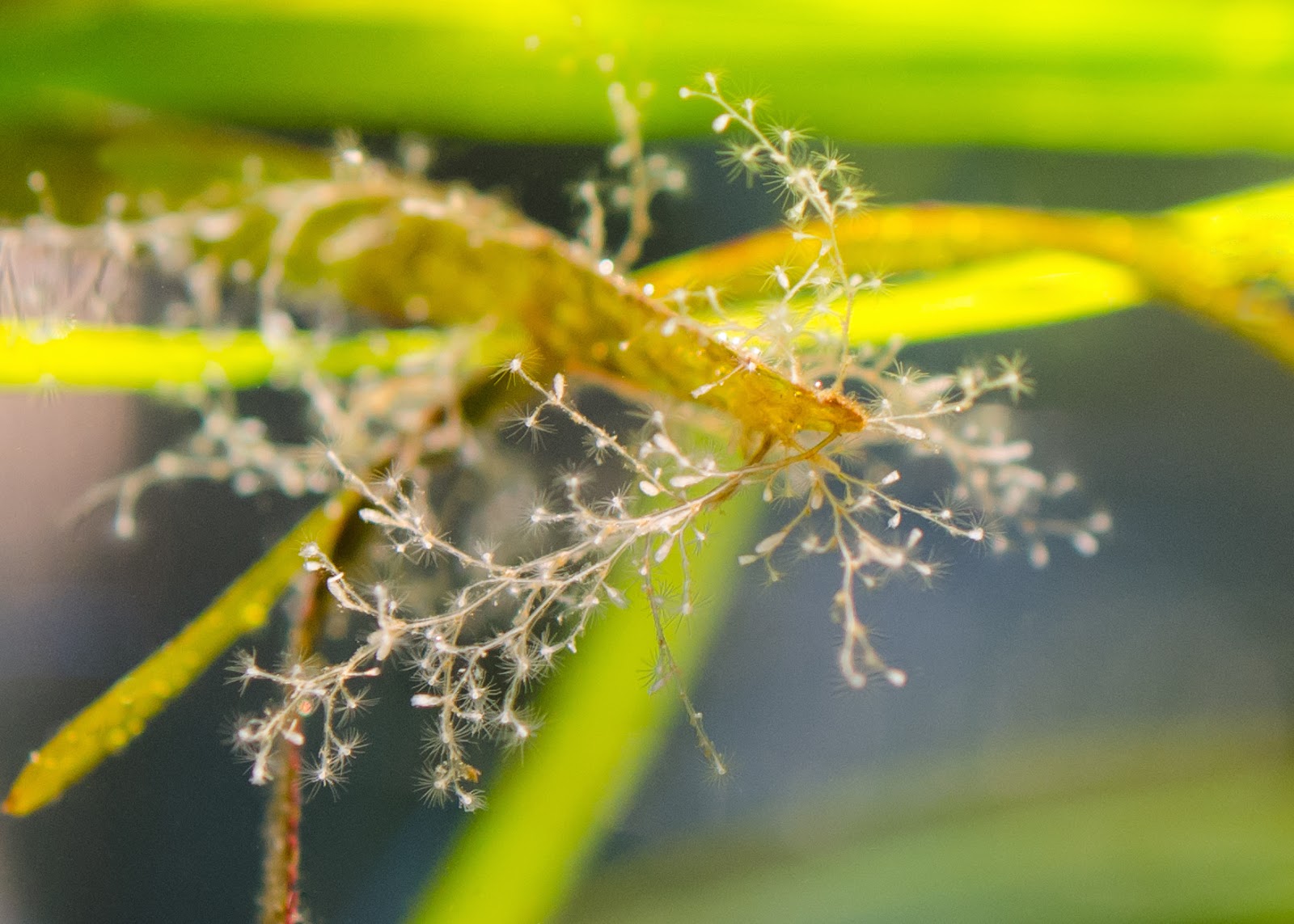
My hermit crabs love hydroids, so I bring home "messy" eelgrass, covered with assorted hydroids and diatom fuzz. Usually, they clean all this off overnight, but this time, they've left me a small cluster of Obelia, right beside the glass wall of the tank.

The tallest of these plant-like animals is about an inch high, and the individual "flowers" are barely visible without a lens. They sway constantly in the current, or bounce as hermits walk up and down the eelgrass. And out of the water, they collapse, so I've been trying to take their photo through the glass.

A tangled mess, growing from the end of a blade of eelgrass also coated with pink tunicates.

Zooming in. Among the hydroids, some small critters have laid their egg masses. To the naked eye, these are just specks of white dust.

Some of the taller stalks, showing the polyps in different stages of development. The feeding polyps (the ones with tentacles) sting tiny swimming critters, such as copepods and smaller plankton.

Life cycle of an Obelia. Image from Kent Simmons, U of Winnipeg.
The reproductive polyps are more difficult to distinguish in these photos. The empty cone near the top of the last photo may be one of them.

An empty reproductive polyp. Photo from 2011.

The hydroids will release the next stage, the medusas, from these reproductive polyps. I have seen them swimming near the parents, but in this tank, they end up in the pump, and don't survive.


Friday, April 11, 2014

Edible glass

Another forgotten photo: hydroids on eelgrass in my aquarium.

Tiny, glassy structures waving in the current. Some of the spots are bubbles, but at least a few are the new medusas just released by the hydroid parents.

Ephemeral beauty; the hermit crabs polish off the hydroids overnight, and the millimetre-wide jellies are swept into the pump and smushed into the black ooze.

The orange-brown tentacly circles are anemones on the aquarium wall.


Tuesday, January 21, 2014

Cladonema pacificum; fuzz to jelly to fuzz

My granddaughters, 7 and 11, were peering into my aquarium as I tickled jellyfish to make them swim. "Where did you get them, Grandma?" the younger one asked.

A good place to start. With, "I don't know."

I can guess. They came from Boundary Bay, but they didn't enter my tank as jellyfish. They were probably the fuzz on sand grains, or old eelgrass blades, or maybe even hermit crab shells. The fuzz would have been about 1/2 mm high, barely enough to see. It could be the brownish stuff that coats the lower edge of the glass walls, where I don't clean as thoroughly as I do the rest of the tank.

The jellies' parents were hydroids. These ones make a creeping mat crowned by stalks, each with four tentacles. At the tip, they form into bulbs that swell into tiny medusas. When they are about 1 mm. long, they break free and swim away. (Photos, Bodegahead)

Freshly released medusa, Cladonema pacificum*

These new baby jellies have 9 canals marking the bell, a tiny hanging stomach, and 9 tentacles around the lip. Each tentacle is branched; one branch is tipped with an adhesive pad, the other holds stinging cells for capturing food.

An older jelly, in a plastic lid, showing adhesive tentacles. 4 per tentacle stem, now.

With these sticky feet, they grab onto any surface; walls, sand, eelgrass, and even the undersurface of the water. There they hang, waving the longer tentacles around, catching dinner, mainly copepods.

As the jellyfish grow, the tentacles lengthen and branch out. The older adhesive pads change, becoming chains of stinging cells.

Early development of stinging tentacles. Note the flower-like mouth at bottom left of central column.

They grow to about 3.5 mm high. I measured a large one of mine: 3 mm., not counting the tentacles, of course.

And they have more eyes than a spider, 9 in total**, although they probably only distinguish light and shadow. The jellies in my tank like to congregate near the light source in the afternoon, although earlier in the day they are usually hiding down on the sand or the eelgrass.

One red eye spot, or ocellus, at the base of each tentacle stem.

Inside view

The central column of the jellyfish contains its stomach, with the mouth at the bottom. When the jelly is feeding, copepods and other plankton are snared by the tentacles, which convulse suddenly, bringing the captive down to the lip of the jelly. The whole gastric column then swings around to eat.***

Since the jellyfish has no other opening, digested food is spit out through the mouth.  And rather quickly, too, because otherwise, it would weigh the jelly down, making it sink.

Backlit jellies. The rear one is stuck to the undersurface of the water.

In a mature jelly, the mouth hangs down (up, in this case) to just beyond the lip of the bell.

When it is full grown, the male will release sperm into the water. The female jelly develops eggs. Once they are fertilized, she releases them as planulae, flat plankton with cilia for swimming. Since these have no mouth or digestive system, they hurry to find a good spot to settle down, so they can develop into hydroids. And the cycle is complete.

*There is no common name for this genus.

**The red-eye medusa, otherwise very similar to this one, has hundreds of tentacles and over 100 eyes.

***Tomorrow, if YouTube cooperates, I will post a video of these jellies feeding.


Wednesday, July 31, 2013

A gourmet treat for my little ones

I brought home a handful of seaweeds for the hermit crabs, planted the eelgrass in the sand at the bottom of the aquarium, and left these brown weeds floating near the surface. Within minutes, half a dozen small critters had climbed up to graze.

While I was checking them, I noticed the hydroids, standing like little fans all around the stalks and the float bladders.

These are tiny; the bladders measure about 3 mm. lengthwise.

I took a quick photo, one only because I had to leave. When I looked at it later, I decided to take my time and get a good shot. I went back to the tank, and found bare stalks. The hermits had eaten the hydroids, every single one.

Gotta be quick around here!

Powered By Blogger