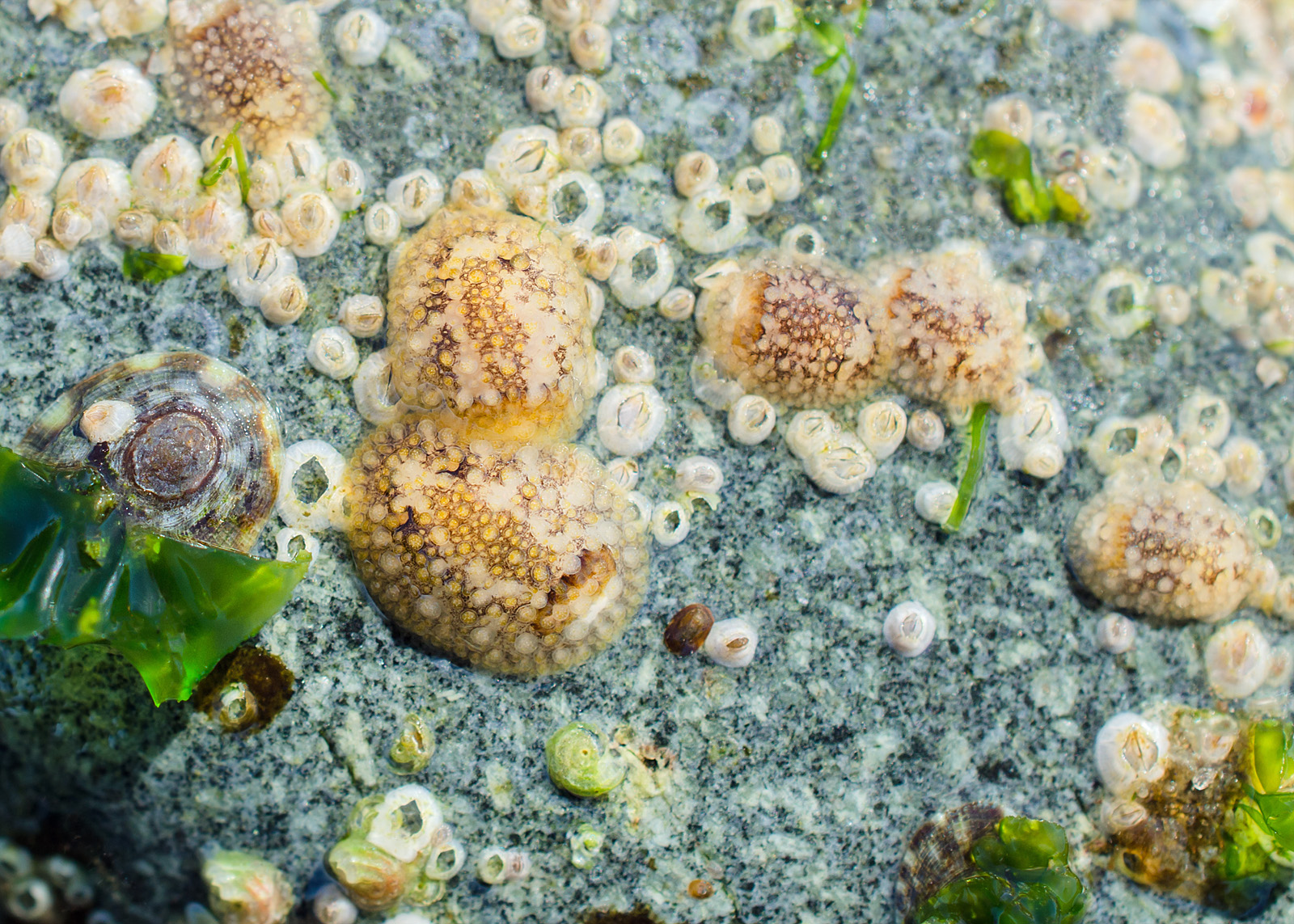
Showing posts with label nudibranch. Show all posts

Sunday, September 03, 2023

Rainbow colours, underwater

 Is there any humble creature more beautiful than a nudibranch? Just look at these two!

Clown nudibranch, Triopha catalinae

Golden dirona, Dirona pellucida

Supporting cast: the turtle crab, purplish pink encrusting sponges, orange cup corals, a brittle star, a stripy snail (topsnail?), and tiny greenish fuzzies.

And the last of this batch of aquarium photos: three gunnels, green and brown.

The brown ones are crescent gunnels, Pholis laeta.

The green gunnel may be a penpoint gunnel; these come in three colours, red, green, or brown, depending on their diet. The round hole is a discarded glass bottle, with a pink sponge coating. Gunnels use these as hideaways. Not an excuse for careless dumping, but at least they're not plastic.

~~~~~~~~~~~~~~~~

¿Acaso hay otra criatura tan humilde y a la vez tan bella como un nudibranquio? Por ejemplo, mira estos dos.
  1. Un nudibranquio "payaso", triopha catalinae. Con un cangrejo tortuga, esponjas encrustantes color de rosa, y el coral Balanophyllia elegans.
  2. Un nudibranquio Dirona pellucida, acompañado por más esponjas y corales, un estrella de mar frágil, y un caracol marino, tal vez el "trompo" (por la forma de la concha).
  3. Y, la última de estas fotos de los residentes del acuario, tres pescaditos "gunnel". Los de color café son Pholis laeta; el pescado verde puede ser un gunnel "punto de pluma". Estos últimos pueden ser o verdes o rojos o cafés, según el color de su dieta. El hoyo circular es la boca de una botella de vidrio, encrustado con esponjas. Estos pescaditos en forma de anguila se aprovechan de botellas abandonados para esconderse. Lo cual no nos desculpa por haberlos tirado al agua. Pero por lo menos, no son de plástico.


Tuesday, May 30, 2023

Blue thighs and black eyes

 More photos from the aquarium on the pier:

Widehand hermit, Elassochirus tenuimanus. With limpets and algae on his shell.

"The blue colour on the thighs (inner surfaces) of its appendages is a distinctive feature." (Marine Life of the PNW)
Thighs! I never thought to apply that word to the segment of a hermit's legs. I think the "proper" term is Ischium. But I like "thigh".

Unidentified nudibranch

This little guy occasionally let go of the wall and started to swim about, twisting back and forth; sort of dancing in the water.

Swimming scallops, Chlamys hastata.

Look for the eyes; little black dots around the rim of the orange flesh. Or white, where the light hits the tiny mirrors inside.

Another scallop and a red and white striped greenling. (Painted?)

And a very spiny crab. Unidentified.

This year I've got a season's pass, so I'll be back. Maybe I'll be able to identify the fish and the crab next visit.

~~~~~~~~~
Y hay más fotos de los animales en el acuario en el muelle.

  1. Un cangrejo ermitaño "de patas anchas", Elassochirus tenuimanus. Lleva una pareja de lapas y algas verdes y color de rosa en la concha. Dice mi enciclopedia — El color azul que lleva en el muslo de sus extremidades es una característica distintiva. — ¡El muslo! Nunca se me hubiera ocurrido darle ese nombre a un segmento de una pata de ermitaño. Creo que el término "apropriado" es isqion. Pero me gusta "muslo".
  2. Un nudibranqio sin identificar. Esta criaturita de vez en cuando se saltaba de la pared y empezaba a nadar, torciéndose como si estuviera bailando.
  3. Vieras natadoras, Chlamys hastata. Busca los ojos; puntitos negros al borde de la carne anaranjada. O blancas, cuando los espejitos en el interior reflejan la luz.
  4. Otra vieira, con un pescado "greenling", vestido en rayas de rojo y blanco.
  5. Y un cangrejo muy espinoso. No lo pude identificar.
Este año tengo un pase de temporada, y voy a poder visitar con frecuencia. Tal vez logre identificar al pescado y al cangrejo en la próxima visita.

Friday, September 17, 2021

Tied in knots

The tide was high, the wind brisk, the waves bouncy. The beach near Salmon Point was just a narrow strip of stones between the water and the rocks of the breakwater. I was there to look at eelgrass and kelp, torn from their roots and holdfasts, all tangled and tossed up by the waves.

Tangle of fresh bull kelp and eelgrass.

A knot like this is full of interest; teasing out separate strands, I find mostly eelgrass, rockweed, sea lettuce, and kelp, with occasional fragments of Turkish towel or washcloth, and maybe some spaghetti-like brown algae. Living on the blades of kelp are bryozoan colonies, sometimes, if I'm lucky and sharp-eyed enough, with their tiny cryptic nudibranchs. Any holdfasts that show up house miniature worms and immature snails, possibly a baby starfish.

The eelgrass carries snails and amphipods, sometimes a stray hermit crab. And in season, there are a variety of snail and nudibranch eggs, all doomed to be tossed onto the stones to die and be sundried. Some of the eelgrass crumbles and disappears; some remains as blackish heaps, leaping with sand hoppers. 

The kelp stipes hold their shape for a long time, bleaching to a greenish yellow. Crabs and hermits love to eat this when it ends up back in the water.

Eelgrass and sea lettuce. Green blobs in the waves themselves are sea lettuce washing in.

~~~~~~~~~~~~~~~~~~~~~~~~~~~

La marea estaba a su máximo, la brisa algo fuerte, las olas caían en espuma sobre las piedras de la playa que ocupaban apenas unos metros entre el agua y el rompeolas de piedra. Yo estaba allí buscando hierba Zostera y quelpo, arrancados de sus raices y rizoides, hechos nudos y depositados por las olas sobre las piedras.

Primera foto: un nudo de quelpo Nereocystis luetkeana y de hierba Zostera en la playa cerca del Punto Salmón.

Un enredo como este tiene mucho de interés. Al separar cada hoja y estipe, encuentro en su mayor parte hierba Zostera, el quelpo, lechuga marina (Ulva sp.), sargaso vejigoso, con fragmentos de toalla turca, y otras algas pardas. En las hojas del quelpo viven colonias de briozoos, y a veces, si tengo suerte y los ojos no me fallan, con sus nudibranquios crípticos que comen los briozoos. Los rizoides que llegan al nudo protegen anélidos pequeñísimos y conchas marinas juveniles, y a veces una estrella de mar infantil.

La hierba Zostera marina lleva conchas marinas y anfípodos, y de vez en cuando un cangrejo ermitaño. En ciertas temporadas habrá huevos de varios nudibranquios y conchas marinas, todos destinados a morir sobre las piedras, tostarse en el sol, y o quedar como un montoncito de fibras negras donde saltan las pulgas de arena, o desmoronarse y desaparecer.

Los estipes del quelpo permanecen por largo tiempo, volviéndose suave y de un color amarillento. A los cangrejos y ermitaños les gusta comer esto, cuando por suerte cae otra vez en el agua.

Segunda foto: piedras, olas, y hierba Zostera. Las manchas oscuras dentro del agua son fragmentos de lechuga marina.


Saturday, April 24, 2021

Lemon of the tidepools

Exploring a shallow tidepool, less than 2 inches deep, I came across this lemon-coloured beauty.

Monterey sea lemon, Doris montereyensis.

He's about the size of a lemon. The front is toward the right of the photo: that lump is one of his two rhinopores, his taste and scent receptors. He was crawling on the rock, half in and half out of the water. When I picked up his rock, he dropped off and started to curl up.

Sea lemon underside.

I took a few photos and moved him carefully to the water in the shade of a stone, right side up.

Walking around the tidepool, I found another, almost hidden under seaweed between two rocks. On my next circuit of the pool, I couldn't see it at all until I stood on the exact same stone, crouched in the same position as before. The first was also invisible except from the right angle. It made me wonder how many other things I am missing.

~~~~~~~~~~~~~~~~~~~~~~~
Buscando entre las pozas intramareales, en una poza de menos de 4 cm. de hondo, encontré esta belleza.

Es un nudibranquio, el "limón marino de monterey", Doris montereyensis. Es más o menos el tamaño de un limón mediano. Su cabeza apunta hacia la derecha en la foto; la pequeña extensión es uno de sus dos rinóforos, órganos que detectan sabores y olores.

Se deslizaba sobre la piedra, la mitad fuera del agua. Cuando levanté su piedra, se soltó y, volteado barriga al aire, empezó a encerrarse. Saqué unas fotos y luego lo regresé al agua en la sombra de una piedra.

Siguiendo la vuelta a la poza, vi otro limón marino medio escondido bajo algas, entre dos piedritas. Y dando una segunda vuelta, no lo podía ver hasta que me paré en la misma piedrita, y me agaché en la misma postura de antes. El primer limón también resultó ser invisible si no fuera desde el ángulo preciso. Me hizo pensar cuantas otras cosas se me pasan.

#InverteFest


Tuesday, July 28, 2020

And the bryozoan eaters

Nothing grows in isolation. There are layers upon layers.

On a blade of kelp, a map of bryozoan colonies provides habitat for dorid sea slugs, nudibranchs. They break into the little zooid boxes and scrape out the animal inside. They are well camouflaged: their bodies are transparent, with white lines that mimic the white walls of the bryozoans.

With the naked eye, all I could see were pinhead bumps on the bryozoans. I searched for them with the microscope and found a half dozen, busily feeding.

This is the bryozoan colony, without dorids. Each little box is about 0.4 mm long.

A dorid, outlined by reflections from the 'scope's lights. About 2 mm. long.

There are two almost identical species of these tiny nudibranchs; Corambe pacifica and Doridella steinbergi. Only with a higher-power microscope could I tell the difference. But the two species happily live together on the same colonies.

A smaller one. The white markings are visible here.

A larger dorid, more visible on hydroids. This is probably the Corambe pacifica, aka the frost spot nudibranch.

This one shows a few yellowish spots.

Even with the microscope, these are often hard to see. Unless they're moving. I probably missed quite a few; there can be up to 240 dorids on one blade of kelp.

And this I didn't know yesterday, when I posted photos of the bryozoan colonies; the bryozoans respond to predation by these nudibranchs by building spines on the top of their walls. Here's yesterday's photo, with the spines, that I didn't recognize when I saw them.

"Keep off!"

Tomorrow, I'll have a video of these crawling about.

~~~~~~~~~~~~~~~~

Nada vive solito. La naturaleza viene con capas. Encima del alga "kelp", existen las colonias de briozoos; encima de los briozoos, se deslizan los nudibranquios, animales del grupo de caracoles y babosas; como caracoles marinas sin concha. Se alimentan de los zooides, rompiendo sus cajitas. Tienen exelente camuflage, siendo transparentes y con lineas blancas que se parecen a las paredes de los briozoos.

Con el ojo solo, apena podía ver unos pequeñísimos protuberancias sobre las colonias de briozoos. Cuando los busqué con el microscopio, encontré una media docena.

Las cajitas de los briozoos miden aproximadamente 0.4 mm. de largo. Los nudibranquios (aka doris) miden desde 2 mm. de largo.

Hay dos especies que viven en estos briozoos; Corambe pacifica y Doridella steinbergi. Son casi idénticos, pudiendo identificarse únicamente por la formación del ano, lo cual no es posible con mi microscopio. Sin embargo, las dos especies viven juntas, así que las fotos aquí pueden representar ambas.

Es muy difícil verlos cuando son tan pequeños, a menos de que estén caminando. Probablemente se me escaparon varios; en una hoja de kelp pueden vivir unos 240 doris.

Y esto no lo sabía ayer cuando subí las fotos: los zooides de la colonia de los briozoos se defienden del ataque de los nudibranquios construyendo espinas encima de sus paredes. Volví a subir la foto donde se ven estas espinas. Ayer no supe que eran.

Mañana, subo un video.


Wednesday, April 29, 2020

Hydroid eater

The problem with digital cameras is that they are too easy. And too cheap. Well, not the camera itself, those are never cheap, but the photos are. I go out for a walk and come home with 300 photos to sort. With film, each film had only 24 photos, and each one had to be developed in a lab, and each one cost a fair amount; we couldn't just click, click, click, without thinking. So a day or two after we'd taken our photos, we sat down and looked them over; there were never more than 20 or so "good" ones, and only one or two would really be worth keeping.

When there are 300, even if half are duplicates, and another quarter are horrible, there are still 50 or more to look over carefully and to process. No wonder some get left behind to check out "tomorrow". Which of course, means 10 years down the line.

I found this one in a batch from 2010; photos of hydroids, almost microscopic hairy plant-like animals growing on eelgrass. On one of the branches, a sea slug was feeding.

Tiny nudibranch, lower left.

The lumpy, greenish appendages along the back are the cerata. They contain branches of the digestive tract, and the colour depends on what they are eating. Sometimes they contain stinging cells; the nudis are soft and look tasty; the stingers are there to discourage predators.

Towards the front there are two upright rhinopores, which dectect odors. The eyes (two tiny dots) are rudimentary, and probably distinguish only light and darkness. The two appendages in front are oral tentacles; more sensory organs, for taste and smell, and only the nudis know what else.

Most of the nudibranchs I've seen are between one and two inches long. Here's one that hitchhiked a ride to my tank, back in 2015.

The opalescent nudibranch, Hermissenda crassicornis. About 1 inch long.

Here you can see the cerata (Hermi has many), the rhinopores, and the oral tentacles in front.

~~~~~~~~~~~

El problema con las cámaras modernas, digitales, es que son tan fáciles de usar, y baratas también. Bueno, las cámaras no son baratas, pero las fotos que sacan sí lo son. Salgo a caminar y regreso con 300 fotos para revisar.

Con las cámaras antiguas, de película, cada rollo tenía solamente unas 24 fotos disponibles, y esas se tenían que mandar al laboratorio, que nunca salía barato. No hacíamos "click" sin pensarlo antes.

Y luego recogíamos nuestras fotos, unas 20 que el laboratorio había decidido que eran buenas. Y no lo eran; nos quedábamos con una o dos.

Ahora, con 300 de un solo paseo, aunque la mitad son dobles, y otra cuarta parte son horribles, todavía me quedan cincuenta o más fotos para revisar. Y resulta que muchas se dejan para procesar "mañana". Tal mañana puede no aparecer por 10 años o más.

Encontré esta en un grupo de fotos de hidroides, animales que parecen plantas miniaturas (casi como pelos), sacadas en 2010. En una de las ramas, descubrí un nudibranquio. (También se les llama babosa de mar, en inglés.)

Véase la primera foto: las ramas verdes en la espalda se llaman cerata, y contienen el sistema digestivo, lo que les da el color. También pueden contener células venenosas: los nudis son suavecitos y muchos animales los quisieran comer, si no fuera por esa protección.

Hacia adelante, se erigen dos "rinoporos", que sirven para percibir los olores. dos ojos (apenas visibles) que pueden distinguir la luz de la oscuridad y no mucho más, y en frente hay dos tentáculos bucales, para probar sabores, olores, y solo los nudis saben qué más.

La segunda foto es de un nudi mucho más grande que vino a pasar algún tiempo en mi acuario. Es el nudibranquio opalescente, Hermissenda crassicornis, y mide más o menos 2 centímetros de largo. Aquí se ven claramente las ceratas, de las cuales, "Hermi" tiene muchas, los rinoporos, y los tentáculos bucales en frente.

Tuesday, May 09, 2017

Shag-rug nudibranchs

It's egg-laying season. I disturbed a nudibranch busy gluing her strings of eggs to a rock.

Aeolida papillosa, with fresh eggs.

When I turned over her rock, she left the eggs and went down to join another nudi on the sand.

They twisted and turned together, facing first one way, then the other.

Shag-rugs are also known as shaggy mouse, or grey nudibranchs. The colour varies from brown, grey, orange, and even purple, depending, in part, on their diet.

The two brown "horns" are rhinopores, sensory organs that detect scent and taste in the water. At the very front of the foot (like a snail, the nudibranch is a monopod, travelling on one broad foot.) two more projections, called pedal tentacles. All the other waving spikes are cerata.

These nudibranchs eat various anemones. They collect the stinging nematocysts from the anemones' tentacles, without getting stung themselves, and move them into the tips of their own cerata, ready to sting anything that thinks a soft, fleshy slug would be good eating.

It is said to be a voracious predator, consuming enough anemone tissue to equal half or all its body weight per day. (Wallawalla.edu)

More shag-rug eggs, with clamshell and crab.


Tuesday, May 17, 2016

Noble lemon, shaggy mouse, and little Doris

Those are all nudibranchs. Aka sea slugs. And one, the noble lemon nudibranch, was definitely sluggish when I woke her up from her afternoon nap.

Peltodoris nobilis, the noble sea lemon.

When I turned over her stone, she was just a circular yellowish blob, not moving, almost looking like a mass of eggs. I took photos of the sea cucumbers I found under her stone, and looked at crabs, then went to replace the stone. But now, she was awake, and stretching out, s l o w l y, s l o w l y.

Now I could see a bump on one end (on the right, above); one of her two sensory organs, the rhinopores, still retracted.  I waited, took photos, measured her (2 inches, still half hunched up), waited some more. Finally, the circle of gills at the back started to expand, millimetre by millimetre. I took pity on her, then, there exposed in the sunlight and air, and carefully flipped the stone back onto the wet sand. She probably went right back to sleep.

She feeds on several species of sponges, when she's awake. No rush; they're not going anywhere.

On the underside of another stone just below the mid-intertidal zone, a group of small barnacle-eating dorids were sitting around the table.

Onchidoris bilamellata, with barnacles, some already eaten. The tiny nudibranchs drill through their shell to get at the meat.

Zooming in. I don't see the two rhinopores at the front end. At the rear (lower right on the bottom nudi here), are the feathery gills. 

And I found a shaggy mouse laying eggs.

Shaggy mouse, aka shag rug nudibranch, sea-mouse, Aeolida papillosa. With eggs. Front end, lower right.

The shaggy mouse eats anemones, mostly the stinging tentacles. She doesn't get stung, but saves the stinging cells and moves them to her shaggy cerata to serve as a defense. A slow, soft-bodied, sluggish creature needs that extra bit of protection in a world full of hungry crabs and fish.


Sunday, April 24, 2016

It's good to be home

After the foray into the vibrant colours and light of Mazatlan, I've come back to the clouds, the rain, and the paler spring colours of home; lilacs and pinks and periwinkle blues. And down on the shore, instead of creamy sand, there are rocks covered in blackish seaweeds and sprinkled with snails.

It's good to be home.

And there are colours to be found on the grey beach; it just takes a bit of careful walking and rock-flipping.

Water's edge, with rockweed.

The tide was out, and when I hiked down to the edge, I found that it was in that mid-stage, neither going nor coming; the water was still, the floating seaweeds fixed in place. A good time to be turning over rocks that are usually underwater.

And, of course, there were zillions of crabs and snails and hermits. Under most of the larger stones, one or two gunnels were hiding; they flopped about madly as soon as the stone began to move, and by the time I had put it aside, they were squirming under the next. A kelp crab saw me first, and pinched my fingers; clams squirted their little fountains as I approached. One got me in the face.

Under several stones, I found tiny sea urchins, pink and yellow, the largest barely an inch across.

Sea urchin and purplish seaweed.

Assorted scraps of seaweed. The pale, lacy one is a torn and bleached sea braid; the others are fresh.

The Monterey sea lemon, aka false lemon peel nudibranch, Doris montereyensis.

The black-tipped tubercules distinguish this nudibranch from the "true" or "noble" sea lemon, which is all yellow.

These will grow up to 6 inches long, but the largest I've found this spring was still under 3 inches.

Another view. The two yellow bumps in front are the rinopores, sensory horn-shaped projections, shut down while he's out of water. In back, once the tide comes in, he will extend his feather gills.


Another Monterey, much smaller, bright yellow. With a frilled whelk, two other snails, the arm of a starfish, spiral tubeworms pasted over with flatworm eggs, and the remains of bryozoan colonies. No space is ever wasted.

Barnacle-eating nudibranchs, with their egg ribbons. These grow to just over an inch long; the largest here is about that.

Interesting egg masses that I can't find an id for.

Yellow whelk egg cases.

Juvenile red rock crab who thinks he's hiding.

Pink-tipped green anemone, Anthopleura elegantissima, mostly shut down, waiting for the tide to come in.

At the foot of several very large rocks, the water has carved out shaded pools a few inches deep, even at low tide. When I approached, I could see the water ripple as schools of tiny sculpins dashed for cover, usually rousting their companions out of the chosen spot, so that they, in turn, had to hurry to find a new one. Sort of like a game of musical chairs, where the music never stopped until I went away.

Greenish tidepool sculpin. Others were grey; one was a reddish brown.

Big plumose anemone in a tide pool. And something else ...

Those red and yellow things at the upper left? I'll have photos of them tomorrow.

Thursday, November 05, 2015

Piling critters

I noticed the smells first; salt, creosote, tar, old wood, engines, something mildly fishy. I was going down the ramp to the dock where the working boats, the fishing and tug boats, tie up, and the scents took me back to a time when I used to fish off a similar dock, catching supper. An old memory surfaced; old log pilings, tarred, at the end of a dock, and a big (well, maybe; I was little) octopus climbing up and peering out of the square opening.

I didn't expect octopuses here; starfish and anemones, probably. I walked down to the end of three long docks, squinting down every gap between dock and boat, every opening for pilings. There wasn't much to be seen; the boats are tied up, two deep, on each side of the dock. Very little light filters down underneath them. And many of the pilings are metal; fat, rusty pipes standing out of the water. Nothing seems to live on them.

But where I found tarred log pilings and a bit of reflected light, I found shrimp. And 'way down at the end of the last dock, where the sunlight penetrates to those log pilings, I found a starfish climbing out of the water. I got down on my knees, then lay flat, ending up lying for a long time with my head and camera down the hole between the pilings.

Because the pilings were alive with things crawling about.

The starfish, half out of water.

There were a fair number of purple starfish. Earlier, I had seen a few pale orange ones, deep down, one in not very good shape. But these were active, crawling about or hunched over something edible. They all looked healthy.

In the photo above, all that white stuff is styrofoam. Tiny, white balls of styrofoam. I found these all along the dock, along the water line of the boats, stuck to the tarry pilings. (Not the metal ones.) I had to keep brushing floating clumps aside to see the animals below.

There wasn't much in the way of seaweeds around the pilings or on the boats. I saw a few kelp streamers, loose in the current, and a few blades of red algae. There seems to be more underneath the dock, but I couldn't see more than bits of the edge.

Kelp crab, barnacle scars, and styrofoam.

The kelp crabs keep walking around and around the pilings; as one disappears on the far side, the first legs of the next show up. Round and round and round; I never saw any of them stop to eat anything, but they must be finding something worthwhile.

Older kelp crab, growing pale seaweeds on his back. He's deeper down; there's only a hint of styrofoam in the foreground. The little toe tips at the top belong to a pair of shrimp on the far side of the piling.

Much smaller crab, possibly the red rock crab, with barnacle scars and a few remnants of styrofoam.

Another coonstripe shrimp. With floating styrofoam. The yellow mound is some sort of sponge. And what's that down at the corner?

That mottled brown thing with the blue vanes showed up in quite a few photos; in each one, the vanes were in a different position. Unfortunately, I hadn't noticed it while I was taking the photos, paying attention to the shrimp.

Mystery critter.

From the shape of this animal, and the waving vanes, I thought it might be a nudibranch, but I've looked at all those in my encyclopedia, and hundreds that Google found for me. Nothing looks right.

Comparing it with the shrimp, which was about 4 inches long, I would guess that it is probably about an inch long. There are brown, mottled nudibranchs the right size, the barnacle-eating nudibranch, Onchidoris bilamellata, for example, but the vanes would be gills, and they should be feathery, and maybe smaller. But they would explain the number of empty barnacle scars on these pilings.

Help!


Sunday, May 10, 2015

Where the wild things are

The critters of the upper intertidal zone, with the exception of the insane mud snails, go into hiding at low tide; Boundary Bay becomes a wide zone of bare, grey sand. But when the tide is low enough, we can walk out to the last sandbars and the eelgrass beds between them. There, life goes on, busily, whether the water is coming or going.

These photos are in chronological order, as I walked out. Some animals only show up in the deeper areas, where the tide rarely drops below the tips of the tallest eelgrass.

Small Dungeness crabs start appearing at the inner edge of the beds. This is under about 4 inches of water.

Opalescent nudibranch, on kelp. There were many in the shallower eelgrass beds, all much more vividly coloured than the one I found last month at the boat ramp.

(More on these, later.)

Fuzzy eelgrass.

The fuzz along the blades of grass is made up of diatoms and bacteria. It doesn't look appetizing, but this is my hermits and crabs absolute favourite food. They're not the only gourmets; the fuzziest grass in this zone is loaded with bubble shells, nudibranchs, skeleton shrimp, amphipods, and other small, darting beasties. It seems that every second blade has its collection of egg masses, pink, white, and yellow; the next generation will be well provided for.

I don't know what was in that ball of pinkish stuff. It felt solid, and was firmly stuck to the eelgrass.

If you look closely at the photo, you may find the baby starfish.

Dungeness crab molt. It must be handy to get rid of your old skin when it loses its youthful smoothness.

Looking back. The photo reminds me, in tone and layout, of an old postcard in my Mom's album.

Purple sand dollar, under flowing water. This one's alive, so it still has the dark spines.

Looking north, across the bay to the hills of South Surrey.

One sandbar to go before the border marker. The water was about knee-deep from here to the bar, then the bottom drops off quickly.

Green burrowing anemone. The deep green is from ingested algae.

I found many empty clamshells; most of them contained small mottled starfish. There are three here; do you see the third?

About a third of the small starfish had the twisted, upturned armtips that may be caused by starfish wasting syndrome. I didn't see any lesions, and there were quite a few babies.

Almost every clamshell that contained starfish also held a few tiny, almost transparent shrimp. Four of them, one a female carrying young, came home with me in a handful of eelgrass. I'll have photos of these, later on.

At the outer edge of the last sandbar, as I watched, the eelgrass stretched out in the outgoing current suddenly faltered, drooped, turned back towards me. The tide was coming in. Time to go.

I had time to stop, once I'd reached shallower water, and take a couple more photos.

Blending in.

Jellyfish, alive and swimming, made visible by its shadow on the sand beneath.

I brought home a small bag of fuzzy eelgrass for my hermits; as usual, there were hitchhikers. Some of them, tomorrow.

Powered By Blogger