Showing posts with label membranipora. Show all posts

Tuesday, July 28, 2020

And the bryozoan eaters

Nothing grows in isolation. There are layers upon layers.

On a blade of kelp, a map of bryozoan colonies provides habitat for dorid sea slugs, nudibranchs. They break into the little zooid boxes and scrape out the animal inside. They are well camouflaged: their bodies are transparent, with white lines that mimic the white walls of the bryozoans.

With the naked eye, all I could see were pinhead bumps on the bryozoans. I searched for them with the microscope and found a half dozen, busily feeding.

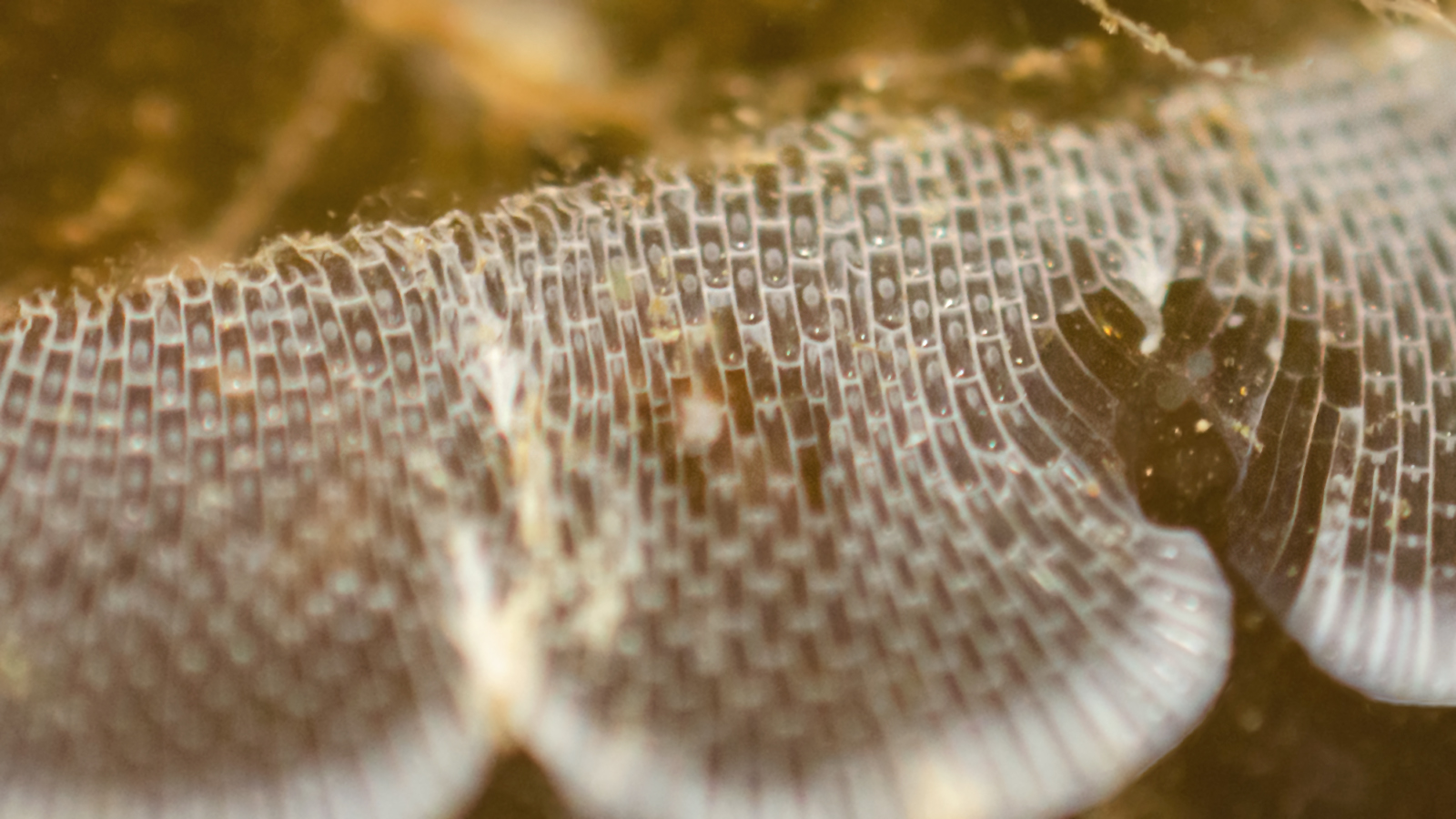
This is the bryozoan colony, without dorids. Each little box is about 0.4 mm long.

A dorid, outlined by reflections from the 'scope's lights. About 2 mm. long.

There are two almost identical species of these tiny nudibranchs; Corambe pacifica and Doridella steinbergi. Only with a higher-power microscope could I tell the difference. But the two species happily live together on the same colonies.

A smaller one. The white markings are visible here.

A larger dorid, more visible on hydroids. This is probably the Corambe pacifica, aka the frost spot nudibranch.

This one shows a few yellowish spots.

Even with the microscope, these are often hard to see. Unless they're moving. I probably missed quite a few; there can be up to 240 dorids on one blade of kelp.

And this I didn't know yesterday, when I posted photos of the bryozoan colonies; the bryozoans respond to predation by these nudibranchs by building spines on the top of their walls. Here's yesterday's photo, with the spines, that I didn't recognize when I saw them.

"Keep off!"

Tomorrow, I'll have a video of these crawling about.

~~~~~~~~~~~~~~~~

Nada vive solito. La naturaleza viene con capas. Encima del alga "kelp", existen las colonias de briozoos; encima de los briozoos, se deslizan los nudibranquios, animales del grupo de caracoles y babosas; como caracoles marinas sin concha. Se alimentan de los zooides, rompiendo sus cajitas. Tienen exelente camuflage, siendo transparentes y con lineas blancas que se parecen a las paredes de los briozoos.

Con el ojo solo, apena podía ver unos pequeñísimos protuberancias sobre las colonias de briozoos. Cuando los busqué con el microscopio, encontré una media docena.

Las cajitas de los briozoos miden aproximadamente 0.4 mm. de largo. Los nudibranquios (aka doris) miden desde 2 mm. de largo.

Hay dos especies que viven en estos briozoos; Corambe pacifica y Doridella steinbergi. Son casi idénticos, pudiendo identificarse únicamente por la formación del ano, lo cual no es posible con mi microscopio. Sin embargo, las dos especies viven juntas, así que las fotos aquí pueden representar ambas.

Es muy difícil verlos cuando son tan pequeños, a menos de que estén caminando. Probablemente se me escaparon varios; en una hoja de kelp pueden vivir unos 240 doris.

Y esto no lo sabía ayer cuando subí las fotos: los zooides de la colonia de los briozoos se defienden del ataque de los nudibranquios construyendo espinas encima de sus paredes. Volví a subir la foto donde se ven estas espinas. Ayer no supe que eran.

Mañana, subo un video.


Monday, July 27, 2020

Little boxes

A couple of days ago, walking with family down on the docks, spotting starfish and anemones, I saw a long streamer of kelp, loaded with bryozoan colonies, almost within my reach. My son fished it out for me.

At home, I examined it, using a lens, then the microscope, finally the camera, when the light was better.

First: the colonies themselves:

Small bryozoan colony, Membranipora membranacea

These bryozoans are tiny animals, each living in its own rectangular, glassy box. The animal inside extends its tentacles (called a lophophore) through a hole at one end of the box, capturing food from the plankton; bacteria, diatoms, and other small floaters.

Little cubicles. Each one holds one zooid.

Looking at a colony on a curve.

A colony, happily feeding.

Another side view. Look closely (or click for full size) to see the individual animals.

Out of the water, the whole colony shuts itself inside its walls. Put them in water, and in a few seconds, the first ones are out, opening and shutting, capturing dinner.

These were some of the camera shots. Tomorrow, the microscope views, and what I found there.

~~~~~~~~~~~~~~~~

El sábado fui con familia a caminar en el muelle, mirando estrellas de mar y anémonas bajo los flotadores. Vi  una hoja larga de alga marina "kelp", cubierta de manchas blancas. Mi hijo me la capturó y la traje a casa para examinarla.

La hoja estaba poblada por gran cantidad de colonias de un briozoo, Membranipora membranacea. Son animales pequeños que se hacen cajitas blancas, casi transparentes; cada animal vive en una caja. Tiene un agujero a un extremo, y por medio de este, (el lofóforo) el animalito extiende sus tentáculos para capturar su presa, que son bacteria, diatomeas, y otros criaturas del plancton.

Fuera del agua, toda la colonia se encierra en sus cajitas. En el agua, inmediatamente, se levantan y empiezan a mover sus tentáculos, capturando la cena.

Estas fotos son algunas que saqué con la cámara; además, examiné las colonias con el microscopio. Mañana subo algunas de esas fotos, con algunos otros animales que viven alrededor del briozoo.

Sunday, May 03, 2015

On staples and little boxes

Sea lettuce. Barnacles. And eelgrass. The staple foods for my aquarium critters. Barnacles for the leafy hornmouth snail, sea lettuce for the hermits, the crabs, and the bubble shells. And eelgrass, preferably decorated with hydroids, for the hermits and snails. Anything else is a special treat, but these three are essentials.

This week, the high tide brought in a truckload of fresh, bright green sea lettuce, which pleased the bubble shells; one ate so much of it that I could see the green in his stomach right through the shell and flesh.

But though I walked a long way, just at the edge of the incoming waves, I only found one small eelgrass plant. And it was a meagre, frayed one, mostly straggly stem and browning leaves. I would have left it there, except that it was the only one available. I and the hermits would have missed a treat.

Settling it into the tank, I noticed a small patch of bryozoans on one thin blade of grass, just below the water surface. A live patch, too; I could even see, with a lens, movement on its surface.

I rarely get to see these; out of the water, they shut down instantly. Underwater, the turbidity and the depth make them into a faint blur. Too much light, and they're asleep. And the individual animals are so very tiny; millimetre-high, transparent funnels.

Encrusting bryozoan colony, Membranipora membranacea, awake and feeding.
This is a small colony, about 8 to 10 animals from edge to edge. Each individual zooid lives inside a little box; seen from above, they look like walls, but there is a top, as well. The animal lies horizontally inside, and when the situation looks right, extends its feeding funnel up into the water. At the slightest disturbance, the funnels disappear and all that can be seen are the walls.

Hydroids and anemones have stinging tentacles, to subdue their prey; these bryozoans do not, but are filter feeders like the barnacles, relying on water currents to deliver their groceries. They will eat diatoms and bacteria, as well as other planktonic swimmers, like my newly-hatched crab zoea.

The little spines at the corners of their boxes (difficult to see here, but we really need a microscope for a better view, like this one) help to make the colony an uncomfortable base for a hungry Doridella nudibranch. I found several of these a few years back, on kelp, eating bryozoans, spines or no spines. There were none on this little eelgrass; not enough prey to keep them here.

...

That was the beginning. I kept finding more and more interesting things on that eelgrass. Unidentified "thingies", tomorrow. And a thingie mimic.

Monday, October 22, 2012

Birthday candle bryozoan

In my last load of seaweed from Boundary Bay, I brought home a rotting piece of green stuff, about 4 inches long. Just "stuff", because it was so well rotted that I couldn't identify it. It was a once-sturdy blade, of the texture of bull kelp, but a bright green, whereas bull kelp rots to a sickly yellow-brown colour.

And it was covered, both sides, edge to edge, with an encrusting bryozoan.

I put it in the aquarium while I was busy with other things, and the hermits picked at it, emptying out the bryozoan cases. The next day, I collected it, and examined it with a microscope. All that was left were the white walls of each animal.

All lined up in alternating rows, like a brick wall.

Zooming in.

The individual cases are not quite rectangular; they're often more the shape of a first birthday candle, with the fat base and the overhang at the top. (On the candle; I don't know which end is the lophophore or mouth end of the bryozoans.)

Compare them to the kelp bryozoans we usually find.

Kelp bryozoan colony, 2009. They form circles on the kelp, radiating out from a central point.

Zooming in. The cases are less regular, slightly rounded. The walls are thinner.

I looked at hundreds of photos of encrusting bryozoans.  Some of the Membranipora membranacea, the kelp-encrusting bryozoans, stretch out on giant kelp, not limited to the narrower blade of bull kelp. The outer edges of these colonies become more rectangular and orderly, much more similar to the "birthday candle bryozoan" (my name).

In the Wikipedia article on M. membranacea, I found this:
Zooids within a colony can communicate via pores in their interconnecting walls, through which coelomic fluid can be exchanged.
It may be that the discontinuities in the walls are the pores. Hard to tell. I really wish I had examined them before the hermits finished them off. I just might have found some still alive.

Living encrusting bryozoans. Feeding zooids in their individual boxes. Image from U of Washington

Basic description of bryozoan anatomy and "weird stuff".

Powered By Blogger