Showing posts with label encrusting bryozoans. Show all posts

Wednesday, April 28, 2021

Still tidepooling

Life on a bald rock; here there is no seaweed to hide the community. Most of the mobile animals have gone into hiding to wait out the exposure at low tide, but the sessile critters brazen it out.

Bryozoans and sponges, mainly

The white patches with a grid are the remains of an encrusting bryozoan. As far as I can tell without a microscopic examination, the dark orange patches are living; looking closely, you can see a regular pattern of tiny darker spots, the "mouths" of each individual animal.

The yellowish jelly is a sponge. Again, looking closely, you can see circles marked out where dust on the surface has caught the light; these would mark the outline of
 the intake holes of the sponge.

The smooth, round, whitish balls are probably eggs, probably of one of the dovesnails, Alia sp. There are two of these in the photo. I have only seen them once before on these shores.
See this photo on iNaturalist, snail and eggs, found just south of here.

Also present: one slowpoke hermit crab: of the tiny ones with yellowish legs, wearing a periwinkle shell; several periwinkles (or hermit crabs with borrowed shells); and many tiny spiral tubeworms.

I am surprised to find no barnacles.

Zooming in

I cropped and inset the photo to show those two snails, and the mouths of the sponge. The inset shows the grid of the bryozoans, living, dead but still solid, and the empty walls of individual boxes.

~~~~~~~~~~~~~~~~

Sigo examinando lo que encuentro en las pozas intramareales. Esta comunidad vive en una piedra sin la protección de algas marinas, expuesta al sol cuando la marea baja. Los animalitos que pudieron se fueron a esconder en las sombras hasta que regrese el agua, pero los que viven fijos en su sitio tienen que aguantar la luz y la sequía.

Las manchas blancas en forma de red son los esqueletos de briozoos encrustantes. Hasta donde puedo determinar sin acceso a un microscopio, la gelatina anaranjada consiste en los animales vivos; se puede ver, acercándonos, los puntos organizados en forma regular; las "bocas" de cada animal. 

La gelatina amarillenta es una esponja; aquí, acercándonos, podemos ver unos círculos de puntitos luminosos donde el polvo capturó la luz. Estos círculos marcan el borde de cada boca de la esponja.

Las pelotitas blancas, lisas probablemente son los huevos de un caracol marino. Creo que pueden pertenecer a los dos caracolitos en la foto, de una especie que solamente he visto una vez anteriormente. Pueden ser, creo, un caracol paloma, una de las Alia. Encontré una foto del caracol, con huevos, en un sitio un poco al sur de aquí; aparece en iNaturalist.

Me sorprende no encontrar bálanos.

Aumenté la foto y la corté para ver mejor esos dos caracoles, y las bocas de la esponja. El recuadro muestra la red de los briozoos, vivos, muertos, y reducidos a las paredes de cada cajita.

Tuesday, July 28, 2020

And the bryozoan eaters

Nothing grows in isolation. There are layers upon layers.

On a blade of kelp, a map of bryozoan colonies provides habitat for dorid sea slugs, nudibranchs. They break into the little zooid boxes and scrape out the animal inside. They are well camouflaged: their bodies are transparent, with white lines that mimic the white walls of the bryozoans.

With the naked eye, all I could see were pinhead bumps on the bryozoans. I searched for them with the microscope and found a half dozen, busily feeding.

This is the bryozoan colony, without dorids. Each little box is about 0.4 mm long.

A dorid, outlined by reflections from the 'scope's lights. About 2 mm. long.

There are two almost identical species of these tiny nudibranchs; Corambe pacifica and Doridella steinbergi. Only with a higher-power microscope could I tell the difference. But the two species happily live together on the same colonies.

A smaller one. The white markings are visible here.

A larger dorid, more visible on hydroids. This is probably the Corambe pacifica, aka the frost spot nudibranch.

This one shows a few yellowish spots.

Even with the microscope, these are often hard to see. Unless they're moving. I probably missed quite a few; there can be up to 240 dorids on one blade of kelp.

And this I didn't know yesterday, when I posted photos of the bryozoan colonies; the bryozoans respond to predation by these nudibranchs by building spines on the top of their walls. Here's yesterday's photo, with the spines, that I didn't recognize when I saw them.

"Keep off!"

Tomorrow, I'll have a video of these crawling about.

~~~~~~~~~~~~~~~~

Nada vive solito. La naturaleza viene con capas. Encima del alga "kelp", existen las colonias de briozoos; encima de los briozoos, se deslizan los nudibranquios, animales del grupo de caracoles y babosas; como caracoles marinas sin concha. Se alimentan de los zooides, rompiendo sus cajitas. Tienen exelente camuflage, siendo transparentes y con lineas blancas que se parecen a las paredes de los briozoos.

Con el ojo solo, apena podía ver unos pequeñísimos protuberancias sobre las colonias de briozoos. Cuando los busqué con el microscopio, encontré una media docena.

Las cajitas de los briozoos miden aproximadamente 0.4 mm. de largo. Los nudibranquios (aka doris) miden desde 2 mm. de largo.

Hay dos especies que viven en estos briozoos; Corambe pacifica y Doridella steinbergi. Son casi idénticos, pudiendo identificarse únicamente por la formación del ano, lo cual no es posible con mi microscopio. Sin embargo, las dos especies viven juntas, así que las fotos aquí pueden representar ambas.

Es muy difícil verlos cuando son tan pequeños, a menos de que estén caminando. Probablemente se me escaparon varios; en una hoja de kelp pueden vivir unos 240 doris.

Y esto no lo sabía ayer cuando subí las fotos: los zooides de la colonia de los briozoos se defienden del ataque de los nudibranquios construyendo espinas encima de sus paredes. Volví a subir la foto donde se ven estas espinas. Ayer no supe que eran.

Mañana, subo un video.


Monday, July 27, 2020

Little boxes

A couple of days ago, walking with family down on the docks, spotting starfish and anemones, I saw a long streamer of kelp, loaded with bryozoan colonies, almost within my reach. My son fished it out for me.

At home, I examined it, using a lens, then the microscope, finally the camera, when the light was better.

First: the colonies themselves:

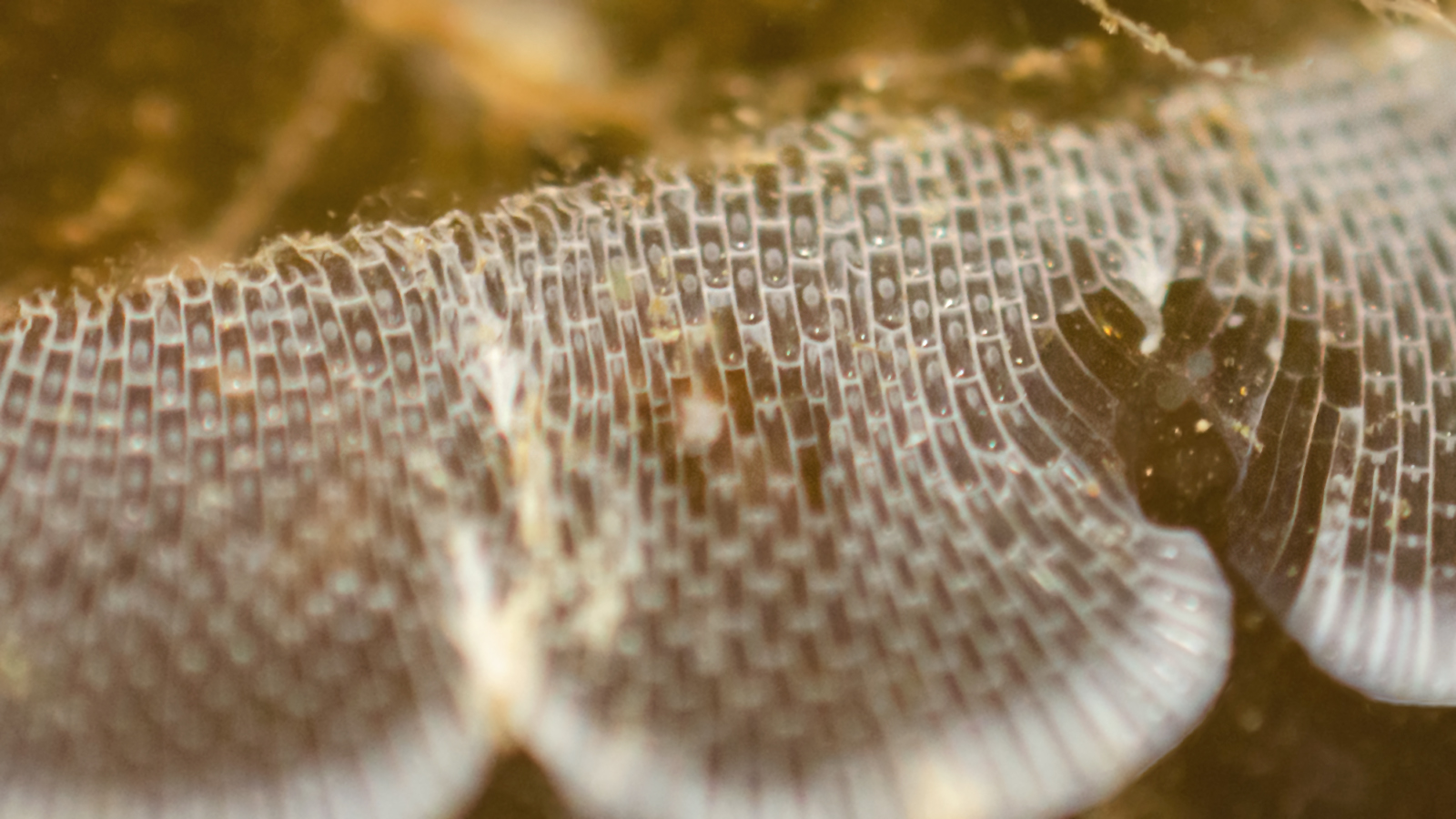
Small bryozoan colony, Membranipora membranacea

These bryozoans are tiny animals, each living in its own rectangular, glassy box. The animal inside extends its tentacles (called a lophophore) through a hole at one end of the box, capturing food from the plankton; bacteria, diatoms, and other small floaters.

Little cubicles. Each one holds one zooid.

Looking at a colony on a curve.

A colony, happily feeding.

Another side view. Look closely (or click for full size) to see the individual animals.

Out of the water, the whole colony shuts itself inside its walls. Put them in water, and in a few seconds, the first ones are out, opening and shutting, capturing dinner.

These were some of the camera shots. Tomorrow, the microscope views, and what I found there.

~~~~~~~~~~~~~~~~

El sábado fui con familia a caminar en el muelle, mirando estrellas de mar y anémonas bajo los flotadores. Vi  una hoja larga de alga marina "kelp", cubierta de manchas blancas. Mi hijo me la capturó y la traje a casa para examinarla.

La hoja estaba poblada por gran cantidad de colonias de un briozoo, Membranipora membranacea. Son animales pequeños que se hacen cajitas blancas, casi transparentes; cada animal vive en una caja. Tiene un agujero a un extremo, y por medio de este, (el lofóforo) el animalito extiende sus tentáculos para capturar su presa, que son bacteria, diatomeas, y otros criaturas del plancton.

Fuera del agua, toda la colonia se encierra en sus cajitas. En el agua, inmediatamente, se levantan y empiezan a mover sus tentáculos, capturando la cena.

Estas fotos son algunas que saqué con la cámara; además, examiné las colonias con el microscopio. Mañana subo algunas de esas fotos, con algunos otros animales que viven alrededor del briozoo.

Tuesday, November 06, 2018

Blobby bryozoans

Early winter storms tear and uproot the summer's crop of seaweeds. The mound along the high tide line, that in summer is mainly eelgrass with a sprinkling of sea lettuce and rockweed, in November becomes a full salad bar, multi-coloured, multi-textured.

In a short walk, I collected a bag of treats for my hermit crabs, with only one sample of each species, I ended up with a full grocery bag. Sea lettuce, of course. Two kinds of rockweed. Turkish washcloth, and a black, leathery, pimpled towel seaweed, four or five kinds of kelp, the invasive sargassum, several tiny blackish curly weeds, Pacific rose algae, red blades, rubbery threads, ... I didn't bother with eelgrass; the aquarium is planted with a fair crop from my last collecting trip.

I collected three pieces of a red algae that was coated with bryozoans. None of the algae were entire; they were stalked, and opened out into red blades, badly torn, rotting along the edges; I couldn't determine their shape or full size. But the bryozoans intrigued me.

At home, in a bowl. The stalks are encrusted with these hard blobs. The pink stub at the right seems to be a growing tip of the algae; there were several of these.

One of the blobs. Each little hole was the home of one zooid. If you look really closely (click for full size) you can see tiny pink pores on the body of each case.

Where the stalks met the blades, the structure changed; here they lie flat, one critter deep. Membranipora sp., maybe?

I don't think any were alive; they'd been lying out on the shore for a while. I looked while they were underwater, but saw no hint of movement.

I've been searching for an ID in my books and on the web, but can't find any that take these two forms on red algae. Blobs on rocks, yes. Single layers encrusting kelp, yes. Both together, no.

Membranipora membranacea is common on bull kelp on our shores; it makes circular, flat colonies on the blades. I could find no photos or record of it making these blobs.

And the crabs, hermit and "true" are happy, busy climbing and feasting.

Powered By Blogger