Showing posts with label styrofoam. Show all posts

Friday, November 06, 2015

Keeping up with modern life

Black clawed crab on a piling:

Half out of the water, about 1 inch across.

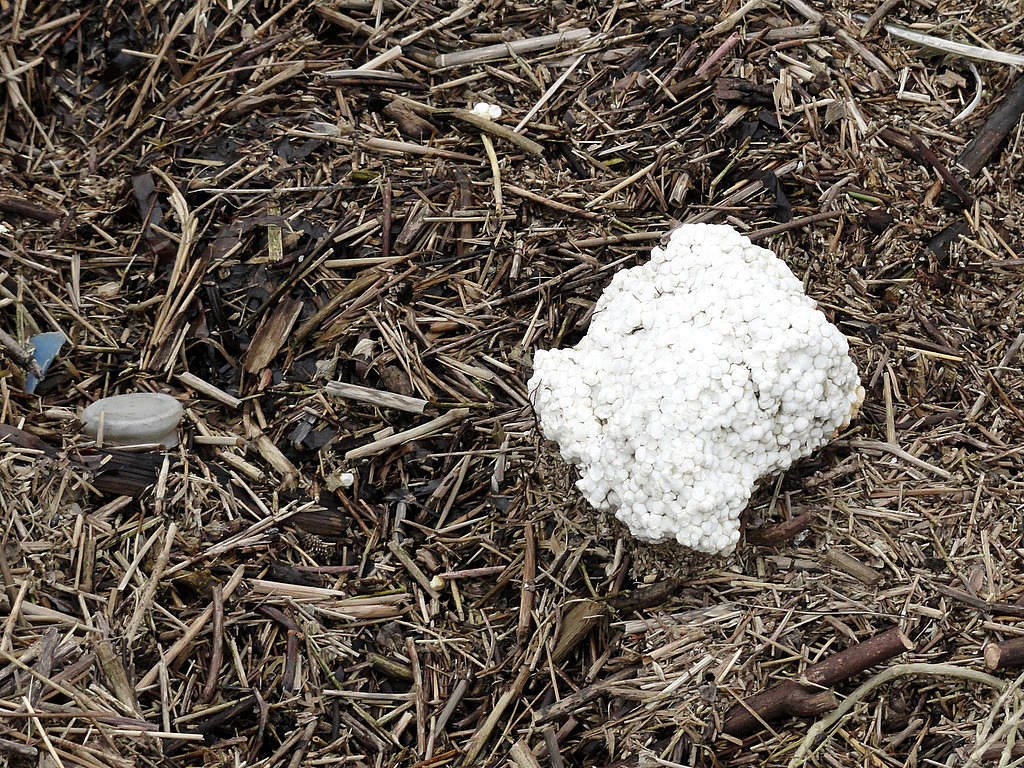
Black clawed crab in hand, pretending to be a clump of dirty styrofoam:

And holding a piece of the styrofoam as a sample.

I had gone back to the dock to see if I could find another of those mystery critters, and get a better look at it, but didn't see any. But these little crabs were foraging at the water line on most of the pilings.

The one I caught rolled himself into this tight little ball. Every time I turned him over, he immediately flipped over and closed down again. In his environment; dirty barnacles on tarry wood, and all encrusted with styrofoam bits; he blends right in. I took several photos of clumps of styrofoam, thinking they were crabs. And I probably saw crabs that I thought were styrofoam, too.

It makes me wonder; what, in unpolluted waters, do these crabs imitate? Or is this a behaviour they have picked up in response to the stresses of life under the docks?

Thursday, November 05, 2015

Piling critters

I noticed the smells first; salt, creosote, tar, old wood, engines, something mildly fishy. I was going down the ramp to the dock where the working boats, the fishing and tug boats, tie up, and the scents took me back to a time when I used to fish off a similar dock, catching supper. An old memory surfaced; old log pilings, tarred, at the end of a dock, and a big (well, maybe; I was little) octopus climbing up and peering out of the square opening.

I didn't expect octopuses here; starfish and anemones, probably. I walked down to the end of three long docks, squinting down every gap between dock and boat, every opening for pilings. There wasn't much to be seen; the boats are tied up, two deep, on each side of the dock. Very little light filters down underneath them. And many of the pilings are metal; fat, rusty pipes standing out of the water. Nothing seems to live on them.

But where I found tarred log pilings and a bit of reflected light, I found shrimp. And 'way down at the end of the last dock, where the sunlight penetrates to those log pilings, I found a starfish climbing out of the water. I got down on my knees, then lay flat, ending up lying for a long time with my head and camera down the hole between the pilings.

Because the pilings were alive with things crawling about.

The starfish, half out of water.

There were a fair number of purple starfish. Earlier, I had seen a few pale orange ones, deep down, one in not very good shape. But these were active, crawling about or hunched over something edible. They all looked healthy.

In the photo above, all that white stuff is styrofoam. Tiny, white balls of styrofoam. I found these all along the dock, along the water line of the boats, stuck to the tarry pilings. (Not the metal ones.) I had to keep brushing floating clumps aside to see the animals below.

There wasn't much in the way of seaweeds around the pilings or on the boats. I saw a few kelp streamers, loose in the current, and a few blades of red algae. There seems to be more underneath the dock, but I couldn't see more than bits of the edge.

Kelp crab, barnacle scars, and styrofoam.

The kelp crabs keep walking around and around the pilings; as one disappears on the far side, the first legs of the next show up. Round and round and round; I never saw any of them stop to eat anything, but they must be finding something worthwhile.

Older kelp crab, growing pale seaweeds on his back. He's deeper down; there's only a hint of styrofoam in the foreground. The little toe tips at the top belong to a pair of shrimp on the far side of the piling.

Much smaller crab, possibly the red rock crab, with barnacle scars and a few remnants of styrofoam.

Another coonstripe shrimp. With floating styrofoam. The yellow mound is some sort of sponge. And what's that down at the corner?

That mottled brown thing with the blue vanes showed up in quite a few photos; in each one, the vanes were in a different position. Unfortunately, I hadn't noticed it while I was taking the photos, paying attention to the shrimp.

Mystery critter.

From the shape of this animal, and the waving vanes, I thought it might be a nudibranch, but I've looked at all those in my encyclopedia, and hundreds that Google found for me. Nothing looks right.

Comparing it with the shrimp, which was about 4 inches long, I would guess that it is probably about an inch long. There are brown, mottled nudibranchs the right size, the barnacle-eating nudibranch, Onchidoris bilamellata, for example, but the vanes would be gills, and they should be feathery, and maybe smaller. But they would explain the number of empty barnacle scars on these pilings.

Help!


Saturday, February 05, 2011

I wish it were all about coconuts.

I promised you coconuts. And I'll deliver. But first ...

Shorelines reflect the dynamics of water currents and the characteristics of the adjoining land. Sandy, like Centennial Beach, protected from "outside" waves, just upstream of tall sandstone cliffs, and always gently watered by small creeks and slow tidal waters. Rocky, like Kwomais Point, sticking out into a less-protected strait, washed by strong currents from two sides. Or deeply muddy, like the inside of Boundary Bay, especially Mud Bay. Two rivers bring silt from the Delta; the outflow joins with the retreating tides, curving southward, hurrying to sea; the waters dredge a deep canal, but leave the inner end in a backwater.

On this shore, high tides and the occasional storm toss up great masses of debris. It stays there, and rots into the mud; a strange variety of objects and materials, stranded among the weeds. This is not what people leave behind. This shore does not attract beach-goers. What shows up here either grew here, or was brought by sea.

We have found the most unexpected items here. A few round stones, foamy like lava, the size and shape of marbles; they float. I don't know where they came from. Rabbit pellets, coconuts, balls and boat floats. For a couple of years, a fiberglass skiff, barnacled and badly in need of paint, but still watertight, lay wedged among logs. It's gone now, maybe crumpled and buried under the last season's logs.

Two-seater, with outboard shelf.

This Wednesday, I took photos of items I found for about a dozen feet along my path, just a few steps above the mud. Here's a sampler:

These - except for the lumber and rocks - grew here. And notice the new growth coming up. Tansy, I think.

A chunk of styrofoam packing material. It's been shedding pellets for a long time.

Styrofoam, from marine uses, protective packaging for our electronics, cheap ice chests, disposable dishes, "peanuts", and so on, turns up too frequently on our shores, especially this one. It is highly dangerous to marine life, birds and critters alike, and won't disappear for centuries.  One of the problems with it is that it disintegrates into bite-size pieces, even for the smallest animals. And once it has crumbled even more, to microscopic dots, it still retains its dangerous properties.
What is clear, however, is that polystyrene is a widespread contaminant in the world's oceans. Samples taken off the coast of Malaysia and in the northern Pacific all contained styrene monomers and other products of styrofoam breakdown, according to Katsuhiko Saido of Nihon University in Chiba, Japan.

Until recently, research into the harmful effects of styrofoam and other plastics in seawater have mainly focused on damage to marine life from ingesting visible chunks or from getting caught in plastic nets. The new research adds to fears that this line of research may be missing significant amounts of plastic that are in particles too small to see. (From Yahoo, via Gary Partain.
Look closely at these next photos. Can you find the styrofoam pellets in them? (They're in all but the last two.)

One sandal. With styrofoam pellets.

Polyethelene wrap, and plastic food bag. And styrofoam pellets.

Shampoo bottle. This has been exposed for a long time.

And here are the coconuts:

Coconut, from some far-away shore. And styrofoam, of course. At least the coconut is edible.

Another coconut, with styrofoam pellets. This is the first one I've found that was cracked open.  Something has eaten most of the innards, recently. (There was no mud inside.)

And a third coconut. No styrofoam, visible, at least. Whatever ate the meat, also nibbled on the inner skin.
A fourth coconut, half eaten. And I think the white specks are coconut meat.

And no, I didn't collect all the plastic. It was just too discouraging; I would have needed a team and a truck to make a dent in it.

In the storeroom at home, I have the cartons that things come in, held while the warranties are still in effect. They're full of styrofoam.  Now I'm wondering; how can I get rid of them, when the time comes?
Powered By Blogger