Showing posts with label plastics. Show all posts

Tuesday, April 11, 2023

Why, why, why?

 Occasionally I just have to rant a bit.

On a quiet hillside, off the highway on a forgotten road leading nowhere, where a squirrel scolded me, objecting, it seemed, to my intrusion, where moss lies deep and salmonberry branches sprout new spring buds, where the breeze carries scents of pine and a hint of rain, I came across human sign; black plastic garbage bags, crushed water bottles, messy t-shirts and underwear, tin cans, torn grocery bags, whacked alder saplings. And an apparently intact camping stove, set up ready for use on a stump, and left behind.

Why?

Why, if you love nature enough to set up camp away from the usual amenities of provincial campsites, the firewood and picnic tables and potable water, and — oh, so welcome — the rustic outhouses, why, if your delight is in the freshness of the forest, why do you then fill it with your rubbish?

Plastic is forever.

That reminds me: why, you careful dog walkers, why do you so considerately collect your dogs' doings in plastic bags, tie a knot in them, and toss them into the bush? Where they will sit, unprocessed by Ma Nature's cleanup crew, for centuries. It's good that you take the dog's leavings off the trail, where people can step in it, but please, just scoop it away, without the plastic. Off the path, it will be taken care of like the bear and deer scat is. Worms and beetles will recycle it, the rain will wash it down into the soil to feed the trees; come back in a week, and there will be no sign of it.

But plastic is forever.

Old tin plate, moss, and Oregon grape leaves.

Someone left behind an enamelware camping plate. Maybe by mistake; this was all by itself in another section of forest. At least this will disintegrate; the metal will return to the soil. The enamel is non-toxic. This is forgivable, if careless.

But not plastic. Plastic kills.

Rant over. Until next time.

~~~~~~~~~~~~~~
A veces siento la necesidad de protestar.

Un camino subía la ladera de un cerro y me dejó en bosque abierto donde una ardilla me regañaba, protegiendo su territorio privado, donde el musgo cubre todo con un cojín verde y de las ramas secas de salmonberry brotan los nuevos botones de la primavera, donde el aire huele a pinos con un toque de lluvia prometida, me di con huellas humanas: bolsas negras de plástico con basura, botellas de agua aplastadas (de plástico, claro), ropa vieja; camisas y calzoncillos sucios, latas, bolsas de plástico de las que llenas de verdura en el mercado, arbolitos cortados como con machete. Y una estufa de acampar que parecía estar en buenas condiciones, dejada en su sitio sobre un tocón, lista para cocinar, y abandonada allí.

¿Porqué?

¿Porqué, si amas tanto la naturaleza como para acampar fuera de los sitios que provee la provincia, sitios con acceso a agua potable, leña para tu fuego, mesas de picnic, — muy apreciados — los retretes rústicos — si tanto amas la pureza de los bosques, porqué, entonces, los llenas de tus basuras?

El plástico dura para siempre.

Y ya que estoy en ese tema, tu que con tanta consideración de los demás, recoges lo que deja tu perro, lo metes en una bolsita de plástico, le cierras con un nudo, y luego lo avientas entre las hierbas, ¿porqué? Si allí permanecerá, sin que los recicladores naturales lo puedan tocar, por siglos. Sí, es una buena cosa que lo quites del camino donde la gente lo puede pisar, pero por favor tíralo sin el plástico. Ya fuera del sendero, la naturaleza se hará cargo, como lo hace con lo que dejan los osos y los venados; los escarabajos y las lombrices lo convertirán en alimento para los árboles, la lluvia lo lavará; regresa en una semana, y no encontrarás nada.

Pero el plástico es para siempre.

Foto: un plato de campamento esmaltado entre el musgo.

Alguién dejó su plato cuando abandonó su picnic. Tal vez por olvido; solamente había este solo plato en ese sitio. Por lo menos, esto va a desaparecer; el metal regresará al suelo; el esmalte no es tóxico. Un descuido perdonable.

Pero el plástico, no. El plástico mata.


Saturday, May 12, 2018

Never saw a shy tulip before

HIdden away behind and beneath the blooming apple trees, back against the fence, I saw a square inch of red. I thought it must have been a piece of plastic bag, blown in during the last windstorm, so, muttering about careless people who toss plastic into the street, I pulled aside branches and squirmed behind trunks to remove it.

A pleasant surprise! Not plastic, after all!

Shy tulip

Thursday, February 22, 2018

A Calculating Eye

I was carrying a plastic bag, collecting plastic trash on the beach.The gulls must have thought it was old bread, or some other unwise addition to their diet; they mobbed me. This one could not be convinced I had nothing for her and followed me, glaring at me and my selfishness.

"Come on, share the goodies!"

After the recent stormy weather, the beach was littered with scraps. I made three trips up to the park to dump my bag of trash in less than half an hour.

Thursday, July 27, 2017

Pet peeve

Every time I walk along a trail near a main road, I come across one or more of these, and go on my way ranting.

Dog poop in a conscientiously selected, carefully tied plastic bag, left beside the trail.

Text of usual rant:

"Look, I see that you're trying to be a responsible pet owner, but think! Use your head for a change!

Your dog's doings will biodegrade, and quickly. One good rain, and they're gone. A hot day, and they'll crumble into dust. But the plastic bag will be there when your remote descendants pop down from Mars to show the kids the old ancestral home. That stuff is forever!

If you don't want to carry the doggy-do out, (and I understand that), carry a pooper-scooper. Or use a handy stick. Be a good neighbour, and remove your dog's contribution from the trail; don't bag it up, but push it away under a handy log, or in the middle of a weed patch. Bury it in the sand, if you will (but not where kids play, but I don't have to tell you that, do I?)

Skip the plastic altogether; why add to all the tons already lying around? Why tempt the birds with what looks so fresh, so delicious? Why?

Need a bag for your dog's leavings? Bring a paper bag. It won't biodegrade as fast as dog poop, but it will be gone by next year, anyhow. Your plastic bag won't.

But whatever you do, don't bag up the stuff and leave it behind to pollute the park!"

End of rant. Until the next neat bag of poop.


Monday, August 17, 2015

There and back again

I walked from White Rock almost to Kwomais Point, looking for purple starfish and Lion's Mane jellies.

Kwomais Point, from the Southeast.

I was aiming for that big squarish rock near the point. It has always been loaded with interesting critters, including a family of purple and pink starfish. Unfortunately, by the time I got there, stumbling over rolling rocks in unfamiliar wading shoes, it was unreachable;

Starfish Rock

I did see two Lion's Manes, both very dead. No starfish.

On the way back, following the easier path at the top of the tidal zone, I collected a big bagful of plastic and styrofoam. If I'd had more bags, I could have filled them, too. What is wrong with people?

Green fishie on dried eelgrass. Probably left behind by mistake.

Sunday, February 01, 2015

Why I left trash on the beach

In an expanse of clean sand, a crushed plastic gallon bottle spoiled the view. I picked it up, planning to remove it to the appropriate trash can, and found that it was being used as a roof by a mud shrimp.

Blue mud shrimp, Upogebia pugettensis, about 3 inches long

These crustaceans usually live in burrows about a metre deep; it is rare to find one on the surface. Apparently, if an adult is removed from his burrow, he can't dig a new one, so this exile may have become fish food as soon as the tide came in. At least the gallon jug kept the gulls from finding her*.

When I exposed her to the sunlight, she started crawling away. She's not very good at it on the surface; she kept unrolling her abdomen to push forward, but there was no purchase on the sand, and her legs didn't seem strong enough to carry her weight out of water. I took a few photos and dug her a new pool to crawl into. When she got there, I replaced her roof above her. Recycling takes several forms.

A couple of years ago, we found a Bay ghost shrimp in this same area:

Bay ghost shrimp, Neotrypaea californiensis

At first glance, these look very much alike, but the Bay ghost shrimp is pinker, more translucent, has no rostrum (the "hat" over the head area), and the pincers are more unequal in size.

The Blue has a hairy rostrum with a sharp point, rather difficult to see because of the hairiness. The legs and claws are hairy; you can see signs in the photo at the front bend of the large pincer. The colour varies from muddy brown to bluish. This one, in the slanting light of a late afternoon sun looked more orange; the blue shows up faintly in the legs.

(Compare; Google images of Urogebia pugettensis.)

*"Her": randomly-selected sex, because I don't like calling conscious beings "it". In these Blues, as opposed to the Bay ghost shrimp, males and females look alike at first glance.

Thursday, December 18, 2014

A rescue and a rant

The tides are at their peak for the year in Boundary Bay, reaching to over 14 feet at high tide, in the middle of the day, and dropping to as low as 1.5 feet around midnight. Compare that, for example, to last July, when the high tide was around 12 feet, and the low just over 7. (And in the daytime, for our wading and exploring pleasure!)

The king tides occur when the Earth, Moon and Sun are aligned at perigee and perihelion, resulting in the largest tidal range seen over the course of a year. So tides are enhanced when the Earth is closest to the sun around January 2nd of each year. They are reduced when it is furthest from the sun, around July 2nd. (Wikipedia)

That's still not an extreme rise and drop, as tides go, but the water has to race in over a mile of flat beach, so the current is strong. Even on a calm day, the waves pound hard on the shore at the high tide line, bringing a load of vegetation, critters, driftwood, and unfortunately, junk with it, and then scouring the sand clean again, as the water roars back out.

A few days ago, at the boat ramp, a tangle of eelgrass was tumbling back and forth, just within the reach of the highest waves. And rolling with it was an unlucky hermit crab, caught without his shell, and unable to get his footing before each new wave caught him and tossed him back onto the cement. I waded in and caught him, and deposited him gently on the wet eelgrass in my bag. I couldn't find a shell for him, but he'd be safe there.

He was hiding under the eelgrass in the bag when we got home, and very jittery; I let him rest in a bowl under a piece of Turkish towel until I found him a selection of shells. A couple of hours later I transferred him, in his chosen shell, to the tank. And he immediately attacked the nearest hermit, a big, no-nonsense male twice his size, and wouldn't let go. I separated them, and he jumped on the next in line, and bullied her out of her shell, which he appropriated.

Not the mild, agreeable hermit behaviour I was used to seeing!

Put it down to panic. By the next morning, he was fitting in fine, sharing food, taking his turn, allowing others to ride on his back. He'd found his spot in the pecking order and all is well.

Other animals weren't quite so lucky. We found this dying nudibranch, still plump and glossy, dumped at the high tide line.

A mid-sized Melibe leonina, with her hood spread out, the teeth still firm at the rim. She's been eating something red or pink.

On the last two trips, I passed dead gulls. No, I didn't take photos; they were a disgusting mess. Maybe I should have. Because I was also collecting bags full of plastic, the stuff that kills seabirds.

There were the usual bottle caps, bits of broken toys, abandoned water bottles - "Pure Spring Water"! - one flip-flop (did the owner hop home?), and candy wrappers. Birds' guts end up full of that stuff; it looks bright and appetizing, and is swallowed too fast for them to realize it's inedible.

But what was worst was the plastic film, the transparent food wrap that, drifting in slow water, looks exactly like a lazy jellyfish. Appetizing, if you're a duck, or a gull. And deadly; it either chokes the bird outright, or clogs up his digestive system so that he can starve to death in the middle of a feast.

I got a full bag of that wrap, along with a few disposable gloves; their fingers fill with water and they wash to and fro, looking juicy. Sort of like that nudibranch above; about the same colour, too.

Why do people leave that sort of stuff on a beach?

A woman saw me dumping my load in a handy garbage container, (put there for that purpose, people!) and thanked me. Good; but wouldn't it be better if everyone put their junk in the barrels in the first place?


Tuesday, November 29, 2011

Tidewrack

A fall storm hit much of our coast over last Friday and Saturday; some ferries were cancelled, power lines down. Nothing major. The wind died down by Sunday morning, but not until it had driven most of our cloud cover away. We went down to White Rock to see what the storm had brought in.

Mostly logs.

The waves were still high, making a continual roaring sound, punctuated by rolling pebbles as each wave retreated. Diving ducks bob up and down in the distance.

Logs piled on the beach, more coming in with each wave.

Log-rolling competitors, waiting for the starting gun?

Big log coming straight in, advancing a few inches with each wave. (It's perfectly straight; if it looks bent to you, it's an optical illusion.)

Wood chewed up by repeated slamming against a stony beach.

Drying out, bashed and stained, draped with black eelgrass.

After the logs, and surpassing them for number and variety, were the plastics. With every step I took, I had to pick up another piece or two. In one small stretch, I collected a full grocery bag of bits and pieces, from broken toys to bags to bottles and containers. Plastic objects (a metre-long drainage pipe, for example) too large to carry along with my bags, I carted up to the blackberry bushes above the tide line; at least they won't slide back down to the beach to be broken up and become gull food. I wished I had more time. I wished I had an army of volunteers with me, all provided with big bags.

I was surprised to see no styrofoam. I wonder why.


Thursday, October 06, 2011

Soft-tissue fossil find

I knew it! I knew! I always knew there were fossils to be found on the White Rock beach!

And I found this proof:

A baby T. rex!

Ok, I'll be sensible now. That was part of my haul of plastic pieces that I collected before the gulls got them.

Monday, July 25, 2011

What the tide washed in

The tide comes in slower in White Rock than in Boundary Bay; without the need to run almost a mile straight inland, I can wade along the edge to see what's floating in the waves.

There are always piles of tangled seaweeds.

And a few individual ones, usually rockweed.

Sometimes the seaweed incorporates driftwood into the pile. This lot included many tiny spiral tubeworms, and a handful of stubby isopods.

Some of the seaweeds are faded, unidentifiable ghosts.

Not all; this hairy weed keeps its vibrant colour even as it rots.

Land-based leaves return home, eroded by the salt water.

So does an unfortunate ladybug.

The molted remains of a purple shore crab.

The waves bring back sand that they took away earlier.

Homo sapiens, var. intertidalus, returning to land with the tide. The gulls will stay put until the water brings them supper.

All is well. But there are other "goodies" coming in on the waves:

Plastic rope.

A large plastic bag.

"Pure Life", it reads. "Eau de source naturelle". (Water from a natural source.)  Good stuff, great for the environment. (/sarcasm)

More "Pure Life".

And tinfoil. Garlic-flavoured something or other.

Why I pick up all the plastics and tinfoil I find:

Recently dead gull. We looked it over; there was no sign of injury or disease. Every feather was clean and in order. The bent-back head, without other evidence of illness, suggests possible asphyxiation. Caused by trying to eat a plastic bag, maybe?

I would love to put up large signs along the parking lane, reading, "PLASTIC BAGS KILL GULLS". But would they do any good?

Saturday, February 05, 2011

I wish it were all about coconuts.

I promised you coconuts. And I'll deliver. But first ...

Shorelines reflect the dynamics of water currents and the characteristics of the adjoining land. Sandy, like Centennial Beach, protected from "outside" waves, just upstream of tall sandstone cliffs, and always gently watered by small creeks and slow tidal waters. Rocky, like Kwomais Point, sticking out into a less-protected strait, washed by strong currents from two sides. Or deeply muddy, like the inside of Boundary Bay, especially Mud Bay. Two rivers bring silt from the Delta; the outflow joins with the retreating tides, curving southward, hurrying to sea; the waters dredge a deep canal, but leave the inner end in a backwater.

On this shore, high tides and the occasional storm toss up great masses of debris. It stays there, and rots into the mud; a strange variety of objects and materials, stranded among the weeds. This is not what people leave behind. This shore does not attract beach-goers. What shows up here either grew here, or was brought by sea.
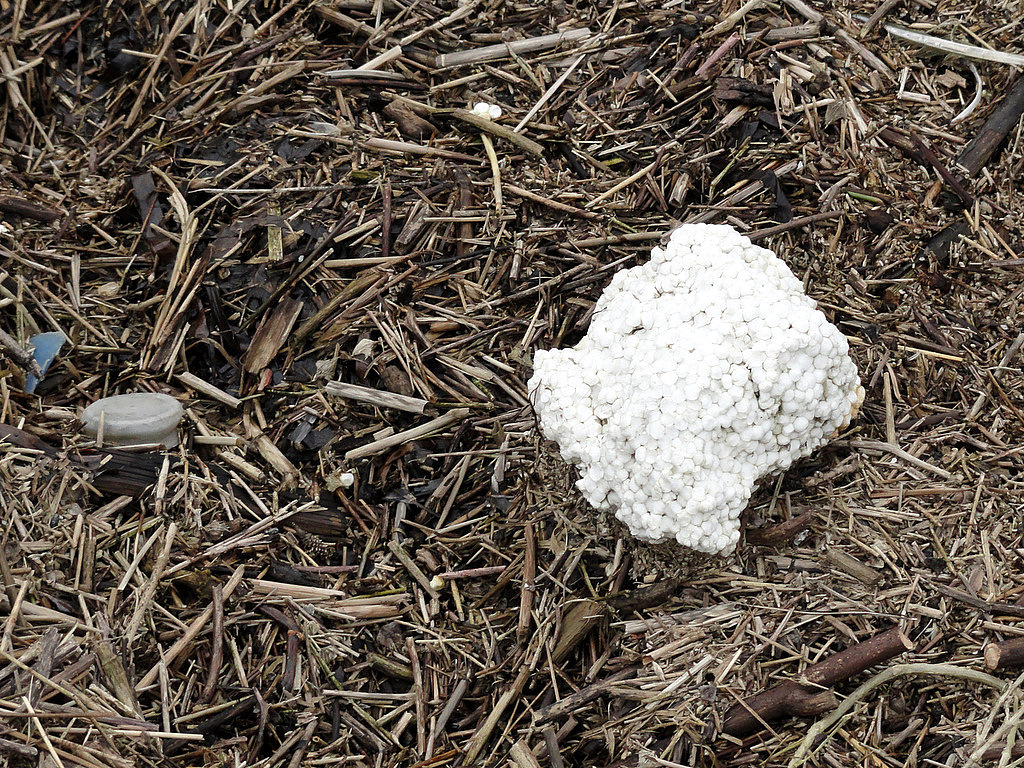
We have found the most unexpected items here. A few round stones, foamy like lava, the size and shape of marbles; they float. I don't know where they came from. Rabbit pellets, coconuts, balls and boat floats. For a couple of years, a fiberglass skiff, barnacled and badly in need of paint, but still watertight, lay wedged among logs. It's gone now, maybe crumpled and buried under the last season's logs.

Two-seater, with outboard shelf.

This Wednesday, I took photos of items I found for about a dozen feet along my path, just a few steps above the mud. Here's a sampler:

These - except for the lumber and rocks - grew here. And notice the new growth coming up. Tansy, I think.

A chunk of styrofoam packing material. It's been shedding pellets for a long time.

Styrofoam, from marine uses, protective packaging for our electronics, cheap ice chests, disposable dishes, "peanuts", and so on, turns up too frequently on our shores, especially this one. It is highly dangerous to marine life, birds and critters alike, and won't disappear for centuries.  One of the problems with it is that it disintegrates into bite-size pieces, even for the smallest animals. And once it has crumbled even more, to microscopic dots, it still retains its dangerous properties.
What is clear, however, is that polystyrene is a widespread contaminant in the world's oceans. Samples taken off the coast of Malaysia and in the northern Pacific all contained styrene monomers and other products of styrofoam breakdown, according to Katsuhiko Saido of Nihon University in Chiba, Japan.

Until recently, research into the harmful effects of styrofoam and other plastics in seawater have mainly focused on damage to marine life from ingesting visible chunks or from getting caught in plastic nets. The new research adds to fears that this line of research may be missing significant amounts of plastic that are in particles too small to see. (From Yahoo, via Gary Partain.
Look closely at these next photos. Can you find the styrofoam pellets in them? (They're in all but the last two.)

One sandal. With styrofoam pellets.

Polyethelene wrap, and plastic food bag. And styrofoam pellets.

Shampoo bottle. This has been exposed for a long time.

And here are the coconuts:

Coconut, from some far-away shore. And styrofoam, of course. At least the coconut is edible.

Another coconut, with styrofoam pellets. This is the first one I've found that was cracked open.  Something has eaten most of the innards, recently. (There was no mud inside.)

And a third coconut. No styrofoam, visible, at least. Whatever ate the meat, also nibbled on the inner skin.
A fourth coconut, half eaten. And I think the white specks are coconut meat.

And no, I didn't collect all the plastic. It was just too discouraging; I would have needed a team and a truck to make a dent in it.

In the storeroom at home, I have the cartons that things come in, held while the warranties are still in effect. They're full of styrofoam.  Now I'm wondering; how can I get rid of them, when the time comes?

Wednesday, December 15, 2010

The price of convenience

Warning; this post may give you bad dreams. Read it anyway; it's important.

Every so often, we come across an unpleasant sight on our beaches. A dead seabird, usually a gull. We always take photos, but at home, I delete them; they are too sad to share. I changed my mind; here is a gull we found a couple of days ago.

Found just above the high tide line. No visible injury.

Recently dead; the eye is still bright, the surrounding flesh, pink.

I have seen a few live gulls with broken wings or injured feet, but the ones we find dead have uniformly seemed uninjured. What killed them?

The most likely culprits are the plastic bags and/or other plastic debris left on the beaches by human beach visitors. As I walk on the beach, we collect any bags we see, and take them to the nearest - accusingly near! - trash can. This last time, I filled a grocery bag (also found on the sand) with other bags, plastic cups, and even a broken toothbrush.

Gulls are particularly vulnerable to this abandoned trash. When I was a kid, I watched a gull on our beach down a huge pile of fish guts. The mass was all connected, and the gull had to struggle and strain to get it all down. I was astounded when he succeeded. Even an entire grocery bag is more maneuverable and smaller than that; the sheer difficulty of swallowing it would not be a deterrent. Lying in water, half-buried in sand, the bags look surprisingly like bits of fish skin, or jellyfish. They even smell like food, as often as not.

All this is well known; entering "Gulls plastic bag die" into Google brought up over 73,000 sites. One of the first was this; "Gulls can't read ...", incorporating this video.


(One of the comments on YouTube asks why the photographer didn't stop this. The answer is in the post: "He was in an elevated postion and was unable to go the herring gull's resuce - but the reality of what was unfolding before his eyes meant he kept his camera on.")


Researchers estimate that around 95% of all sea birds have eaten plastic litter. (Here, here, and here.) Worse still, is the multiplying lethality of these bags; after a killed gull rots away, the plastic, still intact, is released into the sea to lay in wait for another luckless bird or other animal (a turtle, a whale, etc.) And again, and again. The bag will last for centuries. (Even a so-called "bio-degradable" bag will remain intact for a long, long time. And once it has broken down, the plastic is still there, just in tiny pieces. It can still kill; it just won't choke a gull.)


Thanks for watching and "listening". You know what to do.

Wednesday, July 04, 2007

Weekly Five

Scienc-ey links:

Here's a tasty one: Chocolate lowers blood pressure. Great excuse!

Circus of the Spineless # 22. A wealth of bug-and-beastie links. At Burning Silo.

And after the link I posted recently about every bit of plastic ever made still hanging around, this is a tentative promise of good news. Unmaking plastics. Giant microwave turns plastic back to oil.

And turning old tires into oil and pure usable carbon in a microwave. A short video.

A time-waster. Just drag the dots and see what happens. It's a wonder I was able to finish this post!
Powered By Blogger