Showing posts with label pollution. Show all posts

Wednesday, June 12, 2019

Daisy whites

Sometimes it takes a little thing to point out how much we are polluting our environment. I stopped to take photos of daisies beside the highway north. They were covered in dust and pockmarked. Even the bees were dusty.

Then, high on the cliffs above Brown's Bay, 4 kilometres from the highway as the crow flies, I stopped at another daisy patch. Not a speck of dust in sight, even though the road (not frequently travelled, but still) was gravel and bare dirt.

Daisies and unidentified fly. As shot; no cleanup needed. No dust.

Daisy with syrphid fly.

Cropped from previous photo. I think that fly is transparent: I can see the individual florets of the daisy in the "yellow" stripes on the fly's abdomen. Again, no touch-ups needed.

One daisy, many buds. And another syrphid fly.


Sunday, December 20, 2015

Counting backyard birds

More from the "when I get a round tuit" files; these are from 'way back in 2009.

Cedar waxwings in budding magnolia tree, Strathcona, Nov. 2013

I posted the original of this photo, back then, but I was not happy with it. I had taken it with a point-and-shoot, from a distance, against the light, on a dull, grey day, and tried to fix it with free photo-processing software. I gave it another try tonight, with better software and a clearer screen.

That day in 2009, the centre of Strathcona (almost downtown Vancouver) was alive with flocks of crows, sparrows, and cedar waxwings; crows on the rooftops, sparrows in the hedges, and all the treetops sporting their flashes of yellow waxwing breasts.


Tree over MacLean Park. With waxwings.

I checked back: I've seen a flock of waxwings at the Centennial Park duck pond, in 2011, and solitary birds several times at the Reifel Island bird sanctuary, the last one in August of 2012. Since then, not one.

It's a pattern. We used to have families of chickadees at my door, emptying the feeders almost daily, chattering at me as I tried to do a bit of weeding. This last year, there were never more than half a dozen at Laurie's feeder, none at mine.

A busy, mixed flock of juncos, towhees, chickadees, and assorted sparrows ate in my free restaurant every day for years. Last year, I was happy to see one or two juncos.

I saw one varied thrush this summer. No flickers. No goldfinches. No house finches. One Steller's jay. One wren, three whole times. No golden-crowned sparrows. No bushtits. No nuthatches at my feeder; one did turn up at Laurie's feeder a few times.

I've been wondering what caused this disappearance. Pollution? Plastics? More and more buildings going up; noise and smoke and smells? Pesticides; fewer insects (yes, I've noticed that, too) mean less food for hungry young birds. Climate shift? All those co-ordinated schedules of insect and bird lifestyles being offset?

I don't know. But I definitely can see the results.

Is it just Vancouver area? The Fraser Valley? The Lower Mainland? Maybe. There are more birds on the water and the beaches here in Campbell River than there have been in Boundary Bay for some years. And I'm hearing sparrows twittering in hedges as I pass.

Two days ago, I hung out a suet cage for the chickadees. I had only seen one chickadee here, standing on a tree on the front lawn. Maybe he'd notice the feeder next visit.

And yesterday, I looked out, and there was a whole flock of bushtits working on that suet! Yay!

Tomorrow, I'll put out sunflower seeds, too.

Thursday, December 18, 2014

A rescue and a rant

The tides are at their peak for the year in Boundary Bay, reaching to over 14 feet at high tide, in the middle of the day, and dropping to as low as 1.5 feet around midnight. Compare that, for example, to last July, when the high tide was around 12 feet, and the low just over 7. (And in the daytime, for our wading and exploring pleasure!)

The king tides occur when the Earth, Moon and Sun are aligned at perigee and perihelion, resulting in the largest tidal range seen over the course of a year. So tides are enhanced when the Earth is closest to the sun around January 2nd of each year. They are reduced when it is furthest from the sun, around July 2nd. (Wikipedia)

That's still not an extreme rise and drop, as tides go, but the water has to race in over a mile of flat beach, so the current is strong. Even on a calm day, the waves pound hard on the shore at the high tide line, bringing a load of vegetation, critters, driftwood, and unfortunately, junk with it, and then scouring the sand clean again, as the water roars back out.

A few days ago, at the boat ramp, a tangle of eelgrass was tumbling back and forth, just within the reach of the highest waves. And rolling with it was an unlucky hermit crab, caught without his shell, and unable to get his footing before each new wave caught him and tossed him back onto the cement. I waded in and caught him, and deposited him gently on the wet eelgrass in my bag. I couldn't find a shell for him, but he'd be safe there.

He was hiding under the eelgrass in the bag when we got home, and very jittery; I let him rest in a bowl under a piece of Turkish towel until I found him a selection of shells. A couple of hours later I transferred him, in his chosen shell, to the tank. And he immediately attacked the nearest hermit, a big, no-nonsense male twice his size, and wouldn't let go. I separated them, and he jumped on the next in line, and bullied her out of her shell, which he appropriated.

Not the mild, agreeable hermit behaviour I was used to seeing!

Put it down to panic. By the next morning, he was fitting in fine, sharing food, taking his turn, allowing others to ride on his back. He'd found his spot in the pecking order and all is well.

Other animals weren't quite so lucky. We found this dying nudibranch, still plump and glossy, dumped at the high tide line.

A mid-sized Melibe leonina, with her hood spread out, the teeth still firm at the rim. She's been eating something red or pink.

On the last two trips, I passed dead gulls. No, I didn't take photos; they were a disgusting mess. Maybe I should have. Because I was also collecting bags full of plastic, the stuff that kills seabirds.

There were the usual bottle caps, bits of broken toys, abandoned water bottles - "Pure Spring Water"! - one flip-flop (did the owner hop home?), and candy wrappers. Birds' guts end up full of that stuff; it looks bright and appetizing, and is swallowed too fast for them to realize it's inedible.

But what was worst was the plastic film, the transparent food wrap that, drifting in slow water, looks exactly like a lazy jellyfish. Appetizing, if you're a duck, or a gull. And deadly; it either chokes the bird outright, or clogs up his digestive system so that he can starve to death in the middle of a feast.

I got a full bag of that wrap, along with a few disposable gloves; their fingers fill with water and they wash to and fro, looking juicy. Sort of like that nudibranch above; about the same colour, too.

Why do people leave that sort of stuff on a beach?

A woman saw me dumping my load in a handy garbage container, (put there for that purpose, people!) and thanked me. Good; but wouldn't it be better if everyone put their junk in the barrels in the first place?


Saturday, November 29, 2014

Serendipitous goop

Ok. I've been told to stop dawdling and get on with it.

Remember the white stuff that showed up in my aquarium leavings? Maybe not. Here's what I wrote then, September 30th:

Last week I emptied the tank, washed the sand, and replaced everything. As usual, I kept out the dirty water I'd washed the sand with, and let it sit overnight, just in case any tiny snails were hidden in the gunk. Normally, the dirt settles, and the snails climb to the top, where I catch them and return them to the tank, then dump the goopy mess. 
But this time, there was a white network of fibers just on top of the settled gunk, below the inch or two of clear water. I stirred the water again, and let it sit. Two hours later, there was the net again. Three times I stirred it; every time, white lines made a road map along the top two hours later.

And here are a couple of photos:

The white stuff is all tiny, almost straight fibers, growing at both ends.

Growing and spreading across the bowl. This is a patch about 3 inches across, IIRC.

I asked for help. People made suggestions in the comments: marine slime molds, mineral precipitation, salts. Nothing worked out.

Then, reading the article about sea star wasting syndrome by Ron Shimek, I found photos, a description and a reason that matched what I had found. They're bacteria; Beggiatoa sp.

The Reef2Rainforest photo:


Bacterial mat, in the wild.

"The black surface and white bacterial mat is exactly what would be predicted after a major mortality event in the sediment. The black sediment is made in anaerobic environments by sulfide loving bacteria. It is the result of significant decomposition in the sediments proper- where animals died and are now decomposing and releasing a lot of nutrients from their rotting bodies. ..." (From the photo text.)
The white is a characteristic bacterial genus named Beggiatoa. It has several species that metabolize hydrogen sulfide and decomposing critters. (From the caption of another photo.)

The mat in my bowl was on the gunk that I'd collected from washing the sand and the filter in my aquarium. It would have decomposing critter food, mostly shrimp pellets, and rotting eelgrass and sea lettuce. I could smell the shrimp, faintly. I had poured off the clean water as the muck settled, so there was only an inch or two of water over the black stuff; a concentrated mess of rotting animals and plants. It would be more acidic than the clean water I replaced in the tank; Beggiatoa likes acidity.

Beggiatoa lives in freshwater and marine environments. It is present in all the world's oceans, from shallow intertidal waters to the bottom of the deeps. It would be found in the stuff I bring back from the beach, but not in a concentration sufficient to form this sort of mat until I isolated it. I have tried to see if I could recreate the conditions and grow another batch, but not so far.

And they're fascinating bacteria! They are one of the largest prokaryotes (bacteria and similar organisms); up to 200 microns in diameter. That's 2 millimetres, the length of a small carpet beetle. And each filament may grow up to 1 centimetre. No wonder I could see them with the naked eye!

The metabolism of prokaryotes is far more varied than that of eukaryotes (That's everybody else, including us. -Me), leading to many highly distinct prokaryotic types. For example, in addition to using photosynthesis or organic compounds for energy, as eukaryotes do, prokaryotes may obtain energy from inorganic compounds such as hydrogen sulfide. This enables prokaryotes to thrive in harsh environments as cold as the snow surface of Antarctica, studied in cryobiology or as hot as undersea hydrothermal vents and land-based hot springs. (From Wikipedia)

Most Beggiatoa don't need organic food, nor sunlight, to grow.

They are one of the few members of the chemosynthesizers, meaning that they can synthesize carbohydrates from carbon dioxide and water using energy from inorganic compounds. Beggiatoa are found in polluted marine environments, and can be seen by the naked eye as a white filamentous mat on top of the water as a sign of environmental deterioration. (From MicrobeWiki.)

Not all Beggiatoa are white; some are yellow or orange; the white comes from granules of sulfur stored in the filaments.

As I saw, the filaments move about, both spreading, gliding along, and moving vertically. (How they do this, I couldn't discover.) "They respond to oxygen, light, and presumably sulfides."

They prefer the interface between a solid sulfide-containing base and oxygenated water, and use elements from both. In some situations, the surface sediment is oxygenated during the day, due to the the activity of algae in the sunlight. Then when the sun goes down, the oxygen is depleted and the sediment becomes anoxic. Beggiatoa pick up sulfides in the anoxic zone at night, then combine their sulfur with oxygen from the water in the daylight. A short video on YouTube shows this process.

They grow where there is an abundance of rotting organic matter, where the decomposition processes have resulted in an acidic, anoxic, sulfide-rich environment. This means that they may be a marker for pollution, such as sewer outfalls, or die-offs. But they do not contribute to the pollution; rather they help to return the area to a condition usable by more "normal" life forms.

So, while they showed up where the sea stars are dying, they are not the cause. Scientists are still looking. (Maybe it's a virus.)

More info.
The Genera Beggiatoa and Thioploca
And the original article, again.

Tuesday, September 24, 2013

Good news!

Two years ago, in November of 2011, polluted water from the White Rock beach killed my aquarium. A month later, we found a zone of the beach that was basically dead, too.
There were no crabs under any of the rocks I flipped. No hermit crabs. No snails. No limpets. No worms. A few of the higher intertidal amphipods that always swarm on the bottom of these rocks. Just a few.
I walked west, flipping a few more rocks after every couple of steps. Nothing was alive but the amphipods.
We've been back, off and on. The view is always beautiful, but so often, I flip stones and find nothing. With time, even the barnacles were all dead. The rocky west end stunk of a cannery in summer; a long-dead fishy odour. I was beginning to dread walking that direction.

Last week, we headed that way again. It had been a while. And the beach is back! It smells fresh and salty, as it should. I flipped rocks and disturbed whole communities of hermit crabs, hairies, grainy hands, and those little orange ones I can't identify. Shore crabs scuttled away to hide, or stood their ground, menacing me with their mighty half-inch pincers, according to their various personalities. Big eelgrass isopods slept on the bottoms of stones; polychaete worms burrowed into the sand away from the light. The stones were dotted with pinhead snails, probably periwinkles.

I collected a bit of eelgrass for my critters in the tank. Washing them off at home, I found tiny limpets. One blade held at least 10, plus a raft of spiral tubeworms.

And the barnacles and mussels are growing back.

Detail of a stone top.

And flatworms! I'd never seen so many at one time before. Every stone held a few; on some stones, every barnacle seemed to have a flatworm oozing around it.

I count 7 flatworms on this corner of a rock. I don't know if they're the same species or not. Since their bodies are semi-transparent, whatever they've been eating changes their colour and pattern.

Not all the ooze on that stone is flatworm. The more shapeless and patternless blobs seem to be some sort of sponge.

And I've never seen these anemones anywhere but near the American border on the Tsawwassen beach. I didn't see them when I took the photos, but at home, counting flatworms, I noticed quite a few. And two came home on three barnacly stones I brought to feed my one predatory snail.


Orange-striped anemones. Five here, plus one flatworm that I can see. This corner of the photo was blurry, and I've sharpened the anemones to make them stand out.

We walked quite a distance west from the end of the park. I flipped stones at intervals all the way. Every stone harboured a thriving community.

I am so relieved! Life on the edge is tougher than it looks.


Sunday, February 19, 2012

Between the grains of sand

With a good microscope handy, I've been able to look more closely at what's happening on the White Rock beach. Last Tuesday, I brought home a few small containers of sand and water from the contaminated area. I've been examining them to see what's alive, down there between the sand grains.

Wet sand, as my camera sees it. The little orange specks are alive.

I've been taking notes, mostly sketches of what I see, and I've scanned a few pages. I can't identify any of these things, but they give an idea of what's there. Everything I drew was alive and moving. A couple of times, a humongous (or so it seemed) copepod scooted by, at least 10 times the size of the biggest of these critters. The copepod would be about 1 to 2 mm. long.

The images may be pale; I find them easier to see by clicking to get a full-size photo.

Page 1. "Hamburger critters" like a split bun with something in between, boxes and pen-like things.

The ones labelled "1" and several similar ones don't quite match each other, but may be different stages of the same animals. # 5 is like them, but was the largest I saw. In the center, I could see something fluttering. They all swim slowly, along the length-wise axis. The "pens", # 4 and three similar ones, moved only their tips as long as I watched.

Assorted swimmers and jittery stuff.

#6 looks like a piece of threaded pipe. All the ones I saw were the same size. #8 is sort of like an amphipod, but extremely jumpy and hard to see, even though it was large. The antennae/legs/hair moved constantly.

#9 is one of the strangest animals. These are very tiny, like a balloon on a black thread. The top constantly bobs back and forth, always in the same direction.

And #10 is like a hairy flatworm, always changing shape; it has no features that I could distinguish.

Worm?

This was another of the larger animals. It lay against one of the sand grains, moving along sluggishly. Occasionally, something would startle it, and it contracted instantly into a collapsed balloon shape. A minute later, it stretched out again. I'm not sure if I saw tentacles at the forward end, or if they were a trick of the light.

Movers and shakers.

These were the weirdest of all. #13: a blob with a smaller blobby end. It turned around and around, circling about the narrow "head" end, as if it were attached. To what? It was in an empty space between widely-spaced grains.

#14 is tiny. I only saw the one. A rough pyramid, with a tentacle that I could see inside the body as well as out. It traveled with the tentacle in the lead.

#15. A tubeworm? Long and snaky, it hid behind a sand grain, extending the tip. Closed, it looked like a worm head, but it kept opening wide, showing a circular mouth. From time to time, it suddenly extended itself its full length again, as if to capture something.

#16. I can't figure this one out. A dark oval shape that spins and spins, always in the same direction, very rapidly. I could barely see the connection, but a tiny blob spun with it, sometimes close, sometimes a distance away, but always coming back as if tethered.

#17 looks like a baby sand dollar. #18, like a jellyfish. Many different animals start life as a medusa, a jellyfish shape; this could be any of them.

Besides all these and the copepods, I saw a few larger worms slithering about.

All this is good news: there's life down there. Two of the containers held sand and water from about 100 feet down the beach from the center of the dead zone; they were full of those "hamburger" critters, and others. But the two bottles from the center were basically empty; nothing but sand grains and a tiny worm.

Elva Paulson asked how big the dead zone is. I checked again, on Google maps. From where we access the beach, moving west, we went, the first time, 300 feet before I found anything alive. The next time I measured, the zone had extended and the borderline was 1700 feet down the beach; about 1/2 kilometer.

Tuesday, we began to find beach hoppers and tiny snails somewhere between those two distances. And the first bottles of sand I collected were well within the former dead zone, about 100 feet from the access.

Looking at the satellite photo, I notice that a creek comes down from the top of the hill, just there. I wonder if there's another construction project up top.

Friday, February 17, 2012

Hope on the rocks

Last November, I poured fresh seawater from the White Rock beach into my aquarium, and the aquarium died. (A sad post) A month later, we returned to the beach. I searched for live animals, and found that a large section of the beach was dead. (Empty beach)

Since then, I've been flipping stones every time we visit, with discouraging results. The dead zone increased, and I correlated the boundaries with the areas where several large homes are being built up on the cliffs above. It may be that run-off from their work is causing the damage: it may just be a coincidence.

When the tide drops, we walk over the stones covered with barnacles. Dead barnacles, these days; empty shells, for the most part. There is no greenery, except for bits of rockweed. Under the most likely stones, I have been finding the occasional group of immature shore crabs, sometimes a polychaete. Recently, I've seen the amphipods skidding sideways over the underside of the rocks; a welcome sight.

But no snails. No adult crabs. No live barnacles. No gulls dropping clams onto the stones. No flocks of birds feeding just off-shore.

This week, things are looking up. We caught the tide going out, and walked west from the park.

Looking west, towards Kwomais Point

I turned stones half-heartedly at first, finding the expected bare sand underneath. Sad. In the areas where we crunched over large dead barnacles, an odor of old cannery - stale, dead fish - overpowered the sharp aroma of saltwater. But as we went along,  we started to find hints of recovery.

A gull has found a juicy crab.

Burrowing anemone. Small, and just the one, but it's a start.

Purple starfish. We found four, looking healthy.

On the larger rocks, well to the west and in the mid-intertidal zone, the barnacles and mussels are doing fine. And we even found a few whelks; these and two others. 

And among the barnacles on some of the larger rocks, the bright green sea lettuce is starting to grow again.


I didn't see any shore crabs under stones this time, but a few of the tiny black snails that usually pepper all the stony areas showed up. One live clam lay on the sand, with his foot out, getting ready to bury himself. I helped him along, before a gull found him. And every stone sheltered amphipods.

From the center of the dead zone, I brought back a few pill bottles of sand and water. Last night, I examined two under the microscope. I found two copepods, an amphipod-like critter, something that looked like a busy hairy bacterium, a medusa, a long (at least under the 'scope) worm, and dozens of tiny swimming boxes and ovals and wormy things. It's not what it used to be, but it's young life.

I think the beach is going to make it.

Thursday, December 22, 2011

Empty beach

Yesterday morning dawned clear and cold; there was ice on the birdbath again, but by noon the sun had banished it and the breeze was warm. A perfect day to go to the beach.

We hadn't been to White Rock since the day after the storm, back in November, the day I had collected the water that I believed had poisoned my aquarium. It was time to put unhappy memories behind us. We went to our usual spot on the White Rock beach.

A calm, sunny day. Setting sun warms the brown goldenrod heads.

We watched the train go by, I fed another bag of dry bread to shrieking gulls, we watched a kayaker or two. Then I went to the spot where I'd collected the last bottle of water, and started flipping rocks just below the high tide line. I wanted to either discard or confirm my conclusion about the water. Had the animals here suffered the same fate as mine at home?

There were no crabs under any of the rocks I flipped. No hermit crabs. No snails. No limpets. No worms. A few of the higher intertidal amphipods that always swarm on the bottom of these rocks. Just a few.

I walked west, flipping a few more rocks after every couple of steps. Nothing was alive but the amphipods.

I had covered about 150 metres when I found one tiny limpet and an anemone. A bit farther on, there were two limpets, one mussel, and a very small snail, small enough to have washed in after the tides had cleaned the area.

After this, the population of amphipods was denser. Then I found three more limpets, and one miniature hermit. No crabs, though.

Just before the 300 metre mark (measured on Google, at home), one of the stones sheltered a handful of baby crabs, about 1/4 inch across the back. That was reassuring. And a couple of dozen steps further on, I up-ended a large rock, and startled a crowd; too many crabs to count before they scuttled off, a half-dozen small hermits, a mediium periwinkle snail, and a number of black "pinhead" snails, like crawling grains of coarse sand, and under, over and around them all, a mass of slithering amphipods. Yay!

From here on west, just off-shore, a flock of goldeneyes were diving for supper. There had been no birds near the dead zone, except the gulls that mobbed me for my bread, and left as soon as the bag was empty.

So it seems that I was correct: something in the water was probably the culprit. Next time, I'll search in the opposite direction, to see if I can estimate the size of the affected area.

Rocks at the shore, and Common goldeneye.


Saturday, December 17, 2011

A sad post

I've been putting off writing this post, procrastinating in the futile hope that it will go away. It never works, does it?

November 26, three weeks ago: In the aftermath of the storm system that blew over most of BC, we went down to White Rock beach to see what had blown in. Just logs and broken plastic, it seemed. I wrote about it here.

I collected some fresh seawater for my critters in the tank at home; only about one litre, since I'd forgotten my regular 2 litre bottle. The water was dirty, with bits of eelgrass, wood chips, sand and muck, all whipped up by the crashing waves. It didn't matter; at home, as I have done before, I filtered it well, then let it sit for a few days for the fine silt to settle out.

The next week, as usual, I replaced 2 l. of the old water in the tank with new, including the latest beach collection.

All seemed well for a day or two. Then one morning, I noticed that my female crab was having difficulties. She stood on her head, with the hind legs swaying in the water, spread out. It took her a long time to right herself, but then she seemed ok. Until the next time I checked on her, when I found her caught upside-down in some seaweed. Something was wrong. (And she was in berry after their recent mating!)

The other two crabs seemed fine. But the big anemone was writhing and contracting oddly, making himself into a series of balls, then flat, then one ball with a pin-head tip, then a wide tip balanced on a pointed base, never opening tentacles to feed. A smaller anemone had disappeared entirely; so had the eelgrass isopods. I couldn't see any limpets, nor any pairs of amphipods waiting to mate. And the snails, those indestructible nasas and mud snails, were lying about, half out of their shells.

I hurried to change as much of the water as I could for freshly-prepared artificial seawater, adjusted for just-right salinity and temperature.

The next day, the anemone was worse; only a few snails were moving. Three clams were holding their siphons well out of the sand, about an inch high. I've never seen them do that before. And the big male crab was lying paralyzed, with legs stretched out and up, towards the back. The female was upside-down more often than not. The little male had disappeared.

I did what I could; removed everything to a "hospital" container with fresh water and clean stones, twice; watched and hoped. For a while, it looked as though the male would recover, but no, he relapsed. The snails died.

When the little male (that I had raised from crab babyhood) floated belly-up, too, I gave up. I drained off the water and replaced it with alcohol. They died quickly.

The baby, with anemone, in happier days.

What had happened? I have gone over and over each step of those days; the only source of whatever killed my tank would have been the water from the White Rock beach, where I have always collected water. And the only difference there would have been the after-effects of the storm. Was it contaminated rainwater from the city on the hill above the beach? Or something brought in by the wind and waves? I don't know.

(My previous die-off, not as complete, was caused by local pollution, blown in from next door. There was no sign of that this time, and the symptoms and species attacked were different.)

We have seen, on occasion, areas of the beaches we visit where large numbers of dead animals lie half-buried in the sand. (May, 2008, baby sand dollars, for example.) There are spots where dying clams lie thick on stinking mud; patches where we find no live animals at all, no matter how many rocks I flip, or how much sand I filter through. Sure, the areas recover, often, at least in part. Or become hosts to new forms of life, like the invasive mud snails that now cover much of the Boundary Bay beach on the Tsawwassen side. Sometimes they don't; years ago, Mom used to tell me of a beach on Vancouver Island where she could not find anything alive. It seemed impossible, back then; now not so much.

I have emptied and cleaned the tank and all the equipment, and hidden them away. I moved the furniture around so that the gap where they were doesn't show. I dumped everything previously alive in the garbage; I would normally bury it in the garden, as fertilizer, but I can't take the risk of poisoning the many animals that live in my soil. The sand will be spread, well washed first, in the most gravelly, polluted area of the vacant lot.

In the spring, I'll probably have the courage to start again. For now, I'm grieving.

I originally started bringing home beach invertebrates to learn something from them. More than just how to identify them, I wanted to know how they lived, how they interacted with other animals. I was even privileged to learn something about how they think, to see them show a reciprocal curiosity, watching me through the glass, responding to what I was doing. What kills them, how they suffer and die (that anemone's tortured contortions still break my heart!) is also something I have unhappily begun to learn.

It has made me very aware of what I buy, what I use and discard; it all enters the environment; it has the potential to do much damage. We can't turn back the clock; we've fouled our nest already, but at least I can keep from adding more poison to it.


Tuesday, November 29, 2011

Tidewrack

A fall storm hit much of our coast over last Friday and Saturday; some ferries were cancelled, power lines down. Nothing major. The wind died down by Sunday morning, but not until it had driven most of our cloud cover away. We went down to White Rock to see what the storm had brought in.

Mostly logs.

The waves were still high, making a continual roaring sound, punctuated by rolling pebbles as each wave retreated. Diving ducks bob up and down in the distance.

Logs piled on the beach, more coming in with each wave.

Log-rolling competitors, waiting for the starting gun?

Big log coming straight in, advancing a few inches with each wave. (It's perfectly straight; if it looks bent to you, it's an optical illusion.)

Wood chewed up by repeated slamming against a stony beach.

Drying out, bashed and stained, draped with black eelgrass.

After the logs, and surpassing them for number and variety, were the plastics. With every step I took, I had to pick up another piece or two. In one small stretch, I collected a full grocery bag of bits and pieces, from broken toys to bags to bottles and containers. Plastic objects (a metre-long drainage pipe, for example) too large to carry along with my bags, I carted up to the blackberry bushes above the tide line; at least they won't slide back down to the beach to be broken up and become gull food. I wished I had more time. I wished I had an army of volunteers with me, all provided with big bags.

I was surprised to see no styrofoam. I wonder why.


Saturday, October 01, 2011

Recovery, Part three

One advantage to having many mouthparts, like a crab does, is that they can substitute for hands. So when my poisoned shore crab lost both of his pincers, he didn't have to go on a diet, just because he couldn't pick up his food. Instead, he bent down to the ground to grab things with two big, flat paddles, the third maxillipeds. The second maxillipeds (read "jaw feet") have hooks on the ends; between hooks and paddles, he could cut and tear a salad of sea lettuce, or mash a fish filet. And he still had lots of machinery behind those, for chewing; another pair of maxillipeds, two pair of maxillae (jaws), and a pair of mandibles. No problem.

It did worry me when he molted, and promptly lost his replacement pincers and a pair of legs, too. This is a fairly common reaction to stress, called autotomy; the crab amputates his own limbs, usually just one of the pincers. Two pincers and two legs was a sign that Mr. Crab was at the end of his resources.

Once the tank was completely cleaned out, he seemed happy enough. He didn't lose any more pieces. I made sure to feed him well, putting treats down right in front of him, and turning off the water pump until he'd finished eating.

That was in July. In August, I noticed a tiny bud where one pincer had broken off. He had started the process of regeneration. In mid-September, two pincers were well on their way.

Six-legged crab, with pincer buds. Inside the translucent covering, the developing claws are visible.

Yesterday morning, he molted again. And now he has two pincers, and all eight legs.

The pincers are smaller than the originals that he lost. Next molt should fix that.

The molted shell, showing the buds where the pincers grew.

When he backed out of his old shell, his skin was soft and pliable. He pumped his body full of water to expand the tissues before the shell hardened, leaving him room to grow. The new pincers expanded like balloons, so they are many times the size of the buds they came out of.

The tank looks healthy now; the amphipods are multiplying again, and three tiny hairy hermits are scrambling about happily. I think Mr. Crab will be able to keep those shiny, new pincers this time. It's been almost 48 hours now, and he's still intact.

And the thermometer at the window read 60° F. this evening. The long summer is finally over.


Monday, July 04, 2011

An end and a beginning

Here's an update on the aquarium situation:

The three remaining hermits have died. I replaced about half the water, again, this time with an emergency mix (bottled water and sea salt), and then Sunday afternoon, with freshly collected water from Boundary Bay. The shrimps and crabs seem almost back to normal, and the anemones are tentatively opening up again.

I am grateful for the concern people have shown, and for your understanding of the analogy I presented. The life and death of a few miniature hermit crabs and amphipods seems such a small thing, almost not worth wasting time on, much less grieving over (as I have done), but it's like a trickle of sand down a steep mountainside warning us: watch out for landslides! Stop digging at the bottom!

I have been wondering what to do now. I have an almost empty aquarium. I could return the snails to their beach, with no difficulty. But I feel that I have a responsibility to my maimed crab and brain-damaged shrimps. They would not survive the challenges of the wild for very long. So I must keep the aquarium going.

On the other hand, I don't dare import more critters until the construction next door is finished. I've been thinking, though, that I've been so entertained by the more active residents that I've almost completely ignored the plodding workhorses, the snails that aerate the sand and clean the algae off the glass. Maybe this is an opportunity to learn something more about them. So for starters, meet Sir Molasses.

What's not to love about that face*?

* Well, not exactly a face; the "eyes" you see and the "whiskers" are mouth and neck features. We're looking into his mouth. I've started on a video; watching a snail eat turns out to be surprising.

Sunday, July 03, 2011

Extinction event, in microcosm*

It's been a little more than two years since I started my "beach critter" aquarium. I've tried to make it as home-like as possible for the animals I brought home, within the limitations of a constant water level, and limited space. They're possibly a bit safer, since I keep a close eye on predatory species and there are no interruptions in the food supply. My aim has always been to learn more about the beach environment and its residents; to recognize their individuality; to learn their habits and needs, their loves and hates. (Yes, they have those!)

Now I've learned something more, something I'd rather not have. Disaster has struck.

I should have seen it coming. Maybe I did, at some level; the last couple of weeks I've been aware that something was "off", but I couldn't put my finger on it. We reached the tipping point a couple of days ago, and then it was too late to stop the slaughter.

It's a longish story; let me go back to the point where the tank was a happy place, not all that long ago. It was full of varied life, all finding their own niches, interacting with their neighbours, teasing one another (the only way I can describe how the shrimps bounce on the crabs' carapaces, tickling their eyestalks, then dancing away when the crabs react), sometimes squabbling, sometimes co-operating. Snails tunneled through the sand or climbed the walls. Four shore crabs and a baker's dozen of hermit crabs scrambled over them or carried them on their shells. The anemones fished for bits of food; so did many barnacles. Deep in the sand, a few clams and a mid-sized polychaete worm burrowed. Too many amphipods to count swam back and forth, or hid in the sea lettuce. There were four eelgrass isopods, with eelgrass to keep them happy, tiny, brown-and-white limpets, mussels and tubeworms.

It's all gone.

I always kept a bowl of clean water with a few handfuls of sea lettuce and maybe some eelgrass, for when the crabs had eaten holes in the veggies in the tank. A hungry flatworm had been exiled there, with a snail or two, some barnacles and mussels, for prey. The bowl sat outside, in the shade. A couple of weeks ago, when I went to add fresh veggies and a change of water, I found a scum on top of the bowl. Dust in the air, I thought, and cleaned the bowl thoroughly.

(This next seemed unrelated at the time, but now I know better. The small church next door has started on a major construction project. Rather than the wood and metal of our local housing, this building uses huge, curved structures of pre-formed concrete, about three stories high. They've been working on it for about two months.

A few days ago, I walked around that side of our building, taking yard waste to the collection area. As I passed the construction, I almost choked on something wafting from it; it smelled like a combination of industrial-strength cleaner, paint thinner and maybe vinegar. I warned Laurie away, but he was already complaining about not being able to breathe. Our troubles, easily remedied by going somewhere else.)

In the aquarium, some of my critters had gone missing. I cleaned the sand, as usual, a week ago, and didn't find the polychaete. There were only eight hermits and three crabs; where were the rest? The clams had died, and the crabs had cleaned out their shells.

There was more scum on the bowl of seaweed; I drained it, and washed everything well, then put in fresh saltwater. The flatworm was gone, and there were a couple of sickly-looking polychaetes hanging out on top of the sand.

I think it was about then that I started to realize something had gone wrong.

Two days later, the scum was back, thick and oily this time. The water stunk of chemicals. The seaweed was caked with scum and I threw it out, as well as the dead polychaetes, then, with nothing left but sand and smelly water, I dumped the whole lot.

The next evening, the 29th of June, the water in the aquarium was milky and the filter pump was labouring. I could only find five hermit crabs. I took everything out and cleaned the tank and filter again. One of the crabs had molted; all well and good.

The first of July, Canada Day, was a good day. My son came to visit with his family, and later we went for a walk in the cool of the evening and met an old friend on the street. We came home to water the garden before dark. So far, so good, but after that, I checked the aquarium. The crab that molted the day before had lost both big pincers; they were floating up against the glass. Why? And the tank looked empty; there were no amphipods visible, and the anemones had contracted themselves into little plates against the glass.

When I emptied the tank again, I found three healthy hermit crabs, one dying, and one looking sick. The coonstripe shrimp were behaving oddly; trying to swim but being swept away by the current, or failing to achieve lift-off. I could smell just a whiff of that chemical smell in the water of the tank; I changed half of it, with all the fresh sea-water I had on hand.

I counted my critters: surviving were the hermits, about half a dozen amphipods (of hundreds!), most of the barnacles and mussels, the two sick shrimps, and the three crabs, including the clawless one. Looking closely at the hermits, I realized that two of them, the sick ones, had also discarded appendages; a couple of legs by one, and a pincer and a leg by the other. In the morning, those two were dead, and another looks sick now.

The snails are fine, so far. The invasive Asian mud snails seem to have multiplied; I counted about 30. The little nassas plow around as if nothing were the matter. A few periwinkles are left, but they leave the water to rest at the top of the aquarium.

Dying greenmark hermit, upside down in a "hospital" bowl. He only has three legs left at this time; a bit later, he will lose another. He can't right himself, nor walk when I set him upright.

  1. I've been thinking that this is a foretaste of what will happen to our oceans as we continue to pollute our air and water.** I don't see that we are going to stop, either; not until it is far too late. I'm remembering the oilspill from last year; so many dying birds, so many dead animals. And what of the amphipods, the crabs, the beautiful anemones, the jellies and sea urchins, the shrimp, the cheerful hermits! I feel sick.
  2. I think it is possible that their resistance to poisoning may be a factor in the current glut of invasive mud snails on our beaches. And, since they concentrate pollutants*** in their tissues, would they also be a factor in the reduced number of shorebirds that we see?
  3. If so, maybe all life in the seas will not die out. There will always be something that can adapt, some critters that can go on as if nothing had changed. But will our shores be like my tank, now; clean sand, drowsy snails and a few hidden crabs? Nothing else?
  4. As I said, I feel sick.

* Microcosm: From http://www.thefreedictionary.com/microcosm
A small, representative system having analogies to a larger system in constitution, configuration, or development:

** I found this in the morning, while I mourned my dead hermits. http://www.physorg.com/news/2011-06-scientists-massive-ocean-extinctions.html.

*** From http://www.brighthub.com/environment/science-environmental/articles/13705.aspx:
Other organisms are highly tolerant to pollution of their environments, among these are aquatic worms, leeches, and snails. As a rule, as complexity increases, tolerance to pollution decreases. Keep in mind that, even though these species may be able to survive in less than ideal environments, the species that rely on them for food may not be able to. Further, any pollutants or toxins in the prey animals or plants will be concentrated in the predators unless their systems are capable of removing the compound from their system.
Update: Another relevant article. http://www.canadaeast.com/rss/article/1420451
...the vast, empty expanses of our dying oceans.

Saturday, July 02, 2011

Small disaster!

A foretaste of things to come, in miniature. Story tomorrow; I'm too disheartened at the moment to write.

Saturday, February 05, 2011

I wish it were all about coconuts.

I promised you coconuts. And I'll deliver. But first ...

Shorelines reflect the dynamics of water currents and the characteristics of the adjoining land. Sandy, like Centennial Beach, protected from "outside" waves, just upstream of tall sandstone cliffs, and always gently watered by small creeks and slow tidal waters. Rocky, like Kwomais Point, sticking out into a less-protected strait, washed by strong currents from two sides. Or deeply muddy, like the inside of Boundary Bay, especially Mud Bay. Two rivers bring silt from the Delta; the outflow joins with the retreating tides, curving southward, hurrying to sea; the waters dredge a deep canal, but leave the inner end in a backwater.

On this shore, high tides and the occasional storm toss up great masses of debris. It stays there, and rots into the mud; a strange variety of objects and materials, stranded among the weeds. This is not what people leave behind. This shore does not attract beach-goers. What shows up here either grew here, or was brought by sea.

We have found the most unexpected items here. A few round stones, foamy like lava, the size and shape of marbles; they float. I don't know where they came from. Rabbit pellets, coconuts, balls and boat floats. For a couple of years, a fiberglass skiff, barnacled and badly in need of paint, but still watertight, lay wedged among logs. It's gone now, maybe crumpled and buried under the last season's logs.

Two-seater, with outboard shelf.

This Wednesday, I took photos of items I found for about a dozen feet along my path, just a few steps above the mud. Here's a sampler:

These - except for the lumber and rocks - grew here. And notice the new growth coming up. Tansy, I think.

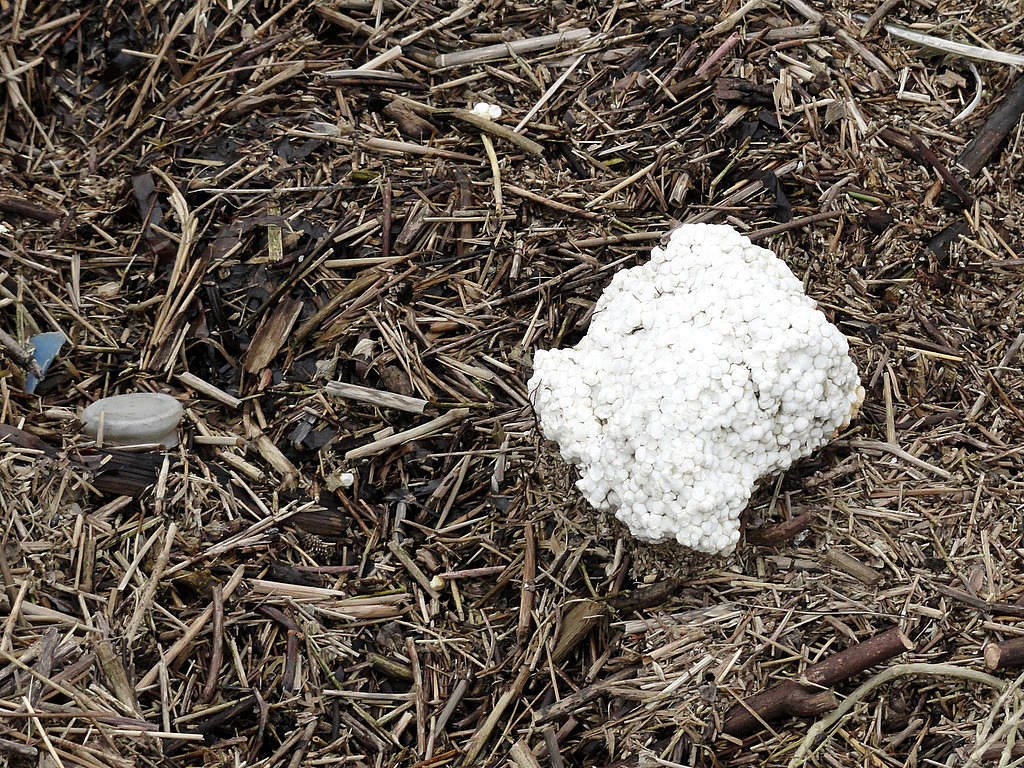
A chunk of styrofoam packing material. It's been shedding pellets for a long time.

Styrofoam, from marine uses, protective packaging for our electronics, cheap ice chests, disposable dishes, "peanuts", and so on, turns up too frequently on our shores, especially this one. It is highly dangerous to marine life, birds and critters alike, and won't disappear for centuries.  One of the problems with it is that it disintegrates into bite-size pieces, even for the smallest animals. And once it has crumbled even more, to microscopic dots, it still retains its dangerous properties.
What is clear, however, is that polystyrene is a widespread contaminant in the world's oceans. Samples taken off the coast of Malaysia and in the northern Pacific all contained styrene monomers and other products of styrofoam breakdown, according to Katsuhiko Saido of Nihon University in Chiba, Japan.

Until recently, research into the harmful effects of styrofoam and other plastics in seawater have mainly focused on damage to marine life from ingesting visible chunks or from getting caught in plastic nets. The new research adds to fears that this line of research may be missing significant amounts of plastic that are in particles too small to see. (From Yahoo, via Gary Partain.
Look closely at these next photos. Can you find the styrofoam pellets in them? (They're in all but the last two.)

One sandal. With styrofoam pellets.

Polyethelene wrap, and plastic food bag. And styrofoam pellets.

Shampoo bottle. This has been exposed for a long time.

And here are the coconuts:

Coconut, from some far-away shore. And styrofoam, of course. At least the coconut is edible.

Another coconut, with styrofoam pellets. This is the first one I've found that was cracked open.  Something has eaten most of the innards, recently. (There was no mud inside.)

And a third coconut. No styrofoam, visible, at least. Whatever ate the meat, also nibbled on the inner skin.
A fourth coconut, half eaten. And I think the white specks are coconut meat.

And no, I didn't collect all the plastic. It was just too discouraging; I would have needed a team and a truck to make a dent in it.

In the storeroom at home, I have the cartons that things come in, held while the warranties are still in effect. They're full of styrofoam.  Now I'm wondering; how can I get rid of them, when the time comes?

Sunday, March 08, 2009

"Grand, awe-inspiring" insanity

What do you do on a windy Saturday when it threatens to snow -- again! --? We went to the Surrey Art Gallery. The exhibition that drew us was Edward Burtysnky's "An Uneasy Beauty - Photographs of Western Canada". From Wikipedia:
Burtynsky's most famous photographs are sweeping views of landscapes altered by industry: mine tailings, quarries, scrap piles. The grand, awe-inspiring beauty of his images is often in tension with the compromised environments they depict.
"Sweeping views" doesn't do justice to the photographs. These were huge, detailed photos, maybe 3 or 4 feet long. Railway and road cuttings (some locations I recognized; a wire net holding the rock face on the Hope-Princeton highway, for example), homesteads, in all their grunginess, a copper mine. These were from the 1980s. Peaceful, and at the same time, disturbing; the stark beauty of our interior cluttered with our machinery.

The display is laid out in a U. The second leg is dedicated to Alberta's oil sands. An online gallery includes the ones we saw, and a few more. (Click on "Oil", then on "Oil Sands".)

The photos are heartbreaking, horrifying. Look at this one. Imagine yourself a waterfowl, on your way North, looking for a place to get a bite to eat, spend the night. Imagine seeing this shiny lake and landing, only to find that the water is poisonous. I read just last week about a flock of 500 ducks dying this way last May. (Story on CTV, stoptarsands, The Star ...) From the Star story:
And they warn the number of bird deaths will jump dramatically as more heavy oil plants are built unless governments bring in tougher environmental rules, including how to deal with billions of litres of poisonous sludge the plants produce.
I was planning to post some cheerful photos of spring flowers from the Art Gallery courtyard, but I don't have the heart for it after looking at the oil sands photos again, even the small versions on the web.

Burtynsky's webpage has more, much more; Eastern Canada, Australia, the US, China, India, Spain, etc. Go see. But be warned; it's not easy viewing.

.
Powered By Blogger