Showing posts with label ecosystems. Show all posts

Sunday, March 08, 2009

"Grand, awe-inspiring" insanity

What do you do on a windy Saturday when it threatens to snow -- again! --? We went to the Surrey Art Gallery. The exhibition that drew us was Edward Burtysnky's "An Uneasy Beauty - Photographs of Western Canada". From Wikipedia:
Burtynsky's most famous photographs are sweeping views of landscapes altered by industry: mine tailings, quarries, scrap piles. The grand, awe-inspiring beauty of his images is often in tension with the compromised environments they depict.
"Sweeping views" doesn't do justice to the photographs. These were huge, detailed photos, maybe 3 or 4 feet long. Railway and road cuttings (some locations I recognized; a wire net holding the rock face on the Hope-Princeton highway, for example), homesteads, in all their grunginess, a copper mine. These were from the 1980s. Peaceful, and at the same time, disturbing; the stark beauty of our interior cluttered with our machinery.

The display is laid out in a U. The second leg is dedicated to Alberta's oil sands. An online gallery includes the ones we saw, and a few more. (Click on "Oil", then on "Oil Sands".)

The photos are heartbreaking, horrifying. Look at this one. Imagine yourself a waterfowl, on your way North, looking for a place to get a bite to eat, spend the night. Imagine seeing this shiny lake and landing, only to find that the water is poisonous. I read just last week about a flock of 500 ducks dying this way last May. (Story on CTV, stoptarsands, The Star ...) From the Star story:
And they warn the number of bird deaths will jump dramatically as more heavy oil plants are built unless governments bring in tougher environmental rules, including how to deal with billions of litres of poisonous sludge the plants produce.
I was planning to post some cheerful photos of spring flowers from the Art Gallery courtyard, but I don't have the heart for it after looking at the oil sands photos again, even the small versions on the web.

Burtynsky's webpage has more, much more; Eastern Canada, Australia, the US, China, India, Spain, etc. Go see. But be warned; it's not easy viewing.

.

Tuesday, August 12, 2008

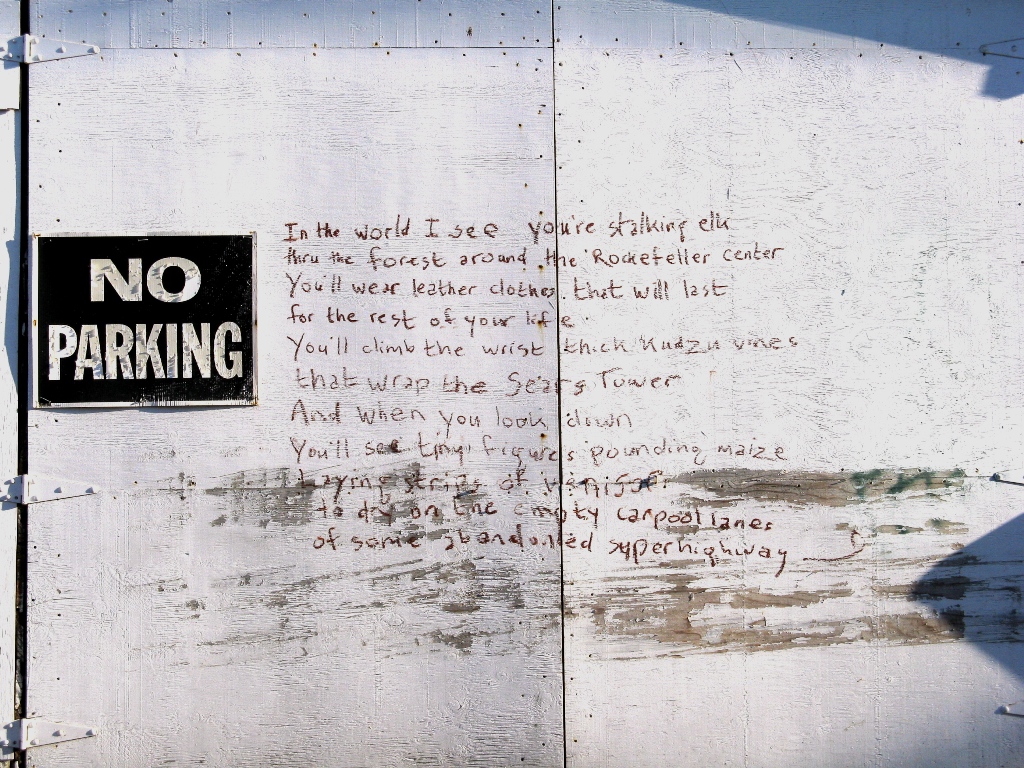
Stalking elk

Another offering of the mad poet without a blog:


In the world I see you're stalking elk
thru the forest around the Rockefeller Center
You'll wear leather clothes that will last
for the rest of your life.
You'll climb the wrist thick kudzu vines
that wrap the Sears tower
And when you look down
You'll see tiny figures pounding maize
Laying strips of venison
to dry on the empty carpool lanes
of some abandoned superhighway
Anonymous. Seen in an alley in Strathcona.
.

Wednesday, May 14, 2008

Death and rebirth in Burns Bog

We don't get down to Burns Bog as often as I would like, even though it is just at the bottom of our hill. This is, in part, because we always tend to walk too far once we're there; it is hard to judge just how far we've come. And in part, because of the dogs. This is sensitive environment, home to many birds and animals, some endangered, and signs at the entrance ask walkers to leash their dogs. Most don't. It is discouraging to see the dogs dashing off into the undergrowth, or into the creek, muddying the water and silencing the birds. We went, this time, on a Monday, not the prime dog-walking day; we still met half a dozen large dogs, none leashed.

Still, this is a tiny corner of the bog; most of it is left to the wild species.


The Nature Reserve, where there is public access, is the part marked in yellow. Part of the rest is private farm land, part is left undisturbed.

We walk in, usually, from the south end. A straight, gravelled path leads along the creek, parallel to the railroad track; from here, raised boardwalks lead off into the trees. This time, we took the #4 entrance, missed our turn to the third entrance (exit, it would be, for us) and ended up walking to the far end, out the #1 entrance, then back along the creek. The photos here were taken somewhere between the Sapsucker Tree and the Cedar Grove. (I have never seen what they call the Bear Cave.)


Cedars, pine, skunk cabbage, ferns, assorted understory shrubs. A typical view in this section.


Laurie, off the boardwalk to look at a fungus.

The ground here is always littered with broken branches, fallen trees, dried evergreen needles. Even many standing trees are dead, or dying. This time, we found more than usual, probably because of last year's storms.


Sometimes the trees don't make it all the way down. Half-fallen, they become supports for whole systems of mosses and shrubs that take advantage of the height to reach for more sunlight.


Others, on the ground, rot into the surrounding peat, hosting mosses and transient plants as they go. A deciduous fern, a common wayside weed, and tiny seedlings share this one.


Dead branches are coated with blankets of mosses; these ones tolerate dryer conditions than the ground-dwelling mosses. In the shadier areas, they grow thick, draping and binding old dead branches, molding them into fantastic shapes, hinting at beasts and birds and alien monsters.


Other trees, without the moss covering, become board and room for insects and birds. I don't know what ate the lower portion of this dead tree. I've seen ants in trees like this; are they there to prey on the tree, or on the tree residents? I don't know.

When a large tree goes down, it often falls in one piece, ripping the roots out of the soft soil, turning them up to the air. I noticed, for the first time, how this clears a bit of land, opening up a window to the sky and making a protected nursery for tender seedlings.


New soil, at the base of a fallen tree. The bottom of the root system now becomes a garden wall.


Young skunk cabbages colonize the new space. Salmonberries take advantage of any gap in the roof that lets in sunlight. These small plants are blooming already.


This old root system has been upturned for some time now. The bare face is covered with some kind of slime or lichen, along with the moss.


And at the base are cracks in the soil, spaces where a root was wrenched out of place, but still forms a sort of roof. I have seen these used by squirrels; no telling what may be living in this one. Not the bear, though.

~~~~~~~~~~~~~
Maps from Burns Bog Conservation Society.
.
.
Powered By Blogger