Showing posts with label art. Show all posts

Thursday, September 29, 2016

Tyrannosaurus rex

There's something inspiring about driftwood. People, from toddlers to ancients, seem compelled to rearrange it, to create something new of it. Fences around sandcastles, teepees or hideouts leaning on logs, shacks simple and complex, roofed or open to the sunshine, full-sized art installations, barricades and territorial markers, circular "rooms" with a fire pit at the centre, bagel holders, flagpoles (I saw one today with a purple t-shirt as a flag); all doomed to disappear with the next tide or the next winter's storms.

At sundown this evening, I met a driftwood dinosaur.

Young T-rex, human-sized, Stories Beach

He's built near the top of the intertidal zone, where only the worst storms will reach him. And his creator intends him to last: he's put together with many brass screws.

I don't know why he has a rock in his head.


Saturday, December 12, 2015

Danger overhead

Downtown Campbell River is infested by spiders. One spider anyhow.

Waiting in her web above the entrance to the theatre.

Luckily, it seems that she has been de-fanged.


Tuesday, November 20, 2012

Rainy day sampler

I have a hard drive full of old photos, most too bad to be used, some with possibilities; but these get lost in the undergrowth. Following Ted McRae's example, I've been sorting them out and rescuing those I can, now that I have newer software and am slowly learning to use it.

Here's a random assortment of the most recent recovers, in no particular order. (Blogger's choice, and I didn't interfere.)

In a dry summer, an angel dreams of days when her pool was full. York Road, Campbell River, 2009.

Is that a ... turtle?!  Photo from Laurie's old film camera, pre-2006. Boundary Bay.

Rotting ball, White Rock beach, April 2009.

I posted this on the blog in August of 2010; I think it's a feather duster worm. The photo was messy and dark, but a few quick tricks with Elements (Ted's first two) brought it to life.

Same worm, clearer pose. It's about an inch and a half long.

Lion, in the jumbled entrance of a house in Finn Slough. The background camouflaged the lion in front; a pity, because I think he's beautiful. I finally figured out how to use the selection tool, masked the lion, and blended the mess. Simple, now I know how. October, 2010.

Signs in the corner of a store window in Strathcona. April, 2011.

1980s photo, taken with one of those little Kodachromes, much faded with age. Scanned and cleaned up, it's passable. This is my younger son rototilling a patch of swamp land we were draining and reclaiming. Wonderful soil! That first year, I had 7 boxes of tomatoes to can.
Firvale, the Bella Coola valley, BC.

Straw "painting" I brought back from Mexico in the 1970s. Cheating here; I threw out all my old photos, and took a new one now that I have a better camera and a decent flash. For the first time, the straw came out as straw, and Elements cleaned up the edges nicely.

I've done a batch of scanned family photos, which I've uploaded to Facebook, and umpteen worm photos; these I will store for reference material for the next time I find another. The weather people threaten us with two solid weeks of rain: I don't care; I'm having fun!


Tuesday, March 06, 2012

Spirit of Haida Gwaii

The upper lobby of the Vancouver International Airport (YVR) is centered around a huge sculpture by Haida artist Bill Reid, named "Spirit of Haida Gwaii: The Jade Canoe" (Haida Gwaii means "Islands of the People"). The islands are two large and 150 small islands to the north of Vancouver Island; until 2010, we knew them as the Queen Charlotte Islands. These days, they have reverted to their old name, Haida Gwaii.

The indigenous population are the Haida Nation. They numbered around 10,00 persons when the white man arrived; now there are about 4,000 people living on the islands.

Bill Reid was a multi-faceted Haida artist (1920 - 1998) who worked in gold, silver, wood (I watched him carving a totem pole long ago), stone and bronze, creating works celebrating the cultural heritage of the Haida.

Plaque section. Sorry about the flash reflection.

The "Spirit" sculpture is cast bronze with a jade green patina, 20 feet long, 13 feet high. It represents a native dugout canoe, carrying a bear/human family and the mythical animals they share the land with.

"... not so long ago, disaster befell Haida Gwaii. Few humans survived and even the supernatural beings were driven from their rock bound houses to the shelter of the surrounding forests and oceans, on the turbulent surface of which rides this magic canoe." (From plaque) 

Left to right, the creatures represented on this side are the bear, his human wife, with their twin cubs sheltered between them, then at the second oar, a beaver. Third oar, a dogfish woman. the raven (at the steering oar on the far side) and mouse woman at the stern are difficult to distinguish.

The wolf, with the eagle's wing between his teeth.

Seen from the other side, the eagle shows his distress by grabbing the bear's paw in his beak. The tall figure in the hat "may or may not be the Spirit of the Haida Gwaii," says Bill Reid.

The beaver, hard at work, as beavers are wont.

Detail: the beaver's tail.

My favourite character; Reid calls him the Ancient Reluctant Conscript. His cape would be woven of spruce bark strips, as is his peaked hat.

Consistent with Haida tradition, the significance of the passengers is highly symbolic. The variety and interdependence of the canoe's occupants represents the natural environment on which the ancient Haida relied for their very survival: the passengers are diverse, and not always in harmony, yet they must depend on one another to live. (Wikipedia)
In the years that I lived on the North Coast, and on Vancouver Island, I learned this; we're all in this together, whatever comes.
The fact that the cunning trickster, Raven, holds the steering oar is likely symbolic of nature's unpredictability.

Description of the creatures in the dugout.

History and construction of the sculpture.


Monday, March 05, 2012

Fat green sea lion

This was in the window of a shop at the Vancouver International Airport yesterday.

Not a good swimmer; too well-fed

The plane I was meeting was on time, but then it sat on the runway for three quarters of an hour, so I walked around, taking photos in low light, since it was past midnight. The humongous jade carving photos worked out ok; I'll post some tomorrow.

Tuesday, February 14, 2012

Hearts and Flowers for Valentine's Day

This was my grandmother's purse, long, long ago. I wonder; did she carry her lacy handkerchief in it when she walked out with my grandfather? There isn't room in it for much else.

It went well with her ribbons and lace collar.

Detail


Monday, December 12, 2011

Mute swan, on water, on paper

Last month, I posted a photo of a mute swan at the Westham Island bridge:


One of my readers, the artist Elva Paulson (Elva Field Notes), loved his pose, and did a painting based on it, which she posted on 100 Paintings Challenge. We (Laurie and I) love it!

Isn't he beautiful?

To see more of Elva's sketches and paintings, visit her blog, or the Challenge blog. (8 other artists post there, too. The challenge refers to the goal of posting 100 paintings in a year. Elva is on her second 100.)


Monday, November 14, 2011

Our daily art

Something different ...

Years ago, on the narrow stone and mud steps that make up many of the “streets” of Taxco, in Mexico, I met a little girl, about 9 or 10 years old. She was sitting at the edge of one of the drier and wider steps, painting on sheets of bark paper, amate, that she kept on the step above her. Finished paintings were stored by her feet on the next step down.

She showed me her work, glowing with pleasure and pride; street scenes, as she saw them. She followed no pattern. Each painting was unique, although certain motifs were in all of them; the people she knew, doing the work she was familiar with, the flowers that overhang every roof and fill every empty corner, the blazing sun above everything.

Taxqueña's Mexico. Paint and crayon on bark.

Detail. Men with vegetables for market, straw-thatched adobe houses.

I bought one; so did the other people with me. Ten pesos I paid, if I remember correctly. I should have paid more, but that is what she asked, and I didn't bargain, at least.

Is this art? Primitive art, maybe? Some would say yes; that little girl wouldn't recognize the term. She painted. That was how she brought home money that would buy her family that day's supper. But there's no doubt but that she loved what she did, that she put her whole being into it, that it expressed the colour, bustle and beauty of her home town.

Taxco is a tourist town. Many of the roofless artisans, the ones without the funds for a shop, sell their work around the public plaza in front of the cathedral. But down towards the market under a roof made of cotton sheets and rope, down, down, down all those steep, slippery steps, where the people of the town buy their daily food, these handicrafts, these “artesanías” are needed, too. There are the clay pots, mugs and bowls; the paper hangings to celebrate family and national occasions; the baskets (I bought one of these, big enough to pack the bean and rice pots I also took home); the hand-woven rebosos; the stick and reed chairs, painted in cheerful colours; and yes, the occasional small painting to decorate the walls.

Men come to market with heavy bundles of pots on their backs, or tied onto burros dwarfed by the load. Women carry smaller loads, but all, even the children, come burdened. All of them are involved in the production of their stock. Staying alive is serious business.

Every town in Mexico has its equivalent, a handful or a small crowd of artisan/sellers with their wares spread out on boxes or cloths in some convenient place where people pass by. If you've been a tourist, you've seen them, maybe bought something pretty to take home at what seemed like a ridiculously low price.

I have a story to tell about a group of artesanos caught in one of our modern dilemmas.

To be continued, tomorrow ...

Saturday, May 14, 2011

Green-eyed seahorse

Seen a few metres from the shore at Crescent Beach:

That's above the shoreline, not below. Rusty iron and green glass on a garden gate.

Thursday, September 09, 2010

Abstract in sand

"... ephemeral art asks that we appreciate the art work now in the present moment, for it may not be there tomorrow." (Sheri Klein)
Or even when the tide comes in. And who's to say snails can't participate?


Snail art, Centennial Beach

The artists are resting along the bottom edge, except for the one putting finishing touches on the upper right corner.

(And, by the way, remember International Rock Flipping Day, this Sunday. All about it, here.)

Friday, May 07, 2010

Artsy ducklings

We saw our first ducklings of the year yesterday, in Cougar Creek Park;


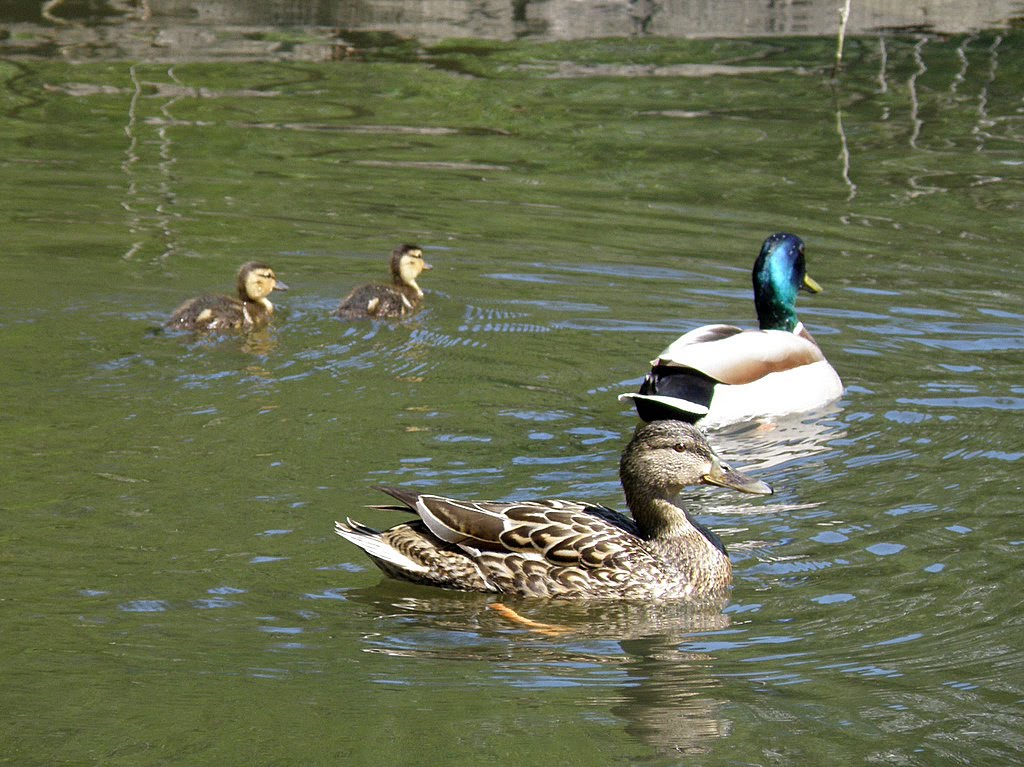
Mama, Papa, and two baby ducks.

The mother and her two little ones were in the creek, in deep shade and rippling water when we first saw them.


A circle under reflected trees.

This part of Cougar Creek is always dark, even more so when the leaves are out. The cameras couldn't cope with the lack of light, added to the confusion of ripples and reflections, and the ducklings bouncing on the water. At one point, I noticed that my camera was taking 1/10 of a second; far too long for a photo of a moving object.

And yet ... the colours were so rich, and the ducklings so cute; we clicked away, regardless. And the photos came out looking more like paintings than photography.

See; here's one in the style of Emily Carr, all dramatic swirls of green:


Another Emily:


And how about a Van Gogh; luminous colours laid on with an impasto knife?


I think this next one could be called Abstract Expressionism:


And then the ducks came out into the sunlight, and posed for a normal family photo again:


Portrait in the Realist style; see Robert Bateman.

Saturday, January 30, 2010

Colourful tapestries

Blue:


Purple:


Yellow:


Red and yellow:


And white:


In the courtyard at the Surrey Art Gallery.

The art was beautiful, too: our favourites were a "Quilt of Belonging", 36 metres of fabric creations celebrating Canada's various peoples, and Ruth Scheuing's "Silkroads". I wrote about her work when we visited her studio in the 2008 Culture Crawl. (Sweeping nudes ...) She has set up her computer-operated loom in the Gallery, and will be working there until April, creating large Jaquard woven tapestries incorporating,
"the patterns and geography of this important historic trade route (The Silk Road) with key historical textile designs that were instrumental in bridging the cultures and economies of East and West. "
This time, we could only look through the door; her Gallery hours are Thursday mornings and Saturday afternoons, 1 to 5, though April 3rd. Well worth a visit. We'll be back.

Tuesday, January 12, 2010

Sign of a sick mind?

New decades call for a clean desktop, at least at first. I've been tidying mine, and found all these in the "To Blog" file.

Updates on previous posts:

* Amphipod maternity ward.
The three pairs of amphipods eventually separated into singles. I watched as tiny (barely visible) babies started swimming about. I couldn't tell if they were from the adults present, or some that had been there all along, but too small to see. Some amphipod mothers brood their eggs or young between their thoracic legs; I've been trying to see if these were brooders. They move too fast, and have too many legs, so I'm still not sure.


I don't think this one is brooding. But it's pretty in that polka-dotted outfit.

The whole kit and kaboodle is back in the aquarium.

* The damaged flatworm.
(Recap: this flatworm had been badly torn, right behind the head and across the mouth. It re-organized its body plan to put the head at the whole end, but the old head end still seemed to have a mind of its own.)

The worm rested on my desk for a few days. I provided it with a stone for shade, and a few barnacles to tempt it to eat. One morning it had swarmed over one of them. Over a couple of days, it eased its way inside, and then just sat there, digesting.


Flatworm inside now-empty barnacle shell. The eyes are visible as dots on the left. The "tongue" is the torn end.

When it finally emerged, it went exploring. It was now a good flatworm shape, but still carried the damaged end upright, like a flag; this flag got caught in a crack of a shell. The worm stretched and stretched and stretc......hed, but couldn't get free. I decided to help. I had read that a flatworm may pull itself in two as a way of reproduction. So I pinched the stretched portion, now barely a thread, and it separated. The head went its merry way.

The torn bit sat there, quivering. It was very small, barely a couple or three millimetres across, and I was sure it would die. It didn't. It, like the whole worm, rested for a few days in one spot, but responding by twisting and stretching whenever I tickled it with my soft brush.

Yesterday morning, when I checked, it was no longer in its old place, but had found shelter in a typical flatworm place, on the bottom side of the stone. Which means that it's alive, can distinguish light (has working eyespots again), and can achieve purposeful movement. Wow!

New stuff.

* Reported to BugGuide:


Parasitic wasp, male.

On New Year's Day, a tiny yellow wasp turned up on my fridge door. In the middle of the winter? I photographed it and measured it (3 mm.), looked up hundreds of wasps, couldn't decide on any, and sent it off to BugGuide. So far, they have identified it as one of the parasitic Apocrita, which is not a valid group, just kept for convenience. Still, it's a start.

Another couple arrived at my desk a couple of days ago, a male and a female. Unfortunately, the male died shortly after capture, though I had handled it gently. She is in a pill bottle, waiting for a new male.


The female of the species. The long projection at the tail end is the ovopositor, which she uses to deposit her eggs in her victim.

If these are parasitic, what and where are their victims? The only live things I find around are the Indian Meal moths that hatch out of the bird seed. Could they have been in the pupated caterpillars that I threw to the juncos? Some of them were black, others cream. Maybe the black ones were parasitized. Next time, I'll look more carefully. When I find a male, I think I'll also donate a live caterpillar to the cause, see what happens.


Wing pattern on wasp. Cute little "stigmata".

* Fish art.


Painting by Jaya, 7. Available light; colours should be more alive. I like the seaweed streamers.


The artist, at work on a new idea.

* Just because these made me happy:


Blue mist over Burns Bog.


Almost summer: reflection in Cougar Creek pond, last week.


Hellebore. First week in January, and the flowers are budding out!

And the clean desktop makes me happy, too.
Powered By Blogger