Showing posts with label fog. Show all posts

Sunday, January 18, 2026

Blink and you missed it.

10 AM. The sun was shining, the sky was blue. It wouldn't last; I hurried to collect jacket and cameras. By 11 I was driving around residential areas north of town, looking for a high point with a view over the water, with bare branches against the sky and Quadra Island on the far shore.

11:45. Found it. Fog was already settling in over Quadra, but the sky overhead was still blue.

Orange Point. Gowlland Island, 2km away.

Twisty branches of red alder.

Below me in the water; a metal float and bull kelp with their live, brown floats (pneumatocysts).

There should be good views from Race Point, 5 km. further north; Seymour Narrows, Menzies Bay, maybe some boats or a float plane ... By the time I got there, the fog had settled in; Quadra, 2 km. away, was invisible.

12:15. That darker grey streak is Quadra Island.

There was a trail heading up into the forest; dim, wet, almost gloomy. Good enough. Giving up on the sky, I climbed the hill. (Mushrooms, moss, more; left for tomorrow.)  20 minutes later, as I was ready to leave, the sun tried to break through the mist again.

12:30 Drifting mists and sunshine through mossy branches.

A Skywatch post.

~~~~~~~~~~~

Las 10 de la mañana. El sol brillaba, el cielo estaba azul. No iba a durar; me apuré a juntar chaqueta y cámaras. Dando las 11, daba vueltas en una zona residencial al norte de la ciudad; buscaba un sitio en alto con vista sobre el agua y con ramas desnudas contra el cielo, además de la isla Quadra al otro lado del estrecho.

11:45. Lo encontré. Una neblina ya se asentaba sobre las islas, pero el cielo seguía azul.

    1. La isla Gowlland, a 2 km de distancia, desde Punto Orange.

    2. Ramas torcidas de aliso rojo.

    3. En el agua al pie del acantilado, un flotador metálico, con algas quelpo y sus flotadores vivos (pneumatocistos).

Debería haber buenas vistas desde Punto Race (Corriente? Carrera?) a 5 km. más al norte; el Estrecho Seymour, la bahía Menzies, tal vez algunos barcos o una hidroavioneta ... Pero cuando llegué, la niebla cubría todo. La isla Quadra, a apenas 2 km. estaba totalmente invisible.

    4. Las 12:15. Esa linea gris tantito más oscura es la isla Quadra.

Había un sendero al otro lado de la calle, entrando al bosque; todo oscuro, mojado, casi triste. Invitaba. Olvidándome de cielos azules, subí el cerrito.. (Hongos, musgos, y más; esto lo dejo para mañana.) 20  minutos más tarde, cuando había regresado al coche para irme a casa, el sol hizo otro intento de penetrar la niebla.

    5. 12:30. Neblinas vagantes, y los rayos del sol alumbrando ramas cubiertas de musgo.

Un post de Skywatch.


Sunday, November 13, 2022

Made me happy Part 2

Here's another handful of photos from my "Things that make me Happy" folder. Again, in no particular order, chosen almost at random from the file.

Oyster Bay. Bird houses on poles, muddy tide flats with busy birdies, calm water.

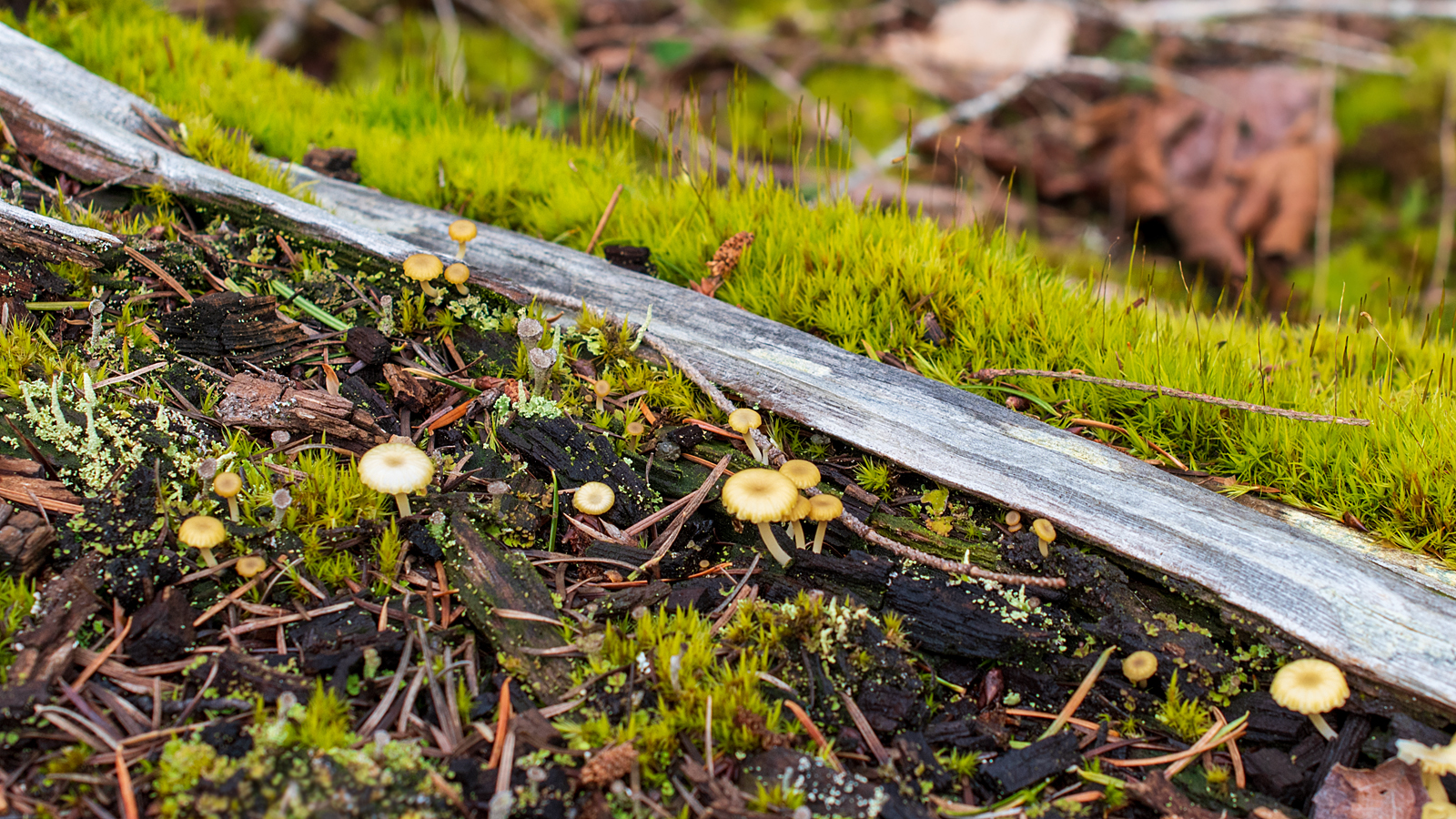
What's left of an old log in the little Oyster Bay woods. With lichens, mosses, and lichen agaric mushrooms, Lichenomphalia umbellifera. Which is really part of a lichen, with its associated alga, Coccomyxa spp.

Orange-striped green anemone, Diadumene lineata, installed in an abandoned snail shell. One the hermits won't get to use.

I love these little floating puddle-jumpers, so essential to contact with many of our Vancouver Island communities. A Cessna Skywagon.

The forest in fog and snow.

The old beaver lodge. I visit several times a year, and have never seen a beaver yet. Their tracks in the mud, yes.

Tartan Dahlia

More tomorrow.

~~~~~~~~~~~~~~~~~~~~~~~~~~~~
Sigo subiendo fotos de mi carpeta de "Cosas que me hacen feliz". Otra vez, escogidas casi al azar.

  1. La lagunita de Oyster Bay, con los nidos de pájaros encima de postes, la zona intramareal llena de lodo y de pajaritos felices, patos y gaviotas en la distancia.
  2. Un tronco caído, ya muy viejo, sosteniendo líquenes, musgos, y esos honguitos Lichenomphalia umbellifera, los cuales son, en realidad, una parte de un líquen, en conjunto con una alga Coccomyxa spp..
  3. Una anémona verde con rayas anaranjadas, Diadumene lineata, que se ha instalado en una concha de caracol marino. Esta no la podrán usar los ermitaños.
  4. Una avioneta con flotadores Cessna Skywagon. Me encantan estos avioncitos, tan trabajadores, tan necesarios para nuestras comunidades isleñas aisladas.
  5. El bosque con nieve en la neblina.
  6. La madriguera de los castores.  Visito esta madriguera varias veces al año y nunca he visto un solo castor. Sus huellas en el lodo, sí los he encontrado. Y cada vez ha crecido la madriguera.
  7. Una dalia, llamado "Tartan". El nombre en náhuatl: atlcocotlixochitl. (Acabo de descubrir esto; me gusta. Otra cosa que me hace feliz.)
Y mañana subo más.


Monday, January 18, 2021

Fog, rain, mist.

The morning fog lifted. The sun came out. Wonderful! I grabbed the camera and hit the road, going north, hoping maybe to see snow on the hillsides. Ice in the ditches. Or at least frost on some leaves.

At the Eve River, about 100 km. north of home, I gave up. It had been raining off and on, and ahead all I could see were more clouds. I stopped at the Eve River rest stop before turning back, and walked through the soggy woods to the banks of the river.

Eve River bridge, Hwy 19, in Scotch mist.

Trail to the river bank.

The ground was thickly carpeted in moss, the trees draped in another moss.

At the parking lot, I had noticed a couple of Christmas ornaments hanging from high above my head on the branches of the evergreens, dripping wet. I didn't see the one in the woods until I blew up the photos. Do you see it?

Rainy road. Leaving the rest area.

Oh, and in the grass at the rest area, I found half-melted snow. A patch about the size of my fist. Mission accomplished.

A Skywatch post.

~~~~~~~~~~~~~~~~~~~~~~

Se disipó la neblina. Salió el sol. ¡Excelente! Recogí la cámara y salí a la carretera para el norte, esperando tal vez hallar un poco de nieve en las laderas de las montañas, o hielo en las zanjas al lado del camino. O por lo menos unas hojas delineadas por escarcha.

Llegué hasta el rio Eve (Eva), como unos cien kilómetros de casa, y abandoné la empresa. Había estado lloviendo de vez en cuando, más entre más al norte llegaba, y adelante, lo único que podía ver eran nubes. Me detuve en el área de descanso del río Eve, y se me ocurrió travesar el pequeño bosque para mirar el río bajo la lluvia.

Primera foto: el puente de la carretera #19,. cruzando el río.

Segunda: uno de los senderitos cruzando el bosque. En el suelo, musgos. En los árboles, otra especie de musgos.

Al lado del estacionamiento, había visto un par de decoraciones navideñas colgadas de ramas de los árboles, bien por encima de mi cabeza, y empapadas, goteando. No noté la que estaba colgada en el bosque hasta que vi las fotos en casa. ¿La ves?

Tercera foto: saliendo del área de descanso.

Y en el zacate en el área de descanso, encontré nieve. Medio derretida, y solamente del tamaño de mi puño. Pero nieve. Misión cumplido.

Wednesday, January 08, 2020

Somewhere there is sunshine

I had the afternoon free and the camera packed. But the day was a dark grey, with patches of rain. Too dark for photos, too unpredictable for walking. And the tide would be high again until after dark. (Sunset was at 4:38.) Time to get out of town; maybe I could find the sun.

I decided to go north. That way, I might find snow, too. The camera and I would like the light; sunshine on snow!

Fog, fog, rain, fog. And more fog. The only colours visible in the watery light were grey, dingy browns, and the greyed dark greens of the evergreens. After the Sayward turnoff, about 50 km from home, where the highway climbs into the hills (and there are warnings to carry chains) snow started to show up on the side of the highway. And up ahead there were tiny patches of slightly blue sky. I drove on, hoping.

I found sunshine!

See? Sunshine on the trees and the valley beyond! No road goes there, though.

The sun came and went, playing peekaboo behind the mountains, then merging back into the fog. Tall trees bordering the highway hid the mountain peaks. I found an abandoned logging road and went up to get a better view.

My logging road. A few metres farther up, and the view was gone. The light patch on the hillside is a clearcut logged area.

Around the next bend. No sunshine visible from here. A bit of snow, behind the trees on the left.

The highway dipped down into the Woss Valley and the roadside snow disappeared. Fog settled in again. Farther north, it started to rain. I turned around and came home. There was snow on Mount Huksan, behind Sayward, visible sometimes when the clouds lifted for a moment. Dim fog merged gradually into dimmer twilight, even before sunset.

I was glad to see the lights of home twinkling over the water under a foggy full moon.

Monday, October 22, 2018

Not quite silhouettes

Fog isolates, showing up shapes I've passed dozens of times without ever seeing them.

Weeds on the rocks

At the boat launch, Stories Beach

Saturday, October 20, 2018

Thursday, December 07, 2017

Foggy feeders

A thick fog settled in yesterday afternoon. At first, I couldn't see Quadra Island three kilometres away; by 4:00, even the shore beside the road disappeared. A pedestrian crossing the street ahead of me was just a blurry, darker area in the fog.

This morning, they're warning us not to drive unless it's necessary. I'm reduced to looking out the window at the fog.

I can just about see my bird feeders from the kitchen window. The camera sees much better; at least I can identify the chickadees; other LBBs are mere shapes.

Chickadee and, I think, a junco. Photo brightened and contrast increased.

Chestnut-backed chickadee.

Over on the mainland, most of our chickadees were the black-capped 'dees. Here on Vancouver Island, the only chickadee is the Chestnut-backed. They don't seem to be as  chatty as the black-capped were. Maybe it's just that there are fewer of them around my feeders; why stay around to dee-dee-dee at me when there are so many other trees to visit?

They take both the suet and the black-oil sunflower seeds, but ignore the mixed bird seed, leaving that for sparrows and juncos.


Saturday, October 19, 2013

Nothing to see but ducks

We've had a few days of those thick fogs, the kind that makes you glad there's another car a few feet ahead of you; you can see its tail lights through the mist, and it's up to that driver to know where you're going. Yesterday morning's fog was just this side of rain. The garden was wet, but the sidewalks were barely damp.

It lifted slightly around lunch time, so we went to the beach.

Not that there would be much to see; blue-grey sky, grey sand, grey mud, grey water, grey birds. The tide was out a ways, coming in slowly, so slowly it brought no seaweed with it, just more grey water.

Ah, but those birds! Thousands upon thousands of ducks, in great grey rafts all across the Mud Bay end of the bay, visible mostly as dark lines on the horizon where there should be only more grey water. We walked north, towards them, but never got near enough to identify more than a few mallards. Most of the ducks were smaller. Wigeons, maybe; there had been a small flock on the duck pond in Centennial Park.

We walked for maybe an hour. It was chilly on the shore; the sun made a weak attempt at shining through the fog at one point, but quickly gave up. Not enough people out to make it worth its while.

Then something disturbed the ducks, probably an eagle. Clouds of birds rose off the water, circling silently. If they were complaining, we were too far away to hear them.

Lifting off

Laurie's camera does distances better than mine. Or than my eyes. These were the ducks nearest to us.

Sky dust.

A few wheeled overhead, before re-joining their flock at the far shore.

Zoomed 'way in; a fuzzy mallard. Many of the ducks were smaller.

The cloud lifted, swirled, thickened, and drifted off behind the dunes, where the mud lies too deep for walking. All we could see then was the end of the raft, black where everything else was grey. We gave up and went back to Tsawwassen and a toasty coffee shop.

As we drove home, the sky cleared in patches; we saw blue through the clouds. Half an hour later, they had all burnt off, and the sky was a deep, summertime blue. No fair!

Today we're back to fog and damp. Ah, BC!

A Skywatch post.


Thursday, January 03, 2013

Minimalist peeps

I am somewhat of a fan of minimalist home design and decor. I find the clean lines attractive; something in me responds to an almost empty room with a bench and a couple of stones, or a white on white kitchen.

(I've collected a few on Pinterest, as a sample.)

But I could never live with the style. I'd be tiptoeing about, afraid to put a coffee cup down in the wrong place, or to leave my current stack of books (mismatched sizes and colours, some propped open) and the scraps of paper that I use as placemarks on a table designed to hold one flower in a vase, or to forget to shut that cupboard door. I'd feel as if I were an unwelcome visitor in my own space. There'd be no home for the latest grandkid's artwork, or a spider in a jar, no forgiveness of small anomalies. I'm an incurable pack-rat.

Still, an empty scene charms me. And what shape of nothing beats a foggy sea and sky?

Here's what met us at Boundary Bay on Tuesday:

Sandpipers, gulls, and a hint of the opposite shore.


And a drowned branch.

We did get close to some of the peeps. Photos tomorrow.

A Skywatch post.


Wednesday, January 02, 2013

Wet, cold, and bejewelled

The Fraser Delta is prone to thick fogs in winter and spring, sometimes so murky that I drive following the shoulder of the road, which is about all I can see. (I once followed the lights of a car a few metres ahead. He seemed to know where he was going, until he drove, without hesitation, into a deep ditch.)

Today's fog wasn't quite that bad. The fields alongside the highway faded out into a grey nothingness, and those inevitable fog-grey Vancouver cars were visible only as a pair of lights. But the traffic was light, and there was no ice - yet - so we zipped ourselves into down and wool, and went to look at birds on Boundary Bay.

We came back with 150 or so peeps photos to sort; I'll post some of them tomorrow.

On the way back to the car, we passed a monkey tree festooned by spider webs,each silken thread heavy with glassy beads.

The central disk is a spider's skating rink. Empty, though.

Detail of another web. These beads look like they're frozen. They could be. The temperature is hovering around 0°C.

Top-heavy web, torn by the weight of the mist.


Friday, February 19, 2010

Flatlands

The Fraser River splits into two arms as it enters the delta. Between them lies Richmond, with another split in the northern arm making a separate island for the airport and Iona Beach. It's flat, low-lying land, as befits a delta. Half of it, more or less, is residential and business; the other half is farmland, growing mostly blueberries and cranberries.

Across the river to the south, is the municipality of Delta, stretching from the Fraser to Boundary Bay to the south. It's the largest municipality in the Greater Vancouver Regional District, flat and boggy like Richmond, but sparsely populated. North Delta, where we live, is off the delta proper, up on the hillsides; most of the people live up here. Below are farmlands, Burns Bog, and a lot of empty space.

I measured the flats on Google; from Reifel Island at the northwest corner to Burns Bog to the Nicomekl River on the south, and back along Mud Bay to Tsawwassen, then up to Reifel again for the fifth side of a kid's drawing of a house; as the crow flies, about 40 miles. Following the roads, it's about 60.

We criss-cross this area on our way to most of our favourite shores. We don't usually stop; it's a long drive already. Often, we take photos from the car windows. Blurry photos, mostly. Not all.


Taken as I drove; soggy field in the rain.


I stopped for this one, along Colebrook Road, just off Mud Bay. The only fishing spot handy was the ditch.


There are fish in this water, see?


Farmhouse and fog. 104th Street, near Burns Bog. This area is prone to fogs and wet mists, even when the sun is shining on the beach.


Grazing goats with the hills of South Surrey in the background.


Sheep on a spit of land between the Nicomekl and the Serpentine rivers.


Why do they leave this coat on the sheep's back? There must be a reason; quite a few were wearing these.


Leeks. 104th Street again. The next field over grew brussel sprouts.


Reflections in a ditch. Tsawwassen.


Last bit of wasteland before the hills and residential area of Tsawwassen. Where we stop to watch hawks.

Tuesday, January 12, 2010

Sign of a sick mind?

New decades call for a clean desktop, at least at first. I've been tidying mine, and found all these in the "To Blog" file.

Updates on previous posts:

* Amphipod maternity ward.
The three pairs of amphipods eventually separated into singles. I watched as tiny (barely visible) babies started swimming about. I couldn't tell if they were from the adults present, or some that had been there all along, but too small to see. Some amphipod mothers brood their eggs or young between their thoracic legs; I've been trying to see if these were brooders. They move too fast, and have too many legs, so I'm still not sure.


I don't think this one is brooding. But it's pretty in that polka-dotted outfit.

The whole kit and kaboodle is back in the aquarium.

* The damaged flatworm.
(Recap: this flatworm had been badly torn, right behind the head and across the mouth. It re-organized its body plan to put the head at the whole end, but the old head end still seemed to have a mind of its own.)

The worm rested on my desk for a few days. I provided it with a stone for shade, and a few barnacles to tempt it to eat. One morning it had swarmed over one of them. Over a couple of days, it eased its way inside, and then just sat there, digesting.


Flatworm inside now-empty barnacle shell. The eyes are visible as dots on the left. The "tongue" is the torn end.

When it finally emerged, it went exploring. It was now a good flatworm shape, but still carried the damaged end upright, like a flag; this flag got caught in a crack of a shell. The worm stretched and stretched and stretc......hed, but couldn't get free. I decided to help. I had read that a flatworm may pull itself in two as a way of reproduction. So I pinched the stretched portion, now barely a thread, and it separated. The head went its merry way.

The torn bit sat there, quivering. It was very small, barely a couple or three millimetres across, and I was sure it would die. It didn't. It, like the whole worm, rested for a few days in one spot, but responding by twisting and stretching whenever I tickled it with my soft brush.

Yesterday morning, when I checked, it was no longer in its old place, but had found shelter in a typical flatworm place, on the bottom side of the stone. Which means that it's alive, can distinguish light (has working eyespots again), and can achieve purposeful movement. Wow!

New stuff.

* Reported to BugGuide:


Parasitic wasp, male.

On New Year's Day, a tiny yellow wasp turned up on my fridge door. In the middle of the winter? I photographed it and measured it (3 mm.), looked up hundreds of wasps, couldn't decide on any, and sent it off to BugGuide. So far, they have identified it as one of the parasitic Apocrita, which is not a valid group, just kept for convenience. Still, it's a start.

Another couple arrived at my desk a couple of days ago, a male and a female. Unfortunately, the male died shortly after capture, though I had handled it gently. She is in a pill bottle, waiting for a new male.


The female of the species. The long projection at the tail end is the ovopositor, which she uses to deposit her eggs in her victim.

If these are parasitic, what and where are their victims? The only live things I find around are the Indian Meal moths that hatch out of the bird seed. Could they have been in the pupated caterpillars that I threw to the juncos? Some of them were black, others cream. Maybe the black ones were parasitized. Next time, I'll look more carefully. When I find a male, I think I'll also donate a live caterpillar to the cause, see what happens.


Wing pattern on wasp. Cute little "stigmata".

* Fish art.


Painting by Jaya, 7. Available light; colours should be more alive. I like the seaweed streamers.


The artist, at work on a new idea.

* Just because these made me happy:


Blue mist over Burns Bog.


Almost summer: reflection in Cougar Creek pond, last week.


Hellebore. First week in January, and the flowers are budding out!

And the clean desktop makes me happy, too.
Powered By Blogger