Showing posts with label parasitoid. Show all posts

Thursday, July 23, 2015

Muddy bassinets

Do spiders eat wasps? Do wasps eat spiders? We've been discussing this in the comments on yesterday's post. Conclusion; yes, and yes.

Even baby wasps eat spiders.

The porch of the building behind the washrooms at Reifel Island Migratory Bird Sanctuary is a quiet corner, rarely visited. There, swallows tend their nests in the eaves, and moths sleep on the walls, undisturbed. And in the shade at the top of the inner wall, black and yellow mud dauber wasps build their baby incubators.

A dozen little cradles, all in a row.

Half a dozen. A new nursery, under construction.

Each little tube contains one wasp egg and provisions for the growing larva. The female wasp collects mud from the edge of the pond nearby, and molds it into tubes on the wall, working from both sides, making ribs which meet in the middle and are cemented shut.

As each tube is finished, she goes grocery shopping, bringing back a half-dozen or more spiders, live, but paralyzed by a shot of wasp venom. They will never wake up. In each tube, then, she lays one egg, and seals the tube up with mud. When the eggs hatch, the growing larvae will eat the spiders, still alive up to that point.

The two open tubes in the photos above are still unfinished; the others all contain comatose spiders and developing eggs.

Here's a mother wasp, working on an open tube.

Once most of the eggs are laid and provisioned, she starts daubing the whole mass with another layer of mud. This will dry hard and seal in the babies until they're ready to break out.


Adding spiders to the latest tube. The spider hiding on the left doesn't realize her danger!

Of course, nothing is foolproof. Other species of wasps, ichneumonids* and cuckoo wasps**, look for mud dauber nurseries under construction, and lay their eggs inside while the mother is off catching spiders. When the invaders' eggs hatch, they eat the spiders and the mud dauber larvae, too, then burrow their way to the surface of the mound.

Look at an old mud dauber nest and you can decipher what happened to the offspring. A large hole chewed out at the end of a cell means an adult mud dauber successfully emerged. Small holes along the length of the cell mean some kind of parasite came out instead. (From BugEric)

About names: the common name is simply Black and Yellow Mud Dauber. Its scientific name is Sceliphron caementarium; hard to pronounce, but it makes sense: caementarius means "mason, builder of walls." Of cement, of course.

* Ichneumonids. Christopher Taylor called them Icky Newmans. A good mnemonic, and it helps with pronunciation, too!

** Cuckoo wasps. Brilliant green; I saw a fair number at Reifel Island on Tuesday. I'll look again at those nests later on, to see who were the final hatchlings.


Monday, August 25, 2014

Doorstep gift, unwrapped.

Last month, I posted the photo of a cocoon that I found on my doormat one morning.

Wooly bear caterpillar cocoon, found July 6th.

I put it in a plastic container with a perforated lid, and left it outside, near the door where the caterpillar had chosen to sleep. I made sure to check it every day.

24 days later, July 27th, something was fluttering around inside the container. But it was not the expected moth.

Not a moth.

BugGuide identifies it as a Braconid wasp, in the genus Macrocentrus. These are parasitoids; parasitic animals that inevitably kill their host. The female wasp lays an egg in a larva of her preferred species. The egg hatches and the wasp larva grows inside the caterpillar until it (the caterpillar) pupates. Then the larva of the wasp begins to feed off the host's body, pupates inside the dead caterpillar's cocoon, and finally emerges as an adult, ready to mate and find itself another caterpillar to start the cycle again.

Exit hole.

Face view. I'm not sure how that extra insect leg got in there.

Pretty stained-glass wing.

Dried out and warmed up, ready for take-off. Work to do!

This wasp is a female; the spike at the end of her abdomen is the ovipositor, the egg-laying tool. She's got about a week to find herself a mate and a moth larva before she dies.

Some species of these wasps are used as pest control, to kill the caterpillars and other larvae that damage our crops. And wasps though they are, they don't sting humans.


Wednesday, September 01, 2010

Cousin wasp

We found this wasp climbing up a window in Tim Horton's. Laurie dug a pill bottle out of his pocket, and I popped her inside.


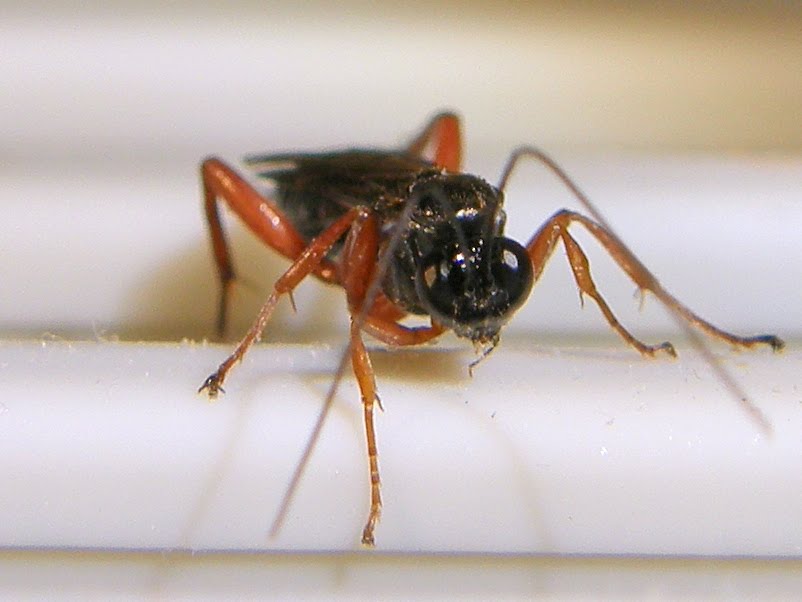
An Ichneumon wasp, Pimpla sanguinipes, female.

At home, she gave me all sorts of trouble, refusing to sit still, even for a second. Even after a time-out in the fridge, she revived instantly and started to race around. I got a few blurry photos, decided that's as good as I was going to get, and put her outside.

She immediately flew over my shoulder, back into the house, and disappeared. Half an hour later, she turned up on an air cleaner behind my computer, and puttered around, stopping every now and then to contemplate the camera. Silly bug!


She's an ichneumonid; a parasitoid wasp. There are tens of thousands of species of these, found world-wide. All are parasites, mostly parasitoids (parasites which eventually kill their hosts) preying on larvae of beetles, flies, moths, butterflies, etc., each wasp specializing in one or a few host species. I couldn't find which one would be the victim of this red-legged wasp.

The female wasp finds a caterpillar or maybe a pupa of the target insect, and lays an egg on or even inside it, using the long ovipositor at the end of her abdomen. This egg-laying tool is specialized to reach the specific prey; in some wasps, because the larvae it seeks are deep inside tree bark, the ovipositor is as long as the wasp herself.

The egg hatches, and the wasp larvae begin to eat their host, still alive.
"The tiny larvae that hatch fed upon the fatty tissues of the Caterpillar's body without damaging any vital organs. When the Ichneumon larvae are almost full-grown they begin to feed on the more vital organs, resulting in death of the caterpillar."
From Organic Garden Info
The wasp larvae then pupate inside the body of their prey, emerging finally as adults.

A gruesome story, especially if you have a vivid imagination, if you can feel empathy even towards the little white maggots and squirmy caterpillars. Not hard, since in reality, they are our distant cousins; they have their tiny delights and agonies, like us, if on a lesser scale. It's a dog-eat-dog world, difficult to understand.
I cannot persuade myself that a beneficent and omnipotent God would have designedly created the Ichneumonidae with the express intention of their feeding within the living bodies of Caterpillars, or that a cat should play with mice. - Darwin, 1860, letter to Asa Gray.
And yet, we are part of that tooth and claw economy, and we can find a benefit even in these wasps; they kill insects that otherwise would damage our crops and reduce our food supply.
Parasitic Wasps are arguably the most important beneficial garden insects. They’re critical because they operate at low population densities. That is, they’re the first check on insect pests. From Grow it Organically.
My little red-legged visitor flew away, eventually. I let her go; she's a solitary, so she should feel at home in my garden. Maybe she'll lay eggs in the aphids, maybe in some other animal that I really don't want in my plants. Or maybe not; maybe she'll just tootle around until the cold weather arrives, providing a spark of warm red on the cool greens of my shady haven.

Tuesday, January 12, 2010

Sign of a sick mind?

New decades call for a clean desktop, at least at first. I've been tidying mine, and found all these in the "To Blog" file.

Updates on previous posts:

* Amphipod maternity ward.
The three pairs of amphipods eventually separated into singles. I watched as tiny (barely visible) babies started swimming about. I couldn't tell if they were from the adults present, or some that had been there all along, but too small to see. Some amphipod mothers brood their eggs or young between their thoracic legs; I've been trying to see if these were brooders. They move too fast, and have too many legs, so I'm still not sure.


I don't think this one is brooding. But it's pretty in that polka-dotted outfit.

The whole kit and kaboodle is back in the aquarium.

* The damaged flatworm.
(Recap: this flatworm had been badly torn, right behind the head and across the mouth. It re-organized its body plan to put the head at the whole end, but the old head end still seemed to have a mind of its own.)

The worm rested on my desk for a few days. I provided it with a stone for shade, and a few barnacles to tempt it to eat. One morning it had swarmed over one of them. Over a couple of days, it eased its way inside, and then just sat there, digesting.


Flatworm inside now-empty barnacle shell. The eyes are visible as dots on the left. The "tongue" is the torn end.

When it finally emerged, it went exploring. It was now a good flatworm shape, but still carried the damaged end upright, like a flag; this flag got caught in a crack of a shell. The worm stretched and stretched and stretc......hed, but couldn't get free. I decided to help. I had read that a flatworm may pull itself in two as a way of reproduction. So I pinched the stretched portion, now barely a thread, and it separated. The head went its merry way.

The torn bit sat there, quivering. It was very small, barely a couple or three millimetres across, and I was sure it would die. It didn't. It, like the whole worm, rested for a few days in one spot, but responding by twisting and stretching whenever I tickled it with my soft brush.

Yesterday morning, when I checked, it was no longer in its old place, but had found shelter in a typical flatworm place, on the bottom side of the stone. Which means that it's alive, can distinguish light (has working eyespots again), and can achieve purposeful movement. Wow!

New stuff.

* Reported to BugGuide:


Parasitic wasp, male.

On New Year's Day, a tiny yellow wasp turned up on my fridge door. In the middle of the winter? I photographed it and measured it (3 mm.), looked up hundreds of wasps, couldn't decide on any, and sent it off to BugGuide. So far, they have identified it as one of the parasitic Apocrita, which is not a valid group, just kept for convenience. Still, it's a start.

Another couple arrived at my desk a couple of days ago, a male and a female. Unfortunately, the male died shortly after capture, though I had handled it gently. She is in a pill bottle, waiting for a new male.


The female of the species. The long projection at the tail end is the ovopositor, which she uses to deposit her eggs in her victim.

If these are parasitic, what and where are their victims? The only live things I find around are the Indian Meal moths that hatch out of the bird seed. Could they have been in the pupated caterpillars that I threw to the juncos? Some of them were black, others cream. Maybe the black ones were parasitized. Next time, I'll look more carefully. When I find a male, I think I'll also donate a live caterpillar to the cause, see what happens.


Wing pattern on wasp. Cute little "stigmata".

* Fish art.


Painting by Jaya, 7. Available light; colours should be more alive. I like the seaweed streamers.


The artist, at work on a new idea.

* Just because these made me happy:


Blue mist over Burns Bog.


Almost summer: reflection in Cougar Creek pond, last week.


Hellebore. First week in January, and the flowers are budding out!

And the clean desktop makes me happy, too.

Saturday, June 06, 2009

It's wasps all the way down

(This is a follow-up to my posts on aphid mummies, Two for the price of one, and The case of the pregnant mummies.)

Thanks to the helpful comments on my aphid mummies, and a generous dose of Google and BugGuide, I thought I had a handle on what is going on in my maple tree. But maybe not; one final comment uncovered the next level down.

Todd suggested the possibility of hyperparasitoidism. And of course I had to look it up.


Another aphid mummy.

First, why the "-oid" suffix?
"A parasitoid is an organism that spends a significant portion of its life history attached to or within a single host organism which it ultimately kills (and often consumes) in the process. ... In a typical parasitic relationship, the parasite and host live side by side without lethal damage to the host. ... In a parasitoid relationship, the host is killed, normally before it can produce offspring." Wikipedia
In other words, the aphid is a parasite; it lives on my maple tree, but doesn't kill it or stop it from producing seeds. The wasp is a parasitoid because it kills the aphids.

And hyperparasitoid, then? Again, from the same Wikipedia article,
"It is not uncommon for a parasitoid itself to serve as the host for another parasitoid's offspring. The latter is commonly termed a hyperparasite, but this term is slightly misleading, as both the host and the primary parasitoid are killed. A better term is secondary parasitoid, or hyperparasitoid..."
In the case of the aphid and the wasps, here's how it works; the wasp, possibly of the sub-family Aphidiinae, lays one egg inside the live aphid. She goes on to find the next aphid, and the next ...

The aphid goes on with its life for a while as if nothing had happened. But the egg hatches and the wasp larva grows, taking its nutrients from the aphid body. Eventually, after the larva has molted for the last time, the aphid dies. The larva slits open the underbelly of the aphid and glues it to the leaf, then builds itself a cocoon and pupates. The aphid becomes a mummy, hardened and brown.

Normally, the new adult wasp cuts a hole in the mummy, and leaves to start the cycle again. However, if it is found by a hyperparasitoid wasp, it in turn becomes a host.

This wasp is from a different family, the Megaspilidae. The female drills a hole through the hardened mummy case and lays one egg on (not in) the larva inside. This new egg hatches, and the larva (#2) feeds on larva #1, killing it, then pupates, emerges, cuts a hole as larva #1 would have, and heads off to find its mate.

So, was the wasp that emerged from my aphid mummy a parasitoid, or a hyperparasitoid, as Todd suggests?


Micro-wasp

I looked up as many of these wasps as I could find, and examined the photos. The closest I could get to my specimen were the Aphidius colemani. (Other similar Aphidius either did not live here or were too large) Bug Guide has a photo of one laying her egg in an unfortunate aphid, and another, whether colemani or not, they couldn't say, but definitely in the genus Aphidius.

The one I had found earlier to match mine (and perhaps a closer match that the A. colemani) was a Lysiphlebus testaceipes, also in the same sub-family.*

Both of these are parasitoids.

I found a photo of a hyperparasitoid wasp, a Dendocerus. It is similar in shape and colouring, and about the same size. The wasp in the photo has "antlers", but only because it is a male.


Dendrocerus. Image from NC State U.

Was my wasp male or female? I don't know.

So I still have a mystery on my hands. All I need to do to solve it, though, is find a male and see if it has antlers. Simple, isn't it?

*These classifications are confusing. The Aphidiinae is a sub-family, or maybe a family, in which case it should be called Aphidiidae. This sub-family is divided into tribes, one of which is called the Aphidiini. And one genus in this tribe is called Aphidius. Lysiphlebus is another at that same level.

And they prey on Aphids, of the superfamily Aphidoidea and family Aphididae.

Don't blame me; I'm just sorting it out in my own head.

.
Powered By Blogger