Showing posts with label mud dauber wasp. Show all posts

Thursday, July 23, 2015

Muddy bassinets

Do spiders eat wasps? Do wasps eat spiders? We've been discussing this in the comments on yesterday's post. Conclusion; yes, and yes.

Even baby wasps eat spiders.

The porch of the building behind the washrooms at Reifel Island Migratory Bird Sanctuary is a quiet corner, rarely visited. There, swallows tend their nests in the eaves, and moths sleep on the walls, undisturbed. And in the shade at the top of the inner wall, black and yellow mud dauber wasps build their baby incubators.

A dozen little cradles, all in a row.

Half a dozen. A new nursery, under construction.

Each little tube contains one wasp egg and provisions for the growing larva. The female wasp collects mud from the edge of the pond nearby, and molds it into tubes on the wall, working from both sides, making ribs which meet in the middle and are cemented shut.

As each tube is finished, she goes grocery shopping, bringing back a half-dozen or more spiders, live, but paralyzed by a shot of wasp venom. They will never wake up. In each tube, then, she lays one egg, and seals the tube up with mud. When the eggs hatch, the growing larvae will eat the spiders, still alive up to that point.

The two open tubes in the photos above are still unfinished; the others all contain comatose spiders and developing eggs.

Here's a mother wasp, working on an open tube.

Once most of the eggs are laid and provisioned, she starts daubing the whole mass with another layer of mud. This will dry hard and seal in the babies until they're ready to break out.


Adding spiders to the latest tube. The spider hiding on the left doesn't realize her danger!

Of course, nothing is foolproof. Other species of wasps, ichneumonids* and cuckoo wasps**, look for mud dauber nurseries under construction, and lay their eggs inside while the mother is off catching spiders. When the invaders' eggs hatch, they eat the spiders and the mud dauber larvae, too, then burrow their way to the surface of the mound.

Look at an old mud dauber nest and you can decipher what happened to the offspring. A large hole chewed out at the end of a cell means an adult mud dauber successfully emerged. Small holes along the length of the cell mean some kind of parasite came out instead. (From BugEric)

About names: the common name is simply Black and Yellow Mud Dauber. Its scientific name is Sceliphron caementarium; hard to pronounce, but it makes sense: caementarius means "mason, builder of walls." Of cement, of course.

* Ichneumonids. Christopher Taylor called them Icky Newmans. A good mnemonic, and it helps with pronunciation, too!

** Cuckoo wasps. Brilliant green; I saw a fair number at Reifel Island on Tuesday. I'll look again at those nests later on, to see who were the final hatchlings.


Sunday, July 29, 2012

The honeydew eaters

Linden trees, says Wikipedia,
"... are subject to the attack of many insects."
It's all the trees' doing; the sap flows richly and freely in its veins, easily tapped into, nutrient-rich, sweet and fragrant. Aphids harvest it, and serve it up to a throng of other insects.

Linden tree branch, with yellow jacket

Aphids, varying ages, and a molted skin.

The aphids that feed on linden are the Eucallipterus tiliae, the Linden Aphid. The new hatchlings are white or pale green, red-eyed. They develop their characteristic dark spots and stripes as they go from molt to molt. Some adults are winged.*

The thing about aphids is that they eat more than they use, and "spill" the excess. (The proper word is "exude", and the honeydew they produce is an exudate.) The nectar coats the leaves, dripping from branch to branch; the leaves become sticky. Sometimes the whole tree glistens and sweet rain falls to the ground beneath, feeding a black fungus in the grass.

And so the food chain goes, from the lawn to the tree to the aphids, to the ants that farm them and the ladybugs that prey on them, to the horde of winged critters feasting on the lot, and back to the ground to start the next cycle.

Ant on a twig

I cheated: two sizes of ants run up and down the trunk, along the branches, across the leaves. Run and run and run and run. I was having trouble getting one where I could focus on it. So I mashed a raspberry with a bit of water and sugar, and painted a stripe around the trunk, where they couldn't miss it. Five minutes later, the large ones were lining up for the treat.

Dessert bar

Ladybugs don't wait for the aphids to produce honey. They take their juice "on the hoof", with fresh aphid meat.

Medium-sized ladybug larva. The orange deepens as they grow.

Younger larva.

And a nineteen-spot adult.

Of course there are always flies.

Very small fly, unidentified.

Accidental fly. I was chasing the yellow jacket, and didn't notice the silhouette of a common fly on the back side of a leaf until later.

There's a small mob of tiny biting black flies, rarely photographed because I'm so busy swatting them before they bite, and usually being too slow.

I don't know what's hiding under this silky tunnel. Probably a pupating moth.

The wasps - dozens of them as long as the sun shines - flit from leaf to leaf, sipping nectar off the leaf surfaces, and looking for a good home for their babies, inside a caterpillar or spider.

Black and yellow mud dauber, I think.

I caught this wasp with the butterfly net, and had to chill him to calm him down. He woke up almost as soon as I brought him out; within a minute he was on his feet and heading for the door. This photo catches him just stretching and yawning.

The female wasps will build a series of one-egg mud nests. With each egg, they will deposit a paralyzed spider, then plaster over the entrance. The larva will hatch and eat the still-living spider.

The orange wasp, again. She's a ichneumon wasp, Theronia atalantae fulvescens.

These wasps prey on several moths and butterflies, notably the pine butterfly, a relative of the cabbage white. I may have seen these about and mistaken them for cabbage whites; they are very similar. The wasp also takes tussock moths and tent caterpillars.

In all the time I spent examining the tree this year, dodging wasps the whole time, I saw only one spider, and one very small caterpillar. It looks like the wasp babies are well provided.

And a tiny wasp, unidentified. It may prey on the larvae and larva food of the larger wasps.

The bark is juicy, too. I don't know what makes these tooth marks. Squirrel, maybe? An ant in the lower right corner shows the size.

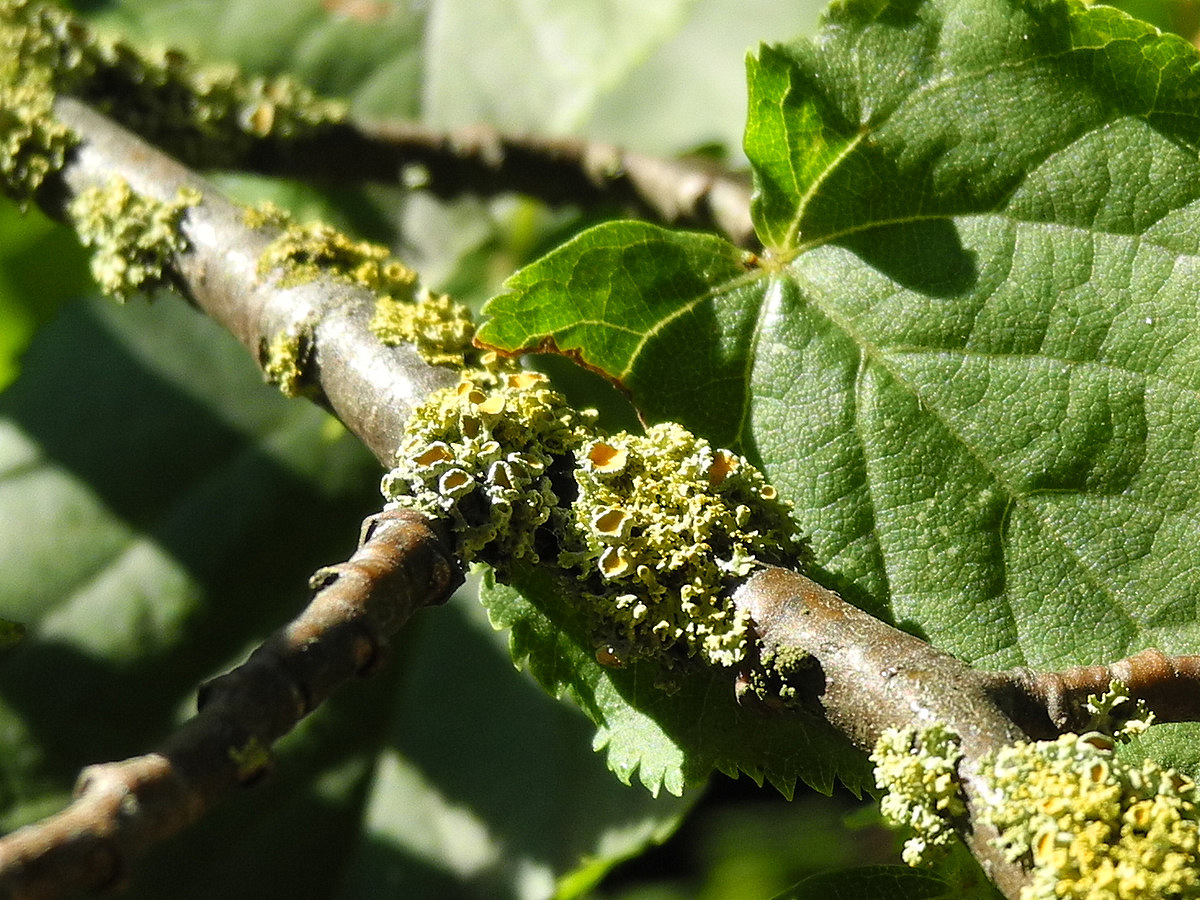
Lichen on a small branch. Just because.

*Last year's post about this same tree, with larger aphid pics, is here.


Powered By Blogger