Showing posts with label ladybug. Show all posts

Friday, November 22, 2019

Polka-dot ladybug

And another lifer among the mushrooms on Bailie Island. Not a mushroom, though.

A pair of mushrooms in dead leaves. But look at the stalk.

A small black and white beetle.
Zooming in still more. Looks like a ladybug.

I think it is a twenty-spotted ladybug, Psillobora vigintimaculata. I found a match on BugGuide, just across the border in Washington state. I'd never seen one before.

Saturday, April 22, 2017

It looks almost innocent

The Campbell River Museum sits on a hillside facing the shore, part sunny lawns, part in deep shade under evergreens or mixed alders and maples. Trails wind through the trees and above the lawn, where a collection of 80 different plants native to the area thrive.

Now that the sun is shining, and flowers are starting to appear along the street, (and I saw my first salmon-berry flower two days ago; more diagnostic of spring than the robins) I went to see what is happening on the Museum lands.

And there were trilliums and flowering red currants and kinnikinick and curly-topped ferns and ... I'll be processing photos for a few days.

But my favourite was this brand new devil's club (Oplopanax horridus) bud, with a visitor:

Two buds, old spines, and a multi-spotted ladybug, probably Harmonia axyridis.

The spines look relatively innocuous now, worn down and de-fanged by a harsh winter. I was almost tempted to touch one. Almost. Once the leaves open, there will be nasty, stinging spines everywhere, even on the leaves.


Sunday, December 13, 2015

When the bough breaks ...

I just stepped outside, in the middle of the night, to see if my Christmas decorations had blown away. They're fine. The night is clear and still, the street still gleaming wetly, but the sky is empty; I can see the beacon blinking on the far side of the channel.

A few hours ago, the wind was howling and tossing sticks at my window. Under the carport, the car was dripping with side-blowing rain. Leaves were piling up on the doormat; I stepped, barefoot, onto a cluster of holly leaves.

And the day before? Sunny and warm, blue skies, pink sunset. But the streets and sidewalks were littered with branches brought down by the previous day's storm. The weather gods have their schedules all scrambled.

I stopped by a stand of Douglas fir to collect cones to make Christmas decorations with. Right beside the car, a 5-foot branch lay on the grass; I threw that in the car, too. It would give me enough greens for a wreath to hang on the door.

At home, I laid the cones out to dry in a basket, and spread the branch on the table, started clipping off short branches to make my wreath. Springtails scattered every which way, fat, hopping globular springtails, mostly. I hadn't expected that, from a branch fallen from a tall tree. I wonder how many ended up on the back seat of my car.

And then, something red left the shelter of a branch and ran across the table. A ladybug! In mid-winter!

A very small ladybug, spotless.

I was surprised to see her*; she may have been overwintering in a crack in the bark before her home came crashing down. But I was also intrigued by the pattern on her pronotum (the black and white "collar" behind her head). Discover Life has a key for identifying ladybugs; I plugged the clues into their boxes and came up with Cycloneda munda as the only match. This is a new ladybug for me.

However, C. munda is found east of the Rockies, not here. Another Cycloneda, polita, redder than the C. munda, but otherwise similar, lives here. Cycloneda polita, aka Western Blood-red Lady Beetle, it is.

These ladybugs are natives, spotless, and noticeably smaller than the common Asian Multicoloured, Harmonia axyridis.

I transferred her to a tray to take a few photos, and then planned to take her outside to find a place to hide. But, alas! She quickly flew away.

"Goodbye!"

And though I looked and looked, I could not find her anywhere. So she'll just have to overwinter in my nice warm kitchen. Although she may think it's springtime, and go looking for a mate. She won't find one; they're all sleeping.

*Female C. munda have black faces. Males have white faces. I'm guessing C. polita is similar.

Sunday, August 04, 2013

Update on the blue anemone

A couple of days ago, Judy asked about the baby blue anemones; "Have any ... survived"?

One had. I wasn't too sure about a couple more.

That one is still hanging in there. It's only a few millimetres across, too young, really, to be out on its own. A persistent little critter, though; it was clinging to a few inches of torn eelgrass when I transferred it to the "hospital" tank, where the current is not as strong and there are no meddling hermits. The eelgrass has rotted away this week, until yesterday there were barely a couple of fraying threads left. Still the anemone hung on.

I fed it shrimp puree, and it stretched out stubby baby tentacles and grabbed some. It's awake and responsive. There's hope!

Tonight, I couldn't find it at first.  The eelgrass had finally disintegrated and sunk to the bottom, in pieces. I searched through the gunk and squirming amphipods until I found a shred of brown eelgrass tissue, with the blue speck of anemone sticking desperately to the end of one thread.

The rescue attempt: I found another length of eelgrass, a good, solid, fresh stem end. With a plastic wire (no metal in the tank) and working underwater, I tied the far end of that thread along the new eelgrass, so that the anemone lay next to it, almost touching.

I spent a few minutes, four or five, shutting down the tanks for the night. Before I turned off the anemone's light, I looked to see if my anchoring job had held. And the little Einstein had taken the opportunity; it was already in the middle of the new eelgrass blade! Brilliant!

Its survival is still iffy, but for now, tag me #happyhappy and #proudfostermamma.

No photos of the blue anemone; have a happy blue ladybug instead.

Smiling 25-spotter, in a Beach Grove garden


Saturday, July 13, 2013

Of ladybugs and linden trees

The linden tree seems to be a little late this year. Or perhaps it's the aphids that are running behind schedule. It wasn't until this week that the tree started to wake up. And yesterday, I found the first ladybugs. Not the first to arrive, since some have pupated already, and at least one larva is in his last instar. Maybe they started in the top of the tree, where the sun shines almost all day.

On the leaves that I could reach, I found aphids producing honey, ants eating the honey, ladybug larvae eating the aphids, assorted wasps, including those bright orange ones, looking for a place to lay eggs, a very pretty fly all spiffed up in red eyes and blue back, who left when I touched his branch. And the adult ladybugs, supervising everything.

Aphids, full-grown, early instar, and an abandoned molted skin.

These are the  Eucallipterus tiliae, the Linden or Lime-tree Aphid. Their population will increase as the summer goes on, until every leaf has its little mob. The mature ones (see the photo above) feed on the thick veins of the leaf, where the sap flows freely. The youngsters, with much smaller feeding stylets, are restricted to the tender areas between veins.

They produce more honey than the ants can eat, so it "rains" onto the grass below the tree. The first year I noticed them, the grass was black with mould, growing on the honey. Since then, I've made sure to wash off the grass well every day or so; last year, there was no mould. None this year, so far, but we're in early days yet.

Adult, Harmonia axyridis, a 19-spotter with a mostly white pronotum. I love those shiny eyes!

Another adult, with smaller spots.

One of the ladybugs had a mostly black pronotum, although it was the same species; it had the "W" clearly marked on the front. I wanted his photo, but he was not in the mood. He ran, and I chased him, from one leaf to another, to the main branch, me getting stickier by the minute, he getting angrier, I think, because he finally dropped onto my arm. "Yay!", I thought, "Now I've got him where I can see him."

And then the little bug bit me, and flew away, muttering imprecations as he went.

The pupas don't run, and they don't bite.

The frills are the old larval skin, shed as he pupated, and glued to the leaf at his tail end. Silky threads hold him down. I'm wondering how he manages to anchor those threads, encased as he is. I'll have to watch another one pupate to see.

And I have no idea what this next thing is. It's too small, and the wrong shape, to be an abandoned ladybug pupa. There is no larval skin, and the ladybug splits her pupa down the back, leaving a black thing standing upright.

It looks as if there is a hole in the front end, where the adult insect emerged. Whether that was the original inhabitant, or a wasp that had parasitized it, I can't tell.

What is this?

Next: a weird fly in my kitchen.

Sunday, July 29, 2012

The honeydew eaters

Linden trees, says Wikipedia,
"... are subject to the attack of many insects."
It's all the trees' doing; the sap flows richly and freely in its veins, easily tapped into, nutrient-rich, sweet and fragrant. Aphids harvest it, and serve it up to a throng of other insects.

Linden tree branch, with yellow jacket

Aphids, varying ages, and a molted skin.

The aphids that feed on linden are the Eucallipterus tiliae, the Linden Aphid. The new hatchlings are white or pale green, red-eyed. They develop their characteristic dark spots and stripes as they go from molt to molt. Some adults are winged.*

The thing about aphids is that they eat more than they use, and "spill" the excess. (The proper word is "exude", and the honeydew they produce is an exudate.) The nectar coats the leaves, dripping from branch to branch; the leaves become sticky. Sometimes the whole tree glistens and sweet rain falls to the ground beneath, feeding a black fungus in the grass.

And so the food chain goes, from the lawn to the tree to the aphids, to the ants that farm them and the ladybugs that prey on them, to the horde of winged critters feasting on the lot, and back to the ground to start the next cycle.

Ant on a twig

I cheated: two sizes of ants run up and down the trunk, along the branches, across the leaves. Run and run and run and run. I was having trouble getting one where I could focus on it. So I mashed a raspberry with a bit of water and sugar, and painted a stripe around the trunk, where they couldn't miss it. Five minutes later, the large ones were lining up for the treat.

Dessert bar

Ladybugs don't wait for the aphids to produce honey. They take their juice "on the hoof", with fresh aphid meat.

Medium-sized ladybug larva. The orange deepens as they grow.

Younger larva.

And a nineteen-spot adult.

Of course there are always flies.

Very small fly, unidentified.

Accidental fly. I was chasing the yellow jacket, and didn't notice the silhouette of a common fly on the back side of a leaf until later.

There's a small mob of tiny biting black flies, rarely photographed because I'm so busy swatting them before they bite, and usually being too slow.

I don't know what's hiding under this silky tunnel. Probably a pupating moth.

The wasps - dozens of them as long as the sun shines - flit from leaf to leaf, sipping nectar off the leaf surfaces, and looking for a good home for their babies, inside a caterpillar or spider.

Black and yellow mud dauber, I think.

I caught this wasp with the butterfly net, and had to chill him to calm him down. He woke up almost as soon as I brought him out; within a minute he was on his feet and heading for the door. This photo catches him just stretching and yawning.

The female wasps will build a series of one-egg mud nests. With each egg, they will deposit a paralyzed spider, then plaster over the entrance. The larva will hatch and eat the still-living spider.

The orange wasp, again. She's a ichneumon wasp, Theronia atalantae fulvescens.

These wasps prey on several moths and butterflies, notably the pine butterfly, a relative of the cabbage white. I may have seen these about and mistaken them for cabbage whites; they are very similar. The wasp also takes tussock moths and tent caterpillars.

In all the time I spent examining the tree this year, dodging wasps the whole time, I saw only one spider, and one very small caterpillar. It looks like the wasp babies are well provided.

And a tiny wasp, unidentified. It may prey on the larvae and larva food of the larger wasps.

The bark is juicy, too. I don't know what makes these tooth marks. Squirrel, maybe? An ant in the lower right corner shows the size.

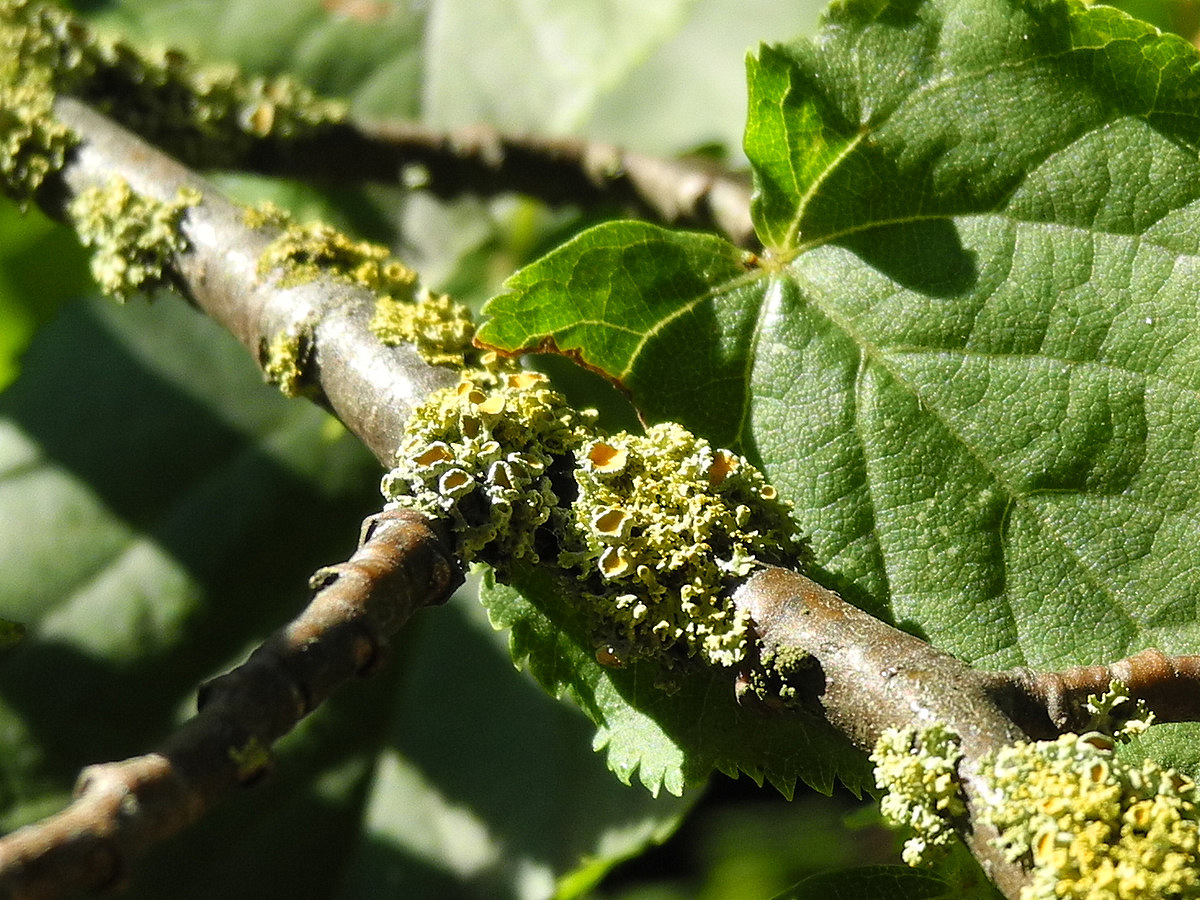
Lichen on a small branch. Just because.

*Last year's post about this same tree, with larger aphid pics, is here.


Sunday, April 15, 2012

Yawn!

It's been a long, productive day, but now I'm too tired to even type properly.

Here's a sleepy-looking ladybug.

A five-spotter

I'm sleepier. Goodnight, all!


Sunday, March 04, 2012

18-spotter

Found in the storage drive:

Ladybug climbing my knuckle

Top o' the hill

October of 2009. There are all sorts of goodies hidden away in hundreds of old files; I'm having fun.

I picked up my grandson from the airport tonight, coming in from Honduras. He says he brought the sunshine with him. We'll see in the morning.

Tuesday, February 07, 2012

Chilly ladybug

The afternoon had been warm, but as the sun set, the temperature dropped to near freezing again. On an old cottonwood, covered with lichens and mosses, we found a ladybug, sound asleep.

Sunny colours, but no warmth there.

She had probably come out of hiding, deceived into thinking it's spring by the sushine, and been caught by surprise out in the open. She woke up in a warm car, and now is happily exploring a bunch of leaves on my desk.

Powered By Blogger