Showing posts with label aquarium. Show all posts

Thursday, November 06, 2014

Fish-eye lens

I took the car in for some work this afternoon, and as usual, went to commiserate with the bored fish in their cramped tank while I waited. A couple of the residents found the camera's eye on the far side of the glass interesting.

"Ohh! And who are you, and how did you get out?" 

"Looks fishy to me!"

And then I got the car back and went out into the sunshine. While the prisoners in their tank swam round and round, back and forth. If they were lions, they'd be pacing.

Wednesday, January 30, 2013

Hermie gets a makeover

When they eat, they scatter the crumbs. They don't clean their plate; they don't tidy away leftovers. That's SEP*. They abandon their houses, walking off with nary a backward glance. Occasionally, they strip off their old clothes and drop them on the ground. Then they climb to high places and sit there, all undressed.

No wonder they get into trouble!

Another of my hermit crabs molted this afternoon. I found his discarded body armour floating in the current, and looked for the ex-owner.

Sure enough; he's resting on the top of a clump of sea lettuce.

He's one of the hairy hermits. The hair isn't usually so apparent. Now, it's new and just stretching out. And he has no jacket on.

While he's walking around in the altogether, we get a chance to count legs. A hermit has 5 pairs of legs, including the pair that serves as pincers. Two more legs on each side are used for walking. The fourth pair, easily seen in this photo, is used to move in and out of the shell he borrows. The fifth pair is smaller, barely visible here. It is used to clean the gills and to remove wastes.

Visitor.

At the very tip of the abdomen, a pair of curvy uropods works as an anchor inside the shell.

As long as the hermit stays aloft, in my tank, he's fine. If there were any fish, he wouldn't be; he'd be a fine lunch. Here, once he goes down to search for a new shell, any crab that he meets will eat his soft abdomen. I kept an eye on him; when he climbed down, I chased out my one crab and put him in a bowl to keep him out of mischief. (I gave him a piece of fish as compensation.)

Hermie took his time choosing his new shell; so many styles and patterns!

He was slow; the crab had to stay in solitary for three hours. While I was watching, I noticed something else in the tank:

Six pearly eggs!

Spring is definitely on it's way, and the snails are ready for it. One of them laid these eggs. I don't know which; there are four species of snail in this tank; the invasive mud snails, a bunch of pretty little Nassas, several periwinkles, and some really tiny, pointy snails that I haven't been able to identify yet. These last are smaller than the eggs, so they're not the parents. Any one of the others could be.

Bonus; the teeniest of all the hermits, like a half grain of rice, even with the shell on.

And Hermie finally decided on that fat white whelk shell.

*Somebody Else's Problem. See Douglas Adams.

Tuesday, December 11, 2012

Hermit reaches for the top

". . . we don't understand animal consciousness . . ."

Marian Stamp Dawkins was talking about "even invertebrates". And when it comes to these "lesser" creatures, we know so little! Here's another hint as to how hermit crabs think and learn.


On second thoughts, that fork was too slippery. I should have taken a minute to wind some string around it.

The things that swim by in the background are amphipods and copepods.

Sunday, December 02, 2012

Critters in my hard drive

On yesterday's post, Sara Rall said, in the comments, "I never knew there were so many intertidal creatures." Nor did I; I'm still constantly surprised by what turns up on the beaches.

And I have a new one tonight. This critter is a main component of the diet of the sandpipers and other peeps that feast on the mud flats.

I found one in my aquarium a year ago last May and couldn't identify it at all.

Here's my description from back then:
I discovered this beastie in a worm tunnel in my aquarium a week ago. It sort of looks like an amphipod with eggs, but stays in the tunnel like a worm, only sliding up to the surface of the sand, then down again every so often.The legs at the top look like they belong to a spider. At the bottom end, almost transparent appendages flutter constantly, again like an amphipod or the shrimps. I think there may be more than one in the tunnel. They, or it, don't match any of the green amphipods in the tank; it's longer and thinner, and leggier.

Corophium (salmonis. spinicorme, or possibly stimpsoni)

 Hugh, of Rock, Paper, Lizard, identified it as an amphipod, of the Genus Corophium*, maybe salmonis. He posted a link, which led to an identification page and a few photos of details which I had no hope of seeing on my critter. Wikipedia had (has) nothing on them; even Google gave me no results. And there the matter lay.

And all the time, I had photos stashed in my hard drive that would have helped. Now, sorting and rescuing, I have discovered them. They're from a year farther back, in April of 2010. In a clump of eelgrass brought back from Boundary Bay, I had discovered a series of tiny wriggling things, mostly worms, mostly unidentifiable from my photos. I had done my best with them, uselessly, and stashed the photos for later, then forgot them. Now I've started working on them again. And the first in line were the Corophium that I had been puzzling over last May.

Definitely tiny; here's one in an eye-dropper

It's an amphipod, but unlike the ones I see all the time.

Long, long front legs and antennae.

Photo of Corophium salmonis from the San Juan Islands. Photo by Michael R. Clapp/nwnature.net

These tiny amphipods (also called "mud shrimp", though they are not shrimp) live in burrows like worm tunnels in intertidal waters. They are adaptable, so can tolerate the varying conditions; high salinity in the salt marshes, dropping to almost freshwater levels after heavy rains; temperatures from bathtub warmth to freezing; sand and wave movement. They feed on the biofilm that grows on fine, silty sand; the Boundary Bay/Mud Bay flats are ideal for them.

The birds know this. A sandpiper can eat thousands of these tasty morsels in an hour, running along the beach following the retreating tide, peck, peck, pecking. At what? I have wondered. The worms lie deeper, but mature A. salmonis females wait at the mouth of their burrow for cruising males; both easy prey, and fat.

When the tide comes in, young salmon and other fish take their turn. There's plenty for everyone. Those apparently barren sands are teeming.

There's a very interesting article about Corophium on the east coast of Canada, here. It looks at a different species, but much about their lifestyle and predators will be the same.

*aka Americorophiuim.

Updated to correct Genus name, broken links, 2015.

Monday, October 15, 2012

Rainy day crab watching

All day Sunday it rained, sometimes in buckets. That's three solid days, much appreciated. And a good time to stay inside and watch my crabs.

Just crabs

"Patch"

These shore crabs are babies still, some so small I hadn't even seen them until this week. I have discovered some, long ago, as small as a sand grain, unseen until they scuttled sideways in an entirely un-sandlike way. The largest of the half-dozen in the aquarium now, Patch, is maybe half an inch across the carapace.

Small or not, they are feisty. Often they sit by the glass, watching me as I watch them. If I aim a finger their way, they lift warning claws; "I'm going to pinch you!"

Patch was by the glass wall, facing me, as usual. But when I approached him, he made no move. Even a finger on the glass by his face made no impression. Odd.

Three hours later, I stopped by again. Now he had his back to the glass, and lying beside him was his old molted shell. No wonder he wasn't interested in anything else; he had urgent business to attend to. The shell was an obvious size smaller than he is now.

I lightened up the photo to make him more visible. Even so, his camouflage is perfect against the sand. Once he'd hardened up, he buried himself so that only his eyes - two sand grains among thousands - showed up.

(The lines at the bottom of the photo in the sand against the glass are worm tunnels. There are at least two different species of worms there, still only visible with a lens. They'll grow.)

A smaller cousin, with his latest building project

Even the tiniest of the crabs, a white-topped cutie about an eighth of an inch across, is a hard worker. Mostly, they're digging new quarters under stones or shells. I watch them backing down the holes, then crawling back up, pushing a load of sand with their pincers. (Tiny Tim - "TT" - moves a grain or two of sand at a time.) The pile is pushed up and far enough away so it won't slide back, and the crab goes back for the next load. Sometimes they surface carrying a stone or a shell in both pincers. Once I saw a crab carry up a snail larger than himself, holding it high overhead until he was on neutral territory, then giving it a good toss. "And stay out!"

In the photo above, the green crab is clearing out a burrow under the stone on the left. The oyster shell on the right is half-buried in the sand, standing on edge, narrow rim upwards. The crab somehow lifted that big white whelk shell up and balanced it between the rock and the rim of the oyster shell. Quite a feat, I thought, and went for the camera.

And when I got back, he had added those two stones, the pink one and the white one, also on the rim. I have no idea how he did it without tipping the whole arrangement onto the ground. He has a steadier hand than I, that's for sure!

Hermit crabs and "True" crabs

Hermit crabs are social beings. They rarely fight, except briefly over some exceptionally prized snack; they climb over each other, take rides on each others' shells, discuss shell economics peacefully, even between different species. And, like human teens, when one gets a new outfit, it starts a general rush.

It works like this: Jim's shell is a bit too tight; he's been growing. So he convinces Sally to pass down hers. She's willing, but then she needs a new outfit. She asks Tom and Pete for theirs; no, they're not ready. She finds a suitable empty and puts it on. But Tom and Pete now begin to notice how their shells are tight, or scratchy, or the wrong shape, and off they go to find someone willing to share. The idea snowballs, until hermits are queueing up; as each one takes the latest one available, the next hermit in line grabs his cast-off. And so it goes until they're all satisfied.

I happened to watch a threesome sorting out shells. It went fine until two were fitted, but the largest was stuck with a shell too small, so she went off with a bare belly, looking for a bigger suit. It's an urgent search, that usually goes off without a hitch. But the hermit is vulnerable in this state; all her weapons are in front, and the back end is tender and appetizing to fish, gulls and other birds, eels and octopuses. And crabs.

When I went back to check, the naked hermit was stranded up a blade of eelgrass, with a big shore crab at the bottom. She dodged back and forth and eventually managed to drop off onto a rock behind the crab. Safe for now.

I came to look later, and after a search, found her. The big crab had her in his pincers; he'd eaten her belly already. She wasn't moving.

I don't know why this makes me sad and annoyed at the crab; I find no problem with anemones eating copepods, or hermits emptying out barnacles. Or, outside my door, robins and worms, spiders and assorted flies. Maybe it's because of the face contact with hermits and crabs; they seem to be connecting with me, at least noticing me and responding.

~~~~~~~~~~

Wandering around the web, I discovered another intriguing fact about hermit crabs. I'll post about it as soon as I've read up on it.


Thursday, October 11, 2012

The quest

The hermit crabs in my salt-water aquarium are very tiny, but they're growing fast. And growth, for a hermit, means getting new clothes. I've provided them with a selection of empty shells, but just like growing kids, they have their own preferences.

I caught a couple of the hairy hermits involved in a discussion over a pretty white shell occupied by a green hermit. Brownie, in a boring mud snail shell, wanted to switch.

By the time I had the camera in hand, he had won, and Green was naked.

(Photos taken through algae-coated glass.)

"A perfect fit!" says Brownie.

And, "What shall I do?" says Green. Note the black belly, normally hidden in the shell.

"May I have your shell?"

"No, you certainly may not!" (Pulls hood over head.)

Brownie's discarded outfit.

"Does this fit me?

Taking its measure. Too big.

"Life's not fair! I can't run around in public like this!"

On with the search

Brownie, up in the eelgrass, watches, chortling.

"This one fits, but it isn't my style at all.  It'll have to do. For now."

Shopping time: 12 minutes. A long time for a tiny hermit to walk about in the nude.


Wednesday, September 26, 2012

The mystery critter, mystified even more.

Once again, a critter I thought I knew has first stumped me, then amazed me.

The mystery. What is this?

Under a stone on the upper intertidal zone at Boundary Bay, a hint of tentacles caught my eye. When I touched the sand, it disappeared, so I dug for it, couldn't see it, and brought home the whole handful of sand.

As first seen. My fingertip at top left. I've removed the colour from most of the photo to highlight both the one I saw and the other one that turned up later.

At home, in a bowl of seawater. There were two of them, about an inch and a half long.


Were they worms? Peanut worms could be shaped something like this, and have similar tentacles. Or were they anemones? But the body didn't look like an anemone stalk.

A hint; the tentacles have those heart-shaped marks.

I've looked and looked, and looked: the only tentacled beasties I find with the heart markings are Anthopleura artemisia, the burrowing anemone, like the one that came home with me from Campbell River.

But that long, worm-like body?

Placed in the aquarium, they lay on the sand, withdrawing then extending their tentacles.

Tentacles partly extended.

I have been Googling for days. I find oodles of conflicting information: the burrowing anemones are not "True" anemones; they are so; it's only the Burrowing Tube anemones that are not "True". The local burrowing anemone, Anthopleura artemisia, does not have a long, worm-like stalk; it is "capable of greatly elongating.". It has a base on the stalk that "glues" it to a solid object; it has a bulbous, muscular base that anchors itself in a burrow. (I think the tail of my critters is remarkably bulbous and muscular.) 

There is a smaller burrowing anemone, the ten-tentacled anemone, a true anemone with similar markings on ten tentacles. My critters have more than ten tentacles.

Of the local anemones, only the Burrowing Tube anemone, Pachycerianthus fimbriatus, in a separate Subclass altogether, makes a tube. (Pachy doesn't look at all like my long-bodied anemones.)

Oh, and they like stone and sand mixes. But they don't; they want fine sand only.

The more I read, the more confused I get. I give up; I'll just report what I see.

One of the little anemones, contorted as they do, feeding.

The critters lay on the stones, contracting and squirming occasionally. They had been found buried in sand, so I buried them in sand. They worked their way to the surface, and lay there practicing their Yoga positions, until the current swept them away to another inhospitable location. I gave them more sand; they abandoned it.

One eventually found an oyster shell with a half-teaspoon of sand in it; he settled in, buried the bottom segment of his body, and started to feed. For a day. Then he upped anchor and coasted around the aquarium, checking out several possible spots on the way. Now he's back in the shell, and looking as if he's planning to stay.

The other one found a place, buried himself completely out of sight for a couple of days, then sprouted tentacles. I thought he'd acclimatized, but this morning he moved out, floated around a bit, then parked beside his big Campbell River cousin. He's there now.

Wanderer # 2, waiting for a lift.

At the left, above, you can see the hint of tentacles, retracted into the body, and the cross-hatch muscles. Those constricting rings move up the body slowly, as if it were a balloon with an elastic band being pushed along.

Wanderer # 1, jammed between two shells at the edge of the oyster shell he likes. At least half of the body is buried, the tentacles retracted.

If, as it seems, these are the same species as my Campbell River Refugee, "Val", then I am more astounded by him than ever; when we found him he was just a round blob of tissue. There was no hint of a long body, no column. And he's regenerated himself from that remnant!

Val, today. Enthusiastically feeding, and almost completely healed.

Update: in the comments, Tim suggests another species, to be found on this West Coast: Flosmaris Grandis, the White Burrowing Anemone. At least the shape is right, but I see no hearts on the tentacles.

Wednesday, September 19, 2012

Simple aquarium arithmetic; multiplication and division

Another aquarium post (It's good to be doing these again!)

Among the crabs and shells that we collected on the beach a week ago, was a small stone with an anemone so small that without a lens, it was almost invisible. I noticed it because it felt soft and jelly-like when I picked up the stone.

At home, in the aquarium, it promptly left the stone for more congenial quarters. I saw it next on a bit of eelgrass; then the grass rotted away, and the anemone seemed lost.

A couple of days later, it turned up half way up the glass wall of the aquarium, and has been there ever since, a pale green circle about 3 millimetres across, sometimes waving white tentacles about. Then this morning, there were two, one smaller than the other. The anemone has cloned itself!

The circular bases are warped where the two split apart. 

At first, the two anemones were side by side, but over the day, the smaller one has moved up and away. I think they're the lined anemone, Haliplanella lineata; in ordinary daylight, the original was a green colour, with a hint of orange lines. These are fairly common on Boundary Bay beaches, but are so tiny that they're usually overlooked.

While I was at it, I took a few photos of the damaged burrowing anemone, "Val". It has regenerated the entire circle of tentacles, and has grown a bit, as well. There is still some healing work going on in the mouth area.

Val of the hearty tentacles.

Notice the water currents; the location chosen by the small anemones is in a high current area. I took the photos with the pump going, and you can see the lines made by the bubbles streaking by. Below, on the floor where "Val" sits, there is still movement, but the lines are short, curvy, and chaotic. Just the way Val likes it.

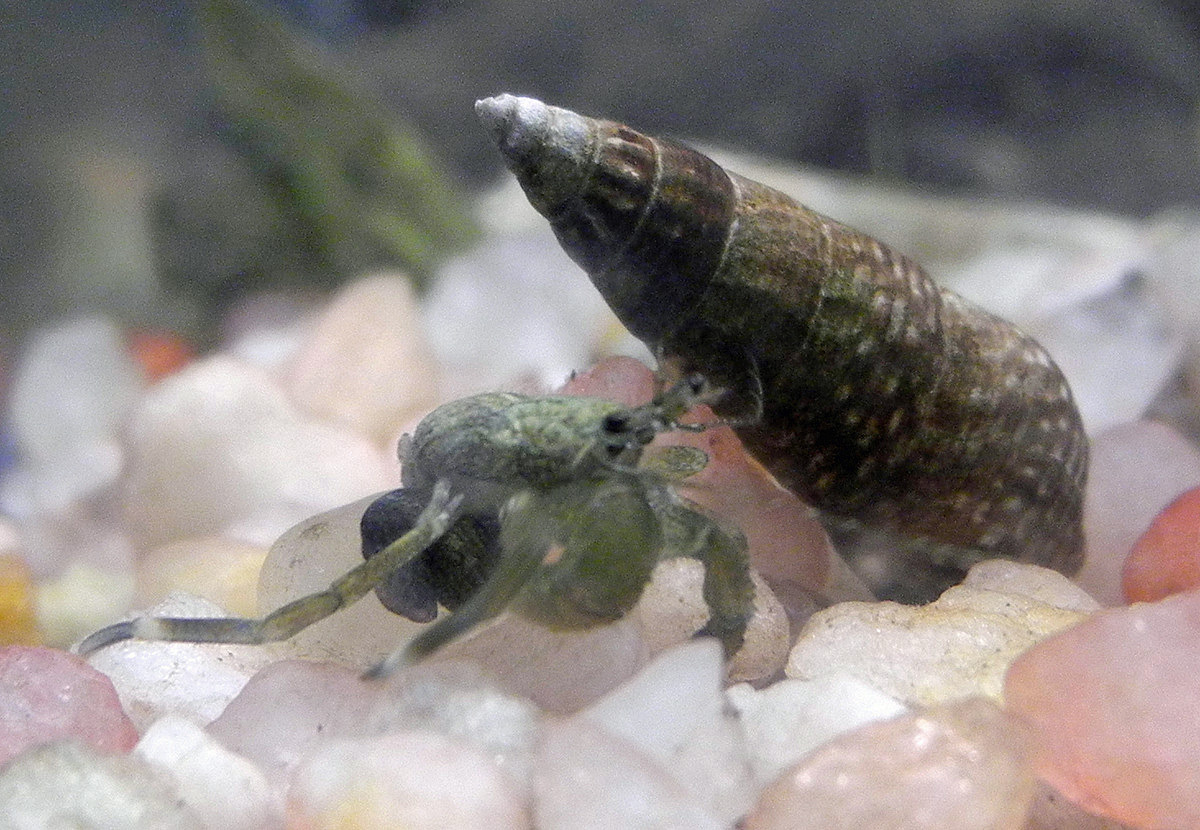
One of the larger, but still small, hairy hermits, in a periwinkle shell.


Monday, September 03, 2012

Of anemones and hermits

Back to the Campbell River series ...

Remember the wounded anemone I rescued on "our" beach? I kept it on the table in the motel, changing its water twice daily, and it seemed to be recovering. When we came home, it came with us, securely double-packed and wedged into a bottle holder on the car door, arriving here unfazed by the experience.

I had brought a litre of its "home" water with me, and continued changing it as before. But that couldn't continue; my guest needed a proper environment.

So. I have set up the little aquarium again*, with a new pump and water from Boundary Bay, tested for a salinity match - dead on! - and some eelgrass, aquarium gravel and beach sand, which came loaded with tiny worms. I brought along some snails to keep the place clean, and a few small hermits.

As usual, half of the snails turned out to be hermits, and the eelgrass was carrying more, miniatures. So the aquarium is bursting with life again.

And here s/he is! In the aquarium, alone as yet.

I've identified it as a burrowing anemone, Anthopleura artemisia. The heart-shaped marks on the tentacles were the main clue, as the colour varies.** These are solitary animals, often reproducing by cloning; right now, it's in the business of reproducing its own body. The circle of tentacles is almost closed, but the mouth area is still only half healed.

Anemones are predators; they catch and kill small fish and crustaceans. So we have been surprised to see how casually the hermit crabs climb over this one, even nibbling at bits of detritus or slime they find on the tentacles. As if they weren't venomous! And the anemone doesn't even bother to close down. It sure does if I barely touch it with a wet paintbrush.

Oh, Google! "Anemones + hermit crabs + symbiosis".
One of the best known examples of symbiosis is that between the hermit crab and a sea anemone (e.g. , Adamsia). The anemone is often found attached to the shell in which the hermit crab lives. ... Often, a sea anemone attaches itself to the crab's shelter and it may envelop part of the crab's own shell as well. ... As the crab moves about in search of food the anemone is brought into contact with a greater supply of food and the crab is protected by the anemone's stinging cells. (From The Encyclopedia of Science)

Of course! Now I remember how one of my previous hermits carried a white plumose anemone on his shell.

Rex, the hairy hermit.

This just goes one step beyond.

In the aquarium now, I have three species of hermits; the Grainy hand hermit, Pagurus granosimanus, ...


At Stories Beach. Red antennae, blue spots on green legs and pincers. And he likes a big, enveloping shell.

A slow mover, maybe because of that heavy shell.

... Greenmark hermits, Pagurus caurinus, ...

Orange on legs, pale orange antennae, without white spots.  A small species, looking like a young hairy. 

He's in the broken tip of a larger shell. They're a speedy race, not burdened with too much armour. This guy was off the edge of my hand and lost among the rocks before the camera was ready for a second shot.

... and the common Hairy hermit, Pagurus hirsutiusculus***. Like Rex, above.

*Wish us luck!

** For convenience, I think I'll be calling him/her "Val" for "Valentine", because of the heart-y tentacles.

*** Hirsutiusculus translates as "hairy tail". Granosimanus is "grainy hand". Sometimes the Latin names actually make sense. But Caurinus (the Greenmark's name) means "North-west wind". So much for relevance. And I still can't find that green mark!


~~~~~~~~~~~~~~~~~~~~


Once again, a reminder: Rock Flipping Day is next Sunday, September 9th. Instructions, history, etc.

Last year, several people wrote later, to say that they had intended to join in, but forgot until it was too late. So this year, I'm harping on the date. You can help by passing the word along. Thanks!

Thursday, December 22, 2011

Empty beach

Yesterday morning dawned clear and cold; there was ice on the birdbath again, but by noon the sun had banished it and the breeze was warm. A perfect day to go to the beach.

We hadn't been to White Rock since the day after the storm, back in November, the day I had collected the water that I believed had poisoned my aquarium. It was time to put unhappy memories behind us. We went to our usual spot on the White Rock beach.

A calm, sunny day. Setting sun warms the brown goldenrod heads.

We watched the train go by, I fed another bag of dry bread to shrieking gulls, we watched a kayaker or two. Then I went to the spot where I'd collected the last bottle of water, and started flipping rocks just below the high tide line. I wanted to either discard or confirm my conclusion about the water. Had the animals here suffered the same fate as mine at home?

There were no crabs under any of the rocks I flipped. No hermit crabs. No snails. No limpets. No worms. A few of the higher intertidal amphipods that always swarm on the bottom of these rocks. Just a few.

I walked west, flipping a few more rocks after every couple of steps. Nothing was alive but the amphipods.

I had covered about 150 metres when I found one tiny limpet and an anemone. A bit farther on, there were two limpets, one mussel, and a very small snail, small enough to have washed in after the tides had cleaned the area.

After this, the population of amphipods was denser. Then I found three more limpets, and one miniature hermit. No crabs, though.

Just before the 300 metre mark (measured on Google, at home), one of the stones sheltered a handful of baby crabs, about 1/4 inch across the back. That was reassuring. And a couple of dozen steps further on, I up-ended a large rock, and startled a crowd; too many crabs to count before they scuttled off, a half-dozen small hermits, a mediium periwinkle snail, and a number of black "pinhead" snails, like crawling grains of coarse sand, and under, over and around them all, a mass of slithering amphipods. Yay!

From here on west, just off-shore, a flock of goldeneyes were diving for supper. There had been no birds near the dead zone, except the gulls that mobbed me for my bread, and left as soon as the bag was empty.

So it seems that I was correct: something in the water was probably the culprit. Next time, I'll search in the opposite direction, to see if I can estimate the size of the affected area.

Rocks at the shore, and Common goldeneye.


Thursday, November 17, 2011

Living in glass houses

...you don't get no privacy.

It was 10 PM, so I went to turn off the aquarium lights. As usual, I looked in to see how things were going; everybody happy? No disasters, no panics? All was calm.

But in the back, half-hidden beside the pump, a pair of crabs were getting ready to mate. I went for the camera.

A tangle of legs. Ma Crab's back. He's underneath her.

It's hard to mate when you're encased in a rigid shell. Crabs have to wait until the female molts; when her new outfit is still soft and pliable, there's a brief window of opportunity, not to be wasted. Her consort, finding her in the process of opening up, grabs her, belly to belly, and holds on until she backs out of the old shell. This may take several hours, or even days. He may even help her with the process; mainly, though, he's making sure he's at hand when the moment comes, and that no other male gets her. (Not a problem for him in the aquarium; there's only one other male, still too young, but he's not taking risks.)

Since his last molt, Pa Crab has been ready, swaggering about with full-size pincers, often frightening the smaller female. Not today; this morning she was hanging around near him. Now, she has allowed him to embrace her tightly. In the photo above, you can see his legs, the striped ones, (hers are spotted) hugging her. Both of them hold their pincers up and away from the body, claws open. They move about, slowly, getting comfortable. After a bit, they squirm down underneath the pump, where they are more private.

I don't know how long it will be until they mate.

Sculpted curves and "teeth" of the female's carapace. Two of her pincers, one of his.

Thursday, November 03, 2011

A multi-species community

These are a few of the larger intertidal critters from the aquarium, photographed in the course of a tank census:

Three different shells; from right to left, Nassa snail, Asian mud snail, and barnacle.

Barnacles usually live attached to rocks or other solid materials. When they break off, the base gets left behind and the barnacle dies. Occasionally, one detaches from the rock without breaking. This one has most of the base intact, so it is still alive and feeding. Look closely to see the pale tentacles at the mouth.

The Nassa shell, on the right, has several round holes drilled through it, the work of a carnivorous snail, such as a whelk. Once the hole penetrates the flesh, the whelk injects paralyzing and digestive enzymes, which dissolve the snail inside. Often, once the shell is vacant, I discover the tentacles of worms waving from these holes.

Rockweed isopod, about an inch long. The flash makes the red seaweed glow in neon reds. Under normal lights, it is a bit paler than the burgundy Turkish towel that the isopod is feeding on.

The second isopod. Look closely; on the back, it is carrying a small shelled animal, probably a limpet.

Head of a polychaete worm, out looking for a meal. They rarely leave the sand completely, and retract almost instantaneously at any disturbance..

One of the round algae-eating periwinkles, with an amphipod taking a short break.

At least four species of snails live in my tank: Nassas, mud snails, periwinkles, and the tiny lacunas; these last may be so small that even with a lens, I am hard put to determine whether they are snails or sand grains until they move. Their eggs often come home with me on blades of eelgrass.

Underside, through the glass, of a very small anemone. 

This anemone sat for weeks on a stone, and then went wandering about. It has now hidden itself. I have never seen that "petal" effect on the base before.


The youngest crab, raised in the tank from babyhood. 

And my new mascot, found in a thrift store. $0.50; I couldn't resist.


Powered By Blogger