Showing posts with label shells. Show all posts

Saturday, February 23, 2019

About broken shells

The lighting around my aquarium always varies, from morning sunshine to rainy-day blues, to snowy whites, to indoor yellows. I take a few photos at random, just to check the lighting of the moment. This was one of them.

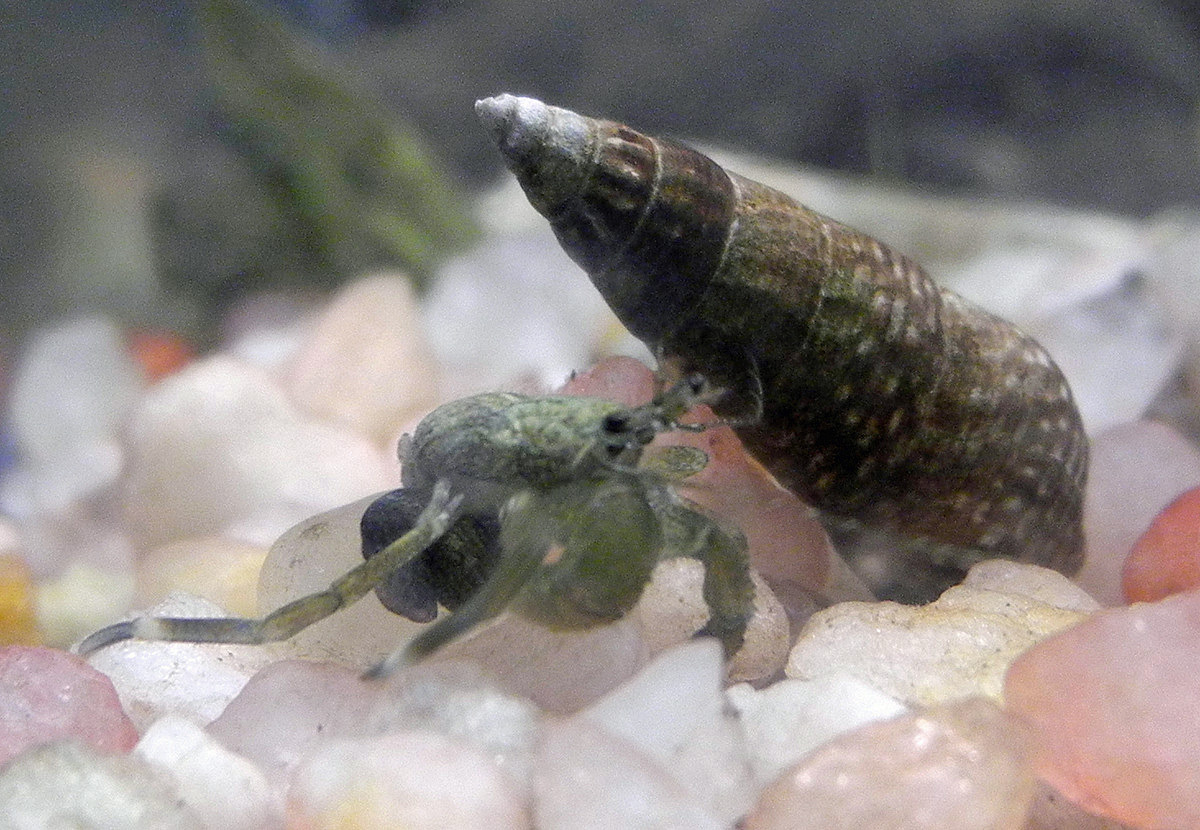
Hermits (3; can you find the 3rd?), holdfast, red algae, broken shells, marine "snow".

The littlest hermit, in the centre, has a couple of big holes in his shell; from one angle, I can see through and out the other side. He seems happy enough in it.

That orange mass is the remains of an old kelp holdfast. I added it to the tank months ago, still wearing its outer skin, and populated with diatoms and assorted bits. The hermits cleaned it completely in a day or two, as usual. Now it looks bare; just the clean, orange twigs, but every time I pull it out, thinking to discard it, there are several hermits and a clan of amphipods on it, so they must be finding something to eat there. And I put it back.

The big shell in the back is a moon snail shell I added two summers ago. It was intact then, but even without wave motion and rolling rocks to break them, shells gradually disintegrate in salt water, so that picking up the shell now, even gently, causes edges to break off. About half the shell is gone now. This deterioration of a shell provides calcium for the living snails' shells.

To build shells, organisms extract calcium ions (Ca2+) and carbonate ions (CO32-) from seawater, which combine into the solid crystals of calcium carbonate (CaCO3) that shells are made of.  (Woods Hole Oceanographic Institution)

Acidity in the water (such as the water I'd brought home from the "improved" boat launch) causes shells to dissolve more rapidly, both on leftover shells and the growing shells of live snails. A new study by Woods Hole OI examined the effects of rising CO2 on marine invertebrates. Some tolerate it, others don't. Some don't survive, as their shells provide less protection from predators and other stresses.

Ries and colleagues found that species with more protective coverings on their shells and skeletons—crustaceans, the temperate urchins, mussels, and coralline red algae—are less vulnerable to the acidified seawater than those with less protective shells, such as conchs, hard clams, and tropical urchins.
All of the test organisms continued to create new shell throughout the experiment, Ries said, but some suffered a net loss of shell because older, more massive portions of their shells dissolved under the highest CO2 conditions. (Woods Hole)

Just another reason to monitor the acidity of my aquarium.

(Also see: As The Oceans Become More Acidic, Sea Snail Shells Could Dissolve.)

Thursday, October 11, 2012

The quest

The hermit crabs in my salt-water aquarium are very tiny, but they're growing fast. And growth, for a hermit, means getting new clothes. I've provided them with a selection of empty shells, but just like growing kids, they have their own preferences.

I caught a couple of the hairy hermits involved in a discussion over a pretty white shell occupied by a green hermit. Brownie, in a boring mud snail shell, wanted to switch.

By the time I had the camera in hand, he had won, and Green was naked.

(Photos taken through algae-coated glass.)

"A perfect fit!" says Brownie.

And, "What shall I do?" says Green. Note the black belly, normally hidden in the shell.

"May I have your shell?"

"No, you certainly may not!" (Pulls hood over head.)

Brownie's discarded outfit.

"Does this fit me?

Taking its measure. Too big.

"Life's not fair! I can't run around in public like this!"

On with the search

Brownie, up in the eelgrass, watches, chortling.

"This one fits, but it isn't my style at all.  It'll have to do. For now."

Shopping time: 12 minutes. A long time for a tiny hermit to walk about in the nude.


Monday, December 06, 2010

One thousand, four hundred and fifty snail shells

We spent Sunday afternoon at a pre-Christmas antique fair. This particular fair is always billed as "Retro Design and Antiques". I'm not sure what that means, but what we find is a hodge-podge of antiques and old "stuff". This time, Laurie bought Japanese porcelain and some jade, as usual, and a tiny amber teapot, with insects embedded in the amber.

I bought a couple of old boxes, not antiques, fairly cheap.

I often see boxes and plaques decorated with flowers and leaves formed out of tiny shells, mostly pink and yellow macoma clams. I skip those; they remind me of the handcrafts we always did at summer camp, a perennial source of frustration for me; I never was good at following someone else's pattern.

This box is covered in glued-on shells, but it's different. It celebrates the shells themselves, instead of trying to make them into flowers.

1,450 snail shells on a 6x4.5 inch box.
 Front, back, sides and top are decorated with only snail shells. They all seem to be the same species*; same size (6-7 mm), same number of whorls, same shape of opening. But the colours and patterns vary considerably.

Browns, pinks, greys, black and red. Rays, dots, and stripes.

Detail of top.

A red and black striped snail shell.
 I have no idea where these snails were collected; the box is home-made, and has no label or other markings. Could be anywhere in the world; one of those curios that travellers brought home as souvenirs or gifts. No matter; I'm going to just enjoy examining them, all 1,450 individual critter houses, one by one.

Looking from the Richmond flats, over Vancouver, to the North Shore mountains. Just a hint of snow, so far.
On the way back, the sun shone so warmly that I had to turn off the car heater. I took this photo as I drove, holding the camera one-handed on my shoulder. A perfect ending to a happy day.

*UPDATE: Snail, in the comments, identifies them as Umbonium. (Compare these photos.)

Friday, October 29, 2010

The fashionable hermit

Spirals are in ...


With a wide selection of shells available, a young hairy hermit chooses to wear cutoffs with a pearly lining.

Saturday, October 10, 2009

A trio of snail shells

I've been sorting photos for the last couple of days. What to store keep, what to load to Flickr or Facebook, or share on the blog, what to dump? Decisions, decisions ...

I found these photos of some of my favourite shells.


Snail, probably from my son's collection -- Mexico, Central America, maybe.


Source unknown. It has the feel and texture of ancient clay pottery. About 1 inch tall.


Underside, showing central well.


Looking down through the spiral of a moon snail with a broken tip.


Moon snail, for reference. handful-sized. From BC, probably.

Time to quit for the night. My eyes are burning. G'night!
.

Friday, April 24, 2009

These books you must -- must -- see!

I'm passing on a link from BugGirl's Blog: she found
"... this lovely artwork from BiblioOdyssey. It’s from a Ukiyo-e book from the late 1700’s."
There are 3 books; Insects, Shells, and Birds; and well over 100 paintings, each with its associated poem and translation.


There is even a bagworm page!*

This link takes you directly to the online museum exhibit. (You have Flash, right?)
"OMG is it beautiful." says BugGirl.
*Bagworm poem:
On a pitch-dark night
when one can't even guess
which way is East or West
the bagworm hides his lust
in a cloak of invisibility.
It wouldn't apply to Canadian bagworms, would it?

.
Powered By Blogger