Showing posts with label bagworm. Show all posts

Friday, December 02, 2011

Now you see me ...

Wednesday had been such a bright, summery day, and we'd spent it in traffic and malls. But we got home with maybe half an hour before the sun set and the chill returned, so I dashed across the street to the vacant lot, to get at least a taste of wildness into the day.

It had been raining off and on for days, so the ground was soggy and puddly. The plants, except for a dandelion and two fading daisies, were all dry stems and crumbled brown leaves. Only the goldenrods held some shape. I picked a handful and headed home; the sun had already dropped behind the evergreens to the west, and the wind was cold.

When I spread out the goldenrods at home, two spiders and a black stick that wriggled dropped out.

I posted the tiny jumping spider yesterday; here is the second:

Hunting spider, blending in to the shapes and colours of the goldenrod.

I tried to photograph the spider on the table; she wasn't interested, so I caught her and replaced her on the plants. Then I spent a good part of the evening looking for her. She was so perfectly camouflaged that I could look straight at her and not see her until she moved.

She's somewhere in here, but I can't see her. A few seconds after I took the photo, there she was, in plain sight.

Goldenrod flowerhead, now fluff, and seed with parachute.

The tiny stick that wriggled was about the size and colour of the seeds. Worse; it was clinging to a bit of the fluff, which made it look even more like a seed. But it was moving, slowly. I brought out the lens.

Bagworm moth larva, 5mm long, with only head showing.

It's a bagworm, the second I've seen. (Dahlica triquetrella, on a wall.) This one doesn't look like the same species, however; the body pattern is different, and instead of sand, it has chosen bits of the goldenrod to make its case.
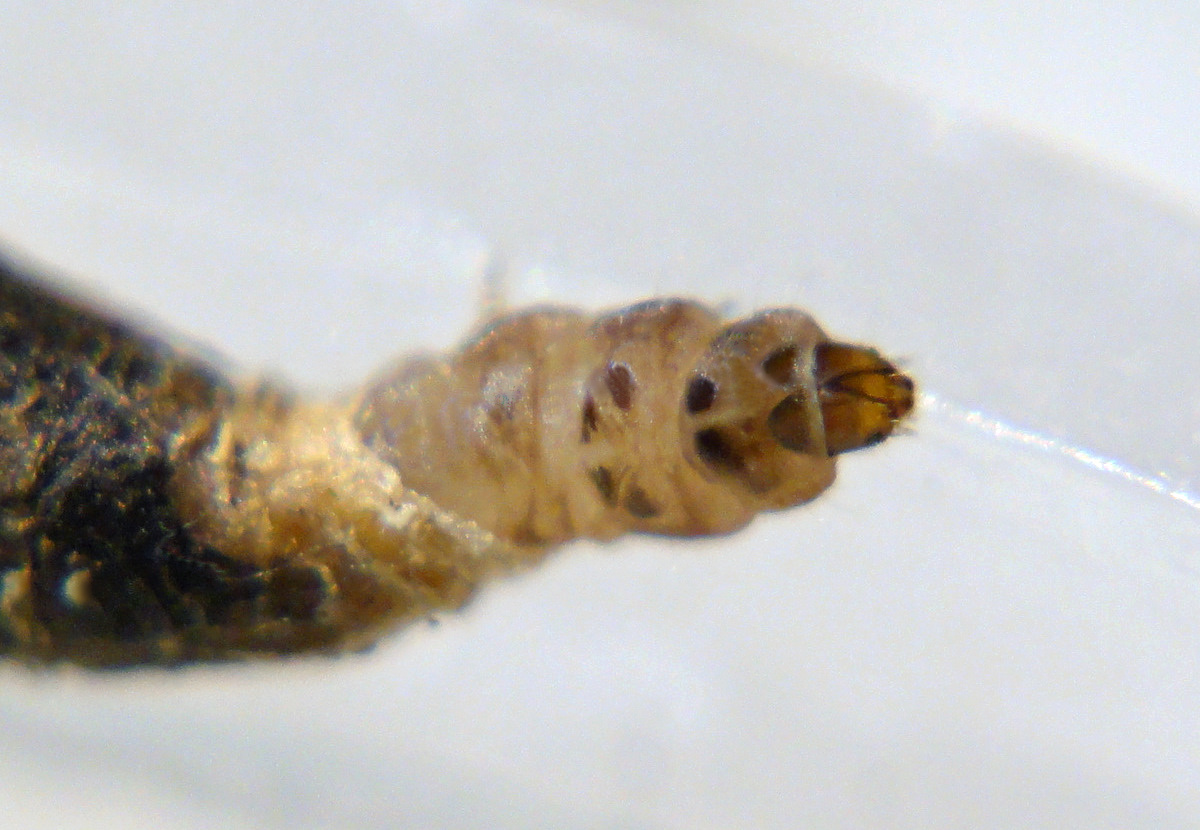
Head end.

Bagworm moths live all or almost all their lives in these cases. Some species are parthenogenic; there are no males, and the females lay their eggs without needing fertilization. These females never leave their cases. Males of other species do, but only to find a female and mate; then they die.

Larvae hatch from eggs inside the mother's case, leave and immediately start building their own case, using materials and patterns specific to their species. The case has two openings; the head end, where the larva stretches out to walk about and to eat, and the tail, which allows the worm to excrete waste materials.

Some cling to walls or stone, where they eat lichen. Some hang from evergreen trees and eat the needles; a large infestation can seriously damage the tree. This one probably eats goldenrod leaves, and it seemed, watching it, that it was also eating the fluffy parachutes of the seeds. The leaves are dry and brown by now, anyhow. When it has eaten enough, it will pupate and wait out the winter in that state.

Making the case out of local material, in this case goldenrod fiber, helps to protect the moth by making it blend in to the background. Once I had replaced the bagworm on top of the goldenrod, and looked to see how it was managing, I couldn't see it at all.

I shook out a lot of the fluff and examined it, shaking it and blowing it about for a while, until I found a second larva.

4mm. Much more timid; by the time I'd brushed the seeds away from it, it had retreated into the case and refused to come out.

One last critter showed up in the pile of sorted fluff; a small ladybug, the eleven-spotted lady beetle, seemingly dormant. When I moistened the cloth she stood on, she woke, took a drink, groomed herself, struggled past the clinging seeds, and flew away.

Coccinella unidecimpuntata, 5 mm. long. Not camouflaged at all.


Friday, April 24, 2009

These books you must -- must -- see!

I'm passing on a link from BugGirl's Blog: she found
"... this lovely artwork from BiblioOdyssey. It’s from a Ukiyo-e book from the late 1700’s."
There are 3 books; Insects, Shells, and Birds; and well over 100 paintings, each with its associated poem and translation.


There is even a bagworm page!*

This link takes you directly to the online museum exhibit. (You have Flash, right?)
"OMG is it beautiful." says BugGirl.
*Bagworm poem:
On a pitch-dark night
when one can't even guess
which way is East or West
the bagworm hides his lust
in a cloak of invisibility.
It wouldn't apply to Canadian bagworms, would it?

.

Thursday, March 26, 2009

The "I can't believe it's a moth!" moth.

Spring! Finally! The sun shines, the birds are looking for construction materials, and the insects have appeared. About time.

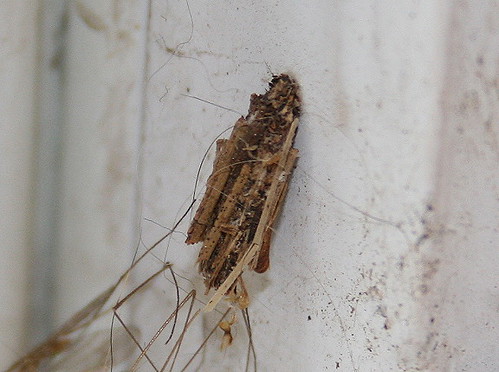
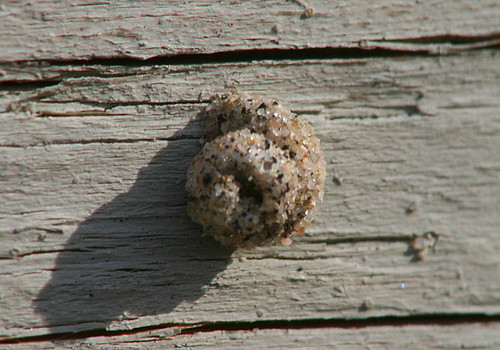
On a sunny wall, last Saturday, a few dozen dark "grains of rice" were hanging. Close up, they turned out to be coated with sand.


A few were moving; they had some sort of larva poking out of the upper end.


I touched one, and it came off in my hand, so I dropped it in a plastic bag and brought it home.


Left alone in a tin, it crawled out of the case, and began moving around, dragging the case behind itself.


With a ladybug, for size comparison. It is about 8 mm. long.

I propped the viewing tin up on its side, to give the larva a wall to climb on. It went up to the top, over to the middle of the top, and dropped on a long silk to the bottom. Then it climbed up the silk, stretching out of the case, grabbing the silk, pulling the case up after itself until only the head was exposed, stretching out again ...


Later, it attached itself firmly to the top, and went into hiding. It is still inside, three days later.

What is it? I had no idea. What makes a case out of sand, besides the aquatic caddisflies?

A bagworm, Dahlica triquetrella. Which is a moth. A moth with no wings, eyes, or mouth. A female moth, in a population without males, at least while they're in Canada.

It gets weirder still.

The adult moth, in Canada, is parthenogenic; always a female, but needing no fertilization by a male. All the offspring are female. In Europe, where they originated, some are parthenogenic, but others do produce males, and reproduce sexually.

The parent produces her eggs, and then either lays them in the case, or dies there with them still inside her body. Laid or unlaid, they hatch. They even hatch if the case has been eaten by a bird; the eggs pass unharmed through the bird's digestive tract.

The newborn larva leaves the parent's case, and builds her own; a silk bag pasted over with grains of sand. The bag has three sides, a hole at the top for eating and moving about, and a hole at the bottom for waste discharge. Where there are males, in Europe, the mature male moth leaves through this bottom exit.

The larva wanders around, dragging the bag behind her, eating lichen, until the fall, when she attaches herself to a handy tree or wall to wait out the winter. She is still a larva; she will not pupate until the spring.

When the spring thaw comes, she pupates. This would be the stage where my specimen is now. I could not find out how long it lasts, but soon enough, the adult emerges. If "emergence" is the right word; the adult moth stays inside the case.

Not that we would recognize her as a moth, if we found her outside the case. She has only vestigial wings, if any. She is eyeless and has no mouthparts; she doesn't eat. She looks more like a worm than anything else.

She lives inside her case for a few days, lays (or doesn't lay) her eggs, and dies. If she leaves the case at all, it is only to lay her eggs back inside the case (through the sides, not the top or bottom hole), die and drop to the ground.

In this area, there are two species; this one, Dahlica triquetrella, and another, Dahlica lichenella, so far seen only near the Alex Fraser bridge. The only photos I have found of this latter one are distinguished by its choice of lichen as a covering material.

Seabrooke, over on the far side of Canada, has photos of a couple of species of bagworm; this one covers its case with sticks, and this one, the snailcase bagworm, uses sand, like the D. triquetrella. The Backyard Arthropod Project has a snailcase bagworm empty bag, and details of its lifecycle; slightly different than triquetrella, as far as diet and timing goes, but still parthenogenic and confined to her bag.

This kind of lifecycle leaves me full of questions. If the female never leaves her bag to interact even with other females, and each of her offspring is basically a clone of the mother, how does the species survive as a species? Would they not gradually change in different ways until each one is almost a species to itself? How did they survive when they first arrived in Canada (first sighting, 1941), if they were "used to" reproducing sexually back home in Europe?

And: how did anyone realize that they were moths?

.
Powered By Blogger