Showing posts with label antiques. Show all posts

Tuesday, December 21, 2021

Solstice peacock

Today was the shortest day, the longest night of the year up here in the northern hemisphere. And by this time next week we'll have gained a whole minute of daylight. Woo hoo!

Solstice peacock, looking back into the dark, forward into the light.

(Vintage double peacock vase, cast iron, possibly of Iranian origin. Hangs out around my house, keeping four eyes on things.)

~~~~~~~~~~~~~~~~~~~~~~~~

Hoy fue el dia más corto, la noche más larga del año para nosotros aquí en el hemisferio del norte. Y para fines de la semana, habremos ganado un minuto entero de luz. ¡Maravilloso!

La foto es de un pavo real que mira para  atrás hacia la oscuridad, para adelante hacia la luz. Es un pájaro doble antiguo (no sé si es una antigüedad o nada más viejo), hecho de hierro y posiblemente de origen en Irán. Anda por mi casa, con los cuatro ojos observándolo todo.

Sunday, April 26, 2015

Great-great-great and then some

Sorting through Laurie's collection of antiques, I found an ant. At least, I think it's an ant. It's all scrunched up, in the centre of a blob of amber made into a pendant.

Amber drop, 4 centimetres tall.

I count 3 legs on this side.

I remember buying this; the dealer said it was a spider. We brought it home and Laurie put it away carefully and I forgot about it until now. It doesn't look like a spider to me, now that I look at it.

Here's the back side of the pendant:

That paler bit could possibly be a spider abdomen, but it looks more like an ant gaster.

What do you think?

And I wonder how old it is; whether it still has relatives in this modern world. Poor lonely ant! (If it is an ant.)

From Wikipedia, I found a range of possible ages and sources; I have no idea where this piece fits, though.

 Amber becomes abundant long after the Carboniferous, in the Early Cretaceous, 150 million years ago, when it is found in association with insects. The oldest amber with arthropod inclusions comes from the Levant, from Lebanon and Jordan. This amber, roughly 125–135 million years old, is considered of high scientific value, providing evidence of some of the oldest sampled ecosystems. (From Wikipedia: Amber; Geological record.)

The Baltic region is home to the largest known deposit of amber, called Baltic amber or succinite. It dates from 44 million years ago (Eocene). It has been estimated that these forests created more than 100,000 tons of amber. (And Wikipedia: Baltic amber.)


Saturday, December 20, 2014

Something old

I have three small antique Chinese ginger jars, the everyday, cheap earthenware pots that were used in every home. They were found on Vancouver Island, buried in a garden, and are much the worse for wear. I use a couple of them to hold small tools and brushes that I use in the aquarium.

Today, I was looking more closely at the old glaze, and took a few close-up photos. Laurie says they look like fields of flowers.

Glassy crystals, pitting, and old earthenware showing through.

Almost like frost patterns.

The third pot holds some real flowers; dried pearly everlastings from a few years back. They seem to fit in with the pot design.

Pearly everlastings, Anaphalis margaritacea.

These grow by the roadsides in dry spots, and are dry and stiff even freshly picked. And they keep for years, as bright as the day they were picked. I always have a jar of them somewhere around the house.

The small whitish to yellowish flower grows in a corymb inflorescence. The inflorescence's most conspicuous part is the numerous white bracts that surround the actual flowers. (Wikipedia)


Monday, March 10, 2014

All the colours of the rainbow

It stopped raining. The sun showed up to work. While I went out and tidied the garden, Laurie took my pocket camera and went for a walk. He found a yard full of crocuses, purple, yellow, and deep, deep blue.

About time!

A hermit crab went out, too. Outside the tank, at least.

"Can't eat this green stuff. Put me back!"

And the cat stayed home and did what cats do.

Antique Japanese ceramic cat. Sleeps 24/7/365.

(I was trying out a new lens, 85 mm. Good for sneaking up on bugs without scaring them off.)


Thursday, February 21, 2013

An oldie but a goodie

We don't have to go to the beach to find intriguing marine invertebrates. Last Sunday, we went to an antique fair, and I came home with an ammonite from Madagascar, split in two to show the chambers.

The two halves, face to face.

The ammonites were prehistoric crustaceans, living at the same time as the dinosaurs, and going extinct with them. They are related to our modern squids and octopuses, and more remotely, to the nautilus, which they looked like.

Artist's reconstruction of Astroceras. Wikipedia, art by Nobu Tamura (http://spinops.blogspot.com)

Fossilized ammonite shells can be found all over the world, with an interesting lode occurring just "next door", in Alberta; these can be highly iridescent, and are sold as gemstones. Others may be filled with chalk, sandstone, pyrite; whatever sediment and minerals are prevalent in the layer where the ammonite is found. My son has an uncut ammonite he found on a mountainside, a charcoal grey, fist-sized, coiled lump of granite. The fossils show up in all sizes, from 1 mm. to over 6 feet across. Mine measures just over 3 inches.

The animal lived in the front end of a series of chambers (camerae), divided by curved walls from the older ones. As the creature grew, always moving to the new room on the front, it sealed off the inner chambers, except for a thin connecting siphon, creating a sort of flotation device that could be filled with water or gas as needed to rise or drop in the water column.

The meaty part of the animal was not often fossilized; what we find are the empty shells, now filled with an assortment of minerals.
Beyond a tentative ink sac and possible digestive organs, no soft parts are known at all. They likely bore a radula and beak, a marginal siphuncle, and ten arms. (Wikipedia)
Sometimes the fossils contain smaller fossils: the animals that the ammonite had eaten, giving us a clue to their life style.
Ammonites were the predators of their time, feeding on most living marine creatures including molluscs, fish and even other cephalopods. By analogy to modern cephalopods, their method of attack probably comprised of silently stalking their prey, then rapidly extending their tentacles to grasp the target. Once caught the prey would be devoured by the ammonite's powerful jaws, located at the base of the tentacles, between the eyes. (From Discovering Fossils.)
This I learned from the web. What can I learn from the critter in hand, itself?

Closer view, showing half the diameter of the shell.

The outer chambers are filled with fine sandstone, with a few larger grains spotted about. Each chamber is divided off by a wavy wall (septa). As we move to the internal sections, the filling changes to crystallized stone, in varying tones of red, and translucent. (That inner spiral looks like sugared fruit; appetizing, but hard on the teeth!) Several chambers are hollow, lined with sharp crystals, slightly purplish, a pale amethyst hue. There seem to be the remains of communication pipes through the walls.

Zooming in on a pair of chambers. Two tubes enter or leave each side of the chamber.

I wondered why there was such a difference in the filling material. Why are the larger chambers filled with sand, and the inner ones with crystal? Back to the web . . .
The body chamber is the final, longest chamber, in which the ammonite animal actually lived. It is not divided by sutures and is often fossilised in a different colour to the phragmocone chambers, as sediment readily filled it after the creature died and its soft parts rotted away. The chambers of the phragmocone however, are largely sealed off from the body chamber, and because of this they are usually mineralised over a longer period, due to percolation of mineral rich water through the shell. (From An Introduction to Ammonites, UK Fossils.)
There is still more variation; each of the larger chambers has collected its own load of sediment, and seepage has tinted the outer sections, creating beautiful patterns.

Detail of first and second chamber filling.
Ammonites from Madagascar and Alberta can be iridescent. This one is from Madagascar. Unfortunately, it is badly worn, and only hints of the iridescent coating are left on the outside of the shell; glints of red and green along the broken edges.

Iridescent ammonite, from Wikipedia.


Thursday, December 27, 2012

Christmas; a report

I've been quiet the last few days, but here's what we've been up to.


Christmas dinner was a fun affair. We held it a few days early, because of people's work schedules; one is a nurse, who always works Christmas Eve or Day; another manages a store that opens 365 days a year. But meeting early only increases the fun, since those who have other family can take in two or even three family gatherings.

So this year, about thirty of us gathered in my daughter's new home, in the back half of their antique church/wedding chapel (so it was a house-warming, too); all ages, from a babe in arms to several great-grandparents; old friends and new in-laws. The usual mix-ups: the last-minute notice that, after all, the stove would not be delivered on time, so several of us brought hot-plates; the waiting for late-comers, while we early birds demolished the appetizers and sampled home-made booze; the non-functional lock on the new bathroom door: it all contributed to the feeling of family pulling together. What it's all about, isn't it?

Tree in my daughter's formal living room, made informal by misplaced chairs and stacks of gifts.

But it had its edge of melancholy, too. Laurie was not with me this time. The long drive to Chilliwack, coupled with a late night, was too much for him, because of his injured back, still not completely healed. Two of my sons are in Mexico, this year; we missed them and the kids. Others have health issues. Time goes on, and it's not always kind.

Oh, but the unalloyed joy of the little ones! The excitement of a toddler stumbling after her running older cousins! The serious conversation with said toddler beside a Christmas tree about balls and trees with little boys crawling underneath! The delight of plates and plates and plates of crackers and cheese and gingerbread! With no-one supervising little hands except tolerant grandparents! The mounds of rattling, torn Christmas wrapping for an 8-month old girl to rustle!

Back to earth. Yes, it was a good Christmas.

Laurie made me a card, with his own poem, and gave me, among other things, an antique Japanese ceramic cat.

She already has her favourite spot picked out, on an antique cheese box and reproduction rag rugs.

The 24th and 25th, we spent quietly at home. It was probably unwise to get a flu shot almost on the spur of the moment on Christmas Eve, but then we shouldn't have put it off so long, either. Usually, the shot has no noticeable effect, but this year, both of us were wiped out by it. I couldn't stay awake through a whole conversation all day Christmas. It was almost as if I'd overdosed on trytophan; I hadn't. I ate leftover chicken soup, because I wasn't up to cooking.

But the family and friends Christmas celebrations went on, and I have been following them on Facebook. Every hour or so, there's a new batch of photos and comments, mostly of the younger set. I don't know how we ever got along without this marvellous web before!

And now we've got the preparations for New Years Day, and after that, Dia de los Reyes, January 6th, to think about. The Twelve Days of Christmas have barely started.

I'm thinking about making pozole*, since for Christmas dinner, we did more or less traditional Canadian. (I made my grandmother's sweet yams, with brown sugar, butter, and mini-marshmallows. Yum!)

*Recipe #28 in this list. Or maybe, if I'm energetic enough, I'll make green chile tamales. (Recipe #32.)

I hope all your Christmasses were as good!

Saturday, November 24, 2012

Granny Dressup, Smiley the Elk, and a Snarky Princess

Still rescuing old, forgotten photos ...

Every place we go, we always visit the antique/secondhand/thrift stores. No telling what we'll find, and each location has its own quirks. At Willow Point, in Campbell River, LJ's  Past and Present Curios is a favourite. The owner has three stuffed BC mammals. (She's not responsible for what's happened to them in the past, she says, but at least she can give them a good home now.) She loves to dress them up with her wares, trying to fit their personality.

Granny Otter, with her reading glasses and shawl.

A cheerful elk. Not For Sale, the sunburst on his nose says. Sometimes the antlers serve as jewelry  holders.

How do you tell the difference between an elk (Canadian usage) and a moose? The moose is bigger, although you can't see the size here. But the moose also has a heavy, drooping nose (see here); the elk is more deer-like.

In Europe the moose is called an elk. And the elk is a wapiti. Which is a kind of deer. Latin is better; the same everywhere. Alces alces is the moose. (Yes, you can translate that to Elk elk. Just to keep you properly confused.) And the elk (our elk) is Cervus canadensis. Cervus means "deer".

The snarky Princess. I think she's an ermine or weasel.She's standing on the counter, maybe 16 inches tall.

The animals are pets, after a fashion. They are not for sale, but their clothes are. This summer, they were outfitted differently.


Tuesday, November 13, 2012

With the head of a dragon

Learn something new every day; they tell you it will keep you young. I don't know about that, but at least it keeps me interested.

I've been learning how to swap backgrounds on my photos. I keep forgetting the commands, so I worked far too long on it last night to do a blog post afterwards. Here's what held me up:

An antique jade turtle with a dragon's head, a Chinese symbol of longevity. It's a tea or sake pot that holds about a shot glass of liquid; the smaller turtle is the lid. I photographed it on a white sheet, for easy selection, then pasted a design from a card over the sheet, taking on the contours of the fabric.

This is fun! Not exactly appopriate for insect and bird photos, unless I mention at the time that the background has been changed, but it may be helpful when the insect in question prefers the wood of my desk to the leaf I have so carefully provided.

Tuesday, March 20, 2012

Windows to gladden your heart

I'm still sorting old photos. Laurie took these in my daughter's antique church/wedding chapel near Chilliwack, at the eastern end of the Fraser Valley. (She and her husband are photographers; this is their headquarters.)

I simply love the colours.

Stained glass window high in the entrance, below the bell tower. The looped-up bell cord and the rim of the bell are just visible in the dim interior.

Round window in the nave, with treetops outside creating water and flame patterns.

The church dates from 1886; these would be the original windows. The bell cord has been replaced, probably several times. The bell is still rung for each wedding.


Friday, March 02, 2012

Menagerie

The weather continues as before. Rain, mist, sunshine, rain again. Another day inside four walls.

If I can't go out and find things, I can at least prowl around my house and take photos of some of the animals that "live" here. I picked these three up at antique fairs; I don't think they're really over 100 years old, just sort of old. Maybe they'd qualify for the "Vintage" group.

A jade goat. There's just a hint of green in the right light. He's resting on a Central American men's cape.

Mythical animal, much battered, in jade. With the cape and a Chinese pot.

Mr. Froggie. I don't know who made him or where. No matter; I think he's cute.

If this weather continues, maybe I'll just go birding inside. We'll see.


Tuesday, February 14, 2012

Hearts and Flowers for Valentine's Day

This was my grandmother's purse, long, long ago. I wonder; did she carry her lacy handkerchief in it when she walked out with my grandfather? There isn't room in it for much else.

It went well with her ribbons and lace collar.

Detail


Sunday, April 17, 2011

Something old, something new.

We can't resist a good antiques fair. Even if the venue is colder inside than it is outside in the rain, and crowded, besides, so that we are constantly bumping into or being bumped by other enthusiasts; even if the closest parking is blocks away, our feet are sore, and our bags heavy. It's worth it all to see the beautiful things people have created, so long ago, and the ingenious, practical, or just wacky ideas they came up with.

Laurie has been collecting Japanese porcelain for years, and more recently, Chinese jade. I look at everything, enjoying the glimpses into an older, sometimes comforting, sometimes strange and foreign world. I learn something new at every fair.

Yesterday, Saturday, we bought several good jade carvings; mythical beasts, a dancing shaman/cricket, a sensitive father/son portrait. And in the Baker's Dozen Antiques stand, I found this ghostly mask:

Fine wire mesh mask with painted features, copper trim, and cloth ties to hold it in place.

Red, well-shaped lips, and a wavy mustache. The nose is a mere crease in the mesh.

The mesh is so fine that the mask allows the back of the child's chair and the face of the painting behind that to show through. Only the eyes and mouth mark the character it portrays.

I'd never seen anything like this before, so I had to research it when I got home. It is an Oddfellows mask from the end of the 19th century.  They used these in their initiation ceremonies; every member except the newcomer wore a mask, although he was blindfolded, so the masks were not meant as disguises. Some descriptions of the ritual - dunking him in water, rolling him in the shrubbery, rattling chains at him - sound as if it were mostly horseplay, maybe a spoof of more serious rituals from other societies.

Here are a few photos of similar masks.

Close-up of the eyes. I moved the mask away from the painting. The "headband" is the edge of the chair seat.

I didn't buy this, although I was tempted. After a pep talk I had given Laurie on the way there, about not buying anything if we didn't have a place to display it, I felt silly about suggesting it, even. Now I sort of wish I had; I think I know where I would have hung it.

It had been cold and windy, with a bit of rain when we went back to the car to get our lunch. But when we left in the afternoon, the sun was bright and warm. The residential district we crossed on our way back to the bridge was lined with trees in full bloom, mostly cherry and star magnolias. I stopped so we could take a few photos.

Pink star magnolia.

Pink and white.

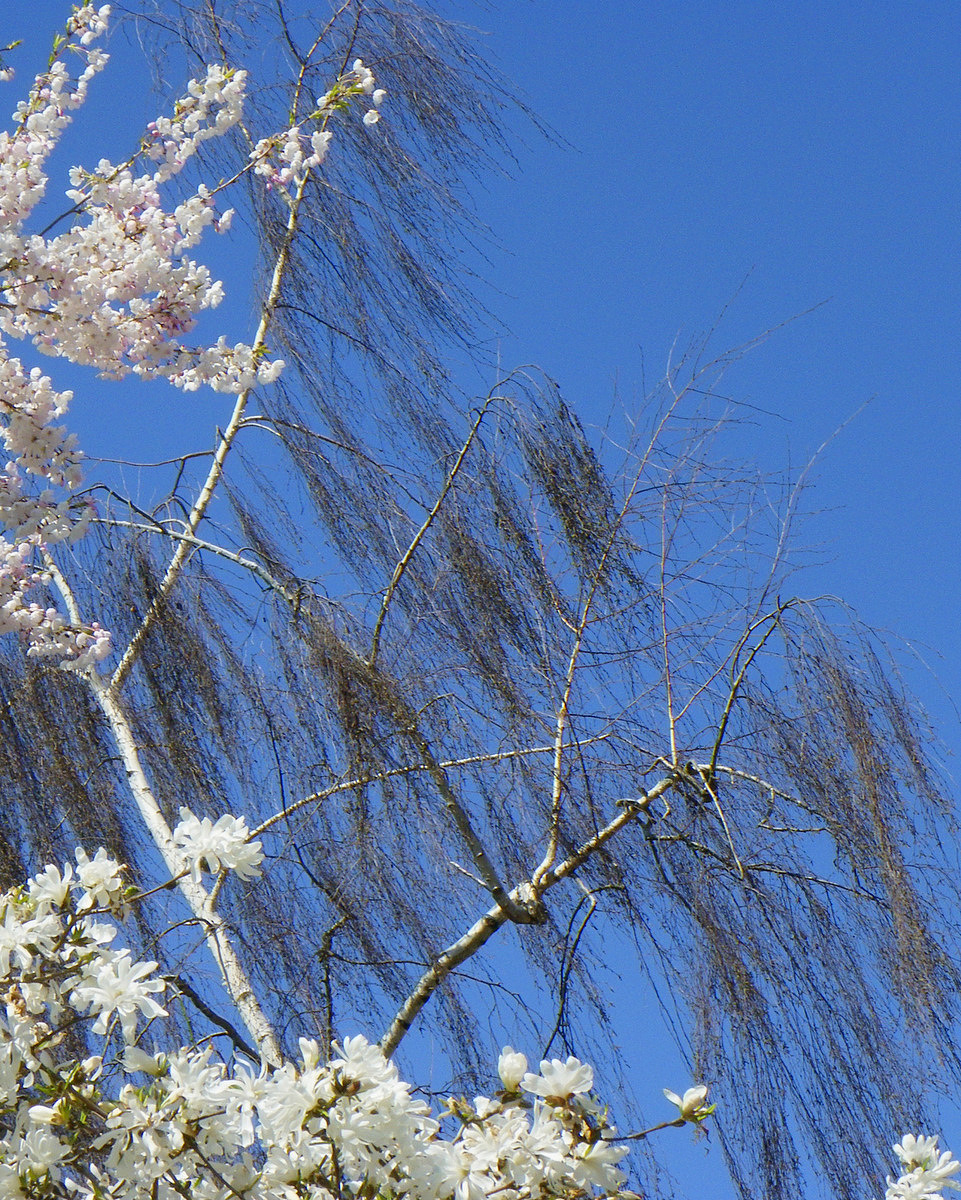
Laurie's favourite. Cherry, magnolia, and feathery branches blowing in the wind. What is that tree?

In the lawn underneath a magnolia, tiny blue flowers, Veronica, I think, nestled in the grass.

At home, I parked the car, yawned, stretched and groaned. Oh, my back! And then we said, almost in unison, "A very good day!"

Monday, December 06, 2010

One thousand, four hundred and fifty snail shells

We spent Sunday afternoon at a pre-Christmas antique fair. This particular fair is always billed as "Retro Design and Antiques". I'm not sure what that means, but what we find is a hodge-podge of antiques and old "stuff". This time, Laurie bought Japanese porcelain and some jade, as usual, and a tiny amber teapot, with insects embedded in the amber.

I bought a couple of old boxes, not antiques, fairly cheap.

I often see boxes and plaques decorated with flowers and leaves formed out of tiny shells, mostly pink and yellow macoma clams. I skip those; they remind me of the handcrafts we always did at summer camp, a perennial source of frustration for me; I never was good at following someone else's pattern.

This box is covered in glued-on shells, but it's different. It celebrates the shells themselves, instead of trying to make them into flowers.

1,450 snail shells on a 6x4.5 inch box.
 Front, back, sides and top are decorated with only snail shells. They all seem to be the same species*; same size (6-7 mm), same number of whorls, same shape of opening. But the colours and patterns vary considerably.

Browns, pinks, greys, black and red. Rays, dots, and stripes.

Detail of top.

A red and black striped snail shell.
 I have no idea where these snails were collected; the box is home-made, and has no label or other markings. Could be anywhere in the world; one of those curios that travellers brought home as souvenirs or gifts. No matter; I'm going to just enjoy examining them, all 1,450 individual critter houses, one by one.

Looking from the Richmond flats, over Vancouver, to the North Shore mountains. Just a hint of snow, so far.
On the way back, the sun shone so warmly that I had to turn off the car heater. I took this photo as I drove, holding the camera one-handed on my shoulder. A perfect ending to a happy day.

*UPDATE: Snail, in the comments, identifies them as Umbonium. (Compare these photos.)

Monday, July 19, 2010

Ancient Mystery Beetle

(What we did on our summer vacation, Part Umpteen)

Just south of Campbell River, Laurie noticed a sign: Black Creek Antiques, and an arrow. One rainy day we decided to check it out.  We followed the arrow to a family home with a sign over a door by the garage, and a pile of rusting household equipment outside in the rain; ancient washing machines, wood stoves, pots, "whats-its". Inside, Mike Lazare plays the cheerful host, always ready to move things, talk about them, run for something else we may be interested in. His store is jammed with everything imaginable; antiques, vintage stuff, English china, bottles and historical memorabilia, collectibles, curiosities, teapots, and much more. In back, Mike showed us an antique cannon and his vintage Ford. (I oohhed and ahhed; Laurie not so much. I'm the car person in this couple.)

We browsed for a while. Laurie bought a couple of items. I picked up a pair of Chinese ginger jars. And Laurie bought me a bug.

Mike called it an antique Egyptian scarab; a real one.


Scarab. About 1.4 cm. long. A glittering, metallic green.


Big round eyes. The pink dots below them are light reflecting off the curve of the antennae.

The underside looks like polished copper. The legs are folded tightly against it; nothing sticks out. I started to doubt. This could not be real! It looks too metallic, too manufactured. I decided to investigate.


Bottom. The camera renders the copper as green and brown; my eyes see only coppery brown.

Yes, with the camera on macro, I can see that this is too detailed for a copy. Here's the head end:


The antennae are tucked underneath the legs. The little stick off to the left is half of a front leg that fell off.

And to doubly confirm that this is a real beetle, I turned the microscope on it:


200x. The "ankle" of the last leg, with part of the abdominal rings. See the hairs?

Verdict; yes, a real once-living beetle. But I looked up the Egyptian scarab; this is not it. It's some sort of dung beetle, but I don't know what kind, nor where it came from.

Not that I'm complaining; it was a great gift. Laurie knows the way to a woman's heart! (Well, mine, at least.)

Tuesday, November 10, 2009

Something completely different; Old Scarborough

We went antiquing last Saturday, to the annual Best of the West show in Abbotsford. Laurie picked up some nice pieces of Japanese porcelain, as usual; I bought a cardboard box.

It's just a book-sized box, nothing fancy, but the cover has a photograph glued under a sheet of glass. It's damaged, the glass is scratched  and stained, but I am fascinated by the photo.

Here's the box:


The vendor told us it was Scarborough, in the UK, but Laurie didn't recognize it. We came home and Googled it; I think I found the place. It's changed a bit in the meantime. The photo is probably from around the turn of the 19th century. Before cars, anyhow.

These old photos are amazing. With such limited technology, black and white film (now turned brown and whitish), heavy, awkward tripods and bellows, and exposure times and developing dependent on the skill of the individual photographer, they often produce a sharp, detailed image. In this photo, a 4x6, the average figure is barely 3/8 of an inch high, and yet I can distinguish expressions on some of the faces.

I have had these enlarged before, with good results. Scanning produces the clearest image, but I have no scanner, so I cleaned up the glass as well as I could and photographed the photograph.

It's a crowd scene; probably a special holiday in the summer. People are out in their best finery, walking down the Esplanade. And this is what the well-dressed holidayer was wearing:


Hats! For the women, even the little girls, great mounds of lace and ribbons and decorative geegaws. The men are wearing bowlers, boaters, cloth caps; one man here has a top hat.

Girls wore their hair down; young women pinned it up in an elaborate pile under the hat.


Even the babies wore big bonnets. And girl babies wore layers and layers of clothing, like their mothers. Note the perambulator, pushed by the father. His wife has a smaller hat, with a sharp brim and a pouf in front. My Mom had one very like it in the 1940s.


A couple of solitary young men. The one in front seems to be wearing a uniform hat. Many men and women carry umbrellas, using them as canes.


Detail of the row of houses. Today, the street has been widened to make a parking lot, and the front lawns are cut off at the bottom of the steps. And now the traffic is mostly cars.

Down by the waterside, there is a quay, fenced off from the water, with benches along it. The swimming beach is on the other side of the spit of land ahead; Scarborough Castle occupies the top of the spit.

Time travel, without the dials and gizmos.
.
Powered By Blogger