Showing posts with label Vancouver. Show all posts

Monday, June 04, 2012

The remaking of False Creek (a repost)

Yesterday, before I posted two photos of False Creek, I looked up a post from a year before, with some history of the area, and discovered that Blogger had lost it. And worse; I hadn't kept a copy. It wasn't even in the Google cache. With help from the Blogger staff, I found a copy on Google Reader, so I'm reposting it. 
The photographs were taken a year ago; visitors to False Creek this year may find raptors in those snags, and other improvements.

*********

When Captain George Vancouver first mapped our Vancouver area shoreline, in 1792, he drew what is now the downtown area and Stanley Park as an island. The south bank was separated from the mainland by a narrow inlet. Along its shores and plying its waters, the Squamish, Musqueam, and Tsleil-Waututh nations spent their winters.

Half a century later, another George, G. H. Richards, captain of a British survey ship, sounded the channel, discovering that it soon petered out into sandbars, tideflats and sloughs, so shallow that canoes scraped bottom at low tide. He gave it the name of False Creek.

The native peoples were wise in their choice of seasons. In the summers, False Creek was a smelly mud flat, a "mosquito-infested swamp", an "eyesore", a "filthy ditch", according to developers and politicians over the next century. Various proposals for its use were tabled and discarded: filling it in completely and running the railroad over it, dredging it to create a harbour, filling the inner end for a railway terminus. At the end of the 19th century, a railway trestle bridge was built at the western end, ending in Kitsilano. In 1908, a bridge went up close to the eastern end, on what is now Main Street. It had a lifting span, intended to allow large ships to enter the "basin". (That shallow, canoe-grounding mud flat. The planners were optimistic!)

In the end, in 1913, the eastern end was filled in and deeded to the Canadian Northern Railway for their terminus. The rest stumbled along, home, variously, to tent cities, squatters, sawmills, shipbuilders, other industry, wasteland, sewer outlets and dump sites. The channel gradually narrowed, the banks encroaching on the open water. One of the sandbars was built up for docks and industrial uses, and named Industrial Island. (Modern users know it as Granville Island, a place to spend a happy hour or three browsing through artists studios, shops and a thriving market.)

I remember it from the 1980s: a noisy, grimy, crumbling jumble of ruins and warehouses. Strathcona residents had already begun their reclamation work at the eastern end, building community gardens; I blogged about this three years ago. (Greening the dump, and Cornucopia)

From the late 1960s through the '80s, the city worked on cleaning up and developing the north and east ends of False Creek. Expo '86 showcased its possiblities. Residential developments were suggested for the southern banks, but I saw no progress until recently. The last time I walked through the area, about a year ago, all the walkways were fenced and surrounded (sometimes roofed) by messes of gravel and construction materials.

The other day, we walked from my daughter's house in Strathcona to the foot of the Cambie bridge, about half the length of False Creek. Look at it now!


In Creekside Park, three stumps with heartwood residents remember past days.

From the southern bank, the old Science World "golf ball".
A row of new buildings looks west.

From here on, all this is so new it doesn't even show up on Google satellite view yet.

A large open plaza between housing developments. Looking north, towards the Creek. Notice the sparrows?

One of the birds.

Big bird.

Very big.

Half-way between Main Street and the Cambie bridge, the city is rebuilding a section of natural shoreline and wildlife habitat.

Park, with the makings of a waterway. Boards and grids (underwater) support the banks and retain native plants until their roots take hold.

Catkins and new leaves, over the edge of the waterway.

Bringing back Birds, Brush and Barnacles: the new/old island.

Looking across the island to the north bank, with the de-roofed stadium like a broken umbrella.

The north end of the Cambie bridge from the island.

Three tall, bare trees encourage raptors.

Next along our route: a fenced area where Emily Carr University of Art & Design presented a project. They left behind this home-made "compost bin".

The remains of some old-timer's dock, with telephone-booth sized shed.

And in the middle of the channel, a cormorant shares old pilings with a gull.

With the last rays of sunlight, we arrived at our destination, at the foot of the Cambie bridge; Cavalia. Well worth the walk!

For more info on False Creek, here are a few interesting sources:

Sunday, June 03, 2012

Blue sunset

At a family birthday party in Brana's Grill on the south side of False Creek, I slipped out between the meal and the cake, to look at the water, and caught the tail end of a muted sunset.

Looking west from Stamps Landing to the Granville Street Bridge.9:15 PM

Boats on the shore of Granville Island.

A Skywatch post.

Saturday, November 12, 2011

Red and gold, with blue mountains

(This is a repost of Thursday's post that I deleted, fixing the blog.)


Fall colour in Vancouver.

I took this through the window today from Laurie's doctor's office, 9 floors above the street. We're looking northwest. Granville Street Bridge is straight ahead, Granville Island in front of and beneath it, the edge of the downtown core on the right across False Creek. The Cypress Mountain ski slopes are just visible under the clouds. And out in English Bay, a half-dozen ships are waiting to load or off-load.


Monday, June 06, 2011

Just a reminder ...

... to myself.

Sometimes, with all the construction going on around us, the traffic and dust, I forget what a green city this is, really. Here's a view of a busy area of Vancouver, taken from near the top of Vancouver General Hospital: we used to live right in the middle of all that greenery.

Cambie Street, Queen E. Park, Mount Baker

Where we are now, in Delta, the plantings are newer, the open areas larger, but just down the hill we have Burns Bog and the Watershed Park, both under dense stands of trees. And then there is wide, flat farmland down on the true delta, where the winds blow fresh, where gulls and eagles play overhead. No wonder Vancouver (and area, the GVRD) scores high on the lists of the world's most livable cities!

I just needed to remember that; the air was dusty this afternoon from the construction projects next door and down the street, and I was grumbling.

Tuesday, April 26, 2011

Placeholder

I promised you a "full story" on a walk down False Creek for yesterday morning, and then I got caught up reading the history of the area, and the time just slipped away. I'm sorry: the report will have to wait until tomorrow.

For now, here are a couple of kayakers under the Cambie Bridge in the early evening.


After that lead-in, I'll have to write about the history, too, won't I?

Sunday, April 24, 2011

Frogs and tadpoles

... on a manhole cover.

Plaza paving, False Creek, Vancouver

It works as an optical illusion, too. Are all four corners of the photo 90 degrees, or not? Or is it the blog design that's gone crooked?

Full story on a walk down False Creek tomorrow.

Sunday, April 17, 2011

Something old, something new.

We can't resist a good antiques fair. Even if the venue is colder inside than it is outside in the rain, and crowded, besides, so that we are constantly bumping into or being bumped by other enthusiasts; even if the closest parking is blocks away, our feet are sore, and our bags heavy. It's worth it all to see the beautiful things people have created, so long ago, and the ingenious, practical, or just wacky ideas they came up with.

Laurie has been collecting Japanese porcelain for years, and more recently, Chinese jade. I look at everything, enjoying the glimpses into an older, sometimes comforting, sometimes strange and foreign world. I learn something new at every fair.

Yesterday, Saturday, we bought several good jade carvings; mythical beasts, a dancing shaman/cricket, a sensitive father/son portrait. And in the Baker's Dozen Antiques stand, I found this ghostly mask:

Fine wire mesh mask with painted features, copper trim, and cloth ties to hold it in place.

Red, well-shaped lips, and a wavy mustache. The nose is a mere crease in the mesh.

The mesh is so fine that the mask allows the back of the child's chair and the face of the painting behind that to show through. Only the eyes and mouth mark the character it portrays.

I'd never seen anything like this before, so I had to research it when I got home. It is an Oddfellows mask from the end of the 19th century.  They used these in their initiation ceremonies; every member except the newcomer wore a mask, although he was blindfolded, so the masks were not meant as disguises. Some descriptions of the ritual - dunking him in water, rolling him in the shrubbery, rattling chains at him - sound as if it were mostly horseplay, maybe a spoof of more serious rituals from other societies.

Here are a few photos of similar masks.

Close-up of the eyes. I moved the mask away from the painting. The "headband" is the edge of the chair seat.

I didn't buy this, although I was tempted. After a pep talk I had given Laurie on the way there, about not buying anything if we didn't have a place to display it, I felt silly about suggesting it, even. Now I sort of wish I had; I think I know where I would have hung it.

It had been cold and windy, with a bit of rain when we went back to the car to get our lunch. But when we left in the afternoon, the sun was bright and warm. The residential district we crossed on our way back to the bridge was lined with trees in full bloom, mostly cherry and star magnolias. I stopped so we could take a few photos.

Pink star magnolia.

Pink and white.

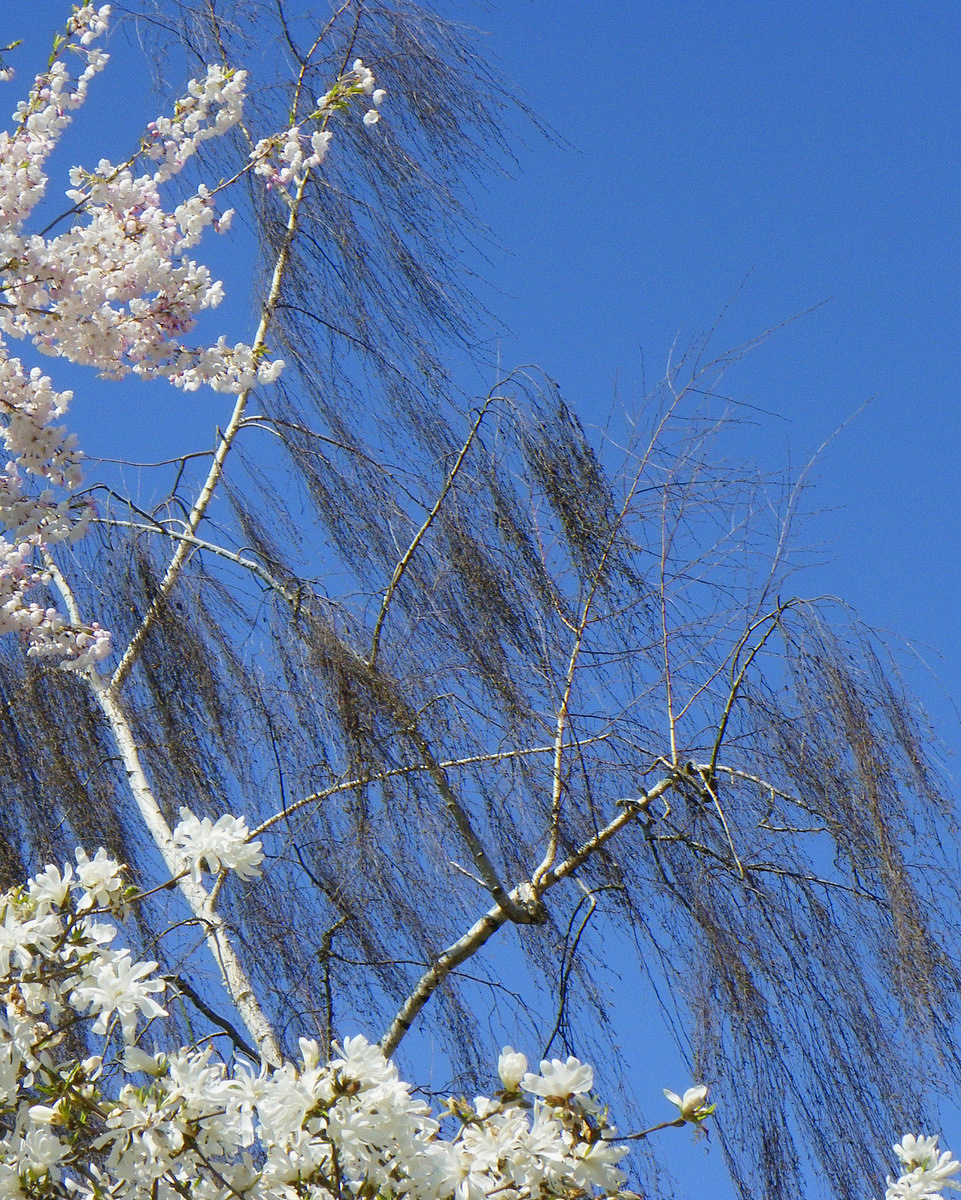
Laurie's favourite. Cherry, magnolia, and feathery branches blowing in the wind. What is that tree?

In the lawn underneath a magnolia, tiny blue flowers, Veronica, I think, nestled in the grass.

At home, I parked the car, yawned, stretched and groaned. Oh, my back! And then we said, almost in unison, "A very good day!"

Sunday, April 04, 2010

SeaBus to Granville Island

A couple more photos from Vancouver:


Downtown Vancouver, and the Burrard Bridge.

I was meeting my daughter on Granville Island. I waited for the SeaBus at the landing beside the market. It's starting off from the West End here, off in the distance under the Burrard Street bridge.


Two SeaBuses set off together; one veered off towards False Creek.


And this one is heading for Granville Island.

A nice little 5 minute ride, cutting off what would be a noisy, smoky trip through the city and in complicated loops on bridge entrances and exits.

I used to live just a few blocks south of here. I loved the area, and sometimes I miss the hustle and bustle of the city, but a morning of shopping and a quick walk in the afternoon is enough. I'm glad to get home to the green fields and the beaches of Delta. Tomorrow, Crescent Beach!

Monday, March 29, 2010

Liquid sunshine

I went to a baby shower in Vancouver's West End. It was showering outside, too...


Afternoon rain over Burrard Inlet.


Rainclouds. Stanley Park across the water, West Vancouver in the distance.


Whatever the weather, she's on the beach ...

Thursday, October 15, 2009

Old familiar mystery

This small tree was growing beside one of the ponds in the Dr. Sun Yat Sen Gardens. The fruits, about the size of cherries, attracted our attention:


Branches over our heads.


Oddly-shaped clumps.


A single fruit, splitting its spotted husk, and the pink growth cone.

I couldn't recognize this, and I've been Googling "Chinese tree fruits", plugging in names of fruit as they occurred to me. I've looked at kumquats, loquats, goji berry, quince, longans, pomegranates, persimmon, strawberry tree, litchi, and so on; anything smallish that I couldn't remember the growth pattern of.

Now I'm hungry.

I found nothing like this, until I examined the twigs and those fuzzy knobs on the tips of some branches. Aha! Magnolia! Google that!

It's the Star magnolia, Magnolia stellata, a familiar tree in Vancouver parks, named for its white flowers. Not all trees produce fruit exactly like this, but the general pattern is the same. At the end of the season, the husks dry out, and the fruit splits open to reveal hard orange seeds. I've seen those before.

There's a good photo on Flickr, here.
.

Monday, August 17, 2009

Snap! Crackle! Pop!

Meet Charlie. He is a Salmon-crested cockatoo from Indonesia, and he lives in the Bloedel Conservatory. He's been there for over 25 years, and loves talking and clowning for his fans. We've visited him before; then he said, hello and told us his name. This time, he wasn't talking, but he showed us his new trick.


When he saw us watching, he climbed down off his perch, and collected a plastic plant pot stuck upside-down on another branch. Then he proceeded to turn it around and around, breaking pieces off the rim; they made a resounding, satisfying "Crack!".


"Gotta make your own musical instruments around here."

.

Sunday, August 16, 2009

La que de amarillo se viste ...

... en su hermosura confia.

Mexican saying: (S)he who dresses in yellow, trusts in her beauty.

Friday, August 14, 2009

Oasis in Chinatown

A summer afternoon in Strathcona, with rain threatening. What to do? Shopping in Chinatown, of course. Laurie visited his favourite bakery, then we went antiquing and spent more money than planned. As usual.

Next: across the street to the Dr. Sun Yat Sen park, a walled hideaway, like the adjacent SYS Garden,
"... almost monochromatic after the dazzle of Chinatown: all contemplative muted greens and stony grays ..."


Stone lion guarding the entrance.


A constant stream of visitors, tourists and locals alike.


Bust of Dr. Sun Yat Sen in front of the circular door.


Detail of the wall.


Stone finial.


View of the main pond from the entrance.


Rock border. Look at it for a while, and faces emerge, shift, blend, disappear.


Roof of the pavilion peeks over the treetops.


I thought this was mist in the distance. It turned out to be a white wall.


Mossy rock and tree reflections.


Rainwater in one of the rock depressions.


A colour accent; Japanese carp swim lazily among reflectons of weeping trees.

And then we went back out into the rush and rattle of traffic, the reds and golds and noisy greens of merchandise. Tea and coffee in a four-table teashop, then home, well content.

.


Powered By Blogger