Showing posts with label magnolia. Show all posts

Sunday, June 06, 2021

Invasive yellows, well-behaved whites

 And now the flowers yellow and white.

Buttercup, Ranunculus sp.

This is a pest. It takes over lawns and gardens, anywhere there's moisture, crowding out grasses and veggies and planted flowers. I ripped a big armful out of a small flower bed this afternoon. I didn't get all the roots, so it will be back soon.

But it is beautiful.

And another pest:

Scotch broom, Cystisus scoparius near Echo Lake.

The individual flowers are beautiful, and the colour is cheerful, but this is an extremely invasive plant. It colonizes roadsides, open fields, logged sites, crowding out native species, overshadowing tree saplings, preventing reforestation. And it is toxic to livestock, including the deer that otherwise would be browsing in these open spaces. On top of that, the plants live up to 25 years, producing vast quantities of seed. And the seeds can survive in the soil for up to 80 years.

Everywhere I've driven this month, north or south or west (can't go east; that's the ocean), I see masses of these yellow flowers. It makes me sad, even if the colour is cheerful.

The native wild strawberry, Fragaria virginiana.

It's always a pleasure to find these tiny plants. They grow in open forest or meadows, and if you're there just at the right time, they may have strawberries, miniature but very sweet.

On a friend's balcony, Bunny tails, Lagurus ovatus. An introduced species, but not likely to become invasive.

Sorting old photos, I came across this one, taken years and years ago, with my pocket camera, and needing to have the colour and lighting corrected. I liked it because of the elegant simplicity of the magnolia flowers against the messy background of someone's backyard.

Magnolia was in bloom down my street the other day, but the flowers never last long; when I went by with the camera, they were falling apart.

Magnolia, Delta, April, 2008

~~~~~~~~~~~~~~~~~~~~~~

Y ahora, las flores amarillas y blancas:

  • 1. Ranúnculus. Esta planta es una plaga. Crece y domina el césped, los jardines de verduras o de flores. Esta tarde arranqué brazos llenos de la planta de un pequeño espacio donde tengo flores tratando de sobrevivir. No terminé con los ranúnculos, porque aun quedan raices en la tierra; volverán a crecer.
  • 2. Pero son hermosas, eso sí.
  • 3. Retama negra, Cytisus scoparius. Otra plaga, peor que los ranúnculos. 
Las flores individuales son bellas, y el color es alegre, pero la planta es extremadamente invasora. Coloniza los lados de las carreteras, campos abiertos, y el terreno donde los madereros han cortado el bosque. Ahoga las plantas nativas, cubriendo los arbolitos nuevos, impidiendo que el bosque vuelva a crecer. Y es una planta tóxica para el ganado, y también para los venados que normalmente se alimentan de las plantas nativas en estos sitios. Y encima de todo eso, las plantas pueden vivir 25 años y producen gran cantidad de semillas que pueden permanecer vivos en la tierra por hasta 80 años.

En todas partes donde he visitado este mes pasado, norte, sur, oeste (al este hay solo agua) veo campos enteros llenos de estas flores amarillas. Me entristece, aunque el color sea alegre.
  • 4. Fresas salvajes. Una especia nativa. Siempre es un placer encontrar unas de estas plantitas. Crecen en campo abierto o en bosques asoleados, y si llegas en hora justa, podrás encontrar sus frutitas, fresas muy pequeñas, pero bien dulces.
  • 5. En el patio de una amiga, vi estas "colas de liebre", Lagurus ovatus. Una especie introducida pero no es probable que se vuelva invasora.
  • 6. Revisando fotos viejas, encontré esta, de hace años, que saqué con mi camarita de bolsillo, y que necesitaba un ajuste de color y luz. Me gustó por la elegancia de las flores de magnolia frente a la maraña que fue el patio trasero donde crecían.
Las magnolias estaban en flor en mi calle hace unos dias, pero las flores no son duraderas, y cuando regresé después con la cámara, ya se habían desbaratado.


Sunday, June 14, 2020

Pink again

These are the last of the pink flowers from last week*

Young pink dogwood planted last fall: first flowers.

Asian bleeding heart, Lamprocapnos spectabilis

Flowers and leaves.


I don't know what these are. They are very small.

*That's just the pink flowers around my house. There are tons more down the block. And more at my doorstep this week.

~~~~~~~~~~~~~~~~~~~~

Y estas son las últimas de las flores color de rosa alrededor de mi casa la semana pasada. Ya hay más; cuando deja de llover tendré que dar otra vuelta.

Primero, las nuevas flores de un árbol nuevecito de cornejo color de rosa.

Luego, un "corazón sangrante asiático", tambien conocido como "corazón de virgen", Lamprocapnos spectabilis. Este crece en la sombra al lado de la cochera.

Y por fin, unas flores que no conozco. Son muy pequeñas. Las sembró mi vecina.


Saturday, October 19, 2019

Old gold

The colours of October, in magnolia leaves, collected and shot 2 years and a day ago.

Bits of green still showing.

Yellow and orange

These were on a tree growing in the divider at the parking lot of the school where I tutor. I stopped each afternoon for a moment to look at it whenever it wasn't raining. I was looking forward to watching it turn gold again this year, but they've improved the parking lot; repainted the lines, removed the divider, and chopped down the tree.

Sometimes I hate progress.

Sunday, February 22, 2015

Hard to believe

It's still February. Last year at this time, we were snowed under:

Snow in my maple tree, Feb. 23, 2014.

This year:

It's cherry blossom time!

Pink everywhere I look

The magnolias are starting to bloom

A tree full of white flames.

And today I took Laurie down to sit in the sunshine again, but it was so hot, even he had to move to the shade.

These last 4 photos are the swan song of my trusty little pocket Sony; it has now developed a bad smear of something inside the lens and I can't clean it. After 4 years of sand, salt spray and the occasional saltwater bath, rain, mud, sticky kid fingers, a few falls, and more sand blasting, it has earned its retirement.

Friday, April 13, 2012

Carpe diem, or "Why everything takes longer than we planned."

Tuesday was warm and bright, with portents of coming rain in the high clouds. A perfect day for working outdoors,  flavoured with a hint of urgency; it could be the last for a while. In the afternoon, while Laurie planted onion sets and transplanted a row of leeks, I took the car down to the car wash for its spring cleaning, a job I love on a warm day. I took my time getting every cranny scrubbed and vacuumed, so it was near supper time when I headed home. My route took me past a housing development where we've been keeping an eye on a magnolia that promised a good crop of flowers this year. And there it was, in the first flush of full bloom.

At home, I found Laurie still in the garden, muddy and looking a little weary. "Grab your camera and come with me," I told him. After a feeble protest, and a change of boots, he did.

We couldn't find parking close to our tree, and ended up under this cherry tree a couple of blocks away.

Deep pink magnolia on the far side of a wall

"Our" tree, in the corner of a yard, surrounded by various shrubs.

The blossoms were at their best, with few of the brown spots and broken petals that appear only a day or so later.

This one was a good 10 inches across; possibly the largest magnolia flower I've yet seen.

magnolia bud
Bud, breaking through the "mouse fur" case. I love the textures of the stem and outer bud covers. (Click for full size.)

More texture. With petals this size, we get to notice how the colour is laid down; in little pink dots on the white background. (See full size.)

Center of the flower. Each stamen is white with a red line down one side. The central clump of pistils will remain when the rest of the flower drops and bright red seeds will burst through its walls.

Towering white magnolia, further down the block.

Another white-flowered tree.

Magnolias, like the horsetail, are ancient plants. They've been around since before there were bees, and are built sturdy, to be pollinated by beetles without too much damage.
Fossilised specimens of Magnolia acuminata have been found dating to 20 million years ago, and of plants identifiably belonging to the Magnoliaceae dating to 95 million years ago. (Wikipedia)
Supper was late, and Laurie had to finish up in the garden in the evening. No matter; schedules are made to be broken.

And the next day, it poured rain all day. When we passed the magnolia yesterday afternoon, it was already looking the worse for wear.

Thursday, April 05, 2012

Pink!

At the corner of 6th and 6th in New Westminster, the city has planted a few magnolia trees. New West sits on a steep hill, looking down onto the river; 6th and 6th is at the top of the south slope, protected from north winds, soaking up more than its share of sunlight, and soothed by the warm air rising from the gardens below. Gardens grow well on this hill, and the magnolias are thriving.

Every spring, when our local magnolia buds are still closed up in their wooly jackets, the trees at 6th and 6th are blooming enthusiastically. We were shopping there last week, so I stopped to take a few photos.

Looking north; the mirrored windows of the building probably increase the greenhouse effect.

Most of the flowers were well over my head.

Looking south, against a cloudy sky.


Next week, the edge of the sidewalk will be covered with pink petals.

Our turn will come eventually.


Sunday, April 17, 2011

Something old, something new.

We can't resist a good antiques fair. Even if the venue is colder inside than it is outside in the rain, and crowded, besides, so that we are constantly bumping into or being bumped by other enthusiasts; even if the closest parking is blocks away, our feet are sore, and our bags heavy. It's worth it all to see the beautiful things people have created, so long ago, and the ingenious, practical, or just wacky ideas they came up with.

Laurie has been collecting Japanese porcelain for years, and more recently, Chinese jade. I look at everything, enjoying the glimpses into an older, sometimes comforting, sometimes strange and foreign world. I learn something new at every fair.

Yesterday, Saturday, we bought several good jade carvings; mythical beasts, a dancing shaman/cricket, a sensitive father/son portrait. And in the Baker's Dozen Antiques stand, I found this ghostly mask:

Fine wire mesh mask with painted features, copper trim, and cloth ties to hold it in place.

Red, well-shaped lips, and a wavy mustache. The nose is a mere crease in the mesh.

The mesh is so fine that the mask allows the back of the child's chair and the face of the painting behind that to show through. Only the eyes and mouth mark the character it portrays.

I'd never seen anything like this before, so I had to research it when I got home. It is an Oddfellows mask from the end of the 19th century.  They used these in their initiation ceremonies; every member except the newcomer wore a mask, although he was blindfolded, so the masks were not meant as disguises. Some descriptions of the ritual - dunking him in water, rolling him in the shrubbery, rattling chains at him - sound as if it were mostly horseplay, maybe a spoof of more serious rituals from other societies.

Here are a few photos of similar masks.

Close-up of the eyes. I moved the mask away from the painting. The "headband" is the edge of the chair seat.

I didn't buy this, although I was tempted. After a pep talk I had given Laurie on the way there, about not buying anything if we didn't have a place to display it, I felt silly about suggesting it, even. Now I sort of wish I had; I think I know where I would have hung it.

It had been cold and windy, with a bit of rain when we went back to the car to get our lunch. But when we left in the afternoon, the sun was bright and warm. The residential district we crossed on our way back to the bridge was lined with trees in full bloom, mostly cherry and star magnolias. I stopped so we could take a few photos.

Pink star magnolia.

Pink and white.

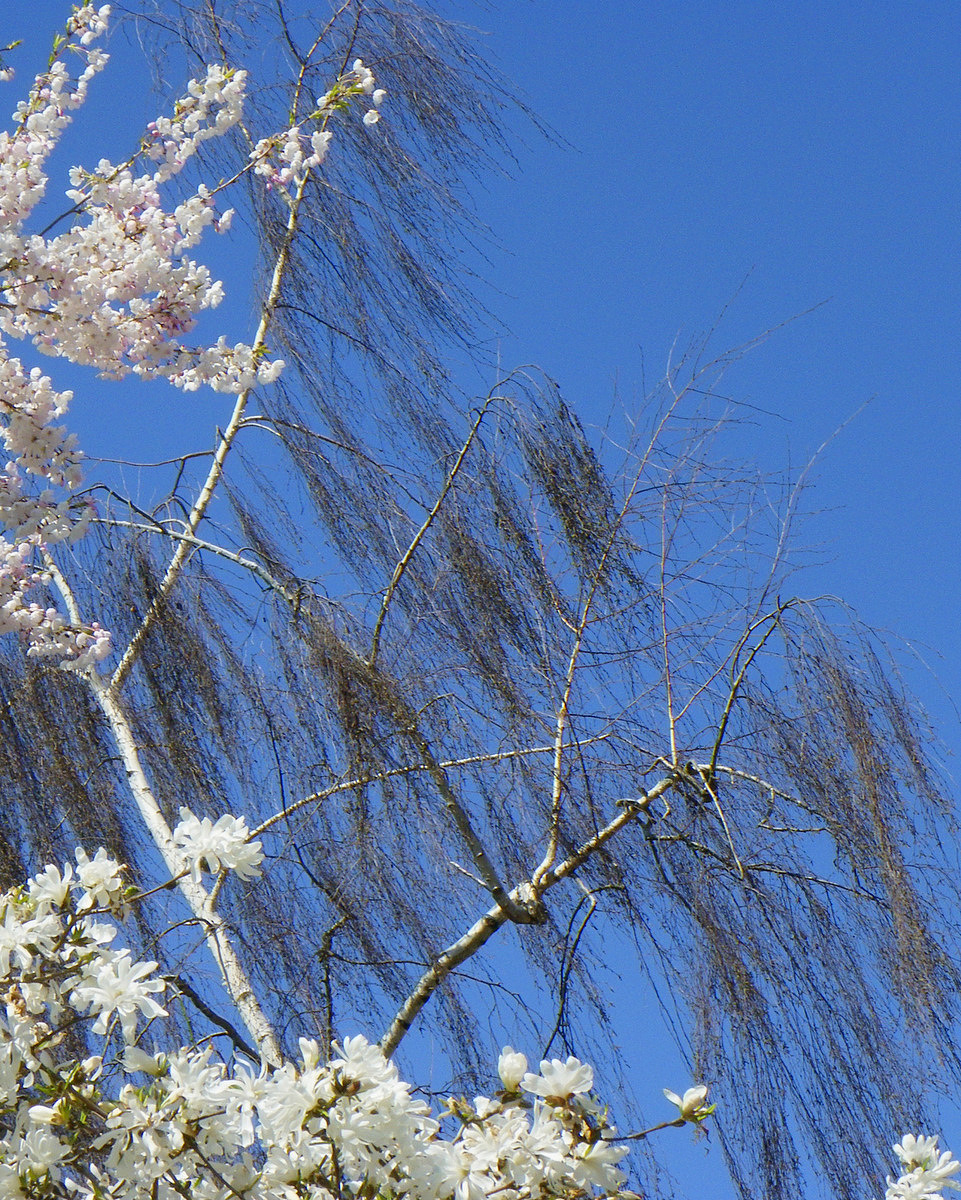
Laurie's favourite. Cherry, magnolia, and feathery branches blowing in the wind. What is that tree?

In the lawn underneath a magnolia, tiny blue flowers, Veronica, I think, nestled in the grass.

At home, I parked the car, yawned, stretched and groaned. Oh, my back! And then we said, almost in unison, "A very good day!"

Thursday, October 15, 2009

Old familiar mystery

This small tree was growing beside one of the ponds in the Dr. Sun Yat Sen Gardens. The fruits, about the size of cherries, attracted our attention:


Branches over our heads.


Oddly-shaped clumps.


A single fruit, splitting its spotted husk, and the pink growth cone.

I couldn't recognize this, and I've been Googling "Chinese tree fruits", plugging in names of fruit as they occurred to me. I've looked at kumquats, loquats, goji berry, quince, longans, pomegranates, persimmon, strawberry tree, litchi, and so on; anything smallish that I couldn't remember the growth pattern of.

Now I'm hungry.

I found nothing like this, until I examined the twigs and those fuzzy knobs on the tips of some branches. Aha! Magnolia! Google that!

It's the Star magnolia, Magnolia stellata, a familiar tree in Vancouver parks, named for its white flowers. Not all trees produce fruit exactly like this, but the general pattern is the same. At the end of the season, the husks dry out, and the fruit splits open to reveal hard orange seeds. I've seen those before.

There's a good photo on Flickr, here.
.

Powered By Blogger