Showing posts with label early spring. Show all posts

Saturday, March 21, 2026

Now it's really spring

It's skunk cabbage time again! In the wetlands and roadside ditches (mini-wetlands) the predominant colour is still the dull brown  of muddy leaves, but now, driving past, I see these bright yellow "light bulbs". Right on time.

Skunk cabbage, aka Swamp Lantern, Lysichiton americanum. With blackberry and dead big-leaf maple leaves.

The flowers on this new spike (spadix) are still buds. The yellow wrapping (spathe) is a bract.

These flowers are mature. They have no petals, but are still "perfect flowers", defined as having both male and female anatomy in each flower.

Once the flowers are done, the leaves will take over, growing to be the largest leaves of any native plant in BC, up to 1.5 metres long. They are edible, but only if they're well cooked to denature the burning calcium oxalate crystals. Traditionally they've been used to wrap foods to be baked in a pit. Bears eat them; raw, of course.

~~~~~~~~~~~~~

¡Ya tenemos linternas! Linternas de los pantanos; ya están alumbrando los humedales y las zanjas al lado de las carreteras. El color principal ahora en estos sitios sigue siendo el pardo oscuro, color de lodo y de hojas podridas, pero al pasar en la carretera, veo estas luces amarillas. Justo a tiempo.

    1. Linterna o Col de los Pantanos, Lysichiton americanum. Con hojas de la mora introducida, Rubus discolor, y hojas muertas de arce de hoja grande.

    2. Las flores en este espádice apenas son botones todavía. La envoltura amarilla (la espata) es una bráctea.

    3. Estas flores ya maduraron. No tienen pétalos, pero reciben el nombre de "flores perfectas", definido como flores que combinan estructuras masculinas y femeninas en la misma flor.

Una vez que las flores hayan producido sus frutos, las hojas cubren todo, llegando a ser las hojas más grandes de las de todas las plantas nativas de la provincia. Pueden alcanzar hasta metro y medio de largo. Son comestibles, pero solamente después de cocinarlas bien para desnaturalizar los cristales de oxalato de calcio que contienen. Se han usado tradiconalmente para envolver alimentos como los salmones y otros pescados que se van a asar bajo una fogata. Los osos las comen. Crudas, claro,

Sunday, February 11, 2024

Early birds

 According to the calendar, we're in mid-winter; officially it runs from the end of December to the end of March. The plants in my garden and the huckleberries in the woods think it's spring. My bleeding hearts, in deep shade, surrounded by chilly concrete, have sent up enthusiastic pink sprouts. My pots of perennials are all over new leaves.

Last year, the first of the snowdrops were blooming the second week of March. Here they are, already in flower at the end of January:

Looks like they're huddled together for warmth. Just before sunset on a grey day.

Cast iron birds surrounded by crocus and hyacinth sprouts.

And those bleeding hearts, hidden away in the dark.

In the forest, the huckleberry stems are a strong green, their tiny buds red-tipped. My camera wanted to look at the trees beyond. Oh, well.

~~~~~~~~~~~
Según el calendario, estamos a medio invierno; corre desde finales de diciembre hasta finales de marzo. Pero las plantas en my jardín y los arándanos rojos en el bosque creen que ya estamos en la primavera. Mis corazones sangrantes, creciendo en sombra densa, rodeados de paredes de cemento frio, son optimistas y ya subieron sus brotes color de rosa. Mis macetas con plantas perennes están todas cubiertas de hojitas verdes.

Y las campanillas de invierno, que el año pasado producieron flores en la segunda semana de marzo, ahora florecieron el último de enero.

Fotos:
  1. Las campanillas (snowdrops). En la tarde de un dia gris.
  2. Mis pajaritos de hierro, rodeados de brotes de crocus y de jacinto.
  3. Y los brotes del corazón sangrante, escondidos allí en la sombra.
En el bosque, los tallos de los arándanos rojos lucen un verde fuerte, y sus botoncitos están rojos. Mi cámara quiso mirar los árboles más distantes. Total; es la vida.


Tuesday, March 28, 2023

Going somewhere, maybe

There's always a bend in the road. And I must explore until the road becomes too rough for my little car.

On a misty, occasionally rainy, early spring afternoon, I took this photo through the windshield.

Unnamed road, going I don't know where.

~~~~~~~~~~~~
Siempre hay otra vuelta en el camino, y yo, pues, estoy obligada a seguir explorando mientras el camino no amenace mis llantas. Esta foto la saqué desde dentro del coche, en una tarde nublada, un poco lluviosa, a principios de la primavera. Un camino sin nombre, que iba no sé donde.


Monday, March 27, 2023

Flames in the muck

The last week of March: skunk cabbage season. I drove some 30 kilometres today, slowly, peering into bogs and beaver ponds and the edges of creeks, looking for them, not seeing any. Maybe it's a bit early, I thought. And then, when I'd given up and was nearly back home again, there they were, in a ditch at the side of the road.

Skunk cabbage with immature flower spike. And the first leaves of a ditch parsley.

It is still early. Most of the yellow spathes were closed, and no flowers are open on the few spikes visible.

Closed bracts, and the beginnings of leaves.

The spear tips poking out of the water and the muck are the start of the horsetails that will soon fill the ditch.

Shaped like the flame of a yellow candle.

So early it is, that there was still no skunky odour. That will come when the flowers open. Next week, probably.

~~~~~~~~~~~~~~~
La semana final de marzo; debemos estar en la temporada de la col fétida, también llamada la linterna de pantano. Manejé unos 30 kilómetros hoy, despacito, mirando hacia ambos lados, buscando entre pantanos y lagunas de los castores y en las orillas de los riachuelos, sin ver ni una. Será un poco temprano, me dije, y regresé hacia la ciudad. Y ya casi llegando a casa, allí estaban, en una zanja.

Sí es temprano; la mayoría de las espatas estaban cerradas, y no hay flores abiertas en las pocas espádices visibles. Tan temprano es que todavía no se nota el olor a zorillo; hay que esperar a que se abran las flores.

Fotos: 
  1. Una col de pantano con la espádice visible. Y con las primeras hojas de una hierba acuática.
  2. Aquí las espatas siguen cerradas. Se ven los primeros brotes de hojas. Las puntas de lanza que se ven saliendo del lodo son brotes de cola de caballo, Equisetum spp.
  3. Otra espata cerrada. Parece la llama de una vela amarilla.

Friday, March 10, 2023

Snow white and the weeds

 Snowdrops. The first of the spring flowers in my garden plots.

Galanthus nivalis. In Spanish, they're called "winter bells", Campanillas de invierno.

The snow covered these; they didn't mind. And now that it has melted, I see that the weeds have been busy under it all. (The proper order of taking garden photos is 1. Weed. 2. Rake. 3. Take photo. I got it backwards.)

I find myself getting impatient about this time of year, waiting for the green to come back, waiting for the crocuses and tulips and bluebells beside my door, the forsythia, all decked out in yellow, waiting for the salmonberry and thimbleberry and elderberry flowers at the edges of the forest, the skunk cabbages in the ditches, so bright against the dark mud. Waiting for those little green lights in the understory, where sunlight picks out the newest leaves. Winter is wonderful, but oh! Those lights in the understory! They catch my breath away.

The snowdrops are a promise; spring is on its way.

~~~~~~~~~~~~~
Estas son campanillas de invierno, Galanthus nivalis. Las primeras flores de la primavera en my jardincito.

La nieve las cubrió pero no les hizo daño alguno. Y ahora que ya se fue, veo que la hierba mala también ha estado creciendo bajo su protección. (El procedimiento correcto para sacar fotos de los jardines va así: 1. Quitar la hierba mala. 2. Rastrillar. Y 3. Sacar las fotos. Yo lo hice al revés.)

Me falta la paciencia en esta época del año; estoy esperando que regrese lo verde, esperando ver los crocus, los tulipanes, los jacintos al lado de mi puerta, la forsitia toda vestida de amarillo, esperando encontrar las flores de salmonberry y thimbleberry (Rubus spp.) y saúco rojo a los bordes del bosque. Y el col de los pantanos en las zanjas, tan brillante saliendo del lodo. Esperando ver esas lucecitas verdes en el sotobosque, donde los rayos del sol iluminan las hojas recién abiertas. El verano me gusta, pero ... ¡Esas luces en el sotobosque! ¡Inolvidables!

Las campanillas de invierno me sirven de promesa: la primavera está en camino.

Monday, March 06, 2023

Mostly greys and blues. And a touch of yellow.

It was an undecided sort of day. Is it winter still, or are we getting into spring? The sun kept trying to break through the clouds but the clouds were winning; the world was blue-grey. I went to Baikie Island; maybe I would find early buds. There, some of the trails were under snow, some dryish, some under water. And yes, there were leaf buds, but it was too dark to see their colours.

But the wintery light, what there was of it, made a good backdrop for the bare branches.

Baikie Slough and bare branches.

Bare branches, reflected in the slough

Alder catkins and the beginnings of leaf buds.

No catkins here. Must be a maple.

Tree lace: a tree full of catkins.

The sun again trying to do its job. The trees are cottonwoods.

And when I got home, I found my forsythia showing off its yellow-tipped flower buds. So there's that.

Must be spring, after all.

A Skywatch post.

~~~~~~~~~~~~
Era uno de esos dias, ni era primavera, ni tampoco invierno, o tanto invierno como primavera; no se decidía. El sol trataba de penetrar las nubes, pero por la mayor parte, no lo lograba. Todo era de un color gris/azul. Fui a la isla Baikie, con las esperanzas de encontrar brotes nuevas de hojas. Los senderos tambien eran variables; algunos bajo nieve, otros puros charcos de agua, otros casi secos. Y sí, había brotes nuevos, pero tan poca luz había que no se podían distinguir sus colores.

Pero la luz invernal, la poca que había, hacía un buen telón de fondo para las ramas desnudas.

Fotos:

  1. El agua tranquila de Baikie, y ramas desnudas.
  2. Ramas reflejadas en el agua.
  3. Candelillas de aliso y los principios de brotes de hojas.
  4. Aquí no hay candelillas. El árbol debe ser un arce.
  5. Encaje de árbol: un árbol lleno de candelillas.
  6. El sol otra vez trata de penetrar. Los árboles son álamos.
  7. Y llegando a mi casa, descubrí que la forsitia estaba luciendo sus nuevos botones amarillos. Parece que sí viene la primavera.
Un post de Skywatch. 

Wednesday, April 06, 2022

And now it's really spring.

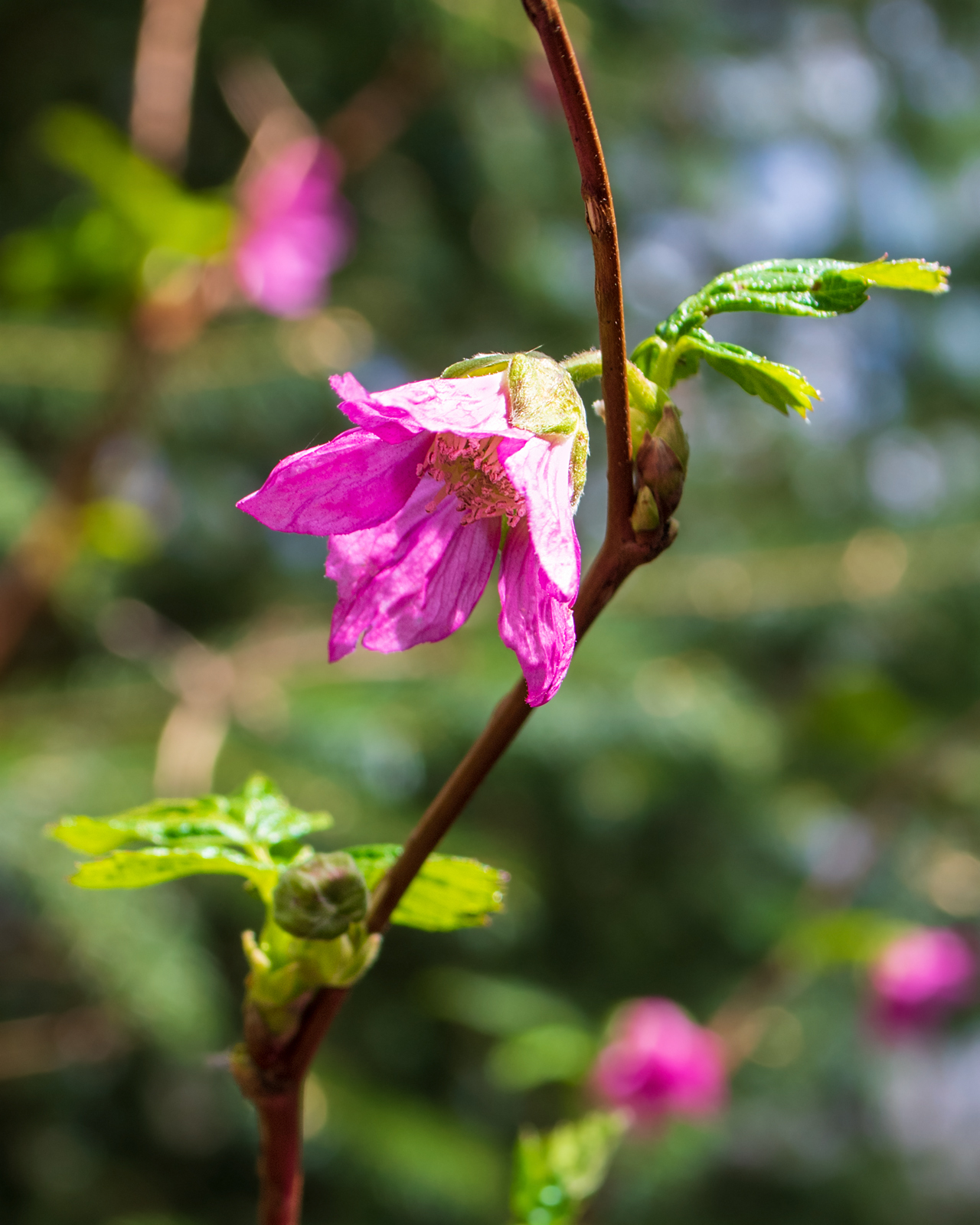
The salmonberries are blooming! More than anything else, these spell "spring" to me, maybe because of growing up on the far west coast where they are always the very first bits of colour (besides the everlasting green) on the edge of the forests.

I love their rumpled petals.

Rubus spectabilis

We used to pick the fresh stem shoots in early spring, peel them, and eat them raw as we walked through the bush. They have a light, green taste, slightly sweet, a foretaste of the sweeter berries that would show up a month later.

The fruit is pink to red to orange; my favourites were always the orange ones.

~~~~~~~~~~~~~~~~~~~~~~~~~~~

¡Están en flor las plantas de Rubus spectabilis, a la que llamamos aquí, baya de salmón! Para mí, éstas flores, más que cualquier otra, definen la primavera. Tal vez sea porque cuando vivía, de niña, en la costa al extremo occidental de la isla, eran los primeros brotes de color (aparte del verde, que nunca faltaba) que aparecían en las orillas de los bosques.

Fotos: flores de Rubus spectabilis.

Cosechábamos los brotes nuevos de los tallos mientras caminábamos, los pelábamos y los comíamos al andar. Tienen un sabor ligero, "verde", un poco dulce; una promesa de las bayas más dulces que aparecerían un mes más tarde.

La fruta es de color de rosa, rojo, o anaranjado. Mis favoritas siempre eran las bayas anaranjadas.

Sunday, April 03, 2022

So yellow!

 It's skunk cabbage season again!

Lysichiton americanum. Swamp lantern.

They're everywhere this week; glowing in every muddy ditch, in shady pools in the forest, in swamps and at the base of cliffs. Anywhere there's stagnant water.

~~~~~~~~~~~~~~~~~~~~~~~~~~

Es la temporada de las linternas de pantano. Alzan sus largas espádices envueltas en una bráctea, todo de un color amarillo brillante, alumbrando cada zanja lodosa, en charcos en el bosque, en pantanos y a la base de precipicios. En cualquier lugar donde haya agua estancada.


Friday, April 01, 2022

Busy beaver pond

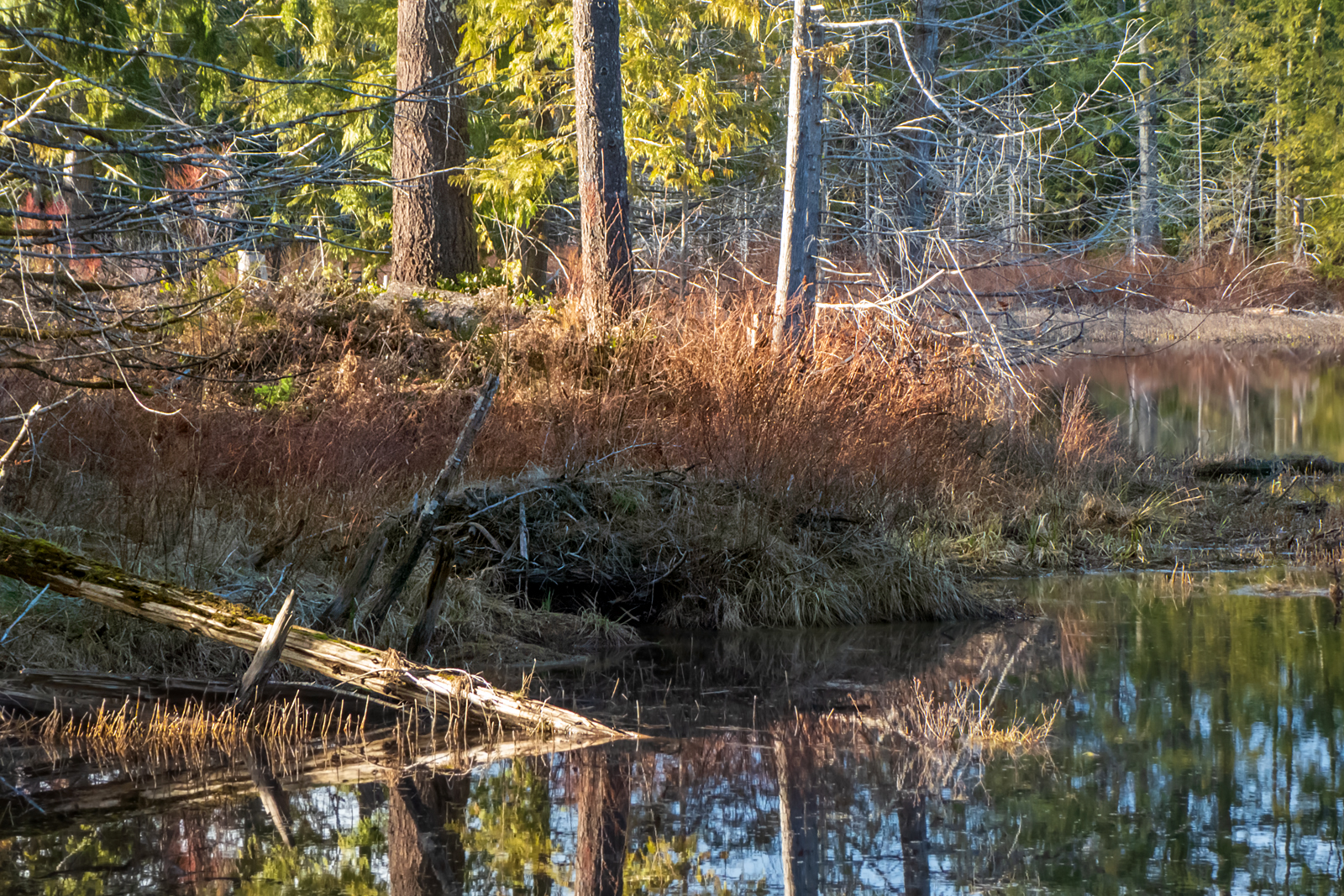
I went down to the beaver pond, now that the snow has gone, to see how it had weathered the winter.

View from the causeway across the centre of the pond.

The water was high, dimpled by a light rain, broken around the edges by the first waterlily leaves, so fresh that they almost seemed as yellow in the sunlight as the flowers will be later on. Small fish jumped, leaving rings on the water. And on the far side, a foursome of ring-necked ducks paddled about.

Ring-necked ducks, Aythya collaris. Three males, one female.

These are migratory ducks, and we're a bit to the north of their year-round range, so they may be recent arrivals. Or not: climate change affects migratory patterns.

They are named for a cinnamon collar on the neck, invisible in most lighting. The rings that are visible are the two white ones around the bill.

As I crossed the pond on the causeway, I heard frogs croaking. I love that sound, and each time (there were about a dozen frogs that I heard nearby) I stopped and approached one slow, quiet step at a time. But each time, before I got close enough to see, the frogs went silent. I didn't hear any "plop" as they jumped away, so again, each time I stood there for a long while pretending to be just another dead tree, another rock at the side of the pond, waiting for them to croak again, and scanning every stone and waterlily leaf for a frog. I couldn't see even one of them.

I heard a frog here. Just another invisible frog.

Later in the year, the beaver lodge is half hidden under new vegetation. Now, as the first green buds start to poke out of brown branches, it stands out clearly.

Beaver lodge, front door.

Again, as usual, I saw no beavers. But there were freshly-downed alders on the back side of the pond.

~~~~~~~~~~~~~~~~~~~~~~~~~~~~
Visité la laguna de los castores, ahora que la nieve se ha derretido, para verla en los primeros colores de la primavera.

Foto: la laguna, vista desde el camino elevado que la corta por la mitad. 

El nivel del agua estaba elevada, la superficie salpicada por una lluvia suave. Cerca de las orillas las primeras hojas de lirio de agua rompen la superficie, sus colores todavía nuevos, casi luciendo en los rayos del sol tan amarillos como las flores que aparecerán más tarde. Pececitos saltaban, dejando círculos en el agua. Y al lado opuesto, cuatro porrones acollarados daban vueltas. 

Foto: porrones acollarados, Aythya collaris; tres machos, una hembra.

Estos son patos migratorios, y estamos un poco al norte de su zona donde viven todo el año. O tal vez, ya no, puesto con el cambio climático las mapas van cambiando.

Se llaman "acollarados" por el anillo alrededor de la garganta, color canela, pero éste es casi invisible fuera de una luz fuerte. Los anillos que sí se ven son los dos anillos blancos en el pico.

Mientras cruzaba la laguna por medio del camino elevado (pero muy poco elevado; el agua ahora casi llega a las partes más bajas del camino) oía el croar de ranas. Me encanta ese sonido, y cada vez, de una docena que se oían casi a mis pies, me detenía y me acercaba lenta y silenciosamente. Pero cada vez, antes de llegar cerca, paraban el canto, pero sin hacer el "plop" al saltar al agua. Y yo me quedaba quieta, haciendo de cuenta que era un árbol muerto, o una roca, esperando a que una ranita se moviera, examinando cada piedra, cada hoja de lirio de agua, tratando de ver una rana. Sin éxito. No vi ni una.

Foto: aquí también oí una rana. Otra rana invisible.

El año más adelantado, la madriguera de los castores se esconde bajo vegetación; ahora, cuando los primeros botones de hojas apenas se asoman en las ramas desnudas, se ve muy claro.

Foto: la puerta principal de la madriguera.

Y no vi ni un castor. Como siempre. Pero al otro lado de la laguna, hay alisos recién tumbados, con marca de dientes de castor.


Friday, March 11, 2022

Lower Upper Campbell Lake

I went to look at some black cliffs (more on that later) and while I was there, looked over the southern tip of Upper Campbell Lake. The buds are just starting to show on the deciduous trees. And the water level is low.

View from the western shore, below the cliffs I came to see.

From the rest area on the eastern shore.

A wider view.

I zoomed in as far as the little camera would take me, to look at the stumps on the shore in the centre of this photo.

Here they are.

The stripes on the shore, painted by the water as the lake fills and empties, fading from tan to almost bluish, are intriguing. I'll have to see if I can find a road to that location.

A Skywatch post. 
~~~~~~~~~~~~~~~~~~~~~~
Fui a mirar unos peñascos negros, de los cuales escribiré más tarde, y mientras estuve en el rumbo, saqué fotos del lago Upper Campbell, desde su extremo más al sur. Apenas empiezan a brotar las hojas primaverales; todavía siguen desnudas las ramas de los árboles de hoja caduca. Con la poca lluvia que hemos tenido, el nivel del agua en el lago está algo bajo.

Fotos:
  1. Desde el lado al oeste, bajo el peñasco que vine a ver.
  2. y
  3. Desde el lado occidental.
  4. Haciendo zoom hasta el máximo para ver los troncos en la distancia en el centro de las fotos anteriores. Me llamaron la atención los colores de la arena o grava, pintados por el agua mientras avanza y retrocede. Tendré que ver si existe un camino o senderito hasta este punto para examinarlos más de cerca.


Wednesday, February 23, 2022

Snowdrops and hyacinths

The snowdrops are up.

Today, from the highway I saw rocky mountain faces wearing frozen waterfalls. Snow still lies on the ground underneath the trees. But the sun was shining and my snowdrops are blooming.

And the news is heartbreaking, and I saw a truck flying threatening flags, and Covid is still here. But the sun shines, and my snowdrops are blooming.

Snowdrops under my kitchen window.

And a promise of hyacinths.

Strength for the day. It's sufficient.

~~~~~~~~~~~~~~~~~~~~~~~~~~~~~

Mis campanillas de invierno están en flor.

Hoy, desde la carretera vi la cara rocosa de la montaña toda cubierta de cataratas congeladas. La nieve todavía cubre el suelo bajo los abetos. Pero salió el sol, y mis campanillas están en flor.

Y las noticias son horrendas, y vi un camión llevando banderas amenazantes, y la pandemia sigue su curso. Pero sale el sol y mis campanillas estrenan sus flores blancas.

Me dan fuerzas para el dia. Es todo lo necesario.

Fotos: las campanillas, Galanthus nivalis, y botones de mis jacintos.


Friday, March 05, 2021

All wet

 Rainy afternoon, Roberts Lake:

View from the picnic grounds. No picnickers today.

Down those two valleys, left and right, are two more lakes.

~~~~~~~~~~~~~~~~~~~~

Una tarde con lluvia, en el lago Roberts.

Thursday, March 04, 2021

End of the long winter

My garden is waking up. The snowdrops are blowing in the wind, the hyacinth is budding, the bleeding hearts are pushing up their first leafy shoots.Daffodil stalks are wearing a yellow cap, and the dead-looking hydrangea sticks are covered with new reddish buds. And everywhere, as thick as lawn grass, the thick bluebell leaves are sprouting.

Time to go shopping for primroses and pansies!

Snowdrops in a dark corner.

Galanthus sp.

And a hyacinth in bud, blotchy and still scentless. Give it a week!

~~~~~~~~~~~~~~~~~

Mi jardincito se está despertando. Ya están en flor las campanillas de invierno (Galanthus nivalis), el jacinto tiene nuevos botones morados, y los corazones sangrantes (Lamprocapnos spectabilis) abren sus primeras hojuelas. Los narcisos lucen sus nuevos gorros amarillilos, y las ramas aparentemente muertas de la hortensia están cubiertas de botones rojizos. Y en todas partes, tan denso como el césped, las hojas gruesas de los jacintos del bosque (Hyacinthoides non-scripta) se apuran a brotar.

¡Ya es hora de ir de compras, buscando Primulas y pensamientos!

Thursday, February 25, 2021

Reaching up

 Waiting for spring.

Shrub, dried grasses basking in afternoon sunlight on the Oyster Bay spit.

Any day now, we'll start seeing buds and green tips.

~~~~~~~~~~~~~~~~~~~~
Esperando la primavera, arbustos y hierbas secas absorben el calor del sol de la tarde en la lengua de tierra encerrando Oyster Bay.

Cualquier dia de estos, empezaremos a ver botones y hojas verdes.


Wednesday, March 28, 2018

The remains of winter

The rain stopped. My forsythia burst into bloom. The hyacinth buds are fat and purple. I headed out of town, looking for the first wildflowers of the year, the skunk cabbages.

I passed a field of them; too soggy to walk there yet. I drove on, delighting in the earliest of the new leaves; green fairy lights along the stems of the salmonberry shrubs, inch-high green fountains on the tops of the elderberry stalks.

And then I thought; it's been a difficult, grumpy winter. I was shut in for a while with an injured back, and then too tired to celebrate the cold weather. And here comes the spring already, and I've missed out on the beauties of our brown and grey back country sleepy season.

I pulled over in a nondescript spot on an empty road, grabbed the camera and went to find the remains of winter.

Morton Lake road. Slow going. Logging trucks use this road, pounding through the potholes, digging them deeper. I followed a camper, watching it tip from side to side as it maneuvered through and around the holes.

Light and reflections in the potholes.

The BC rainforest "bush", as we call it, is a messy, knotty, booby-trapped, ankle-snapping, wet jungle; fallen trees on top of fallen trees, intertwined with ferns and salmonberry canes, thorny, tough blackberry vines, murderous Devil's Club, dead sticks, rotting stumps and new red alder and evergreen trees, all smothered under a slippery blanket of moss. In the summer, all this is covered with a froth of green leaves; prettier, but deceptive.

The low afternoon sun highlights every tree, shining through the moss.

Mossy giant, caught in the open.

If I could get to the base of one of these monsters without a chain saw and ropes, I would probably find the moss (several inches thick) and the bark underneath teeming with life; assorted beetles and grubs, fungal threads, predators like millipedes and spiders. From the side of the road, I noticed the licorice ferns (about two thirds of the way down); these send their long rhizomes down the stem underneath the moss coverlet, and stay green all winter.

The tree may look static from a distance, but it is already covered with white flower buds. Here's a mid-section.

Wide spot in a creek, as it slows to run under the road. A pair of ducks were dabbling in the muck when I arrived, but they quickly hurried around the bend.

Standing water on the far side. With glowing moss sporangia. Dead, rotting leaves, next summer's compost, underwater. And is that a pop can? Shame!

Evergreen ferns and last year's leaves.

Just moss on a log.

Dead leaves and alder catkins by the side of the road.

I found my skunk cabbage. And fresh red alder catkins. Coming right up!

Thursday, January 25, 2018

Signs of spring

I try not to complain. BC winter weather is what it is; fickle, inconstant, but usually wet. Sunny and calm this morning, raining cats and dogs and the occasional fish just as I set out for a long drive on unfamiliar back roads, blowing and howling one moment, the whitecaps out in the channel spraying foam, and so peaceful that every building on the shore reflects cleanly off the water the next.

In a gap between weather extremes, I went to look at the garden. The dandelions and hawkweed are spreading out their new leaves, enthusiastically, as usual. I ripped handfuls out; their roots were already down a full handslength.

But the primulas are blooming, muddily. And my perennial parsley is back. And everywhere, the early blues are sprouting. Bluebells, hyacinths, crocuses, and maybe a tulip or two; at this stage, I can't tell which is which.


Bluebells, I think.

And my pink hydrangea is budding!

No complaints, then. The garden likes the weather, so I will, too.

Thursday, February 02, 2017

Day 1

Spring has sprung! Well, at least, my first spring seeds have popped up. That counts, no?

Alyssum, on my windowsill.

It's supposed to start snowing again tonight, but I still say it's spring. Because, alyssum!


Powered By Blogger