Showing posts with label salmonberry. Show all posts

Thursday, June 06, 2024

Look again.

 When the flowers' petals have fallen, when the birds have eaten their fill, when wind and weather have done their worst, keep on looking. Ma Nature creates beauty at all stages of growth and decay.

One salmonberry, starting to ripen, and another already spent, still shapely.

Twinberry, Lonicera involucrata.

Twinberry berries are deep, shiny, bluish black, and grow in pairs, backed by these red bracts. They're not considered edible. By humans; the birds evidently like them, and First Nations people called them "crow berries". On this whole bush, not a single berry remained.

Another bee, on a salmonberry bush. With a dead berry.

Look again.

So here, one salmonberry flower has produced a berry, still solidly green; look just behind the bee's head. The stamens still seem to be carrying enough pollen to interest a bee. The deep magenta one may have been a bird's snack; its central core is exposed.

And look again; there are two blobs of spittlebug spit.

And isn't the bee's outfit cute?

~~~~~~~~~~~~
Cuando la flor ya ha perdido sus pétalos, cuando los pájaros ya comieron toda la fruta, cuando el viento y el sol han tostado o congelado las ramas; sigue observando. La Madre Naturaleza produce sus bellezas pase lo que pase.

Ejemplos:
  1. Rubus spectabilis, llamado en inglés "salmonberry", fruta de salmón, sea porque la fruta madura en ciertos arbustos tiene el mismo color que la carne del pescado o porque las tribus indígenas comían la fruta con ese pescado. Aquí una flor produjo la fruta, que se pondrá roja o anaranjada al madurarse.
  2. Lonicera involucrata, madreselva bayas de oso, en inglés bayas gemelas, porque las flores y sus bayas se producen en pares. La baya es negra y brillante, y viene protegida por estas brácteas rojas. La fruta no se considera comestible, por lo menos por nosotros los humanos, pero a los pájaros sí les gustan. Las tribus indígenas las llamaban "baya de cuervo". ¿Por el color, o porque los cuervos las comen? En este arbusto, no quedaba ni una sola baya.
  3. Una abeja en el arbusto de salmonberry.
  4. Mirando más de cerca: una flor ha producido su fruta; mira atrás de la cabeza de la abeja; esas bolitas verdes son las frutas (drupas) inmaduras. Los estambres, parece que todavía llevan suficiente polen como para atraer la abeja. Creo que un pájaro ha comido parte de la fruta madura roja. Y mira otra vez: hay dos insectos, los llamados salivazos, escondidos en su espuma. Y ¿no es lindo el traje de la abeja?

Monday, November 28, 2022

Too often overlooked

A dying fern in the rain ...

Just because it's beautiful

And salmonberry stalks and leaves, ready to turn into mulch.

At Lake Hoomak

Strange thing; ever since childhood I've lived among salmonberries. And I never, until now, noticed how the twigs zig-zag with each new leaf stalk. Too busy looking for berries or flowers, harvesting spring shoots to eat raw, watching for the spines on the lower stems. And ignoring the "mess" once the berries were gone.

~~~~~~~~~~~~~~~~~~~~~~~~~
Plantas en via de volverse compostaje. 
  1. Una rama de helecho. Perdido su color verde, sigue hermoso.
  2. Tallos y hojas casi desechas de Rubus spectabilis, el "salmonberry".
Algo extraño: desde la niñez he vivido entre los salmonberry. Y nunca hasta ahora había notado como las ramitas terminales zigzaguean con cada nueva hoja que producen. Demasiado ocupada en buscar frutas o flores, en cosechar los brotes frescos en la primavera para la ensalada, en cuidarme de no tocar las espinas en los tallos inferiores. Y dejando de prestar atención cuando en el otoño todo se volvía un lío desordenado.

Más vale tarde ... 


Sunday, May 29, 2022

Bear food coming up

There will be berries.

Thimbleberry flowers and leaves.

Three stages; buds, flower, pre-berry.

Trailing blackberry, flower and buds.

Coming right along: the salmonberry flowers are done, now there are green berries.

~~~~~~~~~~~~~~~~~~~~
Habrá frutillas. Comida para los osos y los pájaros. Y un tentempié para mi al pasar por el bosque. 

Fotos:

1 y 2, Thimbleberry, Rubus parviflorus.

3, Mora indígena, Rubus ursinus. (Mora de osos)

y 4, Salmonberry, Rubus spectabilis. (Mora de salmones)


Tuesday, May 24, 2022

Slowing down

The trail down to Elk Falls comes, after a steepish drop, to a dip passing a swampy area, before the final rise and the long staircases down to the suspension bridge and the viewpoints. The trail goes on, down and down to the rocks beyond the falls. But I have to stop to look over the swamp first.

I can smell it before I round the final curve. Skunk cabbage, strongly aromatic even after the flowers have faded. Now their huge leaves begin to fill in the whole muddy clearing. And now I can hear it: the buzzing of bees, the hum of an early mosquito looking for a meal on my neck. Something chitters in the trees, a squirrel, maybe.

There is a gap in the trees over the swamp, but they stand tall all around it; it's still too dark down there, even on sunny days, for my camera. But I have to take a photo anyhow.

A busy little swamp

Skunk cabbage, forest. But wait! There's more, much more.
 
In the open swamp area, caught in the photo, I see evergreen ferns (those pale brown curly tips, just unfolding), bracken ferns, (the evergreen sword ferns have long stipes with triangular leaflets on opposite sides of the central vein; brackens have opposite stalks branching out from the main one, with the leaflets along the sides of these branches). Just beyond the first ferns, a few sapling big-leaf maples are getting underway. In the centre, with their feet on a log, huckleberries. If you look closely, you can see the red berries, already tempting the birds. On the left, a clump of salmonberries still carries a pink flower or two. And of course, there are logs, fallen from the sidehill above and covered with moss. If I could get down there, I'd probably find a few mushrooms, as well.

And the skunk cabbage. Off to the side, just beyond the photo, one slow bloomer still showed the remains of the yellow spathe; the rest are all leaves, still only half-grown.

The short-stalked leaves are the largest of any native plant in the region, 30–150 cm long and 10–70 cm wide when mature. (Wikipedia)
Moving on to the forest: The first trees are alders; they tend to skirt the edges. Behind them, near the centre, the large tree with vertical lines of bark and its companions are cedars. Most of the rest of the trees are Douglas-firs.

A fallen tree, showing us its root mass still full of soil, is growing a pyramidal garden of evergreen ferns.

The moss growing on these trees, cat-tail moss, is not the same moss as that below, on the logs.

And the soil (or better, the duff, made up of twigs, dead needles, shredded cones) under the trees is dry and reddish-brown. Under the skunk cabbage, it's mud, soggy, sticky, and almost black. And you can be sure there will be slugs, banana, black, or brown, among the cabbages.

~~~~~~~~~~~~~~~~~~~~~~~~~~~
El sendero que baja hacia las cataratas Elk llega tras una bajada algo empinada, a una depresión en el terreno, un pananito. De ahí sigue otra subida, y luego las escaleras que bajan hacia el puente colgante y las plataformas. Y el sendero sigue aun, bajando, bajando hasta las rocas atrás de las cataratas. Pero hay que detenernos primero para mirar el pantano.

Se nota el olor primero, antes de llegar a la última vuelta en el sendero, donde salta a la vista el pantano. Col de pantano, Lysichiton americanus. Con un fuerte olor, hasta ahora aunque las flores ya desaparecieron. Ahora sus hojas grandes empiezan a llenar el espacio. Y puedo oir ahora el zumbido de abajas, el canto de un mosquito buscando su comida de mi sangre. Algo chirría entre los árboles, tal vez una ardilla.

Hay un espacio abierto sobre el pantano, dejando entrar un poco de luz, pero los árboles alrededor son altos y sigue demasiado oscuro allí abajo, al menos para el gusto de mi cámara. Pero saco una foto de todas maneras.

Foto: el pantano y el bosque, bastante llenos de vida.

Linterna de pantano, bosque. Pero, ¡espera! ¡Hay más!

En el area abierta del pantano, lo que capturó la cámara, veo los helechos perennes, Polystichum munitum — esos espirales de color café claro, al frente, los helechos apenas abriéndose — los helechos de hoja caduca, Pteridium aquilinum — los helechos perennes tienen tallos largos con las hojuelas triangulares a cada lado del tallo central; los helechos "aguila" tienen ramas laterales que salen del tallo central, y de estas, las hojuelas salen a cada lado. — Detrás de estos helechos, unos arces de hoja grande empiezan a crecer, tomando ventaja del aumento de luz en este espacio. En el centro, con sus raices en un tronco caído, los "huckleberry", arándanos rojos, Vaccinium parvifolium. Si miras con cuidado, podrás ver sus frutillas rojas, ya listas para los pájaros. Al lado izquierdo hay un grupo del arbusto "salmonberry", Rubus spectabilis; todavía luce una que otra florecita. Y como siempre, unos troncos caídos, cubiertos de musgo. Si yo podría bajar hasta allí, seguro que encontraría unos hongos, también.

Y la linterna de pantano: a un lado, fuera de la vista de la cámara, había un solo flor, ya medio desbaratada. Las otras plantas ya traen solo las hojas, todavía a la mitad de su tamaño maduro.

"Las hojas, de tallo corto, son las más grandes de cualquier planta de la región, de 30 a 150 cm. de largo y 10 a 70 cm de ancho, al alcanzar la madurez. (Wikipedia)
Adelante. Hacia el bosque. Los primeros árboles son alisos rojos, Alnus rubra; acostumbran situarse a las orillas del bosque. Atrás, a su derecha, el árbol grande con la corteza con lineas verticales, con sus compañeros, son cedros rojos, Thuja plicata. La mayoría de los otros son abetos de Douglas, Pseudotsuga menziesii.

Un árbol caído, mostrándonos solamente las raices, sirve de jardín piramidal para unos helechos perennes.

El musgo que crece en los árboles del bosque, musgo "cola de gato", Isothecium myosuroides, no es el mismo que crece en los troncones en el pantano.

Y la tierra del bosque, mejor dicho la "duff" ya que consiste mayormente de palitos, hojas secas, y piñas desbaratadas, es seca, de un color rojizo. El suelo del pantano es casi negro, empapado y pegajoso. Y allí, puedes estar seguro, habrá babosas, amarillas, negras, y cafés.


Monday, April 18, 2022

April pink and whites

I went down to the Nunns Creek wetlands to look for pink fawn lilies.. And they are there again, in the millions. It's a bit earlier in April than on previous visits, so the bleeding hearts are barely putting out their first flower buds, and the salmonberry canes are mostly bare, letting more light fall on the ground-level plants.

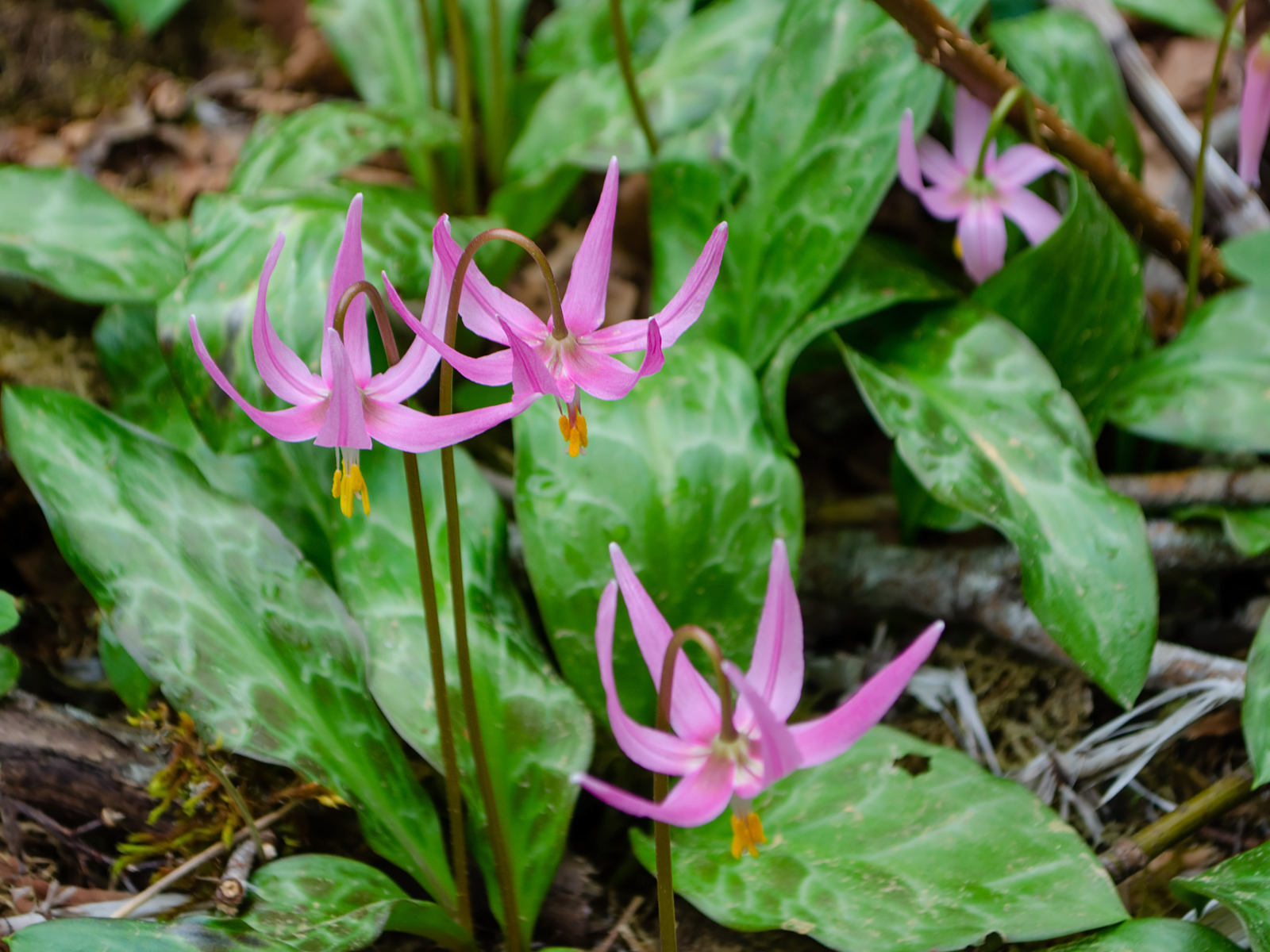
Pink fawn lilies, Erythronium evolutum, with false lily-of-the-valley (Maianthemum dilatatum) leaves.

And here's one with its own spotted leaves.

And against a backdrop of bleeding heart leaves.

Another salmonberry flower.

And down in the grass along the drier edges of the site, a flock of tiny white flowers caught my eye.

I can never identify these with any certainty.

So delicate!

Update: the tiny whites are slender toothwort, Cardamine nuttallii.

And I'll just have to go back for the bleeding hearts.

~~~~~~~~~~~~~~~~~~~~~~~~~~~~~~~~~~
Fui a los humedales de Nunns Creek para ver a los lirios de cervato que crecen allí en la primavera. Y los encontré, por millones, como antes. Es un poco más temprano que mis visitas en años anteriores, así que las flores de corazón sangrante no son más que botones todavía, y aunque las flores de mora de salmón ya aparecen, todavía hay pocas hojas, lo que permite que la luz del dia penetre hasta las plantas del suelo.

Fotos:
  1. lirio de cervato con hojas de lirio de la valle falso.
  2. lirio de cervato con sus propias hojas, con sus manchas de color morado.
  3. lirio de cervato con hojas de corazón sangrante
  4. flor de mora de salmón
  5. y en las orillas del sitio, donde es más seco, estas florecitas se asoman entre el pasto.
  6. las mismas, de cerca. No las puedo nunca identificar con alguna certeza. (Y ahora me las identificaron, son "hierba de dientes", Cardamine nuttallii.)
Y tendré que hacer otra visita para ver a los corazoncitos.

Wednesday, April 06, 2022

And now it's really spring.

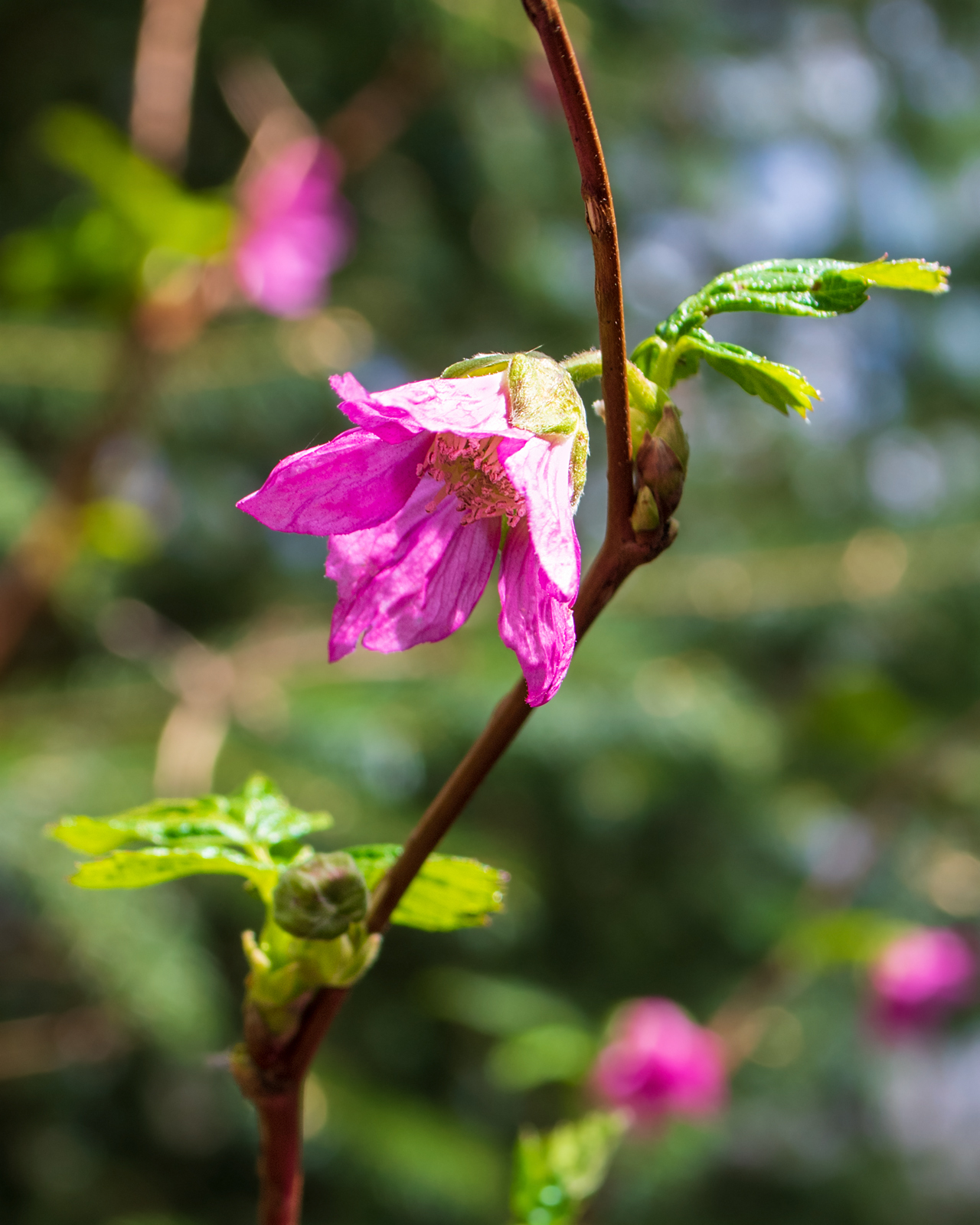
The salmonberries are blooming! More than anything else, these spell "spring" to me, maybe because of growing up on the far west coast where they are always the very first bits of colour (besides the everlasting green) on the edge of the forests.

I love their rumpled petals.

Rubus spectabilis

We used to pick the fresh stem shoots in early spring, peel them, and eat them raw as we walked through the bush. They have a light, green taste, slightly sweet, a foretaste of the sweeter berries that would show up a month later.

The fruit is pink to red to orange; my favourites were always the orange ones.

~~~~~~~~~~~~~~~~~~~~~~~~~~~

¡Están en flor las plantas de Rubus spectabilis, a la que llamamos aquí, baya de salmón! Para mí, éstas flores, más que cualquier otra, definen la primavera. Tal vez sea porque cuando vivía, de niña, en la costa al extremo occidental de la isla, eran los primeros brotes de color (aparte del verde, que nunca faltaba) que aparecían en las orillas de los bosques.

Fotos: flores de Rubus spectabilis.

Cosechábamos los brotes nuevos de los tallos mientras caminábamos, los pelábamos y los comíamos al andar. Tienen un sabor ligero, "verde", un poco dulce; una promesa de las bayas más dulces que aparecerían un mes más tarde.

La fruta es de color de rosa, rojo, o anaranjado. Mis favoritas siempre eran las bayas anaranjadas.

Tuesday, April 20, 2021

Lights in the understory

The red-flowering currants are among the earliest flowers blooming in the shady edges of the forest. This year, they even beat the salmonberries.

Red-flowering currant, Ribes sanguineum

With a background of sun shining through new leaves.

~~~~~~~~~~~~~~~~~~~~
Las grosellas de flor roja. Ribes sanguineum, son de las primeras flores que aparecen en las sombras de la periferia del bosque. Este año hasta le ganaron a los Rubus spectabilis,  a los que aquí llamamos "salmonberry", o sea "baya de salmón", que casi siempre son las primeras flores que veo.


Thursday, May 07, 2020

On a sunny shoulder

The sunshine was blazing down, a nice change after several rainy weeks. I went exploring.
Down an access road beside the highway, home to logging trucks, pickups, and potholes, I stopped to look at some horsetails, and found roadside flowers, tiny and not so tiny.

Fringe-cup, Tellima grandiflora

Although why they call it "grandiflora", big flowers, when they are so very small, I don't understand. A large flower; stalk, cup, and fringe; may be only 1 cm. long. Big enough, if you're a bee.

One flower.

Herb-Robert, Geranium robertanium.
Another mysterious name. My guide book gives 6 possible Roberts it's named for, one being a house-goblin.

These grow prolifically in waste spaces. If they invade a garden, they quickly become invasive. They have a slightly unpleasant odor; before I found the name Herb-Robert, I used to call them Stinky geraniums. But they're pretty and cheerful, so I'm glad to see them.

Two flowers and a dropped petal.
Salmonberry flower. Overhanging a gravel road, the poor petals have been bombarded with fine sand. Behind it, one has already formed a berry, still hard and green.

Not a flower. The new curling tips of bracken fern, Pteridium aquilinum.

And on the shady side of the road, another sword fern.

I'll post horsetails tomorrow.

~~~~~~~~~~~~~~~~~~~~

Salió el sol, resplandeciente en un cielo azul, un cambio muy agradable después de un par de semanas de lluvia y nubes. Salí a explorar. Me encontré en un camino de grava frecuentado por camiones madereros, camionetas, y baches como para tragarse mis llantas. Hice parada para mirar unas "colas de caballo", Equisetum sp., y encontrá además muchas flores silvestres pequeñas.

Primero: "fringe-cup" Tellima grandiflora. No sé porque la llamaron grandiflora, cuando las flores apenas miden un centímetro con todo y tallo.

Luego, un geranio silvestre, "la hierba de Roberto", o Geranium robertanium. Otro nombre misterioso: nadie sabe por cierto quien era el tal Roberto. Mi libro guía da 6 posibles, uno siendo un duende. Tienen un olor un tanto desagradable; antes de conocer el nombre oficial, yo las llamaba los "geranios apestosos". Pero son bonitas y alegres, y siempre estoy contenta de verlas.

Después viene una flor de salmonberry, muy salpicada de arena del camino. Atrás, ya se ha formado una de las frutillas, todavía verde y dura.

Y luego dos helechos: las puntas enrolladas de un Pteridium aquilinum. Estos helechos desaparecen en invierno y brotan de nuevo en abril. Crecen muy altos, hasta tres metros o más. La segunda foto es un helecho de los que se mantienen verdes todo el año, pero surgen nuevas hojas en el centro en primavera.

Mañana vienen los "cola de caballo".

Thursday, April 23, 2020

Color de rosa

Pink. April flowers in the swampy forest.

Bleeding hearts
Salmonberry

Siberian miner's lettuce

Miner's lettuce, again

Pink fawn lily, with its blotchy leaves.

A single fawn lily.. The green towers are new horsetail sprouts.

~~~~~~~~~~~~

Flores de abril, que crecen donde hay agua, lodo, sombra.

1. Dicentra formosa (Corazón sangrante)
2. Rubus spectabilis (Mora de salmón)
3 y 4. Claytonia sibirica (candy flower)
5 y 6. Erythronium revolutum (lirio de cervato)


Tuesday, November 19, 2019

Meanwhile ... some flowers

The sun came out today, and I went to Baikie Island and found a ton of mushrooms. (Slight exaggeration, I know.) I'll be busy processing them for a bit, so meanwhile, here's a batch of flowers from my "round tuit" file, some old, some older, a few recent.

A real oldie. The last photo of Laurie's garden in Delta.

And the newest, a few weeks ago. But the flowers are old. Or fake. Pearly everlasting, saved from last summer, with a bit of colour from an old decoration.

Such a beautiful, horrible weed! Cat's ear or hawkweed, I can never tell without looking at the leaves.

From my indoor "garden". The spathe of a variegated Diffenbachia

A welcome sight in the spring. Salmonberry flower.

Gumweed in the snow, Tyee Spit.


Sunday, April 14, 2019

April flowers

Along the Myrt Thompson trail.

Red flowering currant. They are growing wild in the bush along the river's edge, but this and a dozen or so more have been planted as part of the restoration project.

Sign near the beginning of the trail

Text of the sign:
Myrt Thompson Restoration
This trail winds along the banks of the river and through the heart of the estuary. After a century of industrial use by the forest industry, the Myrt Thompson trail is now being restored to provide habitat for a wonderful array of wildlife, including bald eagles, cedar waxwings, and black bears. Invasive species such as Scotch broom and Himalayan blackberry have been cleared by volunteers and replanted with native species. These plants will provide a diverse habitat for avian wildlife. Riverside vegetation also helps to protect the riverbank from erosion and provides hiding places for juvenile salmon.
The eagles were much in evidence this week. A couple of years ago, I saw many piles of bear scat. It's too early this year for them; they'll show up when the berries ripen.

More red-flowering currant. Looks like there will be a good crop of berries. For now, they'll attract hummingbirds.

Salmonberry flower. More bear bait coming up.

A lineup of salmonberry buds.

I think this is Pacific crabapple, Malus fusca.

Tuesday, May 01, 2018

There will be berries

Salmonberries are the first to leaf out, then the first to flower in spring. Now the sides of the highway north are lined with their cheerful greens and pink accents.

Rubus spectabilis. The one in back has already lost its petals, and will start a green berry ripening very soon.

Flower and new bud.

The birds and the bears and I will be happy to see the first red and orange berries.

Thursday, September 14, 2017

Orangey.

With the cooler nights and the rainy days, deciduous leaves are starting to change colour. The bracken ferns are first in line.

These ferns like open, disturbed sites. This is a logged-off area, populated now by huckleberries, salal, trailing blackberries, mosses, and the ferns. A few trees are moving in.

Detail of fern branches.

Salmonberry is next. They're among the first leaves to show up in spring, and the first to disappear in the fall.

Powered By Blogger