Showing posts with label miner's lettuce. Show all posts

Tuesday, April 21, 2026

Roadside delights

Third week of April. Some of the flowers along the roadside above the river.

Miner's lettuce, Claytonia sibirica. Great masses of these line the upper road.

The bleeding hearts are blooming! Dicentra formosa.

More.

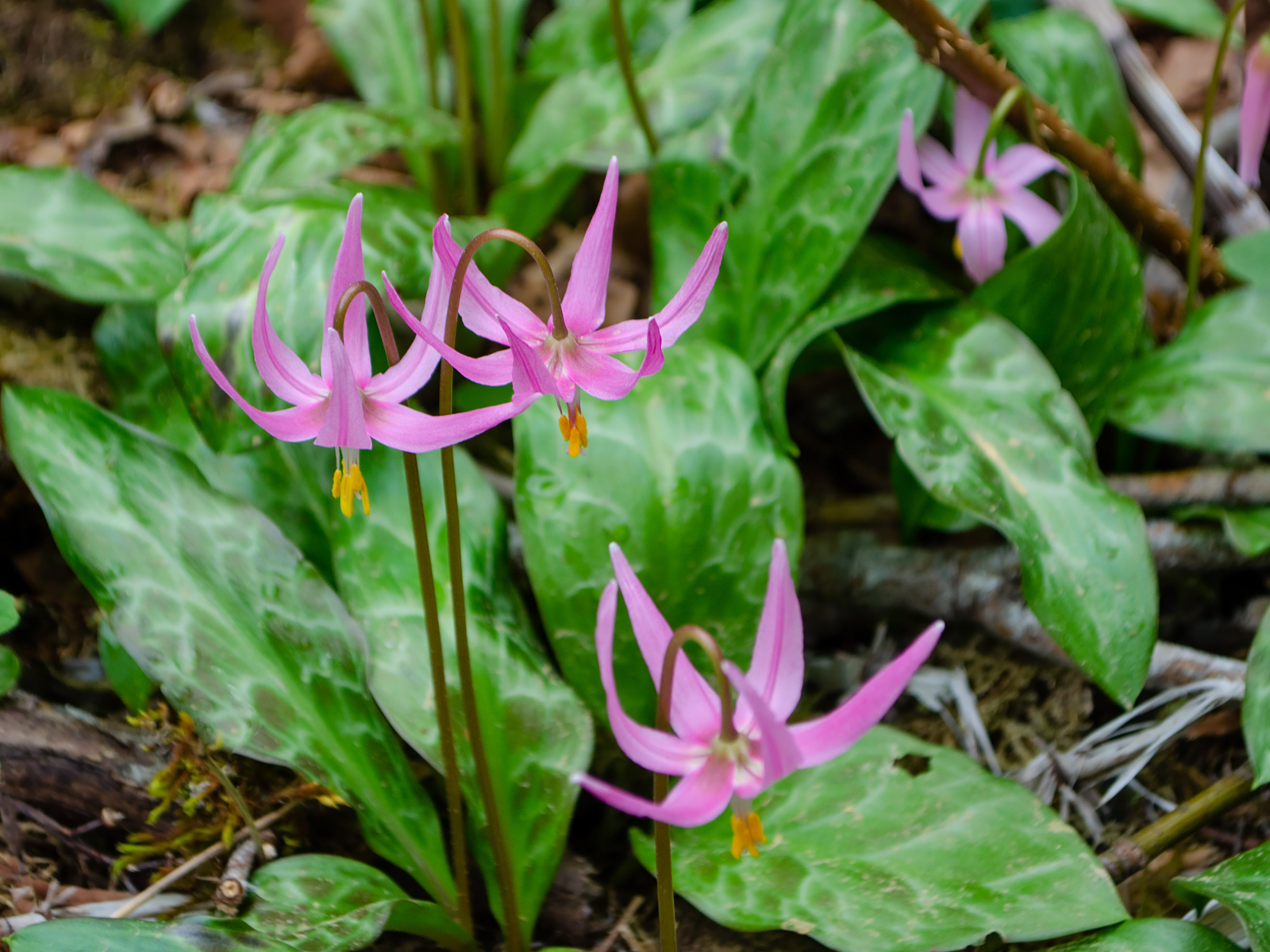
Down on the flats, in the shade. A stray ray of sunlight highlights a fawn lily, Erythronium revolutum. Its leaves are the mottled ones on the right. The deeply-veined leaf on the left is a False Lily of the Valleyy, Maianthemum dilatatum. They had no flowers yet.

Not exactly flowers; common horsetail, Equisetum arvense, a fertile shoot, with the spore-bearing strobilus. The leaves wrapping the stem belong to a new thimbleberry cane.

Not a flower, either. New coiled leaves of the evergreen sword fern, Polystichum munitum.

All those tiny blue butterflies that flitted and fluttered over the flowers and refused to sit for a photo?  I saw another today on the beach, and this one sat still for me.

Echo azure butterfly, Celestrina echo. In flight, it exposes the blue upper side of the wings.

~~~~~~~~~~~~~~~~~~~~
Estas son algunas de las flores vistas esta tercera semana de abril, por el camino al norte del rio.

  1. Claytonia sibirica.
  2. Dicentra formosa, el corazón sangrante.
  3. Cada planta produce muchas flores.
  4. Cerca del rio, en el bosque, un rayo del sol alumbra un lirio "venadito", Erythronium revolutum. Las hojas moteadas a la derecha son las de estas flores;  la hoja con venas marcadas, a la izquierda, pertence al lirio del valle, Maianthemum dilatatum. Todavía no aparecen sus flores.
  5. No es precisamente una flor. "Cola de caballo", Equisetum arvense. Este es un tallo fértil, con su estróbilo, donde produce las esporas. Las hojas que envuelven el tallo son de thimbleberry, Rubus parviflorus.
  6. Pues estos tampoco son flores. Los brotes nuevos del helecho de espada, Polystichum munitum.
  7. ¿Y esas maripositas azules que bailaban por encima de las flores y no se dejaban fotografiar? Vi una hoy en la playa, y esta sí se detuvo por un rato. Es la mariposa azul eco, Celestrina echo. Al volar, se ve la cara superior de las alas, azul con un borde color café.

Saturday, April 04, 2026

Flowers underfoot, overhead

First week of April. Suddenly, there are flowers everywhere. In the city, up and down the streets, in the parks; pink, white, yellow, blue. In the edges of the forests, in wetlands and meadows and on roadsides; mostly white, some yellow. I saw one (1) tiny flower of Blue-eyed Mary; they should be all over the Oyster Bay meadow in a week or so.

These were found on Tyee Spit and at Oyster Bay.

Miner's lettuce, Claytonia perfiolata.Edible, but really, too tiny to bother. Oyster Bay.  Purslane family.

Even tinier. These are everywhere around Oyster Bay, like miniature specks of white at ground level. A cress, possibly Cardamine hirsuta. Mustard family.

Purple dead-nettle, Lamium purpureum. Everywhere. Mint family.

Flower buds of the Big-leaf maple, Acer macrophyllum. This one's at Oyster Bay.

More Big-Leaf buds, on a different tree.

Tall Oregon grape, Berberis aquifolium. Tyee Spit.

Pussy willow, species undetermined. Tyee Spit.

Once upon a time (1940s) there was a logging camp here on the shore of Oyster Bay. Someone planted daffodils. The cabins are long gone, but the daffodils still bloom.

The fawn lilies should be blooming down by the river around now. I'll go see tomorrow.

~~~~~~~~~~~~~~~~

Estamos en la primera semana de abril, y de repente, hay flores en todas partes. En el pueblo, por las calles y en los parques; color de rosa, blancas, amarillas, azules En los bordes del bosque, en los humedales y al lado de las carreteras; principalmente blancas o amarillas. Vi una sola flor miniatura de Collinsia verna, María de los ojos azules. En una semana, o dos, pintarán toda la pradera en Oyster Bay de azul.

Vi estas flores en Oyster Bay y Tyee Spit.

  1. Claytonia perfiolata, lechuga de los mineros. Se puede añadir a las ensaladas, pero siendo tan pequeñito, casi no vale la pena. Oyster Bay. De la famila de los Portulacaceae.
  2. Estas florecitas cubren el suelo en Oyster Bay, motitas blancas, casi como polvo. Pueden ser Cardamine hirsuta, de la familia de las mostazas.
  3. Lamia purpúrea. Se ven estas ahora por todas partes. De la familia de las mentas.
  4. Botones de las flores del arce de hojas grandes, Acer macrophyllum. Oyster Bay.
  5. En otro árbol en el mismo sitio.
  6. Uva de Oregón, Berberis aquifolium. En Tyee Spit.
  7. Sauce gatuno (gatitos) de algún sauce que no traté de identificar.
  8. Hace algunos años (en los años 1940 - 45) había aquí en la orilla del mar en Oyster Bay, un campamento de obreros forestales. Alguien sembró narcisos. Las casas ya desaparecieron, hace mucho, pero los narcisos siguen floreciendo.
Los lirios "de los venaditos", Erythronium revolutum, ya deben estar en flor en la orilla del rio.  Mañana, si el clima lo permite, iré a ver.


Saturday, April 05, 2025

Down by the riverside

Promissory notes.

Huckleberry flowers. If there are pollinators, there will be red berries in mid-summer.

Early shoots of red elderberry. A fast grower; the white flowers will be along in short order.

Cow parsnip has a lot of growing to do, big flower heads to build.

Another salmonberry flower, with a couple of buds. Will the berries be orange or red? Check back later.

The first flower buds of miners' lettuce, aka spring beauty, soon to line the trails with a dusting of white stars.

~~~~~~~~~~~~~~~~~
Promesas ...
  1. Las flores de arándanos rojos (huckleberry, Vaccinium parvifolium). Si se  presentan los insectos polinizadores, habrá bayas rojas a medio verano.
  2. Las primeras hojas de saúco rojo (Sambucus racemosa). Este arbusto se desarrolla rapidamente; pronto aparecerán las flores blancas, seguidas en poco tiempo por las bayas rojas.
  3. La pastinata de vaca, Heracleum maximum, es una planta bastante grande; hasta estos primeros brotes son grandes, las umbelas de flores blancas también lo serán.
  4. Otra flor de salmonberry. Las frutillas serán o rojas o anaranjadas.
  5. Los primeros botoncitos de Claytonia sibirica, "la lechuga del minero". Las flores en poco tiempo pintarán los bordes del camino de blanco.


Monday, February 13, 2023

Trail brighteners

Spring is on its way. The snowdrops are up in my garden, the bluebells have pushed their green tips above the soil. And along the trails in the forest, still green with moss and sword ferns, the first leaves of warm-weather plants sprout from damp soil. These three were all on a half-buried burnt log, in deep shade beside the trail along the river banks.

Siberian Miner's Lettuce?

Going by the pink stems and the leaves, and the location, I think this is Siberian Miner's Lettuce, which in the summer borders the paths with masses of tiny white or pinkish flowers wherever the sun manages to filter through.

Fringe cup, Tellima grandiflora?

Another common path liner. In a few months, it will raise tall stalks with tiny, greenish to pink frilly flowers. The Latin name is a misnomer; "grandiflora", big flower. But the flowers are tiny, up to 1 cm. long.

And the ever-present Herb Robert, Geranium robertianum.

This one is a bit of a nuisance. It's an imported plant, escaped from gardens. The leaves and the bright pink flowers are pretty, but it soon grows leggy and will cover any exposed area, smothering native plants. It self-seeds, by means of exploding seed pods, so extends its coverage quickly. I used to rip out great armloads that threatened to take over my garden. Fortunately, the roots are shallow.

~~~~~~~~~~~~~~~~~~~~~~~~
Estamos viendo señas de la primavera. En mi jardín, las campanillas de invierno, las que llamamos gotas de nieve, ya abrieron sus flores blancas; los jacintos levantaron sus primeros brotes verdes. En el bosque, verde por los helechos perennes y los musgos, las primeras hojas de plantas invernales brotan en el suelo húmedo.

Estos tres crecen en un tronco medio cubierto de tierra, al lado de un sendero en la sombra a la orilla del rio.

Fotos: 
  1. Claytonia sibirica, "la lechuga del minero", creo, por los tallos color de rosa y la forma de las hojas, además del sitio. En el verano sus florecitas blancas cubren los bordes de los caminos entre el bosque dondequiera que entran los rayos del sol.
  2. Tellima grandiflora; otra planta que crece al los bordes de los caminos. Más adelante alzará tallos altos llevando muchas flores de un verde claro, volviendo color rosa mientras maduran. El nombre scientífico no le queda bien; "grandiflora" pero las flores son pequeñas, midiendo apenas 1 cm.
  3. Y la hierba "Robert", Geranium robertianum. Éste llega a ser algo nocivo. Es una planta importada, que escapó de jardines domésticos. Las hojas y las flores, de un color rosa fuerte, son bonitas, pero luego se vuelve rojo y se alargan los tallos, llegando a cubrir todo el espacio libre, ahogando las plantas indígenas, esparciendo semillas por medio de vainas explosivas. Hace tiempo, yo arrancaba grandes cantidades que amenazaban con colonizar mi jardín. Por suerte, las raices crecen cerca de la superficie del suelo.


Tuesday, July 05, 2022

Hard at work

Moving right along ...

Between the flower and the seed, there is a seed factory. I found these, mostly still green, along the river trail, where two months ago (That long ago? Time just races on!) the ground was carpeted in white and pink.

Trillium ovatum. Three leaves, three sepals, three sections of the seed pod.

Another trillium, bowed under the weight of the growing seeds.

Three trilliums in this gathering.

The trilliums were easy to identify. Then there was this:

Lone seed pod.

These were everywhere; there's one up above alongside a trillium. The stems, leafless, spring out of the moss, with no branches, nothing but the stem and this pod, from about 5 cm to 7 cm long. I had to ask for help, but it was so obvious once I was pointed in the right direction. Two months ago, the flowers were everywhere, springing out of the moss on tall stalks, with only a few basal leaves showing. Pink fawn lilies!

Almost ripe.

Another set of three. Developing seeds.

And among the ever-blooming ones, there is the Siberian miner's lettuce. It will flower as long as there is shade and occasional rain, making seeds as it goes. The flower is tiny, the seed pods tinier.

Inset: enlargement of flowers and seed pods.

~~~~~~~~~~~~~~~~~~~~~~~~~~~

Entre la flor y la semilla, se interpone la fábrica de semillas. Encontré estas cápsulas de semilla, todavía verdes, en el sendero al lado del rio, donde hace dos meses —¿Hace tanto? ¡Cómo vuela el tiempo! — el terreno llevaba una alfombra de colores blanco y color de rosa. 

Fotos:

  1. Un trilio. Tiene tres hojas, tres sépalos, en flor, tres pétalos, pero ahora, tres cápsulas combinadas donde crecen las semillas.
  2. Otro trilio, doblado bajo el peso de las semillas en desarrollo.
  3. Y tres trilios juntos.
  4. Era fácil identificar los trilios. Pero luego, están estos. Estaban por todas partes; hay uno con el segundo de los trilios. Los tallos saltan de entre el musgo sin hojas; nada más un tallo alto con la única cápsula encima. Mide de 5 a 7 cm de largo. No los pude identificar y tuve que pedir ayuda. Y luego al recibir una sugerencia, ¡era tan obvio! Hace dos meses, las flores cubrían el suelo aquí, levantándose altas de entre el musgo, con una que otra hoja en la base. Lirios de cervato, Erythtonium revolutum.
  5. Una cápsula casi madura.
  6. La misma, mostrando sus tres semillas.
  7. Y entre las flores que siguen floreciendo, están las lechugas de minero, Claytonia sibrica. Seguirá floreciendo mientras haya sombra y algo de lluvia. Las flores son miniaturas y las cápsulas de semilla aun más. En la foto, la inserción es un zoom de unas flores y sus cápsulas.

Thursday, April 23, 2020

Color de rosa

Pink. April flowers in the swampy forest.

Bleeding hearts
Salmonberry

Siberian miner's lettuce

Miner's lettuce, again

Pink fawn lily, with its blotchy leaves.

A single fawn lily.. The green towers are new horsetail sprouts.

~~~~~~~~~~~~

Flores de abril, que crecen donde hay agua, lodo, sombra.

1. Dicentra formosa (Corazón sangrante)
2. Rubus spectabilis (Mora de salmón)
3 y 4. Claytonia sibirica (candy flower)
5 y 6. Erythronium revolutum (lirio de cervato)


Sunday, April 21, 2019

They broke the heart

"And beside the stone there were wild flowers growing, small flowers of such beauty and perfection that they broke the heart. They broke the heart."
Alexander McCall Smith, Blue Shoes and Happiness

Miner's lettuce. Montia parviflora, I think.

Seen beside the trail in Nunns Creek Park. More flowers tomorrow.
Powered By Blogger