Showing posts with label cedar. Show all posts

Monday, November 14, 2022

These made me happy, Part 3.

 Again, I'm looking through my "Things that make me Happy" folder. 

I didn't know the title of this poem by Robert Louis Stevenson, and just found it now, looking up the quote.

Happy Thought

The world is so full of a number of things,

I'm sure we should all be as happy as kings.

Anyhow, here's today's batch of photos, again in no particular order.

Rotten pilings, Oyster Bay tidal lagoon at low tide.

New pickleweed, Salicornia pacifica, on the Oyster Bay breakwater.

Reflections: a tiny anemone at the corner of my aquarium, reflected doubly in the surface of the water and the adjacent wall.

Just a rock, tumbled down from a cliff beside Buttle Lake, exposing its white "innards".

An old Ford, rusting away.

The baby monkey tree outside my window, under fresh snow.

Woodpecker snag. There are faces in those holes! Trapped dryads?

Cedar bark, branch tips, and cone, and my winter gloved fingers. Tyee Spit.

That's all for now; tomorrow I'll go on to look at lichens and moss. But I'll come back to this folder from time to time, now that it has a proper name and location on my hard drive.

~~~~~~~~~~~~~~~~~~~~~~~

Otra vez con la carpeta de cosas que me hacen feliz.

El poeta Robert Louis Stevenson (1850 - 1894) lo dijo en un pequeño poema de dos lineas, al que le dió el título de "Pensamiento Feliz":
"El mundo está tan lleno de tantas cosas,
Yo sé que todos seremos felices como los reyes."
Bueno, aquí están las fotos de hoy, desorganizadas como siempre.

  1. Pilotes viejísimos de un muelle ya bien desaparecido en la laguna mareal de Oyster Bay.
  2. Brotes nuevos de Salicornia pacifica, planta que crece donde le llega a cubrir agua salada de vez en cuando. En el rompeolas de Oyster Bay.
  3. Reflejos. Una anémona en mi acuario, reflejada en la superficie del agua, y también en la pared que se une a la suya.
  4. Una roca cualquiera, caída del precipicio al lado de Buttle Lake, rota y mostrando su relleno blanco.
  5. Un Ford antiguo, oxidándose lentamente al lado del bosque.
  6. Mi pequeño piñonero (pehuén, Araucaria araucana, árbol nativo a Chile) bajo nieve recién caída.
  7. Un tronco excavado por los pájaros carpinteros. Dentro de las excavaciones se ven caras. ¿Serán dríades?
  8. Cedro: corteza, ramitas y cono. Y mis dedos en guantes por el frio.
Y eso es todo por ahora: mañana vuelvo a mirar líquenes y musgos. Pero volveré a esta carpeta de vez en vez, ya que ahora tiene su nombre y su sitio en mi computadora.


Thursday, September 29, 2022

Ancient companions

I promised you trees. From the trail through the forest above the Campbell River. Here are a few.

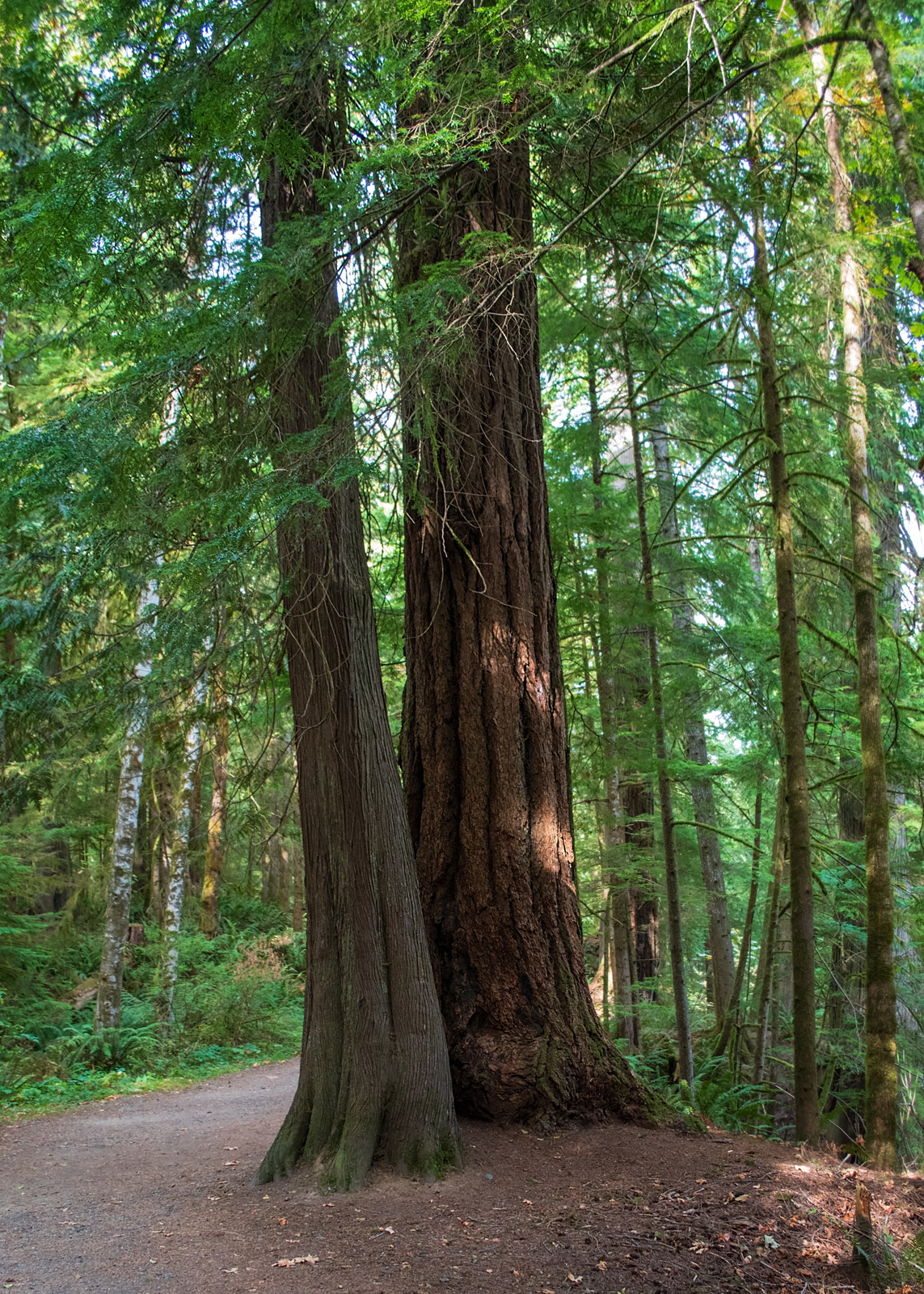
Companions. A Douglas fir and a cedar.

This is a mixed forest, home to "the only significant stand of old-growth Douglas Fir north of Macmillan Provincial Park [Cathedral Grove].” ... the “towering old growth Douglas Fir and Cedar trees” in the  3.5 kilometre Riverside and Old Growth Loop trails. (CortesCurrents) Some of these trees are hundreds of years old.

I've been examining the bark. Mature Douglas fir bark is thick, tough, and deeply grooved, resistant to fire, sometimes singed black. On some trees the grooves are deep enough for me to insert my whole hand.

Cedar bark is thin and fibrous, and forms long strips. First Nations peoples used the inner bark, which is soft and pliable, for clothing and woven baskets, for masks and ropes, even for fishing lines. (See The Story of Cedar, Powell River Museum.)

Cedar and Douglas fir bark.

Another cedar.

Gauti made a cut near the base of the tree that was about the width of his hand, peeled the bark up the tree as far as it could reach, and then tore it off. ... “It’s important that we do this sustainably. We only take one strip from it for the life of that tree, so that it will forever only have a minor wound to heal, instead of a huge wound that could kill the tree,” (Saanich News)

Kwaguʼł girl, wearing a cedar blanket and abalone earings. Public Domain photo, 1914.

Next, another old cedar.

~~~~~~~~~~~~~~~~~~~~
Les prometí unos árboles. Aquí vienen los primeros, vistos en el sendero por el bosque al lado del rio Campbell.

Fotos:
1: Compañeros. Un abeto de Douglas y un cedro rojo.

Este es un bosque mixto, donde se encuentra "el único grupo importante de abetos de Douglas antiguos al norte del Parque Provincial Maxmilian (Bosque Catedral)" ... los "antiguos y altísimos cedros y abetos de Douglas" a lo largo de los 3.5 km de los senderos al lado del rio" (Campbell) (Cortes Currents). Algunos de estos árboles datan de hace cientos de años.

He estado mirando las cortezas. La corteza de un abeto de Douglas maduro es grueso, fuerte, agrietado, resistente al fuego (a veces quemado pero todavía entero). En algunos de estos árboles, los surcos son tan grandes que puedo hundir la mano entera.

La corteza de cedro, en cambio, es fina, fibrosa, formando tiras largas. Las poblaciones indígenas usaban la corteza interior, suave y flexible, para hacer ropa, canastas, máscaras y lazos; inclusive para hacer sedal de pesca. (Véase The Story of Cedar, Powell River Museum.)

Foto #2: Esos dos árboles vistos de cerca.

#3: La corteza de otro cedro.

Gauti hizo un corte cerca de la base del árbol aproximadamente al tamaño de su palma, peló la corteza del árbol hasta donde pudo alcanzar, y la desprendió. ... Es importante que lo hacemos de manera sostenible. Le sacamos solamente una hilera durante la vida del árbol, para que siempre tenga solamente una herida leve para sanar, en vez de una herida que puede matarlo. (Saanich News)
Foto #4: Una muchacha Kwagu'ł, vistiendo una capa de cedro y aretes de abulón. Foto en dominio público, 1914.

Mañana, otro cedro antiguo.


Wednesday, July 20, 2022

Mossy ice-cream cone

 It's still alive. It's heart is gone, but it stands strong.

Lower section of a hollow tree.

It stands on the bank of the Campbell River, just above the high water level. I think it's a cedar: it's hard to tell if the branches overhead belong to it or to the Douglas-firs around it. Some of those visible are cedar. And the tree is hollow as far up as I can see.

The living parts of a tree are all on the outer rim; the bark, the phloem, where food coming down from the needles flows to the rest of the tree, the cambium, where the growing cells are, and the sapwood, which carries water from the roots to the needles. As long as these survive, the tree continues to grow.

The central part, the heartwood, is dead wood. And when it is gone, the tree becomes a habitat for many other species. A hideaway, a food source, a shelter from the weather, a place to sleep, a maternity ward for small and large animals, a place for bats to hang up at night.

Ancient cedars often hollow out like upside-down ice-cream cones,... (From Ancient Forest Alliance)
~~~~~~~~~~~~~~~~~~~~~~~
No tiene corazón, pero sigue viviendo, sigue en pie.

Foto: un cedro con el centro vacío.

Crece a la orilla del rio Campbell, un poco arriba del límite del agua. Creo que es un cedro; es difícil saber si las ramas que se ven le pertenecen o vienen de los árboles alrededor. Pero creo que este es el cedro.

Y hasta donde puedo alcanzar a ver, no tiene corazón.

Las partes vivas de un árbol son las del exterior, empezando con la corteza, luego la floema, que lleva nutrientes desde las hojas hacia la madera y las raices; sigue el cambium, donde están las células que están en crecimiento; y finalmente la xilema, que lleva el agua desde las raices hasta las hojas. Mientras estas partes viven, el árbol siguie creciendo.

La parte central, el duramen, es madera muerta. Y cuando desaparece, el árbol se convierte en refugio para muchas especies, tanto plantas como animales y hongos. Es un escondite, un lugar para protegerse de la lluvia, un dormitorio, una sala de maternidad para animales grandes y chicos, un lugar donde los murciélagos pueden colgarse de noche.

"Los cedros antiguos muchas veces se ahuecan como si fueran un cono de helado boca abajo" (Del sitio Alianza de los Bosques Antiguos)


Tuesday, May 24, 2022

Slowing down

The trail down to Elk Falls comes, after a steepish drop, to a dip passing a swampy area, before the final rise and the long staircases down to the suspension bridge and the viewpoints. The trail goes on, down and down to the rocks beyond the falls. But I have to stop to look over the swamp first.

I can smell it before I round the final curve. Skunk cabbage, strongly aromatic even after the flowers have faded. Now their huge leaves begin to fill in the whole muddy clearing. And now I can hear it: the buzzing of bees, the hum of an early mosquito looking for a meal on my neck. Something chitters in the trees, a squirrel, maybe.

There is a gap in the trees over the swamp, but they stand tall all around it; it's still too dark down there, even on sunny days, for my camera. But I have to take a photo anyhow.

A busy little swamp

Skunk cabbage, forest. But wait! There's more, much more.
 
In the open swamp area, caught in the photo, I see evergreen ferns (those pale brown curly tips, just unfolding), bracken ferns, (the evergreen sword ferns have long stipes with triangular leaflets on opposite sides of the central vein; brackens have opposite stalks branching out from the main one, with the leaflets along the sides of these branches). Just beyond the first ferns, a few sapling big-leaf maples are getting underway. In the centre, with their feet on a log, huckleberries. If you look closely, you can see the red berries, already tempting the birds. On the left, a clump of salmonberries still carries a pink flower or two. And of course, there are logs, fallen from the sidehill above and covered with moss. If I could get down there, I'd probably find a few mushrooms, as well.

And the skunk cabbage. Off to the side, just beyond the photo, one slow bloomer still showed the remains of the yellow spathe; the rest are all leaves, still only half-grown.

The short-stalked leaves are the largest of any native plant in the region, 30–150 cm long and 10–70 cm wide when mature. (Wikipedia)
Moving on to the forest: The first trees are alders; they tend to skirt the edges. Behind them, near the centre, the large tree with vertical lines of bark and its companions are cedars. Most of the rest of the trees are Douglas-firs.

A fallen tree, showing us its root mass still full of soil, is growing a pyramidal garden of evergreen ferns.

The moss growing on these trees, cat-tail moss, is not the same moss as that below, on the logs.

And the soil (or better, the duff, made up of twigs, dead needles, shredded cones) under the trees is dry and reddish-brown. Under the skunk cabbage, it's mud, soggy, sticky, and almost black. And you can be sure there will be slugs, banana, black, or brown, among the cabbages.

~~~~~~~~~~~~~~~~~~~~~~~~~~~
El sendero que baja hacia las cataratas Elk llega tras una bajada algo empinada, a una depresión en el terreno, un pananito. De ahí sigue otra subida, y luego las escaleras que bajan hacia el puente colgante y las plataformas. Y el sendero sigue aun, bajando, bajando hasta las rocas atrás de las cataratas. Pero hay que detenernos primero para mirar el pantano.

Se nota el olor primero, antes de llegar a la última vuelta en el sendero, donde salta a la vista el pantano. Col de pantano, Lysichiton americanus. Con un fuerte olor, hasta ahora aunque las flores ya desaparecieron. Ahora sus hojas grandes empiezan a llenar el espacio. Y puedo oir ahora el zumbido de abajas, el canto de un mosquito buscando su comida de mi sangre. Algo chirría entre los árboles, tal vez una ardilla.

Hay un espacio abierto sobre el pantano, dejando entrar un poco de luz, pero los árboles alrededor son altos y sigue demasiado oscuro allí abajo, al menos para el gusto de mi cámara. Pero saco una foto de todas maneras.

Foto: el pantano y el bosque, bastante llenos de vida.

Linterna de pantano, bosque. Pero, ¡espera! ¡Hay más!

En el area abierta del pantano, lo que capturó la cámara, veo los helechos perennes, Polystichum munitum — esos espirales de color café claro, al frente, los helechos apenas abriéndose — los helechos de hoja caduca, Pteridium aquilinum — los helechos perennes tienen tallos largos con las hojuelas triangulares a cada lado del tallo central; los helechos "aguila" tienen ramas laterales que salen del tallo central, y de estas, las hojuelas salen a cada lado. — Detrás de estos helechos, unos arces de hoja grande empiezan a crecer, tomando ventaja del aumento de luz en este espacio. En el centro, con sus raices en un tronco caído, los "huckleberry", arándanos rojos, Vaccinium parvifolium. Si miras con cuidado, podrás ver sus frutillas rojas, ya listas para los pájaros. Al lado izquierdo hay un grupo del arbusto "salmonberry", Rubus spectabilis; todavía luce una que otra florecita. Y como siempre, unos troncos caídos, cubiertos de musgo. Si yo podría bajar hasta allí, seguro que encontraría unos hongos, también.

Y la linterna de pantano: a un lado, fuera de la vista de la cámara, había un solo flor, ya medio desbaratada. Las otras plantas ya traen solo las hojas, todavía a la mitad de su tamaño maduro.

"Las hojas, de tallo corto, son las más grandes de cualquier planta de la región, de 30 a 150 cm. de largo y 10 a 70 cm de ancho, al alcanzar la madurez. (Wikipedia)
Adelante. Hacia el bosque. Los primeros árboles son alisos rojos, Alnus rubra; acostumbran situarse a las orillas del bosque. Atrás, a su derecha, el árbol grande con la corteza con lineas verticales, con sus compañeros, son cedros rojos, Thuja plicata. La mayoría de los otros son abetos de Douglas, Pseudotsuga menziesii.

Un árbol caído, mostrándonos solamente las raices, sirve de jardín piramidal para unos helechos perennes.

El musgo que crece en los árboles del bosque, musgo "cola de gato", Isothecium myosuroides, no es el mismo que crece en los troncones en el pantano.

Y la tierra del bosque, mejor dicho la "duff" ya que consiste mayormente de palitos, hojas secas, y piñas desbaratadas, es seca, de un color rojizo. El suelo del pantano es casi negro, empapado y pegajoso. Y allí, puedes estar seguro, habrá babosas, amarillas, negras, y cafés.


Tuesday, December 18, 2018

Old cedar walls

Where the highway runs along the shore, there's usually a strip of weeds, then a scramble over rocks, then an obstacle course over logs (never in the same place for long), then the shore itself. In a slightly wider patch, an old fisherman's shack sits gently disintegrating. A crumbling skiff alongside is labelled "Rod and Reel". (On the landward side of the highway, a small RV site bears that name.)

I passed it on foot the other day and stopped to look at the ancient cedar shake siding.

Wind and spray have removed most of the paint and chewed away at the edges of the shakes. The brown line is rusty barbed-wire fence.

On the landward side, out of the reach of salt spray, half the paint still remains, but it's being colonized by green lichens. The roof is bright with green moss.

Cedar shakes are locally produced, and snug and durable in all weather conditions. Current producers mention a 50- to 100-year lifespan due to cedar's resistance to rot.


Powered By Blogger