Showing posts with label Douglas-fir bark. Show all posts

Friday, January 16, 2026

A matter of size

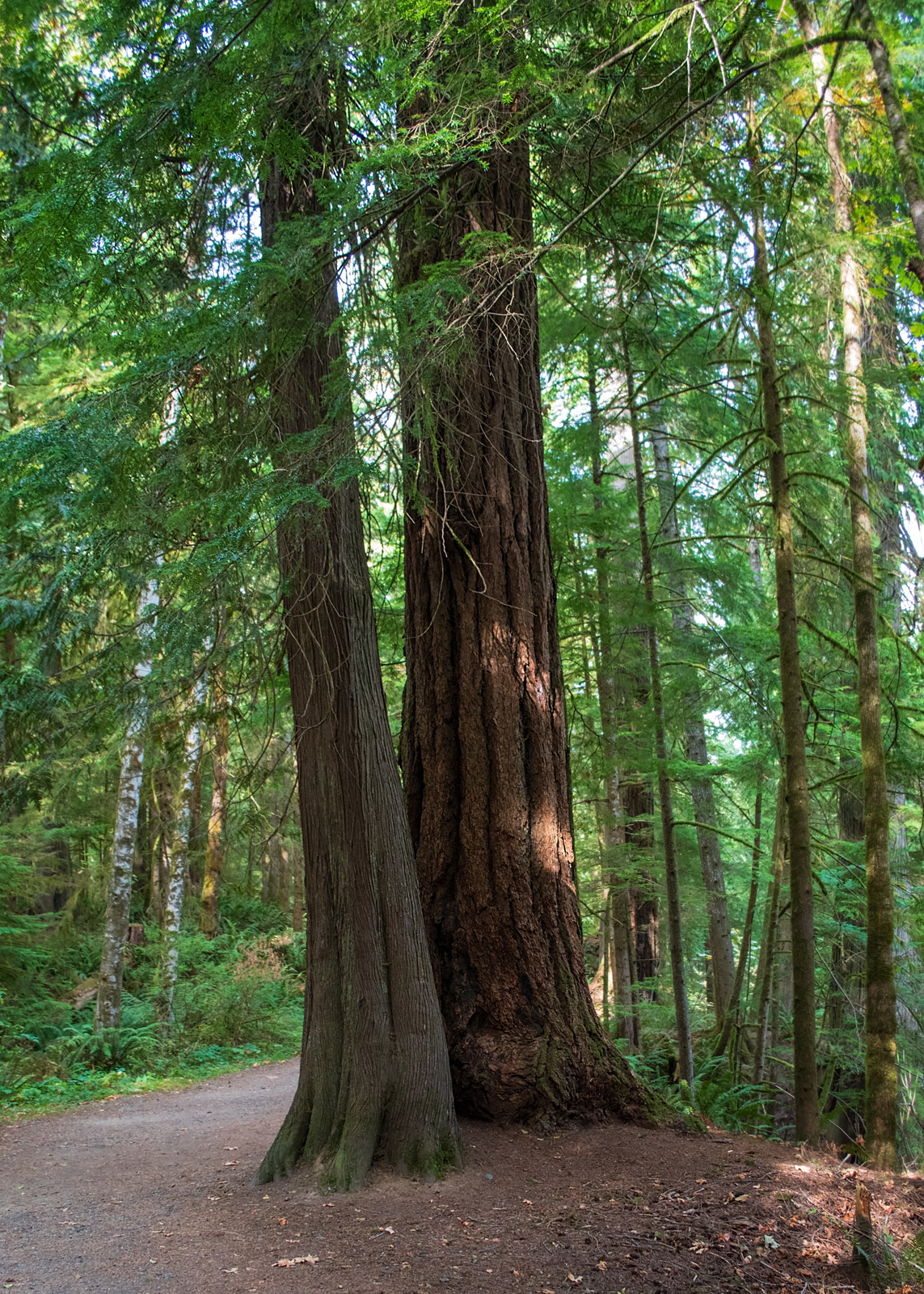
"The largest surviving (Douglas-) Fir in the Comox Valley." So reads the sign I found at the base of a tree in Kitty Coleman Park.

The lower end of the trunk.

Well. I had to check the numbers. This one measures 58 metres tall (but the top has been lopped off, so it would have been taller) and has a diameter at the base of 2.7 metres. Big, but not exceptionally so.

The largest Douglas-fir in Cathedral Grove, 60 km. to the southwest, is slightly larger, measuring 76 metres tall, and with a diameter of 2.9 metres.

Sorting through my Dad's old photo albums yesterday for a family project, I found one of him in Cathedral Grove, with one of these big trees.

Big Douglas-Fir, Dad, 1991.

Dad was 1.76 metres tall. (They made people shorter back in his day.) Comparing him to the tree behind him, it looks like they measured the diameter right down at soil level.

The largest Douglas-fir in Canada, and some say in the world, by volume, is the Red Creek Fir here on Vancouver Island, in Port Renfrew, on the southwest coast. It measures 74 metres tall and has a diameter of 4.2 metres at a height of 1.37 metres above ground.

All these trees are between 600 to 1000 years old, and have survived our periodic forest fires; Douglas-fir is good at that, the older trees having an extra-thick bark that can tolerate a medium-intensity fire.

Back to this particular tree's history:

The sign.
Legend: 
Douglas Fir.
Kitty Coleman Beach Class "C"  Provincial Park has may (sic) large Douglas Fir growing in the Park. This Douglas Fir is the largest in the Park to have survived early logging on the British Columbia Coast. This tree was to be cut down, but was saved as the under cut was put in the base of the tree, the marks are still visible.
It was noticed around 1970 that the top part of the tree was dead. The die back continued, and in 1992 an arborist climbed the giant Fir, swinging over from a balsam tree near by. He then trimmed the top below the center rot, this procedure saved the tree from more die back, giving the tree more years of growth.
The age of the tree can be determined by it's (sic) growth rings.
The giant Fir has been, and is at this time, supporting a large eagle nest near the top.
This Douglas Fir is considered to be the largest surviving Fir in the Comox Valley. It is estimated to be 600 to 800 years old. It has a circumference of 28 feet and a height of 190 feet.
Kitty Coleman Beach Class "C" Provincial Park Board.
It was raining too hard and it was too foggy up top to see the eagle's nest. But I stopped to look at the depth of those creases and holes in the bark. The bark may be 30 or more centimetres thick on a mature tree, and the fissures may go right down to the inner layer. These were not quite that.

Deeply fissured bark.

While I was there, I stopped to look at another Douglas-fir, this one growing a good collection of conks.

The whole interior of the tree must be full of fungal mycelium.

Probably Red-belted Polypore, Fmetromitopsis mounceae. The broken one exposes the struture of the pores.

~~~~~~~~~~~~~~~

"El Abeto de Douglas sobreviviente más grande en el valle Comox." Así dice el letrero que vi junto a un árbol en el Parque Provincial Kitty Coleman.

    1. Foto de la parte inferior de este árbol.

Bueno, tuve que comparar esos números. Este árbol alcanza 58 metros de altura (pero le han cortado, o estaría más alto) y tiene un diámetro de 2.7 metros. Es grande, pero nada excepcional.

El abeto de Douglas más grande en Cathedral Grove, a 60 km. hacia el sudoeste, en un poco más grande, midiendo 76 metros de altura, y con un diámetro de 2.9 metros.

Ayer estaba examinando unos álbumes viejos de mi Papá, planeando un proyecto familiar, y encontré una foto suya, tomada en Cathedral Grove, con uno de estos árboles grandes.

    2. Cathedral Grove, 1991.

Papá medía 1.76 metros. (En esos dias, todos eran un poco más chaparros.) Comparándole con el árbol, parece que midieron el diámetro a nivel del suelo.

El abeto de Douglas más grande en Canadá, y dicen algunos, en el mundo, por su volumen, es el Abeto de Red Creek aquí en la isla, en Port Renfrew, en la costa sudoeste, Mide 74 metros de altura y tiene un diámetro de 4.2 metros a una altura de 1.37 metros sobre el nivel del suelo.

Todos estos árboles tienen de 600 a 1.000 años, y han sobrevivido nuestros repetidos incendios forestales : los abetos de Douglas maduros tienen la corteza muy gruesa, y pueden tolerar un incendio mediano.

Regresando a la historia de este árbol, el del parque KC:

    3. El letrero.

Texto del letrero:
Legend: 
Abeto de Dougla
Muchos abetos de Douglas grandes crecen en el Parque Provincial Clase "C" Kitty Coleman. Este abeto de Douglas es el más grande que ha sobrevivido la tala de madera en la costa de Columbia Británica. Este árbol fue designado para la tala, pero lo salvaron cuando ya se había hecho la primera corte en la base; todavía se ven las huellas.
Se observó cerca de 1970 que la copa del árbol estaba muerta. La parte muerta siguió aumentando, y en 1992, un arborista se trepó al abeto gigante, llegando por medio de un álamo cercano. Cortó la copa debajo de la zona podrida; este procedimiento previno mortalidad subsiguiente, dando al árbol más años de crecimiento.
La edad de un árbol se puede determinar por medio de sus anillos de crecimiento.
El abeto gigante ha sostenido, y todavía sostiene un gran nido de águilas cerca de la copa.
Este abeto de Dougas se considera que es el abeto más grande que todavía existe en el valle Comox. Se estima que tiene de 600 a 800 años de vida. Tiene una circunferencia de 28 pies y una altura de 190 pies.
Kitty Coleman Beach Class "C" Provincial Park Board.
La lluvia y la neblina me hicieron imposible ver el nido de los águilas. Pero examiné lo hondo de esas grietas y agujeros en la corteza. Esta corteza puede llegar a más de 30 cm. de espesor en un árbol maduro, y las fisuras pueden alcanzar hasta la capa interior de la corteza. Estos no llegaban a tanto.

    4. Corteza hondamente agrietada.

Camino de regreso, me detuve para mirar otro abeto de Douglas; este está completamente invadido por hongos políporos.

    5. La madera de este árbol estará totalmente infiltrado por el micelio del hongo.

    6. Probablemente son Fomitopsis mounceae. El hongo roto expone a la vista la estructura de los poros.


Sunday, January 22, 2023

Nose to the bark again

I was a kid growing up on the far west coast of this island, back in the days when little of it was logged off. All around us were the dense, green forests. Evergreens: hemlock, Douglas-fir, cedar. On the hill across the channel there was a stand of maple. Mom used to love those when they turned red in the fall; they reminded her of home in Ontario, she said. But we never went over to look at them more closely.

What I knew were the evergreens. I knew the way the cedars drape their branches to leave a dry hideaway underneath. I knew the taste of hemlock branch tips in the spring. I knew the smell of fresh-cut firewood and the spicy aroma of the huge Christmas tree in the hospital lounge. And the mossy silence under the giants. And the way the darkness of the shadows between the trunks beckoned me. Beyond that, not much. My curiosity led me down other paths, had me turning over stones on the beach and diving under the wharf. 

So when, years later, on drier shores, I learned that deciduous trees (like maples, not fruit trees; they were special, right?) produced flowers, I was astounded. I thought flowers were things that grew on the ground or on shrubs, like daisies and thimbleberries. And even now, in the spring when the maples and red alders dangle their catkins and blossoms, I am filled with that same sense of wonder.

And the wonder goes on; the more I look at the trees, the more amazing they become. Hence, looking at bark. How it works, how it changes, how it lasts. And what it looks like on individual trees.

Here are more nose-level tree trunks, these decorated with dust and crust lichens. All of these are in the lawns around the Campbell River museum.

Douglas-fir with green dust. It always looks like old paint.

This is a maple, and there are two lichens; the dry, crusty whitish patches, and a tiny leafy lichen colonizing the cracks in the bark.

I can't identify this tree; not even when it was in leaf. Spruce, maybe? It's painted top to toe with this green lichen.

Maple, with whitish patches. And I liked the extra pattern from the sun peeking through the leaves overhead.

Another Douglas-fir, I think, with just a light dusting of green lichens.

And I've been told to look at other details, the trunk flair, the buds, the cones. So many fractal levels! So I'll go back again soon, and again in the spring, when the leaves start to show.

~~~~~~~~~~~~~~~~~~~~~~~~~~~~~~~~
Yo era una niña que vivía entre los bosques en la costa del oeste de esta isla, en los años cuando todavía no se habían cortado tanto. Nos rodeaban esos bosques, verdes, tupidos. Siempre verde; eran tsugas (hemlock), cedros, abetos de Douglas. En la cara del cerro al otro lado del estrecho frente a nuestra casa crecía una arboleda de arces; a Mamá le gustaba cuando se volvían rojos en el otoño; le recordaban su casa en Ontario, decía. Pero nunca fuimos a mirarlos más de cerca.

Lo que yo conocía eran los árboles perennes. Sabía como cuelgan las ramas los cedros, dejando un escondite en seco junto al tronco. Conocía el sabor de las ramitas nuevas de tsuga en la primavera. Conocía el olor de leña recién cortada, y el aroma picante del gran árbol de Navidad en la sala de estar del hospital. Y es silencio bajo los gigantes, todos los sonidos del munído exterior apagados por el musgo. Y como la oscuridad entre los troncos me llamaba. Más de eso, no sabía gran cosa. La curiosidad me llevaba por otros caminos, volteando piedras en la playa o buceando debajo del muelle.

Así fue que cuando, años más tarde, en tierras secas, descubrí que los árboles de hoja caduca (no los frutales; ellos eran algo especial ¿no?) producían flores, me quedé atónita.  Hasta entonces, pensaba que las flores eran cosas que crecían en tierra, o en arbustos frutales, como por ejemplo las margaritas y las moras. Y hasta ahora, cuando en la primavera veo las flores y candelillas de los arces y los alisos rojos, me llena un asombro vivo.

Y sigue ese asombro; entre más observo los árboles, tanto más fascinantes son. Y por lo tanto, aquí estoy mirando cortezas, preguntando como es que funciona, como cambia, como perdura. Y como se ve en cada árbol individual.

Aquí subo más troncos vistos a nivel de mis ojos, todos creciendo en los jardines del museo de Campbell River y llevando líquenes de polvo o crustosos.

Fotos:
  1. Abeto de Douglas con liquen de polvo verde. Siempre se ve como si se hubiera tirado pintura.
  2. Un arce, con dos líquenes, uno duro, seco, blanquisco, el otro muy pequeño, folioso, creciendo entre las grietas de la corteza.
  3. No puedo identificar con certeza este árbol. Picea, tal vez. El liquen lo cubre desde arriba hasta abajo.
  4. Arce, con liquen blanquisco. Y me gustó el diseño de sombras formado por el sol entre las hojas.
  5. Otro abeto de Douglas con solo una salpicadura de liquen verde.
Y me han dicho que hay que ver otros detalles, o sea el ángulo de la base del tronco, los botones, las piñas. ¡Tantas capas de detalles que hay! Iré de vuelta pronto a visitarlos, y otra vez en la primavera, cuando empiezan a aparecer las hojas nuevas.

Thursday, September 29, 2022

Ancient companions

I promised you trees. From the trail through the forest above the Campbell River. Here are a few.

Companions. A Douglas fir and a cedar.

This is a mixed forest, home to "the only significant stand of old-growth Douglas Fir north of Macmillan Provincial Park [Cathedral Grove].” ... the “towering old growth Douglas Fir and Cedar trees” in the  3.5 kilometre Riverside and Old Growth Loop trails. (CortesCurrents) Some of these trees are hundreds of years old.

I've been examining the bark. Mature Douglas fir bark is thick, tough, and deeply grooved, resistant to fire, sometimes singed black. On some trees the grooves are deep enough for me to insert my whole hand.

Cedar bark is thin and fibrous, and forms long strips. First Nations peoples used the inner bark, which is soft and pliable, for clothing and woven baskets, for masks and ropes, even for fishing lines. (See The Story of Cedar, Powell River Museum.)

Cedar and Douglas fir bark.

Another cedar.

Gauti made a cut near the base of the tree that was about the width of his hand, peeled the bark up the tree as far as it could reach, and then tore it off. ... “It’s important that we do this sustainably. We only take one strip from it for the life of that tree, so that it will forever only have a minor wound to heal, instead of a huge wound that could kill the tree,” (Saanich News)

Kwaguʼł girl, wearing a cedar blanket and abalone earings. Public Domain photo, 1914.

Next, another old cedar.

~~~~~~~~~~~~~~~~~~~~
Les prometí unos árboles. Aquí vienen los primeros, vistos en el sendero por el bosque al lado del rio Campbell.

Fotos:
1: Compañeros. Un abeto de Douglas y un cedro rojo.

Este es un bosque mixto, donde se encuentra "el único grupo importante de abetos de Douglas antiguos al norte del Parque Provincial Maxmilian (Bosque Catedral)" ... los "antiguos y altísimos cedros y abetos de Douglas" a lo largo de los 3.5 km de los senderos al lado del rio" (Campbell) (Cortes Currents). Algunos de estos árboles datan de hace cientos de años.

He estado mirando las cortezas. La corteza de un abeto de Douglas maduro es grueso, fuerte, agrietado, resistente al fuego (a veces quemado pero todavía entero). En algunos de estos árboles, los surcos son tan grandes que puedo hundir la mano entera.

La corteza de cedro, en cambio, es fina, fibrosa, formando tiras largas. Las poblaciones indígenas usaban la corteza interior, suave y flexible, para hacer ropa, canastas, máscaras y lazos; inclusive para hacer sedal de pesca. (Véase The Story of Cedar, Powell River Museum.)

Foto #2: Esos dos árboles vistos de cerca.

#3: La corteza de otro cedro.

Gauti hizo un corte cerca de la base del árbol aproximadamente al tamaño de su palma, peló la corteza del árbol hasta donde pudo alcanzar, y la desprendió. ... Es importante que lo hacemos de manera sostenible. Le sacamos solamente una hilera durante la vida del árbol, para que siempre tenga solamente una herida leve para sanar, en vez de una herida que puede matarlo. (Saanich News)
Foto #4: Una muchacha Kwagu'ł, vistiendo una capa de cedro y aretes de abulón. Foto en dominio público, 1914.

Mañana, otro cedro antiguo.


Friday, March 04, 2022

Lipstick Cladonia

Just a tree. At eye level, just a rough, brown pillar. It pays to move in close, closer. Inches away.

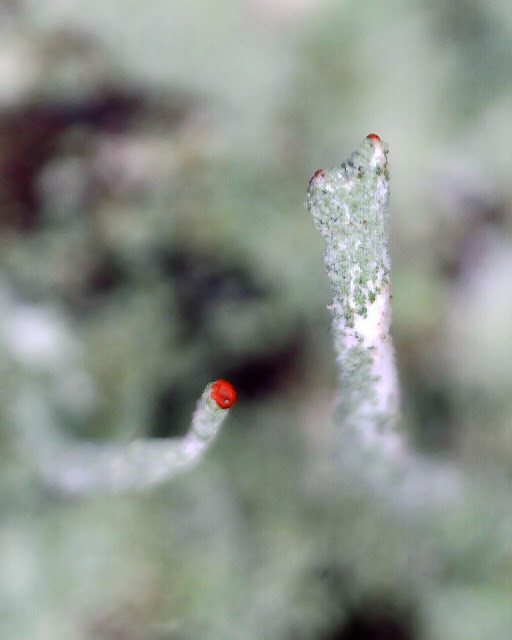
Lipstick Cladonia, on Douglas fir bark.

~~~~~~~~~~~~~~~~
Un árbol, nada más. Solo un árbol. Y al nivel de la vista, es solo una columna rugosa color café. Vale la pena acercarnos algo más, hasta unos centímetros de la superficie.

Es el liquen Cladonia macilenta, en la corteza de un abeto de Douglas.


Friday, January 21, 2022

More mini beasties

 And on yesterday's lichen, look what I found!

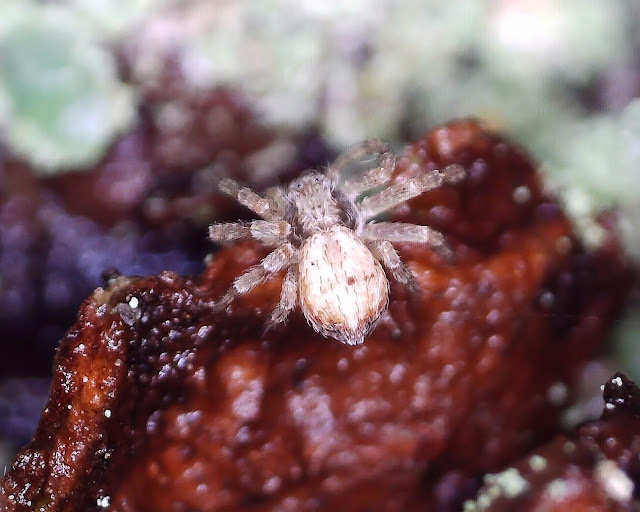
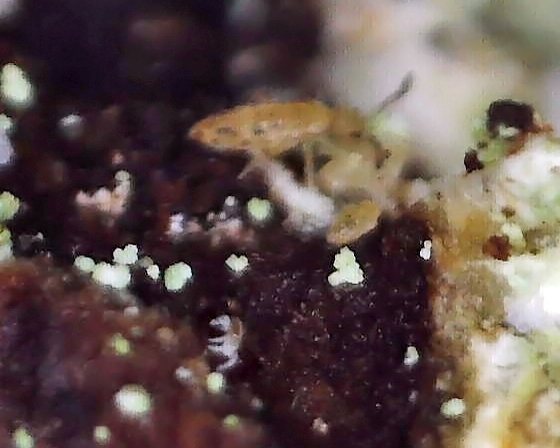
Such a pretty little spider! 1 mm. long or so.

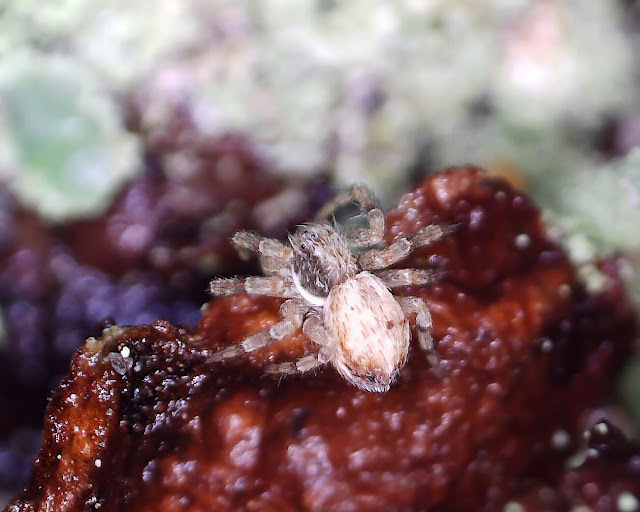
Side eye. If you look closely, she has a mite on her back.

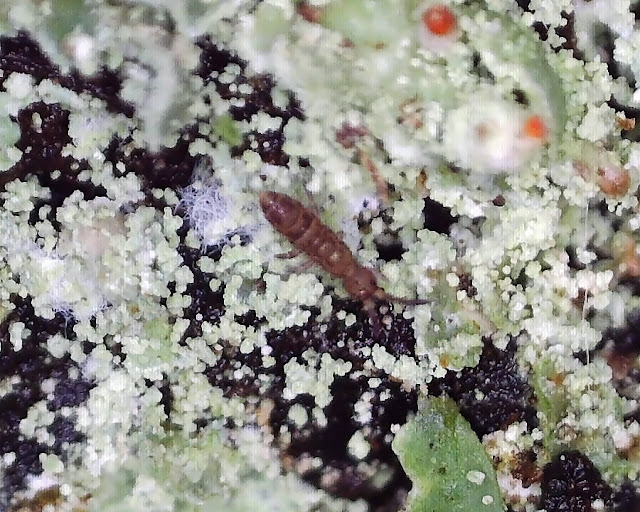
A long springtail.

Blurry: a smaller springtail, and another of those mites.


That springtail, eating lichen. View it full-screen.

~~~~~~~~~~~~~~~~~~~~~~~~~~~~

¡Y mira lo que encontré en esos líquenes ayer!

Fotos:
  1. Una linda arañita. Mide aproximadamente 1 mm. de largo.
  2. Tres cuartos vista, viendo otro ojo. Si te fijas, hay un ácaro en su espalda.
  3. Un colémbolo, de los largos.
  4. Otro colémbolo, un tanto borroso, con otro ácaro.
Y un video de ese colémbolo comiéndose el liquen. Se ve mejor a pantalla completa.

Thursday, January 20, 2022

Green smears

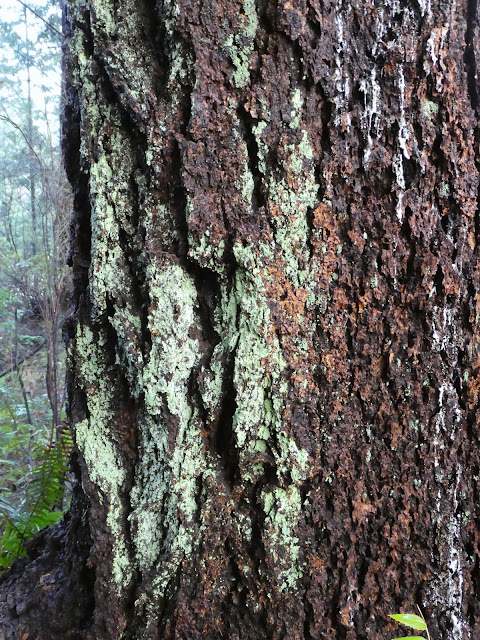
In the dark of the little museum woods, lichens on the lower trunks shine out a pale, ghostly green.

Lichen on a tree on the very edge of the woods, where the light was better.

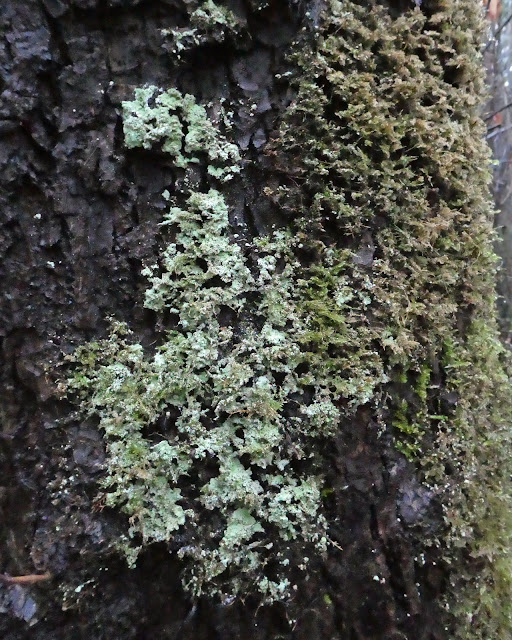
Lichen and moss.

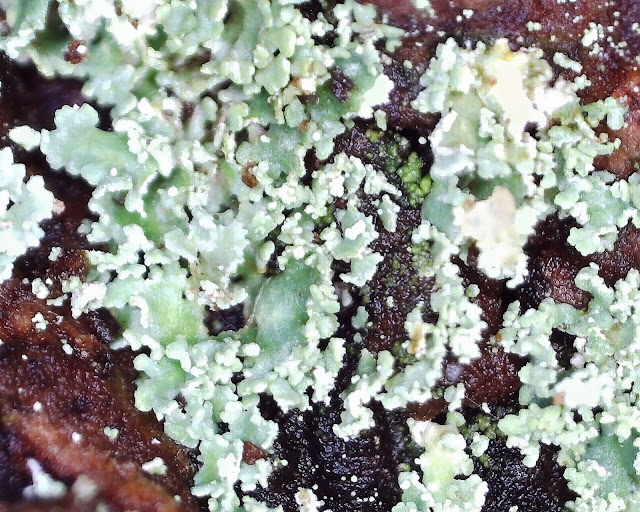
I collected a few pieces of loose bark and brought it home for a better look, under the microscope.

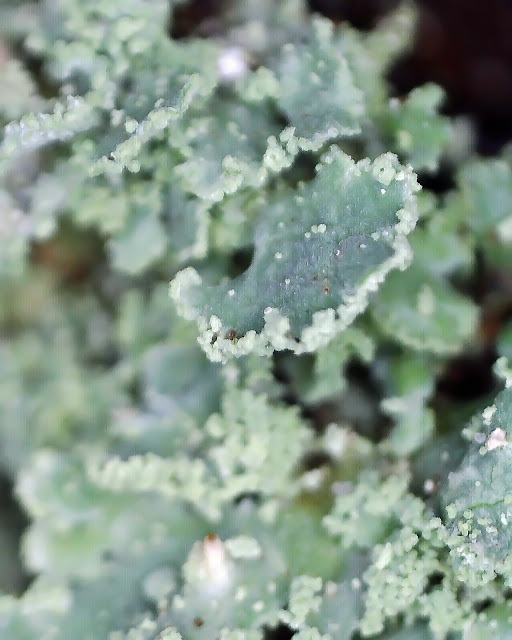
This is Cladonia. The white blobs at the edges of the leafy structures (squamules) are asexual reproductive structures.

A closer look.

And these are the sexual fruiting bodies. The red spots on top are apothecia, containing fungal spores.

~~~~~~~~~~~~~~~~~~~~~~

En la oscuridad del bosquecito del museo, los líquenes se destacan por su color verde claro, fantasmal.

Fotos:
  1. Liquen en un tronco al borde del bosque, donde la luz está mejor.
  2. Liquen y musgos más adentro del bosque.
  3. Recogí algunos pedazos de corteza que estaban flojos y los traje a casa para verlos bajo el microscopio. Estos líquenes son del género Cladonia. Aquí, las bolitas blancas a los bordes de los talos, (escamas) son estructuras reproductivas asexuales.
  4. Mirando más de cerca.
  5. Y estos son los cuerpos reproductivos sexuales. Las partes rojas son apotecios, y contienen esporas del hongo que forma parte del liquen.. 


Tuesday, September 08, 2020

Just trunks

Most of the forests accessible from roads on Vancouver Island have been logged off several times; the trees are mostly small and often close together. In a few places, small pockets of second-growth forests can still be found. Dalrymple Trail winds through one of these; the forest was replanted sometime in the middle of last century.

Most of these trees are Douglas-fir. They are tall trees; from ground level, the view is mostly trunks. Up above, the branches allow some sunlight to penetrate, so the understory hosts a fair crop of huckleberry and salal bushes, besides the usual ferns and mosses. But the trunks are what commanded my attention.

So tall, so straight! The trunk passes through the branches of the smaller surrounding trees, spreading its own branches far above.

Rugged, deeply furrowed bark, with minor fire damage.

Old Douglas-firs are very fire-resistant, due largely to the protective bark that
develops with age. In contrast, the thin bark of young trees offers little protection,
even from low-intensity fires. The thin bark begins to thicken and develop vertical
fissures as trees mature. (Dept. of Natural Resources, WA)

Fire is always a threat to our trees, whether as a result of human interference or started by lightning strikes. (I have seen, on a mountain side across the valley, where lightning struck the forest, and a tall tree burst into flames. Luckily, this was during a heavy rainstorm, and the fire was quickly drenched.) Once a fire is going, the smaller trees are vulnerable; the old Douglas firs shrug it off.

One of the few signs that were readable on the trail. The #7 probably refers to the long-gone explanatory pamphlets.

The bottom of a fire-scarred trunk.

Detail of that trunk.

So stripy! The black stripes are burnt bark. The warm brown lines are undamaged bark. And the greens: on the far right, there's moss, a dull, green. The pale green and greenish yellow stripes are a dust lichen, one of the Lepraria species.

Many older trees wear a coating of this tiny lichen. It appears as dust on the surface, and does not produce fruiting bodies, like other lichens, but spreads as the powdery dust blows or washes away.

~~~~~~~~~~~~~~
La mayoría de los bosques en la isla de Vancouver han sido cosechados varias veces; los árboles de ahora son relativamente chicos y cercanos el uno del otro. (Piensa palillos de dientes en una cajita.) En algunos lugares grupos de árboles de crecimiento secundario todavía existen. El sendero Dalrymple serpentea por uno de éstos; los árboles fueron sembrados allá por mediados del siglo pasado.

La mayor parte de estos árboles son los Douglas-fir, Pseudotsuga menziesii, Son árboles muy altos; desde el suelo, la vista consiste principalmente de troncos. Allá arriba, los ramos permiten la entrada de un poco de sol, así que aquí abajo, crecen los arándanos rojos y los arbustos de salal, además de los helechos y musgos que siempre se encuentran. Pero eran los troncos que más me llamaban la atención.

Los Douglas-fir ancianos son muy resistentes al fuego, lo que es un constante peligro en estos bosques, si por actividades de los humanos, o por relámpagos. He visto, en una montaña al otro lado del valle donde vivía, cuando un relámpago pegó en un árbol alto, y de inmediato el árbol estalló en llamas. Por suerte, estaba lloviendo fuertemente, y el agua pronto apagó el fuego.

La corteza gruesa de los Douglas-fir los protege, y aunque árboles más pequeños se queman, los grandes aguantan.

En estos troncos, en las últimas fotos, se ven las manchas negras donde el fuego quemó la parte exterior de la corteza sin dañar al árbol. Las partes color café muestran el color natural de la corteza.

Las rayas verdes son, a la derecha, en un verde oscuro, musgo. Y las demás, en verde claro, son de un liquen muy fino, como un polvo, que es muy frecuente en troncos viejos en la sombra. Son del género Lepraria.


Saturday, September 28, 2019

Time-outs

The trails and stairs going to the Elk Falls river bed are long and steep; going down, my old knees protest. Going back up, I have to stop to catch my breath. And then I lean on the railings and look at whatever's just in front of me.

This time, it was a section of Douglas fir trunk.

Moss, lichen, salal, shed needles, growing on crevassed bark.

And then there was a patch of Western Maidenhair fern.

Adiatum aleuticum, with the ever-present, ever-green sword fern in the background.

Double-checking the name, since it once was included with the Eastern species, I came across an interesting pair of quotes:

The name, maidenhair, originated from another plant — a European bog species that young girls once used to turn their hair blonde. (Central Coast Biodiversity)

And: 

The Quinault burnt the leaves and rubbed ashes in their hair to make it long, shiny and black. (Native Plants, PNW)

But other sources say the name refers to the black root hairs, or, conversely, to the glossy black stems.


Thursday, September 05, 2019

Ancient Vikings and eye seat belts.

Looking for the sasquatch, we took a trail through a dark forest of old Douglas firs, tall monsters with their tops blocking the sunlight; away from the edge of the forest, the rest of the trunks were bare, with deeply grooved, broken, and lumpy bark.  Any branches remaining below the greenery above were dead, black, wildly convoluted.


Bark, bits of burls, woodpecker holes (two sizes).

This tree has fallen, but got hung up on two others high above us by its tangle of dead branches.
Stump. With a face. An ancient Viking, maybe?

It's woodpecker habitat. At the edge of the forest, we came across a busy pileated woodpecker, pounding away at fallen wood.

He* sees me hiding behind a tree, but continues with his search for grubs.

*He's a male: the males have the red crest, and a red "mustache", as well.

Pileated woodpeckers need a large territory of old growth forest; one pair occupies about a square kilometer. Rebecca  Spit, where we met this one, is about 2 kilometres long, but only about an average of 150 metres across; it's his back yard only.

He pounded away at the broken logs on the ground; before he left, he'd made visible square holes in it:

His fresh holes are a paler brown.

Why don't woodpeckers get headaches?

Woodpeckers hit their heads up to 20 times a second. But muscles, bones and an extra eyelid protect their small bird brains.
Strong, dense muscles in the bird's neck give it strength to repeatedly thump its head. But it is extra muscles in the skull that keep the bird from getting hurt. These muscles act like a protective helmet for the brain.
Unlike the human brain, the woodpecker's brain is tightly confined by muscles in the skull and a compressible bone. This keeps the woodpecker brain from jiggling around when the bird is stabbing away at a tree trunk.
A millisecond before making impact, a woodpecker contracts its neck muscles. Then, it closes its thick inner eyelid.
 The eyelid acts like a seat belt for the eye, said University of California Davis ophthalmologist Ivan Schwab, whose 2007 study on this phenomenon was published in the British Journal of Ophthalmology.
Without an extra eyelid, the retina could tear, and worse, the eye could pop out of its socket. (From LiveScience.com)

I almost got a headache, watching him.

Sasquatch site and woodpecker forest.

Monday, March 11, 2019

Old burn

In the summer of 1938, Vancouver Island sweltered through the longest drought seen for over 50 years. Sparks from logging operations set off dozens of small brush fires. Smoke hung over the hills.

Fire broke out in a log pile on Menzies Bay, just north of Campbell River, and leapt into the forest. A couple of days later, in spite of the 400 firefighters trying to quench it, it was burning over several thousand acres of timber. By the third day, it was threatening Campbell River, and racing up-river, past Elk Falls. The smoke rose two kilometres into the air, and covered almost two-thirds of Vancouver Island.

The fire headed south then, passing Campbell River, racing towards Comox, and east up the mountainsides to Mount Washington. 2000 men fought it, hopelessly. 470 square kilometres of forest were in flames, and the wind was picking up. At times, it reached 150 km/hr.

And then the rain came. The blessed, drenching West Coast rain, pouring down steadily for weeks. In the ancient forest off Elma Bay, these days called the Miracle Beach Provincial Park, the roaring blaze sizzled into damp coals.

Some say that's how Miracle Beach got its name.

Today, many of the older trees in Miracle Beach Provincial Park still wear the scars of that fire.

Survivor, still green up top.

Older Douglas-fir bark is thick and deeply grooved, providing habitat for many insects and nesting sites and groceries for birds and small animals. And old, damaged bark is even more hospitable. This old tree still retains some old scorch marks; it looks like most has been riddled by insects and then birds collecting insects.

The crevices go deep into the tree; I tried to light the bottom of several holes with the camera's flash, but the light didn't reach that far.

Near the centre of the section above, if you look closely, you'll see a white circle. I moved in to get a better look.

"Come into my parlor ..."

A spider hole, wide enough for a chickadee to wander in.

From another angle

I can't be sure; is that a spider lurking deep inside, or just blotchy patches in the bark? I didn't risk sticking a finger in to find out.

For comparison: a pair of unburnt Douglas-fir trunks. Grooved, but much neater.

And the remains of a smaller tree, after the woodpeckers have eaten their fill.


Powered By Blogger