Showing posts with label squamules. Show all posts

Saturday, December 27, 2025

Some iffy Cladonias

"Cladonia is a big, beautiful genus." So says my lichen guide book.  "... enticing to beginners," they add. I can vouch for that; I never pass through a bit of forest that I don't stop several times to look at another patch on a stump or a tree. I take photos, hundreds of them by now, and delete most of them; too far away, too close, too dark, mixed focus, should've moved over thataway ... Sometimes one turns out nicely. More often, even the best are iffy.

But they do entice me.

The guide book has 41 pages of Cladonia species in our neck of the woods; the index lists 76 species, not counting variants. Some groups are easy to recognize (not the species, just the group); the reindeer lichens, the pixie cups, the lipsticks and other red-topped ones. That's about as close as I can get. But I do wonder about them.

These are a few I've seen recently.  All similar, all different.

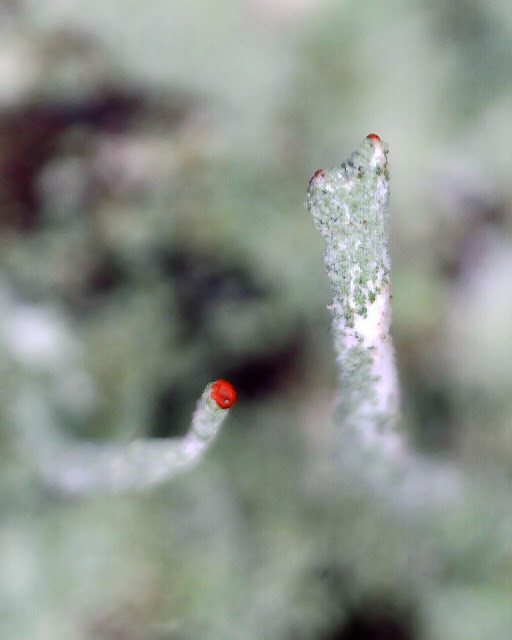
Mostly single red apothecia. The dark green "leaves" are the basal squamules, the standing stalks are podetia. Some of these form a cup at the tip; same species?

Podetia with forked tips, with grouped red apothecia, or with a small cup. 

New clump, with branched tips.

This one, among moss on a stump at Roberts Lake, has not developed the podetia yet.

Some "normal" podetia, thickish and covered with tiny granules, and some skinny, pointed podetia. And some of the apothecia are red, some orange.

     ~~~~~~~~~~~~~~~~~~

"Cladonia es un género grande y hermoso." Así dice mi libro guía de líquenes.  "... seductor de principiantes," añaden. De acuerdo; nunca paso por el bosque sin detenerme varias veces para mirar otro grupo de estos líquenes en un tronco o un tocón. Saco fotos, cientos de fotos hasta el presente, y desecho la mayoría por ser: demasiado lejos, demasiado cerca, con foco mezclado, debería haberme arrimado un poco para un lado ... De vez en cuando, raramente por cierto, una foto sale más o menos buena. Por regla general, ni las mejores fotos llegan a adecuadas.

Pero me siguen seduciendo estos líquenes.

El libro guía tiene 41 páginas de especies de Cladonia que se encuentran en esta zona; el índice incluye 76 especies, sin contar los variantes. Algunos grupos se pueden reconocer facilmente; los grupos, peron no las especies: los líquenes de los renos, las copas de duendes, los "lapices labiales" y otros con apotecios rojos. Hasta allí voy más o menos bien. Pero sigo queriendo conocerlos mejor.

Estos son algunos que he visto recientemente. Todos se parecen; cada uno es distinto.

  1. Los apotecios casi todos son únicos y rojos. Las "hojitas" de verde más fuerte son las escamas, la primera etapa de su vida. Los tallos alzados son podetios. Algunos de estos forman una copa en la punta; ¿serán la misma especie u otra?
  2. Los podetios tienen las puntas bifurcadas. Algunas tienen grupos de apotecios rojos, otros una copa pequeña.
  3. Un grupo nuevo; este tiene las puntas enramadas.
  4. Este, en un tocón cerca del lago Roberts, todavía no ha desarrollado los podetios.
  5. Algunos de los podetios son "típicos": gruesos y cubiertos de granulitos. Otros son delgados y puntiagudos. Algunos de los apotecios son rojos, otros anaranjados.


Tuesday, January 30, 2024

Rainy day Cladonias

 Rain, rain, rain. It's what keeps us green. And all wet.

Here's some wet, green lichen on soaking-wet wood.

Cladonia sp. And a few dots of witches' butter.

The two forms of lichen here are all the same species. The tiny "leaves", or squamules, are the first to appear; the tall stalks, or podetia, are the fruiting bodies.

More Cladonia, on a blackened log.

More podetia here. Some with "pixie cup" tops, a couple with the red "lipstick" tips. These may be two distinct species.

And more. These fruiting bodies have neither cups nor red caps.

The weather people are promising us a few hours without rain tomorrow. That would be nice.

~~~~~~~~~~~~~~

Lluvia. Y más lluvia. Lo que nos pinta la isla de verde. Y bien mojada.

Aquí hay unos líquenes Cladonia sp., mojadas y verdes.

  1. El liquen tiene dos formas: las escamas, que son la base del liquen, y los tallos, llamados podetia, que son los cuerpos fructíferos. En esta foto también hay unos pequeños hongos anaranjados, los que llamamos mantequilla de brujas.
  2. Estos parecen ser dos distintas especies de Cladonia; unos cuyos cuerpos fructíferos llevan tazas, y otros con los sombreritos rojos.
  3. Más líquenes, estos sin tazas ni sombreros.
Los meteorológicos nos están prometiendo unas horas sin lluvia para mañana. Bueno sería.


Thursday, January 20, 2022

Green smears

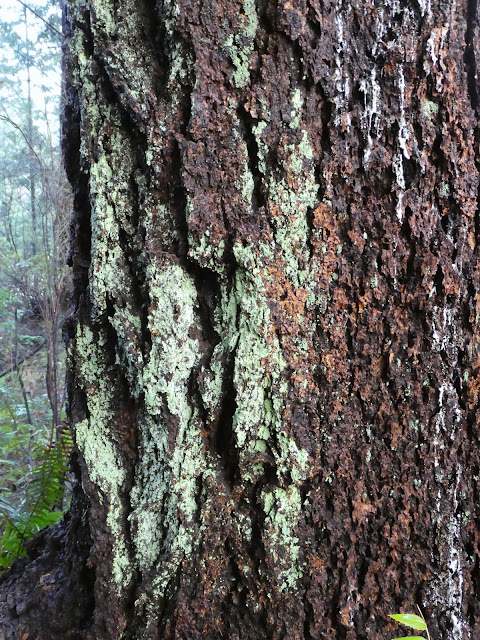
In the dark of the little museum woods, lichens on the lower trunks shine out a pale, ghostly green.

Lichen on a tree on the very edge of the woods, where the light was better.

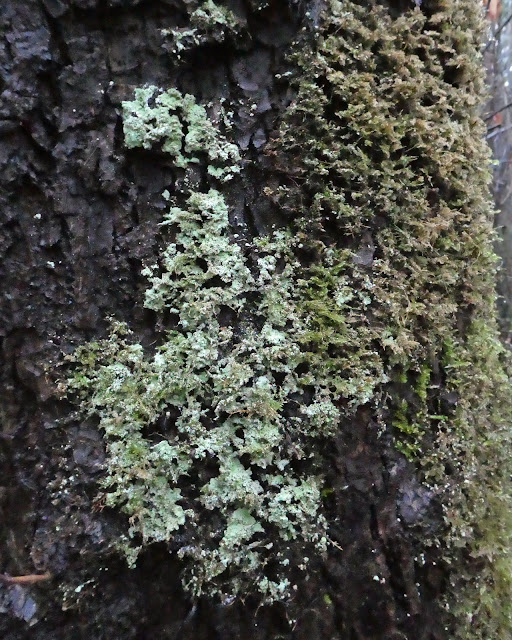
Lichen and moss.

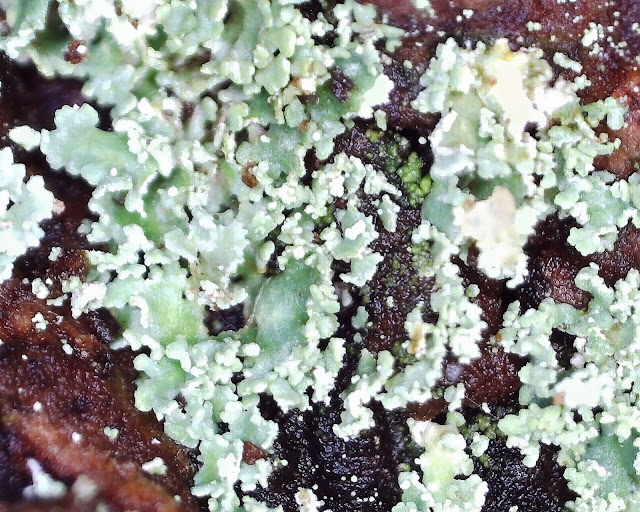
I collected a few pieces of loose bark and brought it home for a better look, under the microscope.

This is Cladonia. The white blobs at the edges of the leafy structures (squamules) are asexual reproductive structures.

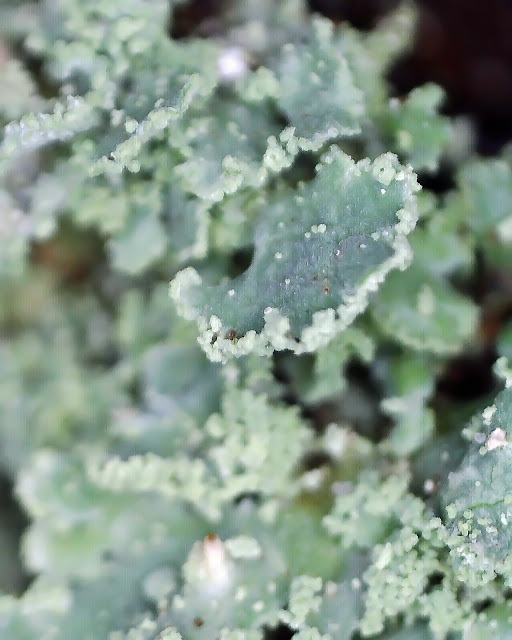
A closer look.

And these are the sexual fruiting bodies. The red spots on top are apothecia, containing fungal spores.

~~~~~~~~~~~~~~~~~~~~~~

En la oscuridad del bosquecito del museo, los líquenes se destacan por su color verde claro, fantasmal.

Fotos:
  1. Liquen en un tronco al borde del bosque, donde la luz está mejor.
  2. Liquen y musgos más adentro del bosque.
  3. Recogí algunos pedazos de corteza que estaban flojos y los traje a casa para verlos bajo el microscopio. Estos líquenes son del género Cladonia. Aquí, las bolitas blancas a los bordes de los talos, (escamas) son estructuras reproductivas asexuales.
  4. Mirando más de cerca.
  5. Y estos son los cuerpos reproductivos sexuales. Las partes rojas son apotecios, y contienen esporas del hongo que forma parte del liquen.. 


Tuesday, April 14, 2020

Cladonia and moss

More tinies:

Cladonia lichen.

Lichen and moss on rotten log. The tall wands are moss sporophytes.

Pixie cup cladonia and two species of moss.

The small green flakes around the base of the columns are the main body of the lichen, the squamulose thalli. The tall, hollow columns are the fruiting bodies, aka podetia. The pinkish tops (red or black in some Cladonia species) are apothecia, the spore producers.

Cladonia lichen vocabulary:
tallus/thalli = leaf-like lichen structures.
squamules = small, flake-like thalli, attached to substrate at the bottom, but with raised edges.
podetium/a = reproductive structure
apothecium/a = where you find the spores.

Other types of lichen have different structures, with other names. I have to review them all from time to time, but not today.

~~~~~~~~~~~~

Estos son líquenes del género Cladonia, creciendo en un viejo tronco caído con musgo.

Las hojuelas verdes alrededor de la base de las columnas constituyen el cuerpo principal del liquen; se llaman talos escamulosos. Un talo tiene la forma de una hoja. Una escámula es un talo pequeño, adherido al tronco u otro base, pero con las márgenes elevadas. 

Las columnas son las estructuras reproductivas, llamadas podetios. Y encima, las áreas de un color de rosa claro (en otras especies de Cladonia pueden ser negras o rojas) son apotecios, y producen las esporas.

Otros tipos de liquen tienen diversas estructuras, con otros nombres. De vez en cuando los tengo que volver a estudiar. Hoy, no.
Powered By Blogger