Showing posts with label cladonia. Show all posts

Thursday, February 22, 2024

Some are Scantily Clad

 Ways of Enlichenment's 2010 list of Macrolichens of British Columbia includes 69 species of Cladonia lichen. They are all very similar, starting off as small scales, then developing the fertile clubs and pixie cups. They bear intriguing common names: Scantily Clad Pixie, Singing Pixie, the Bighorn and the Biggerhorn Pixie, the Troubled, Wounded, Starving, Imponderable, and Card-carrying Pixies ... Many need either/or chemical tests or microscopic examination for a definite identification. Fine by me; I'm content to look and wonder.

In a protected dip in rock covered by Hoary Rock moss, I found these Cladonias:

Fruiting bodies, top view.

These are the typical "pixie cups"; a goblet on a stalk, here the cups are lined with tiny pink and green granules, the fruiting bodies, aka propagules, called soredia. A slight touch is enough to dislodge them; then each one, a few cells each of fungus and alga, finding itself in a suitable spot, will become a new member of the colony.

Around the base of these stalks (the podetia) are the squamules, or scales; like tiny green leaves with scalloped edges.

A step away, more exposed, where the sun reached sooner, and where there was some soil on top of the rock, some of the Cladonias were long and spindly. A different species, probably; these lichens grow in mixed groups.

The whole stalk is covered by these granules.

Here the scales are tiny, dry and shrivelled, although the moss is still damp.

And then there were these, in a shadowy forest, growing on very wet, rotting wood;
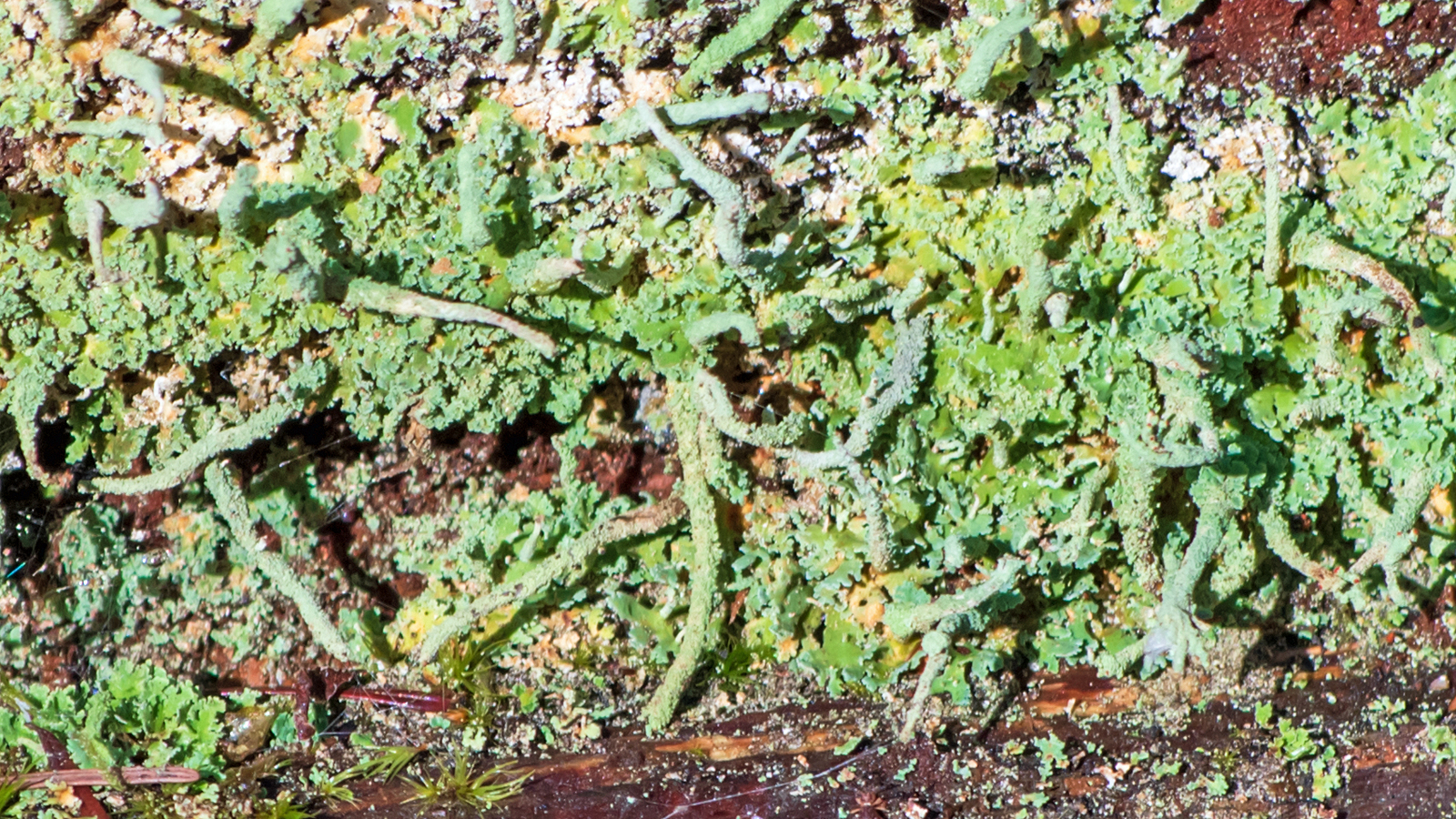
An almost poisonous-looking green.

On these, the granules cover everything; the scales and the stalks, top to bottom. I don't see any cups or red tops.

Typical Cladonia stump.

~~~~~~~~~~~~~~~~
El sitio web "Ways of Enlichenment" tiene un catálogo de los líquenes de Columbia Británica, hecha en 2010; incluidas hay 69 especies de los Cladonia. Todos son muy similares; empiezan la vida como escamas miniaturas, y luego se desarrollan los cuerpos fructíferos, los tallos y las "copas de duendes". Llevan nombres comunes fascinantes (en inglés): El Duende semi-desnuda, Duende Cantante, el Duende de Cornamenta Grande, y el de Cornamenta Más Grande, el Problemático, el Herido, El Hambriento, el Imponderable, y el Poseedor de Tarjeta de Identidad ... Para identificarlos con alguna certeza se necesita o una prueba química o un examen microscópico o ambos. No importa: yo estoy contenta con admirarlos.

  1. En un sitio protegido entre las rocas cubiertas de musgo, encontré estos líquenes Cladonia. Estas son las típicas "copas de duendecillo"; un cáliz con su soporte; aquí cada copa está cubierta por dentro y en el borde de pequeños gránulos, que son los cuerpos fructíferos, llamados soredios. Con solo un leve contacto, se desprenden y cada uno, compuesto de unas pocas células de hongo y de alga, al encontrarse en tierra, formará un organismo nuevo. Alrededor de la base de cada tallo se ven las escamas; parecen hojitas verdes con los bordes ondulados.
  2. A apenas un paso de distancia, más expuestos al clima, donde les llega más el sol, y donde hay un poco de tierra sobre la roca, algunos de los Cladonia son altos y delgados.  Probablemente sean una especie distinta; los Cladonia crecen en comunidades mixtas. Aquí las escamas están secas y arrugadas, aunque el musgo sigue húmedo.
  3. Estos crecen en un bosque en sombra, sobre madera podrida, bien mojada. En estos, los gránulos cubren todo; los tallos y las escamas también. No veo copas ni puntas rojas, que tienen otras de la especies de Cladonia.
  4. Un tocón lleno de Cladonia sp.


Wednesday, March 23, 2022

Pale green stump fur

 More lichens. These are on dry stumps in full sun, on a logged-off hillside.

More Cladonia lichens.

Many Cladonia lichens have two forms, easily distinguished on this stump: they start out as tiny green thalli, scale-like. As they mature, the tall fruiting bodies form; hollow, grainy tubes called podetia, with the reproductive organs held at the top, red, brown or pink, mostly; some are black.

These podetia are about 1 cm. tall.

Green stump fur.

~~~~~~~~~~~~~~~~~~~~~~
Y vuelvo a mirar a los líquenes. Estos crecen en troncos cortados, algo secos, a pleno sol en un cerro donde el bosque ha sido talado.

Los líquenes Cladonia se presentan en dos formas, claramente visibles en las primeras dos fotos. Al principio son pequeñas escamas verdes, a las que llamamos "talos". Más tarde se forman los podecios, tubitos cubiertos de granitos, que crecen perpendicularmente a los talos, y que llevan en su extremo los órganos reproductivos, mayormente rojos, cafés, o color de rosa; en algunas especies son negros.

Friday, March 04, 2022

Lipstick Cladonia

Just a tree. At eye level, just a rough, brown pillar. It pays to move in close, closer. Inches away.

Lipstick Cladonia, on Douglas fir bark.

~~~~~~~~~~~~~~~~
Un árbol, nada más. Solo un árbol. Y al nivel de la vista, es solo una columna rugosa color café. Vale la pena acercarnos algo más, hasta unos centímetros de la superficie.

Es el liquen Cladonia macilenta, en la corteza de un abeto de Douglas.


Thursday, April 01, 2021

When is a lichen not a lichen?

 Okay. I had forgotten about these mushrooms and their companions. Matt, of Sitka Nature, commented on my post about those little green balls, reminding me. He sent me a helpful link to MycoWeb. Thanks, Matt!

The green balls are algae, always associated with the mushroom Lichenomphalia umbellifera, those little mushrooms growing over the logs on the forest floor. I had mentioned them last November, looking at the mushrooms, but I described the algae as a "dark green, crumbly-looking growth".

Lichen agaric mushrooms with lichen, moss, and "dark green stuff".

Well, they're not crumbly; they're shiny, damp balls. And though they look dark green in the shady woods, under a light they may be yellow-green to bluish.

More mushrooms, lichen, dead leaves, red sorrel, and the green algae.

Under the microscope, green algae swarm over a baby moss.

From the page on MycoWeb:

This small omphaloid mushroom is actually a lichen. The mycelium of Lichenomphalia umbellifera is symbiotically associated with the green alga Coccomyxa and forms tiny, granulose to globular bodies near the base of the agaric that were originally described as Botrydina vulgaris. Botrydina was considered a primitive lichen and has a complex arrangement of algal cells in a compact hyphal system.

A lichen is not one organism. It combines two or three different species. Usually, they combine so that they appear to be one thing, like the Cladonia in the photos above.

A lichen is not a single organism. Rather, it is a symbiosis between different organisms - a fungus and an alga or cyanobacterium. Cyanobacteria are sometimes still referred to as 'blue-green algae', though they are quite distinct from the algae. The non-fungal partner contains chlorophyll and is called the photobiont. The fungal partner may be referred to as the mycobiont. (Australian National Herbarium)

This combination, the mushroom and the algae break the rules; they grow together, but each keeps their own form. The alga, Coccomyxa, (which describes them in the scientific notation as "Cocco" - seed, and "myxa" - mucus, referring to their shape and texture) grows near, or at the base of the mushrooms, on rotting wood or damp soil. Because they contain chlorophyll, they capture sunlight, even down there in their dark hideouts, producing nutrients for the other half of the partnership.

While I was looking at the algae and lichens under the microscope, I discovered a lively collection of critters.


Spider, running. She kept dashing across my field, always in a great hurry. The pale green lobes are squamules of Cladonia lichens.

Little black mite. There were many of these.

And a pretty little springtail, Entomobria sp.. Many of these, too, all very busy.

I took their moss and lichen outside to a shady corner of my garden. I hope they like it there.

~~~~~~~~~~~~~~~~~~~~

Bueno. Se me había olvidado este hongo y sus compañeros. Matt, el dueño de Sitka Nature, puso un comentario en mi último post sobre esas pelotitas verdes; una gran ayuda, por cierto. Me envió un enlace para el sitio MycoWeb. ¡Gracias, Matt!

Las pelotitas sí son algas y siempre crecen en relación con el hongo Lichenomphalia umbellifera, esos honguitos que crecen en los troncos podridos en el suelo del bosque. Las había mencionado el noviembre pasado, viendo los hongos, pero describí el alga como "de un verde oscuro, friable".

Pues no son friables; son pelotitas brillosas, húmedas. Y aunque parecen de un color oscuro allí en las sombras del bosque, bajo la luz resulta que pueden ser amarillentas, verde claro, o hasta azul.

Primera y segunda fotos, los hongos, con líquenes Cladonia y el alga.

Tercera foto: bajo el microscopio, las algas cubren un musgo nuevecito.

De la página de MycoWeb:

Este pequeño hongo "omphaloid" (con ombligo) es realmente un liquen. El micelio de Lichenomphalia umbellifera se asocia en simbiosis con el alga verde Coccomyxa y forma cuerpos miniaturos globulosos o en grano, cerca de la base del hongo, los cuales antes se nombraban Botrydina vulgaris. Botrydina se consideraba un liquen primitivo y tiene una organización compleja de células de alga en un sistema compacto de hifas.

Un liquen no es un solo organismo. Lleva en combinación dos o tres diferentes especies. Casi siempre, se unen de forma que aparecen ser una cosa, como por ejemplo, los líquenes Cladonia de las fotos.

Del Herbario Nacional de Australia: 

Un liquen no es un organismo. En cambio, forma un simbiosis entre organismos diferentes — un hongo y un alga o una cianobacteria. A las cianobacterias todavía se les nombra a veces como algas verde azuladas, aunque son bastante diferentes de las algas. La pareja que no es hongo contiene clorofila y se llama el fotobionte. El hongo se puede llamar el micobionte.

Esta combinación particular, deshecha las reglas. Crecen juntos, pero cada organismo mantiene su propia forma. El alga, (que se describe en su nombre científico como "Cocco" es decir, semilla o frutilla, y "myxa", que quiere decir moco, refiriéndose a su forma y textura) crece cerca de la base del hongo en madera podrida o tierra húmeda. Porque contienen clorofila, se aprovechan de la luz del sol, aun aquí en sus escondites oscuros en en fondo del bosque y proveen los nutrientes que usa el hongo.

Mientras miraba los líquenes y las algas bajo el microscopio, aparecieron varios animalitos bastante activos.

Cuarta foto: una ar­aña, corriendo. Los lóbulos de verde claro son las escamas del liquen Cladonia.

Quinta foto: un ácaro negro, brilloso. Había muchos de estos.

Sexta foto: una brincacola Entomobria sp. También había varias, todas muy ocupadas.

Al final, llevé los líquenes con su carga de bichitos a una esquina sombreada de mi jardín. Ojalá la encuentran cómoda.


Saturday, March 27, 2021

Tall Cladonia

In a few weeks, the understory will be full of new leaves, hiding the ground-dwellers, the under-understory. I've spent a few afternoons in the Oyster Bay woods catching up on this bottom layer before it goes into hiding again.

These are cladonia lichens, on a pair of logs.

These have a purplish brown stalk and apothecia (the fruiting bodies at the tip).

Those little mushrooms are everywhere throughout the shady woods this month, growing on well-rotted wood.

Red-tipped cladonia. The tiny specks around the tall stalks are the "leafy" stage, the squamules.

A closer view. The red "lipstick", again, colours the fruiting bodies.

Tomorrow: that poisonous-looking green stuff.

~~~~~~~~~~~~~~~~~~~~~~~~~

En unas pocas semanas, los sotobosques, el nivel de vegetación entre el suelo y las copas de los árboles, estarán llenos de hojas nuevas, escondiendo los residentes al nivel de mis zapatos, el soto-sotobosque, si se me permite inventar una palabra. Pasé unas tardes mirando esta zona de cerca mientras todavía está a la vista.

Estas fotos son del liquen Cladonia sp. creciendo en troncos caídos, ya bien podridos. En la primera foto, la base es de un color café morado, asimismo los cuerpos fructíferos, los apotecios, en la punta del tallo.

Los honguitos en la primera foto abundan en todo este bosque este mes, creciendo en madera descompuesta. 

En las otras fotos, los apotecios son rojos, dando el nombre común de lapiz labial a estos líquenes. Alrededor de los tallos levantados, las hojitas (escamas) que cubren la madera son la forma inmadura del liiquen.

Monday, February 15, 2021

Staying warm

When the wind is chilly and the nights are long, overwintering plants (and lichens) like a cosy container garden.

Practice chain-saw cuts hold in the heat.

Moss and cladonia lichen in the heartwood.

Cladonia lichen over a bed of moss.

The tinies, just getting started. Moss, lichen, kinnikinnick.

Oyster Bay woods, last week. Now they're all even cozier, under a blanket of snow.

~~~~~~~~~~~~~~~~~~~~~~~~~~~
Cuando el viento es frío y las noches largas, plantas y líquenes pasando el invierno al aire libre están felices en sus jardincitos en contenedores, estos al natural.

Musgos y líquenes cladonia, con unas hojas de kinnikinnick, protegidos dentro de troncos viejos en el bosquecito de Oyster Bay, la semana pasada. Hoy, están aun más contentos y calientitos, bajo una cobija de nieve.


Tuesday, January 05, 2021

Caribou lichen?

On mossy ground where the trees overhead don't cut out too much of the light, reindeer lichen makes fluffy mounds and carpets.

Reindeer lichen on a log with pixie cup cladonia.

By a path through the Oyster Bay woods, I stopped to look more closely at broken pieces.

Probably Cladonia portentosa pacifica.

A closer look.

Lichens come in three or four basic shapes: crusts, leaves (foliose), upright or dangling structures (fruticose), and scaly (squamulose). Reindeer lichen start out as tiny scaly or leafy bits (squamules), then develop the more noticeable branched tubes. In the photo above, some of the basic squamules are growing on the wood at the lower right.

More reindeer lichen, these from the Bella Coola valley.

Reindeer lichen, like most others, reproduce vegetatively; if a piece or a powdery soredia breaks off, it continues growing and forms a new clump. They also produce spores on the tips of the branches. In this photo (above) the spore-bearing apothecia can be seen; they're brownish dots at the tips of the branches.

Since lichens are a symbiotic association of fungus/bacteria/algae, when they reproduce vegetatively, each piece carries with it the three partners. But when reindeer lichens try to reproduce by spores, it does not go so well for them. Each spore bears only the fungal component; if it doesn't land where the needed algae are present (and they're rare on their own), they die.

Reindeer lichen and mushroom, Salmon Point.

Something I learned today: reindeer lichen weed their gardens.

Mats also limit the amounts of nutrients, water, and light available to other organisms, which prevent seeds from germinating. The few seeds that do germinate in the soil below the mat can be pulled out of the soil by the lichen as it expands and contracts due to changes in humidity. These last two actions prevent plants from colonizing the lichens’ area, which keeps the forest canopy open and allows the lichens access to sufficient amounts of sunlight. (FungusFactFriday)

 Oh, and they're called reindeer lichen because in the winter in northern Europe, they're the main food of reindeer (we call them caribou here in Canada), which dig through the snow to get them.

~~~~~~~~~~~~~~~~~~~

En terrenos cubiertos de musgos donde los árboles crecen con suficiente espacio como para permitir la entrada de sol al suelo, los líquenes de renos forman cojines y tapetes.

Primera foto: líquenes de reno en un tronco, con líquenes Cladonia.

Pasando por el bosque en Oyster Bay, me detuve a mirar algunos pedazos rotos de liquen de renos.

Segunda y tercera fotos: se ve la estructura de estos líquenes.

Los líquenes se clasifican aproximadamente como:  1) Líquenes en forma de costra (crustáceos) fuertemente unidos al sustrato. Carecen de córtex inferior y no se pueden separar del sustrato sin romperlos; 2) Líquenes en forma de hoja (foliáceos) sólo parcialmente unidos al substrato por lo que se pueden separar con facilidad de él; 3) Líquenes en forma de diminutos arbustos ramificados (fruticulosos), que sólo contactan con el substrato por una pequeña zona. (U. de Guanajuato) Aparte de esto, algunos llevan escamas, y se denominan escamosos.

Los líquenes de renos empiezan a crecer como pequeñas escamas o hojas a nivel del suelo, para luego crecer y formar los tubos ramificados que se elevan en cojines. En la tercera foto, al lado derecho, abajo, se ven algunas escamas del liquen de renos.

Los líquenes de reno, como la mayor parte de los otros, se propagan por medio de fragmentos o estructuras llamados soredios que se separan del organismo original, y que, encontrándose aislados, siguen creciendo para formar un líquen nuevo. Además, producen esporas; en los líquenes de renos, estos se forman en las puntas de las ramas. En la cuarta foto, se pueden ver como manchitas de color café.

Puesto que los líquenes son una asociación simbiótica de tres organismos; un hongo, un alga, y bacteria, cuando se propagan a base de fragmentos o soredios, cada fragmento lleva consigo los tres. Pero cuando se reproducen sexualmente, cada espora lleva solamente el hongo, y si no encuentran el alga apropriada donde llegan a dar, se mueren sin formar un nuevo liquen.

Esto lo aprendí hoy: los líquenes de reno cultivan su jardín, estirpando las hierbas ajenas:

Los tapetes también limitan las cantidades de sustancias nutritivas, de agua, y  de luz que llega a otros organismos, lo cual impide germinar a las semillas ajenas. Las pocas semillas que logran brotar pueden ser arrancados del suelo por el liquen, mientras se contrae y se extiende debido a los cambios de humedad. Estas dos acciones impiden que plantas colonizen el sitio, y ayuda a mantener el bosque abierto, proporcionando a los líquenes una cantidad suficiente de luz del sol. (FungusFactFriday)

Otra cosa: se llaman líquenes de renos porque en el norte de Europa, forman la mayor parte de la dieta de los renos en invierno. Renos, que aquí en Canadá, se llaman caribú.


Saturday, October 17, 2020

Curly

 Lichen growing on a log:

Cladonia sp.

~~~~~~~~~~~~~~~~~

Liquen, Cladonia sp., en un tronco viejo.


Wednesday, September 02, 2020

Cladonias and a bullseye

 A few more lichens:

Bronzed Pixie lichen, Cladonia gracilis

The many Cladonia species of lichen come in many forms; this tall club or cup shape with a coloured top is a common shape. But others are like strings, or bushes, or leafy scales or tangled wires. This next one is bushy, but with a grainy surface that makes it hard to see clearly.

Dragon Horn lichen, Cladonia squamosa

But, like the upright cups above, it has similar fruiting bodies; the dark spots at the tips of branches.

A larger clump of Dragon Horn

And not a Cladonia: 

Common bullseye lichen, Placopsis gelida

~~~~~~~~~~~~~~~~~~~
Aquí hay más líquenes: los primeros son del género Cladonia; este género viene en una multitud de formas, algunos como tazas con la copa bordeada de colores como rojo o azul, otros como arbustitos, hilos, alambres enredadas, o incluso como hojas o escamas.

El primero es el liquen "de hada bronceada"; los que siguen son "cuerno de dragón". El tercero no es Cladonia, sino otro tipo muy común, que hace placas redondas en las piedras.


Tuesday, April 14, 2020

Cladonia and moss

More tinies:

Cladonia lichen.

Lichen and moss on rotten log. The tall wands are moss sporophytes.

Pixie cup cladonia and two species of moss.

The small green flakes around the base of the columns are the main body of the lichen, the squamulose thalli. The tall, hollow columns are the fruiting bodies, aka podetia. The pinkish tops (red or black in some Cladonia species) are apothecia, the spore producers.

Cladonia lichen vocabulary:
tallus/thalli = leaf-like lichen structures.
squamules = small, flake-like thalli, attached to substrate at the bottom, but with raised edges.
podetium/a = reproductive structure
apothecium/a = where you find the spores.

Other types of lichen have different structures, with other names. I have to review them all from time to time, but not today.

~~~~~~~~~~~~

Estos son líquenes del género Cladonia, creciendo en un viejo tronco caído con musgo.

Las hojuelas verdes alrededor de la base de las columnas constituyen el cuerpo principal del liquen; se llaman talos escamulosos. Un talo tiene la forma de una hoja. Una escámula es un talo pequeño, adherido al tronco u otro base, pero con las márgenes elevadas. 

Las columnas son las estructuras reproductivas, llamadas podetios. Y encima, las áreas de un color de rosa claro (en otras especies de Cladonia pueden ser negras o rojas) son apotecios, y producen las esporas.

Otros tipos de liquen tienen diversas estructuras, con otros nombres. De vez en cuando los tengo que volver a estudiar. Hoy, no.

Monday, March 30, 2020

Green ghost

This is a strange thing. In a tangle of old dead ferns, thimbleberry canes, alder branches, blackberry vines and ancient logs, all in shades of brown and grey, a large mass of pale, sickly green shone out. I pushed through the weeds and climbed over a few slippery logs to get a better look.

It's a stump, almost completely encased in lichen.

Of course, these lichens are everywhere, but what intrigues me is that on none of the surrounding logs or branches is there any sign of it. Just on this stump. The green on the logs on the right is moss; there was no lichen on them.

View from as close as I could get without breaking my neck.

The lichen is mainly lipstick cladonia; here and there you can see the tiny spots of red on the tips. Scattered throughout are a bunch of those button lichens that grow on old trees.

UPDATE: In the comments, M. Goff identified much of this mass, the green stuff with pinkish buttons, as Icmadophila ericetorum, otherwise known as "fairy barf", "fairy puke", "fairy upchuck", and more politely, as peppermint drop lichen or spraypaint lichen.

UBC has a good photo, here.

~~~~~~~~~~~~~~~~

Muy extraño: en un lío de helechos muertos, ramas de aliso rojo, cañas de mora y de "thimbleberry" (Rubus parviflorus), y troncos caídos, viejos y podridos, todo esto en tonos de café y gris, una masa pálida, de un verde claro, llamaba la atención. Abrí camino entre la hierba y sobre troncos resbalosos para poder verlo mejor.

Es un tronco cubierto completamente por líquenes. Estos líquenes son bastante comunes, pero lo que me sorprendió es que ninguno de los troncos y restos de plantas alrededor traían el liquen; solamente en este tronco se veía.

El liquen es Cladonia sp., o sea liquen "lapiz labial", y además unos botones de un liquen parecido al que encontré en el manzano.

Friday, March 27, 2020

Spikes, curls, lipstick

I looked at a couple of handfuls of moss and lichen from under the trees in the Oyster Bay woods under my microscope.

Spiky

Curly

With lipstick cladonia. The lichen leaves white speckles on everything.

One stalk of lipstick cladonia.

And racing through the cladonia speckles, the tiniest ant I've seen.

~~~~~~~~~~~~~~~

Traje una bolsita de musgos y liquen del bosquecito de Oyster Bay, y los examiné bajo el microscopio. No pude identificar los musgos, pero el liquen es Cladonia macilenta, o como lo llamamos aquí, cladonia lapiz labial. Entre los fragmentos de líquenes, una hormiga miniatura corría y corría.

Saturday, November 17, 2018

It's complicated

The closer you get to the ground, the busier it gets. A mushroom on old wood turns out to be an entire garden community.

Lichen agaric mushroom (I think), with lipstick cladonia (lichen), moss, last summer's weed stalks,and a grass seed head.

Moving back to see the surroundings. Now there's the odd pixie cup lichen, a handful of Douglas fir needles, a sprinkling of brand new seedlings; two or four red leaves getting ready for the spring, fragments of big leaf maple leaves, and a coating of dark green algae on the old wood. Also present, but well camouflaged; several springtails.


Another mushroom/wood/moss/stems/grass group, including here a bird's nest fungus (where the old stem meets the patch of moss).

Zooming in on one of these lichen agarics. Latin name, Omphalina, meaning having a navel.


Thursday, November 15, 2018

Red lipstick and white reindeer

A few lichens from the edge of Oyster Bay forest:

Coastal reindeer lichen on old, wet wood

Look for the bright red spot near the pointer on the upper left; the tip of a lipstick Cladonia; and near the bottom left, I think that scaly lichen is a Dragon Cladonia.

"Roughly 70 species of Cladonia occur in our region, making this one of the most diverse of lichen genera." (Plants of Coastal British Columbia)

Spiky-branched lichen, a few pixie cup Cladonia, moss, and fir needles.

More of those spiky lichens behind a mushroom

And a whole mini-forest of lipsticks.

Thursday, November 30, 2017

Scribblings and pumpkin tarts

Once the fall leaves are busy making mulch on the ground, it's a good time to stop and look at the exposed tree trunks and stumps, each with its own crop of mosses and lichens. The unnamed trail I was following passed through a mixed forest, half evergreens, half deciduous trees, mostly red alder, cottonwood, and various maples.

Black cottonwood; mid-size tree, with its mossy earmuffs.

Two persistent leaves. Cottonwood.

Orange jelly fungus. Looking closely, the surface even has the bumpy texture of an orange peel.

Lipstick cladonia on a rotting log

And these miniature pumpkin pies are a barnacle lichen, Thelotrema lepadinum.

The genus name, "Thelotrema" comes from the Greek for "perforated nipple", which accurately describes the immature "barnacles". "Lepadinum" means "like limpets". Someone got their intertidal critters mixed up.

Red alder, Alnus rubra. With bark barnacles and pencil script lichen.

Red alder, moss, and lichens

Zooming in. The little branching lines are the fruiting bodies of Pencil script lichen, Graphis scripta. 

The pale patches are the main body of the lichen; it's a crust lichen, making smooth writing surfaces on trees in shady woods.

The path. Well travelled, wide enough for the occasional vehicle.
Still round the corner we may meet
A sudden tree or standing stone
That none have seen but we alone.
(From JRR Tolkien, "Walking song")


Powered By Blogger