Showing posts with label bark barnacle. Show all posts

Monday, January 09, 2023

Custard tarts and minty chocolate and orange jelly? It's lichen.

 Continuing on with those two lichen-covered twigs, here are the two that I didn't show yesterday.

This is the bottom of the second twig.

Almost everywhere that the green lichens have left a bit of space, the barnacle lichens, Thelotrema lepadinum, have colonized the bark. They coat it with a thin crust, breaking out into these "barnacles", which hold the fruiting bodies, or apothecia. 

Zooming in.

Zooming in more.

Barnacles? These ones look more like tiny custard tarts to me, with their scalloped, raised rims, and the palish pink or cream filling.

The mint green and dark chocolate blob is the start of another bone lichen.

I don't know if the green coating is part of the lichen, or a separate green alga growing on top, just to add another layer of complexity to the whole thing.

And then there are the pale orange patches, with their frilly edges:

Looks like a crust.

These patches are hard and dry, as hard as the old bark. I couldn't see any lobes or fruiting bodies, and I finally dug out the microscope again, and looked at them after I'd sprayed them with distilled water. Sometimes that makes a difference.

Wet orange stuff.

It just looks paler, and jelly-like. It still felt hard, though. Is it a lichen, or some sort of fungi?

But while I was looking at orangey stuff, I saw this, more rhizines on the shield lichen, Parmelia sp.:

They sort of look like eyelashes.

And there's one more thing to work on tomorrow.

~~~~~~~~~~~~~~~~~~~~~~~~~~~~~~~~

Sigo con los líquenes que cubren las dos ramitas, los que vimos ayer, con dos otros líquenes.

Fotos: 

  1. La parte inferior de la segunda ramita.
  2. En casi todas partes donde los dos líquenes verdes han dejado espacio, la corteza de la rama está cubierta de estos líquenes "balano", los Thelotrema lepadinum. Cubren la corteza con una masa delgada, y encima se producen estos cuerpos fructíferos, llamados apotecios.
  3. Con el microscopio.
  4. Más aumento. ¿Balanos, los llaman? Se parecen más, aquí, a pastelitos de nata, con los bordes ondulados y el relleno en crema o color rosado. La masa en color menta con gotas de chocolate es un liquen nuevo de las Parmelia. Y no sé si lo verde es parte del mismo liquen, o si es una alga verde, para hacer aun más complicada la cosa.
  5. Y luego hay las manchas anaranjadas, con los bordes como deshilachados. Parece una costra. Es duro y seco, tan duro como la corteza misma. No pude ver nada de lóbulos ni cuerpos reproductivos y por fin saqué otra vez el microscopio y los miré después de rociarlos con agua destilada. A veces eso cambia las cosas.
  6. No mucho. Se ve más pálido, y parece una jalea, pero sigue tan duro como antes. ¿Será un liquen o tal vez algún hongo?
  7. Y mientras veía de nuevo las masas anaranjadas, ví más de las ricinas que vimos antes. Parecen pestañas, ¿no?
Y todavía hay más para mañana.

Tuesday, December 13, 2022

Rags, bones, kidneys, skulls

I've been leafing through my guide book, trying to identify lichens found on an alder trunk and Douglas-fir twigs. It's (for me, anyhow) an impossible task. But I was struck, once again, by the strange names that common lichens have been saddled with. Like these:

  • Punctured rock tripe
  • Seaside kidney
  • Peppered moon
  • Questionable rock frog (My favourite)
  • Lettuce lung
  • Tickertape bone
  • Blood-spattered beard
After those, something like Bark barnacle or Laundered rag sounds almost humdrum.

Anyhoo ... These are the lichens that sent me on the search:

The leaf lichen is the most noticeable, but look closer.

This leaf lichen could be the Hooded bone. Or not. There are several similar species.

Zooming in, Bark barnacle, Thelotrema lepadinum, a crust lichen.

The round buttons are the apothecia, the fruiting bodies or the lichen. I'm not sure about that patch with dark brown spots. Could be holes, could be fruiting bodies of another lichen. Update: It looks like button lichen, Buellia erubescens.

Zooming in on another spot.

Are these two different lichens, or different stages of the same one? Update: the one on the right may be Parmelia sulcata.

Further up the same tree. More barnacles, more leaf lichen. The underside of this pale green lichen is a dark brown.

A twig fallen off a Douglas-fir into the snow.

The lichens at either end are more of the bone lichens. The leafy one may be ragbag, Platismatia glauca, a "bewilderingly variable species", says the guide book. There are several other similar species. Ragbag has frilly margins with tiny outgrowths or powdery balls. Laundered rag, one of the other common rags, doesn't have these frilly margins.

A key characteristic that helps with identification of a lichen is the surface it grows on, whether rocks or ground or trees, and whether the trees are live or dead, and what species. The ones above are on live trees, alder and Douglas-fir. 

A bit of folklore from my guide book: "In Europe, lichens growing on human skulls were once valued at their weight in gold as a remedy for epilepsy."

I don't think I'll be finding any of those. I hope I won't!

~~~~~~~~~~~~~~~~~~~~~~~~~~~~~~~~
He estado hojeando mi libro guía, tratando de identificar algunos líquenes que encontré en la corteza de unos alisos y en ramitas de abeto de Douglas. Una tarea imposible, para mi, por lo menos. Pero, no por la primera vez, me fijé en los nombres curiosos con que les han denominado en inglés, como por ejemplo (traducción literal):
  • Tripas de piedra perforadas
  • El riñon al borde de la mar
  • La luna salpicada. (O con pimienta, según como se traduce "peppered".)
  • Rana de piedra discutible (Este es mi favorito.)
  • Pulmón de lechuga
  • Hueso de cinta de teletipo
  • Barba salpicada de sangre.
De;spués de leer estos, algo así como Bálano de corteza, o Trapo lavado parece hasta aburrido.

Bueno, pues estos son los que me hicieron estudiar mi guía otra vez:

Fotos:
  1. Líquenes en la corteza de un aliso. El más grande puede ser el Hueso con capuchón, Hypogymnia physodes. O no. Hay varias especies muy parecidos. Y no hay que olvidar todos los otros que lo acompañan.
  2. Haciendo Zoom. Bálano de corteza, Thelotrema lepadinum. Un liquen crustáceos. Los "botones" son los apotecios, los cuerpos de reproducción. No estoy segura que será esa mancha con puntos negros; pueden ser agujeros, o tal vez otro liquen.
  3. Otro zoom, el mismo árbol. ¿Son estos dos líquenes diferentes, o dos etapas de la vida del mismo liquen?
  4. En el mismo árbol. Más bálanos y líquenes foliosos. El liquen folioso es verde claro arriba, y casi negro en la parte inferior.
  5. Una ramita caída de un abeto de Douglas. Los líquenes en los extremos son de los líquenes hueso. El del centro es uno de los "trapos", probablemente "bolsa de trapos", Platismatia glauca. "Una especie extremadamente variable", dice mi libro guía. Hay otras especies parecidas. P. glauca tiene los bordes irregulares y con protuberancias o bolitas pequeñas; la otra especie común tiene bordes lisos.
Una característica que es importante notar para lograr una identificación es el substrato en donde se halla, sea en piedra, en suelo, o en madera, sea en madera muerta o viva, y de cual especie. Los líquenes de estas fotos estaban en aliso y abeto de Douglas.

Un dato folklórico encontrado en mi libro guía: "En Europa, los líquenes que crecían en calaveras humanas se valuaban según su peso en oro, por ser considerados un remedio para la epilepsia."

No creo que voy a encontrar ninguno de estos.

Wednesday, November 30, 2022

Ruffles, pimples, bones in the forest.

It's always dark under the trees at Hoomak Lake. Even on bright, sunny days. The canopy overhead is dense, the hillside steep, casting a permanent shadow. On a wet winter day in the rain, the forest is so dim that colours are leached out. Only by the shore does green show up as green.  The camera has a trick that my eyes can't match; it turns on the flash.

It showed me these mosses and lichens on the trunks of red alder trees.

It looks like Tree ruffle liverwort, and an unidentified moss.

Impossible to identify

The longer view. Leaf lichens, tree barnacle, and the moss.

Zooming in on another tree. Baby leaf lichen, and bark barnacle.

The leaf lichen, I think, is what my guide book calls "hooded bone" and Wikipedia calls "monk's hood lichen", Hypogymna physodes. Or one of the common Hypogymna species, of which 17 are found in BC. E-Flora explains that these lichens are called bone lichens because of "... the hollow lobes of the species and the pale, often whitish, upper cortex."

The bark barnacle is another common lichen, growing mainly on alder trunks. It is a crust lichen, barely visible; what draws our attention, and gives it its name, are the round fruiting bodies, tiny blisters (another site calls them "pimples") with an open pore in the centre.

And on the ground beneath the trees, wherever the light reaches in, I see step moss.

Step moss, alder leaves, and a shiny leaf moss (upper right).

More step moss and alder leaves. With salal leaves; these are evergreen, always bright, always glossy.

~~~~~~~~~~~~~~~~~~~~~~~
 Siempre está oscuro alrededor del lago Hoomak. Cuando el sol brilla, y más en el bosque invernal, en la lluvia. La cubierta forestal es densa, el terreno empinado, manteniendo todo en sombra. En un dia gris, es tan oscuro que los ojos casi no pueden distinguir los colores. Solamente en la orilla del lago entra suficiente luz para que lo verde se vea como verde. Pero mi cámara tiene un truco que no tienen mis ojos; el flash.

Y el flash me mostró estos líquenes y musgos en los troncos de alisos rojos.

Fotos:
  1. Parece ser la hepática "fleco de árbol", Porella navicularis. Y un musgo sin identificar.
  2. Musgos que no pude identificar.
  3. Vista de una sección más larga del tronco, El musgo, y los líquenes Thelotrema lepadinum y Hypogymna physodes.
  4. En otro aliso, un brote nuevo del líquen Hypogymna physodes, y el "bálano de corteza", Thelotrema lepadinum.
El líquen folioso, creo, es el que llaman "hueso con capuchón". Wikipedia le da el nombre de "capuchón de monje". O puede ser otro del mismo género, del cual hay 17 en esta provincia. E-Flora explica que se le ha dado el nombre de "hueso", porque, dice, "los lóbulos son huecos, y la corteza es pálida, casi blanco a veces".

El "bálano de corteza" es otro líquen muy común que crece principalmente en los troncos de los alisos. Es un líquen incrustante, apenas visible. Lo que salta a la vista son los cuerpos fructíforos; las ampollitas (granos, les llaman otros) que se abren por medio de un poro central.

Y en el suelo debajo de los árboles al mero borde del agua, donde le llega la luz, se halla el musgo "de escalera", Hylocomium splendens.

2 fotos: el musgo, con hojas de alder, y un musgo de hojas grandes en la parte superior a la derecha, y (segunda foto) hojas de salal, 

Sunday, January 23, 2022

Underfoot, up a tree, on a log

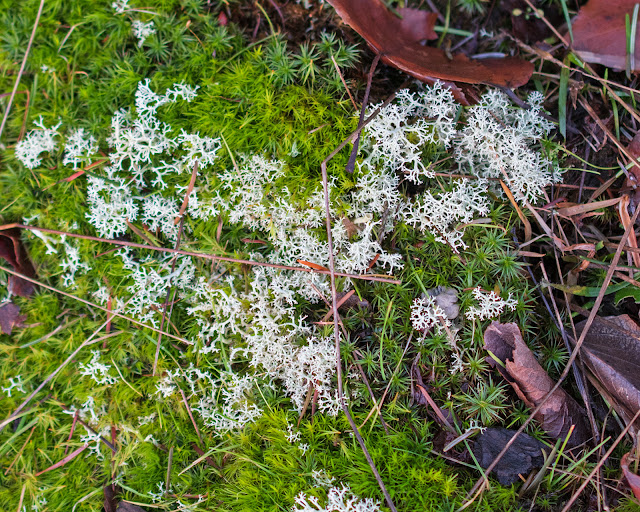
In the open areas of the Oyster Bay little forest, reindeer lichen is sprinkled over logs and moss, never in huge mounds like I see in other places; just a few inches deep, in handfuls or even individual "shrubs".

Reindeer lichen, Cladina portentosa?, and moss.

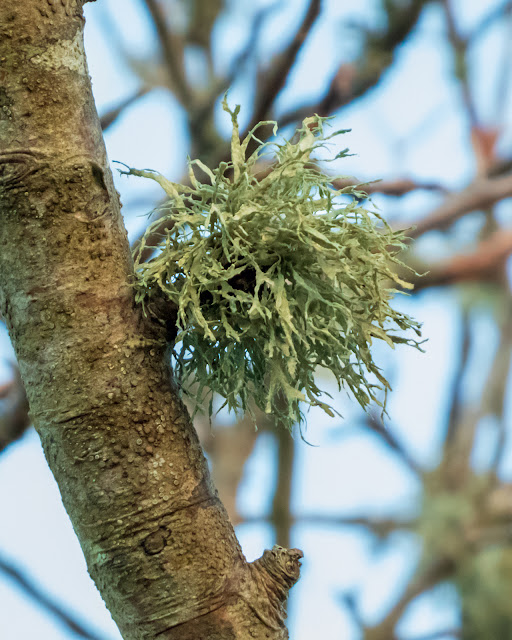
I walked to the dike overlooking the bay and down to the old apple tree. At this time of year, it is decorated with handfuls of hanging leaf lichen and buttons on the trunk and larger branches.

Antlered perfume lichen, maybe. Evernia sp., anyhow. And bark barnacles.

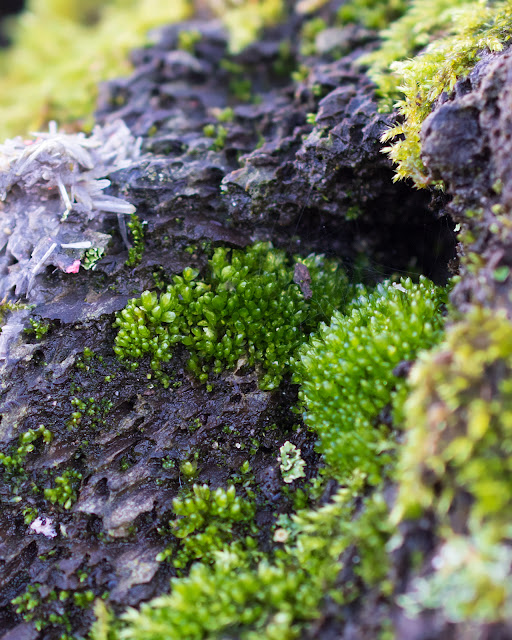
On the old landmark log, I found mosses. And something else.

Tiny, jewel-like moss, a yellow-green moss, spider webs (I couldn't find the spider) and the start of a leaf lichen. And what are those white sticks on the upper left? They almost look like ice crystals. Could be.

Sunset will be at 5:00 this afternoon! A milestone!

~~~~~~~~~~~~~~~~~~~~~~~~~~~

En las areas más abiertas del bosquecito de Oyster Bay, el liquen de los renos, Cladina sp., crece salpicado sobre los troncones y el musgo. Nunca, aquí, forma grandes cojines como los que veo en otros sitios; aquí apenas llega a unos cuantos centímetros de altura, en pequeños grupos o aun solitarios.

Primera foto: este liquen sobre musgos.

Fui hasta el dique que bordea la laguna y hasta el viejo manzano. En esta época del año está adornado solamente con líquenes foliosas y botoncitos en la corteza del tronco y las ramas mayores.

Segunda foto: una rama del manzano con sus botoncitos (a los que llamamos bálanos de corteza) y el liquen folioso, Evernia sp.

En el viejo troncón encontré musgos. Y algo más.

Tercera foto: musgos que parecen joyas miniaturas, además, un musto verde/amarillo, telarañas (pero no pude encontrar la araña) y un liquen folioso recién brotado. ¿Y esos palos blancos en la esquina superior a la izquierda? Casi parecen cristales de hielo. Podría ser.

¡Y el sol se pondrá esta tarde a las 5! ¡Feliz!


Thursday, September 23, 2021

Twig art

Lichen and friends on fallen twigs, from the museum grounds:

A rag lichen and moss. On fallen needles.

Yellow disc lichen and bark barnacle lichen.

*Update: Identified as Common Sunburst Lichen, Xanthoria parietina.

Interesting spotted lichen,

More spotted lichen and bark barnacles.

Rags and moss.

Not a twig. The old eagle totem, with shoulder corsage.

~~~~~~~~~~~~~~~~~~~~~~

Varios líquenes, musgos y hongos en ramitas caídas, alrededor del museo.

  1. Liquen de hoja, muy común aquí. Con musgo.
  2. Un liquen amarillo en forma de platito, y el liquen que llamamos el bálano de la corteza.
  3. No había visto estos antes. Líquenes con sus cuerpos reproductivos, los puntitos negros.
  4. Otro liquen con lunares. Y más bálanos de corteza.
  5. Hojas y musgo.
  6. No es ramita. El viejo totem con su ramillete de liquen en el hombro.


Thursday, November 30, 2017

Scribblings and pumpkin tarts

Once the fall leaves are busy making mulch on the ground, it's a good time to stop and look at the exposed tree trunks and stumps, each with its own crop of mosses and lichens. The unnamed trail I was following passed through a mixed forest, half evergreens, half deciduous trees, mostly red alder, cottonwood, and various maples.

Black cottonwood; mid-size tree, with its mossy earmuffs.

Two persistent leaves. Cottonwood.

Orange jelly fungus. Looking closely, the surface even has the bumpy texture of an orange peel.

Lipstick cladonia on a rotting log

And these miniature pumpkin pies are a barnacle lichen, Thelotrema lepadinum.

The genus name, "Thelotrema" comes from the Greek for "perforated nipple", which accurately describes the immature "barnacles". "Lepadinum" means "like limpets". Someone got their intertidal critters mixed up.

Red alder, Alnus rubra. With bark barnacles and pencil script lichen.

Red alder, moss, and lichens

Zooming in. The little branching lines are the fruiting bodies of Pencil script lichen, Graphis scripta. 

The pale patches are the main body of the lichen; it's a crust lichen, making smooth writing surfaces on trees in shady woods.

The path. Well travelled, wide enough for the occasional vehicle.
Still round the corner we may meet
A sudden tree or standing stone
That none have seen but we alone.
(From JRR Tolkien, "Walking song")


Powered By Blogger