Two more lichens:
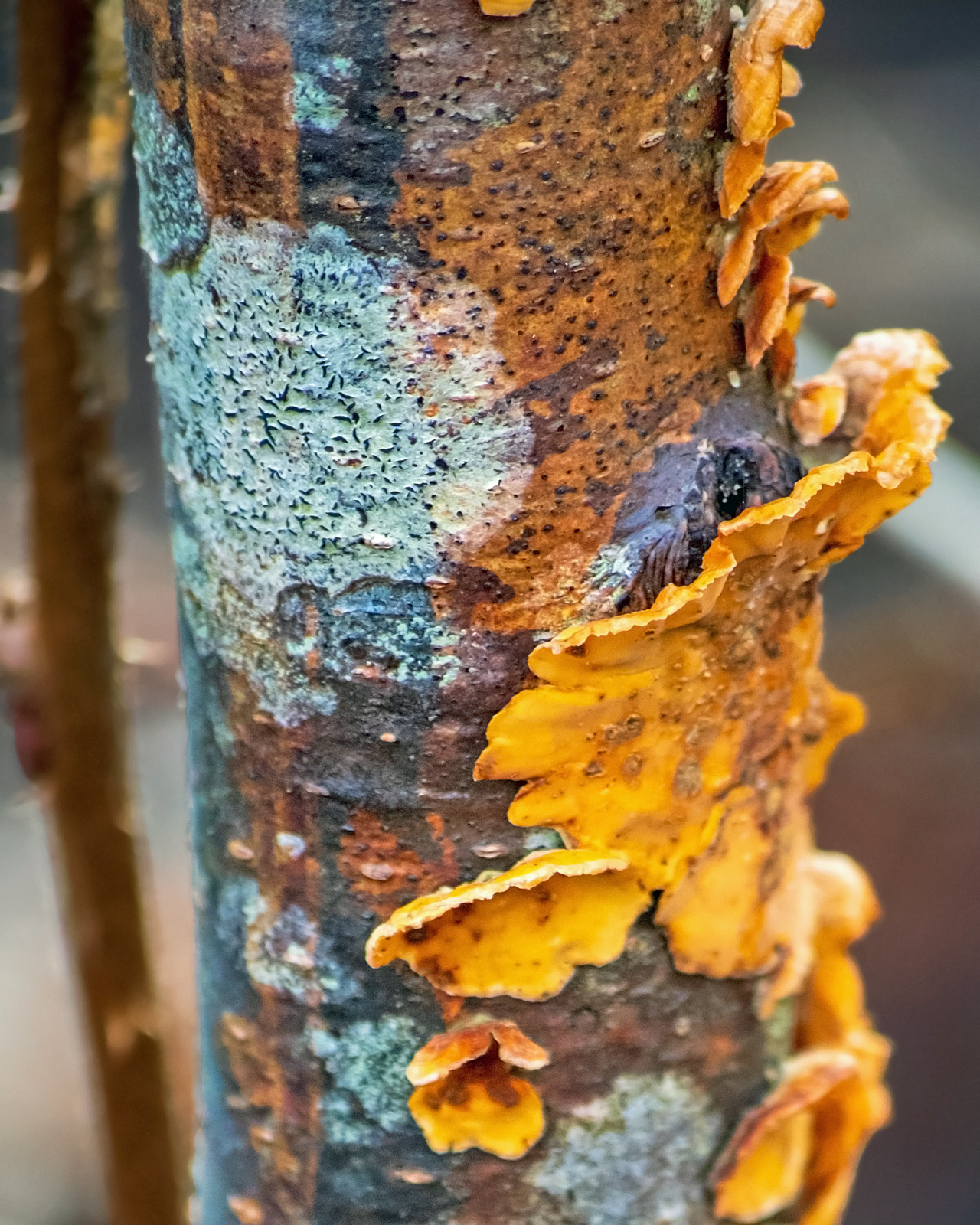
The first is on a log beside the river.
 |
| Hard, crusty lichen on the bark and on the bare wood. Stuck on tight; I could not break it off. |
 |
| A slightly grainy texture, no other structures. |
I was looking through the photos on
Ways of Enlichenment, a very handy source for finding similar lichens, with well over 11 thousand photos of lichen, organized by species name, by body type (morphology), or by its place in the family tree (the phylogroup). Each photo includes the location where the photo was taken, and the substrate.
For this lichen, I looked through the morphology list for photos of crustose lichens. The basic body types are listed: Crustose, Squamulose (these are scales), Foliose (leafy). And, for good measure, the "Flames"; all the yellow lichens, whichever basic type they fall under, and "Gelatinose" (with dark centres). And 'way down the bottom of the list, I found this: Etceterose. I don't think that's a standard scientific category. But it should be.
I did find among the crustose script lichens
a sort-of look-alike,
Llimonea californica, here on Vancouver Island, on seaside juniper. Could be this one, maybe, although it doesn't look like a script.
Now this is a script lichen:
 |
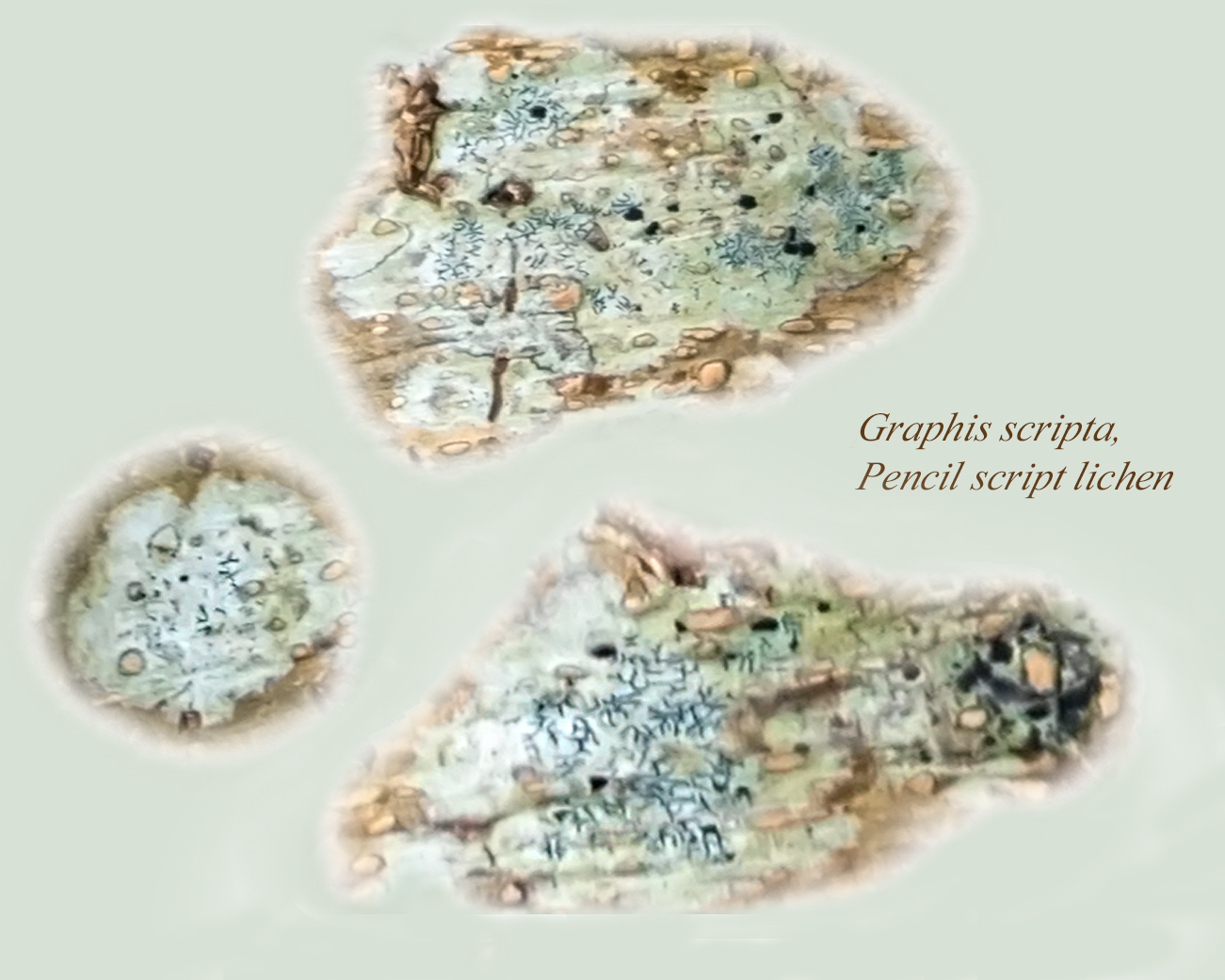
| Script lichens on alder in Stories Creek Park. |
They are hard to see, with all the other alder markings, so I copied a few patches and isolated them:
 |
| Looks like the workings of a mad scientist. |
This is probably
Graphis scripta, the Pencil script.
A continuous crust lichen, upper surface pale whitish-grey, smooth, bearing numerous black hieroglyphic squiggles. ... The squiggles are diagnostic and represent an unusual form of fruiting body called a "lirella". ... This species has been identified from prehistoric amber, dating from 70 to 25 million years ago. (Plants of Coastal BC)
~~~~~~~~~~~~~~
Y aquí hay dos otros líquenes.
Fotos #1, 2: Líquenes en un troncón en la orilla del rio. Un liquen duro, como una costra encima de la corteza y también en la madera lisa. Está firmemente adherido y no pude separarlo de la madera. Tiene una textura un poco granoso, pero no se ven otras estructuras.
Busqué entre las fotos en el sitio "Ways of Enlichenment", el cual es muy útil para descubrir líquenes parecidos al que tienes en mano, ya que tiene más de 11,000 fotos de líquenes, clasificados por su morfología, por su nombre de especies, y por su taxonomía. Cada foto incluye la ubicación y el tipo de sustrato donde se encontró ese ejemplo.
Para encontrar este liquen, buscaba entre los líquenes crustáceos en la lista por morfología. Se nombran tres tipos generales de liquen: los crustáceos, los foliosos, y los escuamulosos (con escamas). Y como extra, hay una categoría de todos los líquenes amarillos, que ellos llaman "Las llamas", y otra, "Los Gelatinosos", que son los que tienen el centro oscuro. Y al pie de la lista, encontré "Los Etcéteroses". Lo cual no creo que sea una categoría científica aceptada. Pero lo debe ser.
Entre los líquenes crustáceos de escritura, encontré una foto de un liquen muy parecido, Llimonea californica, aquí en la isla, creciendo en un enebro. Puede ser este, o no; no veo señales de escritura en este.
Y este, sí es un liquen de escritura:
Fotos #3, 4: Liquen de escritura en un aliso en Stories Creek Park. Son muy difíciles de ver con todas las otras marcas en la corteza del aliso, así que los copié: parece algo escrito por un científico loco.
Probablemente sea Graphis scripta, la escritura por lápiz.
Un liquen de costra continua, la superfice superior pálido, grisáceo con blanco, liso, llevando muchos garabatos hieroglíficos negros. ... Los garabatos son diagnósticos y representan un tipo de cuerpo fructífero inusitado que se llama una "lirella". ... Esta especie se ha identificado en ámbar prehistórico, datado a hace de 70 a 25 millones de años. (Plants of Coastal BC)