Showing posts with label snag. Show all posts

Friday, January 10, 2025

Branches, not quite bare

The hydrangea outside my kitchen window is all over new buds. A sign of early spring, maybe, or just a response to the warm weather; it may be a mistake, if we end up with winter weather later this month.

The red alders are wearing their red catkins, too. They started producing them last November, and a bit (or a lot) of freezing weather won't phase them.

Red alder, Alnus rubra, January 2025.

The male alder flowers are the long, reddish catkins. Female catkins are smaller, and oval-shaped, greenish when they're new. Both male and female catkins appear before the leaves, but the males will drop off once pollination is finished. The female catkins will develop into small, brown cones; these stay on the tree over the winter. About now, the seeds will be dropping from between the scales of these cones. The first beginnings of pinkish leaf buds are showing at the tips of the branches.

Snag with eagle. No buds on this tree, but there's lichen.

Big-leaf maple. No leaves, no buds, no catkins yet.

~~~~~~~~~~~~~~~
Hay botones nuevos en la hortensia en frente de mi casa. ¿Señal de primavera, tal vez? ¿Una respuesta al clima que este año, hasta ahora, ha pasado por alto el invierno? ¿O un error que se pagará si es que veamos temperaturas de invierno más tarde?

Los alisos rojos ahora estrenan sus candelillas rojizas. Las empezaron a producir en noviembre, y no les espanta el frio, aunque todo se congele.
  1. Rama de aliso rojo, Alnus rubra, ahora en enero, 2025. Las candelillas machas son largas y rojas. Las candelillas hembras son más chicas, redondeadas, verdes cuando están nuevecitas. Tanto las candelillas machas como las hembras salen antes de que aparezcan las hojas, pero las candelillas machas se caerán una vez terminada la temporada de polinización. Las candelillas hembras formarán pequeñas piñas; estas permanecen en el árbol durante todo el invierno, y ahora las semillas están escapando de entre las escamas. Y se ven en la punta de las ramas los primeros brotes rojizos de las hojas.
  2. El árbol estará muerto, pero lleva vida; el águila y los líquenes que cubren las ramas.
  3. Un arce de hoja grande. Este árbol todavía no muestra señas de hojas, ni sus botones, ni las candelillas que aparecerán más tarde.


Tuesday, August 02, 2022

Help, I am being held prisoner!

Sometimes I see faces in snags. Like this one, carved by woodpeckers, imitating Edvard Munch's "Scream".

Trapped.

A half-profile view. The shrub on top is a huckleberry.

~~~~~~~~~~~~~~~~~~~~~~~~~~~~~
A veces encuentro caras esculpidas en los troncos. Esta, hecha por pájaros carpinteros, me recuerda la pintura "El Grito", por Edvard Munch.

El arbusto que crece encima es un huckleberry, aprovechando el sol allá arriba.


Thursday, December 30, 2021

Outlined in white

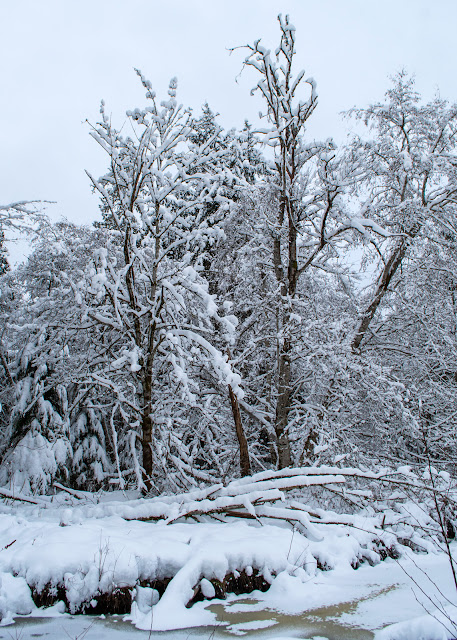
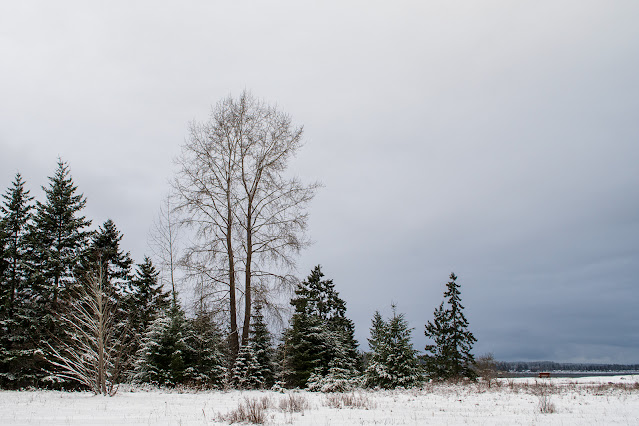
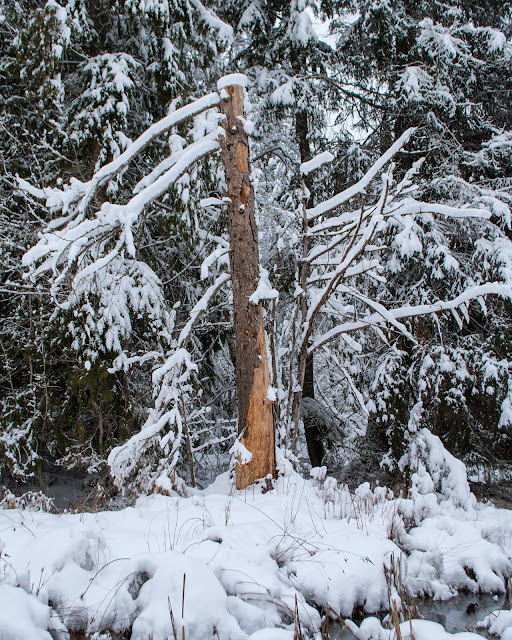
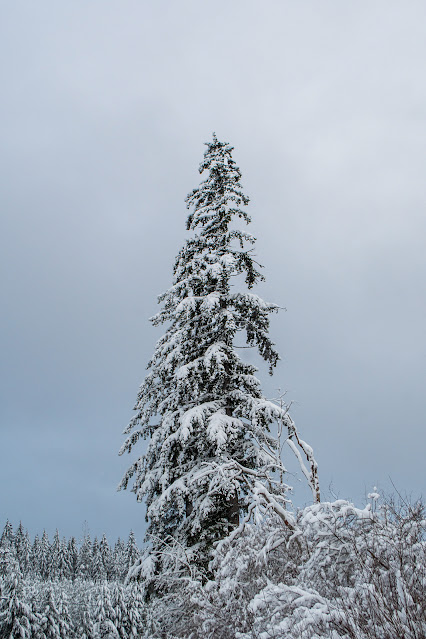
Snow brings out the varied shapes of trees.

Deciduous trees and beaver-downed alders.

Oyster Bay meadow.

Wildlife snag with snow cap.

Older tree, with new saplings.

I never noticed before; most of the branches on the right side (from this angle) are missing. Or never grew. Wind patterns? 

~~~~~~~~~~~~~~~~~~~~~

La nieve destaca las formas variadas de los árboles.
  1. Alisos tumbadas por los castores, y árboles de hoja caduca en pie.
  2. El prado de Oyster Bay.
  3. Un tronco muerto, habitat y fuente de alimento de animales y pájaros, con sombrerito de nieve.
  4. Árboles perennifolios, viejo y jovenes.
No lo había notado antes: este árbol ha perdido la mayor parte de sus ramas del lado derecho visto desde este punto. O nunca crecieron. ¿Qué sería la causa? ¿La dirección de los vientos, tal vez?

Wednesday, June 16, 2021

Housing development and grocery store

"It is important to remember that, under natural conditions, a tree remains part of the forest ecosystem long after its death." (Wildlife & Trees in British Columbia, p13)

So I scramble through the bush to look at old woodpecker trees. This one stands near the Ridge trail, high above the Campbell River.

Long past its sell-by date. Or is it?

Loose bark, rectangular excavations, drilled holes.

The rectangular cuttings identify the carver as a woodpecker, probably the pileated woodpecker, Dryocopus pileatus, which I have seen in these woods.

The lowest cut was just above my head. I moved in closer for a good look.

Two, or maybe three, types of holes.

Pileated Woodpeckers forage in large, dead wood—standing dead trees, stumps, or logs lying on the forest floor. They make impressive rectangular excavations that can be a foot or more long and go deep inside the wood. These holes pursue the tunnels of carpenter ants, the woodpecker’s primary food. The birds also use their long, barbed tongues to extract woodboring beetle larvae (which can be more than an inch long) or termites lying deep in the wood. (Cornell: All About Birds)
Nose to the tree now:

Chipping goes deep into the sapwood; drill holes go deeper still.

Sapsuckers drill a series of holes into the bark, where the sap runs freely. Beavers go a bit deeper, and eat the cambium layer of deciduous trees. Beetles and ants tunnel through the newer, live layers of the inner tree, where the woodpeckers chase them down.

This snag still has a solid centre, at least at the bottom; as this rots, probably with the help of shelf fungi, inner space opens, creating opportunities for snag nesters, from chickadees to woodpeckers to owls and ducks, squirrels and mice. The holes at the top (see the first photo) may be nest sites. And where the bark hangs loose, bats may shelter.

I found this diagram helpful:

Borrowed from MyWoodshop.

The outer layers are clearly visible in the woodpeckers' carving; they slowed down when they reached the denser heartwood.

~~~~~~~~~~~~~~~~~~~~~~~~~~~

"Es importante recordar que bajo condiciones normales, un árbol permanece como parte integral del ecosistema del bosque por largo tiempo después de su muerte." (De "Wildlife & Trees in British Columbia")

Así que yo me hago camino entre el bosque para mirar viejos árboles usados por los pájaros carpinteros. Este se alza en el bosque en el cerro arriba del rio Campbell.

Fotos 1 a 4: el árbol muerto, visto cada vez más de cerca.

Los cortes rectangulares identifican al creador como pájaro carpintero, probablemente el picamaderos norteamericano, Dryocopus pileatus; los he visto en este bosque.

"Los picamaderos norteamericanos buscan su comida en madera muerta y grande — árboles muertos que se mantienen en pie, troncos cortados, o caídos al suelo del bosque. Hacen excavaciones rectangulares impresionantes que pueden medir 30cm. o más de largo, y extenderse profundamente en la madera. Estas excavaciones siguen los túneles de hormigas carpinteras, que son la comida principal de los picamaderos. Los pájaros también utilizan sus lenguas largas y espinosas para sacar los larvas de escarabajos que taladran la madera (estos pueden medir más de 2 cm.) o termitas que viven en el interior de la madera." (De Cornell: All About Birds)
Los chupasavias hacen una serie de agujeros en la corteza, donde fluye la savia. Los castores pasan por la corteza para comerse el cambium de los árboles de hojas caducas. Los escarabajos y las hormigas penetran más, entre la madera viva del interior del árbol; aquí les persiguen los pájaros carpinteros.

Este árbol muerto todavía tiene el corazón entero, por lo menos en la parte inferior; cuando este se pudre, con la ayudad de los hongos políporos, abre espacio para los que ahí hacen sus nidos, desde los pequeños chickadees hasta los picamaderos, los buhos y algunos patos, las ardillas y los ratones silvestres. Los huecos allá arriba (véase la primera foto) pueden contener nidos. Y donde la corteza se cuelga flojamente, se pueden acobijar los murciélagos.

Quinta foto: Esta esquema me parecía útil.

Las capas exteriores se ven claramente en la excavación de los picamaderos; cuando llegaron al duramen se detuvieron, aparte de hacer pequeños hoyos.


Sunday, March 14, 2021

Tree mushrooms

Mushrooms in March. Growing on trees.

In a crack on a live tree.

On a dead tree. With script lichen and spider webs.

Turkey tails on a long-dead tree, on the ground.

~~~~~~~~~~~~~~~~~~

Hongos en el mes de marzo. Creciendo en madera.

1. En una grieta en un árbol vivo.

2. En todo el tronco de un árbol muerto. Con líquenes de escritura y telarañas.

3. En un tronco muy muerto, cortado y dejado en el suelo. Son "cola de guajolote", Trametes versicolor. 

Tuesday, March 09, 2021

Tippy snag

I have to wonder about this.

Peeled, burnt, holed. And tipped.

Just a snag. But where's the rest of it? Why is it burnt and peeled in a forest with no other burnt wood? Does anyone live in that big hole?

~~~~~~~~~~~~~~~~~~~

Este tronco roto me tiene intrigada. ¿Qué le pasó? ¿Adónde está lo demás del árbol; porqué no está en el suelo cerca del tronco? ¿Porqué está quemado y sin la corteza en medio de un bosque sin ningún otro árbol quemado? ¿Quién vive en ese hoyo?


Monday, July 15, 2019

Giant's laundry

Every now and then I find a log on the ground that's twisted in a spiral, as if some giant had hand-washed it, wrung it out, and forgotten to hang it to dry. I have wondered what caused that; could it have been because of the way it fell?

But today, I found one still standing, and already wrung out.

Tall, twisted snag. On the highway to Zeballos.

Mid-section showing the spiral twist. The snags next to it are perfectly straight.

With a little twisty baby on the top.

Zeballos highlighted in pink. Snag halfway there from Hwy 19.


Monday, April 29, 2019

Trail, trees, stumps

The Nunns Creek flowers were so astonishing, that I almost forgot to look at the trees. Almost.

The path through the woods, heading down to the creek.

Nurse stumps, one nursing mostly shelf fungi.

Woodpecker snag. Some of those holes, the neat round ones, may be nest holes.

Black fungi buttons.

Oddly-shaped burl, and an unusual lichen.

And that's it for now. I'll have to go back soon, this week maybe, to see the next batch of flowers, the lilies of the valley, the salmonberries, and possibly some early hardhack.

Friday, April 12, 2019

Beware of the trees!

Before all the new leaves cover them, I stopped to look at bare logs and tree roots along the Myrt Thompson trail and found them a bit worrisome.

Tangled roots at the river's edge. The water frequently covers this spot, washing out the silt, leaving the roots a couple of feet above ground.

Shades of Old Man Willow! This tree has captured an unfortunate hiker.

Another capture. "Oh, woe, woe, woe! I've been swallowed by this log and I can't get out!"

Snag. Looks vicious. May bite.


Tuesday, January 22, 2019

An assortment of nurse stumps

An old stump is a great spot for a growing sapling; it lifts it above the light-hogging mosses and ferns, it provides nutrients and good drainage.

Nurse stump with two trees, well established.

But some young trees are more ambitious. Here's one that chose a tall tree as a nurse stump:

There's plenty of sunlight up here! Tall snag with youngster, beside the Campbell River canyon.

Zooming 'way in: this young tree seems to be thriving up there, even in mid-winter. (And no, that's not a rabbit.)

And here are a couple of newborns, just getting settled in:

Evergreen on a nurse stump, a dozen and a half needles, about 2 inches tall.

Same stump, another seedling. Cute, isn't it?


Saturday, July 28, 2018

Two tall trees at the beaver pond

One looks alive ...

Green and growing.

And another looks dead. But ...

It's full of life.

Snags can provide more habitat for wildlife than they did in their green youth. A "young" snag, like this one attracts insects, lichens, fungi, small plants like licorice ferns, spiders, and birds. Woodpeckers will feast on the grubs in the wood. As the tree ages, squirrels and assorted birds will dig out cavities for their nests; and eagles will perch on the highest branches, keeping an eye on the beaver pond below.

... “dying and dead wood provides one of the two or three greatest resources for animal species in a natural forest… if fallen timber and slightly decayed trees are removed the whole system is greatly impoverished of perhaps more than a fifth of its fauna.” (Ottawa Field Naturalists)


Tuesday, June 13, 2017

Snag and sky

At the edge of the cliff, a dead snag stands tall, roots firmly clamped into the rock, twigs still attached. Woodpeckers have just started working on the trunk. Good eating in there!

The live trees are growing from lower down, on what looks like a bare rock face.

Ripple Rock trail, Viewpoint 1.
Powered By Blogger