Showing posts with label wildlife tree. Show all posts

Saturday, October 01, 2022

Look inside

Many of the larger red-cedar* trees in the forest above the Campbell River have cavities at the base, large enough to provide shelter for small animals, and sometimes large enough for a big bear.

We stopped to look inside one of these.

The view from the trail.

I went around back to see where the hole came out.

There's a whole room inside there! 

The opening is maybe 4 metres high; the hole inside goes on up into the darkness.

And the tree is still healthy, with its green crown held high up in the sunlight.

These holes make the trees a valuable resource for forest dwellers. The hollowed-out trees can still live and thrive; the heartwood is dead wood and the outer layers maintain the circulation of nutrients and water. The Stanley Park Hollow Tree in Vancouver was around 800 years old when it finally lost its crown.

Quoting from the book, Wildlife & Trees in British Columbia:

"Over time, butt- and trunk-rot fungi often create the large cavities and hollow trunks that are so highly valuable to wildlife. The western red-cedar can survive with a higher ratio of decayed wood to living wood than any other B.C. tree species, and relative to most tree species, hollow trunks are comparatively common in western red-cedars of sufficient age. ...

their wood provides better heat insulation than that of any other conifer species. ... black bears seek out the hollow trees for use as dry, warm hibernation dens."

Bears, birds, bats, beetles; the residents in an old red-cedar may include raccoons, woodpeckers, brown creepers, sapsuckers and chickadees, cedar bark beetles and weevils. And skunks, but not here on the island. So far.

*About the name: "Most authorities ... transliterate the English name in two words as 'western redcedar', or occasionally hyphenated as 'western red-cedar', to indicate that it is not a true cedar (Cedrus), but it also appears as 'western red cedar' in some popular works." (Wikipedia) I had been calling it "red cedar" but will use the better red-cedar in future. It's species name is Thuja plicata

~~~~~~~~~~~~~~~~~~~

Muchos de los grandes cedros rojos, Thuja plicata, que se encuentran en el bosque en las laderas a lo largo del rio Campbell, tienen huecos en la base de suficiente tamaño como para proporcionar albergue a animales pequeños, y a veces hasta animales grandes como los osos.

Nos detuvimos para mirar una de estas cavidades.

Fotos:

  1. El árbol, visto desde el sendero. Tiene una apertura que parece penetrar hacia el lado opuesto.
  2. Visto desde el otro lado; hay todo una habitación adentro.
  3. La apertura mide aproximadamente 4 metros, y el hueco sigue encerrado hacia arriba.
  4. El árbol sigue vivo y sano; la corona se alza hacia la luz del sol en lo alto.
Estas cavidades hacen del árbol una proveedora valiosa para los habitantes del bosque. Los árboles así ahuecados todavía pueden vivir y vivir bien — la madera del corazón del árbol es madera muerta y son las capas exteriores que mantienen la circulación de nutrientes y agua. Un árbol hueco en el parque Stanley en Vancouver, tenía unos 800 años cuando por fin perdió la corona.


"Pasando el tiempo, hongos que pudren la base y el tronco muchas veces crean las grandes cavidades y troncos ahuecados que son tan valiosos para la fauna silvestre. El cedro rojo occidental puede sobrevivir con una proporción más alta de madera podrida a madera sana que cualquier otra especie de árboles de Columbia Británica, y con respeto a la mayoría de especies de árboles, los troncos ahuecados son más comunes en los cedros rojos occidentales de edad suficiente ...
su madera provee mejor aislamiento contra el calor, comparada con la de todas las otras especies de árboles coníferos ... los osos negros buscan los árboles ahuecados para usarlos como guaridas de hibernación secas y cálidas."
Los osos, los pájaros, los murciélagos, los escarabajos y más: los residentes dentro de un cedro rojo anciano pueden incluir mapaches, pájaros carpinteros, agateadores, chupasavias, "chickadees", escarabajos de corteza de cedro, gorgojos, y más. Y zorillos, pero no aquí en la isla.

Thursday, June 30, 2022

Questioning the snags

 Walking down a shady trail, stopping to look at old wood:

Still standing, barely.

If this snag could talk, it would have quite a story to tell. Did it snap off because it was rotten? Or did it rot because it was broken and dying? Who has been digging holes in it? Who has lived in those holes? I stand and stare, wondering.

Bare naked tree. Holding a tray full of moss.

This one, still standing tall, has lost all of its bark, top to bottom. Why?

Orange jelly on the cut end of a log. With shiny, fat beetles.

Crews were out as we passed by, cutting off logs that had fallen across the trail, creating new habitat for dead wood fungi.

I saw some interesting things on this walk, that made me return for a closer look today. And now I found something else, something that showed up on the photo, not to my eyes. So back I go tomorrow, with a lens and a flashlight. The woods are full of mystery!

~~~~~~~~~~~~~~~~~~~~~~~~~~~~~~

Caminando por el bosque, me detengo a mirar troncos viejos.

Foto #1: Un tronco que apenas se mantiene en pie. Si pudiera hablar ¿qué nos contaría? ¿Se rompió porque estaba podrido, o se pudrió porque el viento lo rompió? ¿Y quién le ha estado excavando? ¿Qué criaturas han hecho sus refugios en esos agujeros? Lo miro y quedo asombrada.

Foto #2: Este árbol, todavía con su altura normal, pero sin hojas, se ha desnudado; no tiene ni un poquitito de corteza. ¿Porqué?

Foto #3: En el extremo cortado de un troncón, surgen brotes de hongos, la jalea anaranjada, Dacrymyces chrysospermus. Algunos escarabajos, pequeños, gorditos, le rodean.

Mientras pasábamos, unos jóvenes estaban cortando troncos y árboles que habían caído sobre el sendero, creando así nuevos habitats para más hongos.

Vi algunas cosas interesantes en este paseo, cosas que hacían necesario otra visita hoy para mirarlas con más atención. Y ahora, veo otra cosa que no vi al momento, pero que apareció en las fotos. Mañana, si no llueve mucho, regreso otra vez, con un lente y una linterna de mano. ¡El bosque está lleno de misterios!

Wednesday, April 20, 2022

Busy wildlife tree

The birds have been busy ...

Muti-species snack bar and housing development

What made these holes? The squarish chopping into the inner wood must have been a woodpecker collecting grubs. But the round holes look more like nest holes, although they're barely a metre above ground.

~~~~~~~~~~~~~~~~~~~~~~~~~~~~~~~

Un tronco corto usado por muchos animales. Un pájaro carpintero habrá hecho el hueco rectangular, buscando gusanitos o hormigas. Pero ¿qué animal hizo esos hoyos redondos más profundos? Apenas se encuentran a un metro arriba del suelo.

Friday, April 09, 2021

Not done yet

I am always intrigued by standing dead trees. I take their photos every time I'm in the woods, usually only to delete them; they're so often tangled in among branches of live trees and behind shrubs. Difficult to see clearly, even on the spot.

I found a few standing alone by the water.

Half gone.

These trees are an important part of a healthy forest system. They serve as housing, food sources, lookouts, and drumming posts for a great variety of wildlife: insects, birds, bats, chipmunks and squirrels, even the occasional bear (in a larger snag). 

This one still retains most of its bark. Beneath that bark, woodpeckers will find ants and beetles and other grubs. There may be a chickadee nest or roosting hole; they make tiny holes, under 2 inches across, in dead trees and branches over 4 inches in diameter. When they're nesting, the female stays in the nest overnight, and the male makes himself a separate "bedroom" nearby. Other birds, woodpeckers and nuthatches, owls and swallows, buffleheads and mergansers, among many, look for larger dead trees.

Two and some half trees on the shore of the beaver pond.

Tall trees like these serve as good lookout roosts for hawks and other hunters.

Life has been a struggle for this one, in the wetlands beside McCreight Lake.

The moss that covers many of the branches becomes extra habitat for tiny critters, from beetles to grubs to spiders.

I think I see several small holes in this tall snag.

Not quite dead yet; there are a few needles on some branches.

Bats and some small birds hide behind flaking bark. And of course, there are smaller critters. I pulled loose bark off several dead trees, finding mostly sowbugs and millipedes this time.

Tomorrow: more dead trees.

~~~~~~~~~~~~~~~~~~~~~~

Siempre me llaman la atención los árboles muertos todavía en pie. Cada vez que ando en el bosque, les saco fotos, las que llegando a casa veo y borro, pues los árboles están por regla general enredados entre ramas de otros árboles, estos vivos, y medio escondidos tras una maraña de arbustos. Son difíciles de ver claro, hasta en el sitio.

Encontré algunos que se levantan frente al agua.

Estos árboles son una parte integral de un sistema forestal sano. Sirven como alojamiento, central de abastos, puestos de observación, y tambores para una gran variedad de animales, tales como insectos, pájaros, murciélagos, ardillas y ardillitas, y hasta uno que otro oso (en los árboles muertos más grandes).

Este, en la primera foto, todavía retiene la mayor parte de su corteza. Debajo de esa corteza, los pájaros carpinteros hallarán escarabajos, hormigas, y otros bichos. Puede haber un nido de pajarito carbonero; hacen hoyos muy pequeños, de unos 4 cm. de diámetro en árboles y ramas muertos desde 10 cm para arriba. Cuando tienen cría, la hembra pasa la noche en el nido, y el macho se hace otra "recámara" en una rama cercana. Otros pájaros, los carpinteros, los trepatroncos, los buhos y las golondrinas, los porrones y las serretas, entre muchos otros, escogen árboles muertos más grandes.

Debajo de la corteza media despegada, murciélagos y algunos pájaros pequeños se esconden para dormir. Y claro, hay muchos insectos y otras criaturas miniaturas. Esta vez arranqué varios trozos de algunos árboles, encontrando, ahora, solo cochinillas y milpiés.

Mañana habrá más árboles muertos.

Thursday, January 17, 2019

Not a pretty picture

I didn't know this.

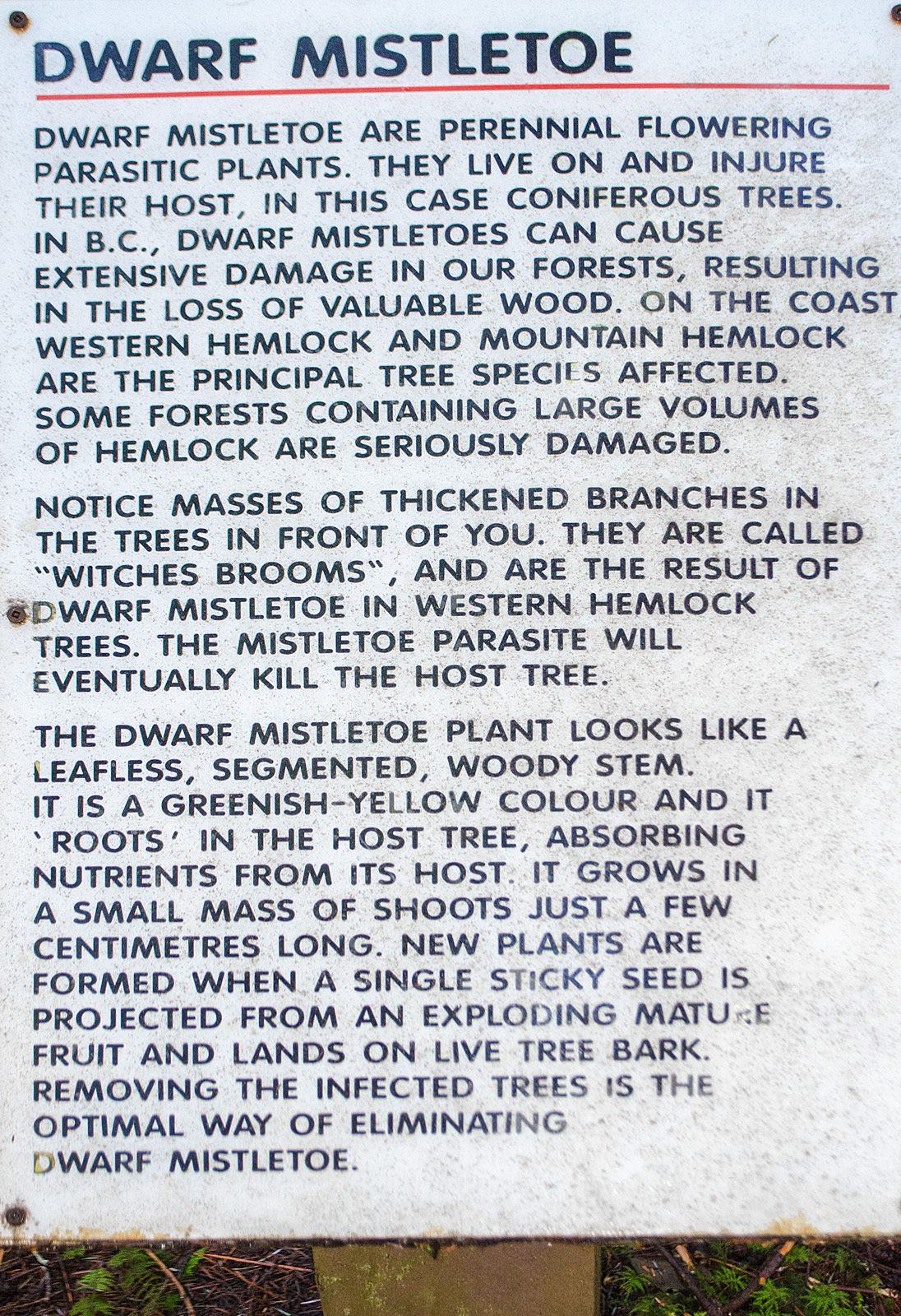
Hoomak Lake sign: Dwarf mistletoe

Legend: Dwarf mistletoe are perennial flowering parasitic plants. They live on and injure their host, in this case coniferous trees. In BC., dwarf mistletoes can cause extensive damage in our forests, resulting in the loss of valuable wood. On the coast western hemlock and mountain hemlock are the principal tree species affectd. Some forests containing large volumes of hemlock are seriously damaged.
Notice masses of thickened branches in the trees in front of you. They are called "witches brooms", and are the result of dwarf mistletoe in western hemlock trees. The mistletoe parasite will eventually kill the host tree.

This was written 20 years ago. The poor tree in front of me as I read the sign is long dead.

Legend, continued: The dwarf mistletoe plant looks like a leafless, segmented, woody stem. It is a greenish-yellow colour and it "roots" in the host tree, absorbing nutrients from its host. It grows in a small mass of shoots just a few centimetres long. New plants are formed when a single sticky seed is projected from an exploding mature fruit and lands on live tree bark. Removing the infected trees is the optimal way of eliminating dwarf mistletoe.

And here's that infected tree.

Not a pretty picture.

I have seen trees like this before, and wondered briefly what chewed them up, out here in the forest where no machinery wanders. I never looked too closely; just shuddered and went on my way. Now, I paid more attention, and came home to study up on it.

Look at the photo above: you can see the short stalks of the mistletoe. They sprout directly from the tree bark, and almost, but not quite look like part of the tree. Also note the fat branches. The root system interferes with the normal growth of the branches. These thick branches are weakened, and easily broken (in a wind storm, for example).

Fat branch and "brooms".

The balls of deformed branches plus a tangle of mistletoe are called brooms. (Not my idea of a witches' broom, which is designed for speed. Not these.) They don't appear until the tree has been infected for several years; at first, the mistletoe lies hidden beneath the bark.

The mistletoe damages the tree in other ways; it absorbes its nutrients, primarily carbohydrates, from the tree sap. And it can somehow extract water from the tree xylem even in times of extreme drought. The tree above the mistletoe infestation is starved and thirsty, and dies off.

I have looked at these and said "How ugly!" I have thought they spoiled the forest. I cringed at the sight.

I was wrong. I've been too stuck on my limited human ideas of beauty. These witches' brooms are valuable wildlife habitat. My "Wildlife and Trees" guide mentions fishers, martens, flying squirrels, black-backed woodpeckers, marbled murrelets (endangered), and spotted owls (ditto) as species which roost or nest in the shelter of these knots.

Dwarf mistletoes may contribute in various ways to biodiversity - by creating openings in the forest following tree death, by providing nesting sites in the 'brooms' and by providing food for a range of vertebrates and invertebrates. There can therefore be some conflict between the requirements of forest exploitation, and environmental concerns. (Plantwise Knowledge Bank)

E-Flora BC has several good photos of dwarf mistletoe on live hemlock. Here's one. Next time I see one of these trees, I'll stop and examine it closely, to get a good look at the mistletoe.


Saturday, July 28, 2018

Two tall trees at the beaver pond

One looks alive ...

Green and growing.

And another looks dead. But ...

It's full of life.

Snags can provide more habitat for wildlife than they did in their green youth. A "young" snag, like this one attracts insects, lichens, fungi, small plants like licorice ferns, spiders, and birds. Woodpeckers will feast on the grubs in the wood. As the tree ages, squirrels and assorted birds will dig out cavities for their nests; and eagles will perch on the highest branches, keeping an eye on the beaver pond below.

... “dying and dead wood provides one of the two or three greatest resources for animal species in a natural forest… if fallen timber and slightly decayed trees are removed the whole system is greatly impoverished of perhaps more than a fifth of its fauna.” (Ottawa Field Naturalists)


Powered By Blogger