Showing posts with label trees. Show all posts

Friday, September 12, 2025

Trees are like cats.

Trees are like cats; they have nine lives. This one is working on it's fifth life. "Dead" (so we say), dried and fallen, with its roots in the air, it's growing another crop of greenery.

Basking in the sunlight, enjoying life.

Counting the lives: 
  1. Standing tall, making leaves and cones.
  2. Still standing, supposedly dead, growing fungi and ferns and housing insects, birds and bats, squirrels and woodmice. Look for woodpecker holes. 
  3. Tipped over, or lying on the ground growing moss and more ferns and fungi, home to small beasties. Starting a family of saplings. 
  4. Dried out, full of holes. Resting. Ants and spiders hang out inside. Yellow witches butter bubbles out of the cracks.
  5. This one; roots in the air. Still mossy. Saplings rooting at the further end.
  6. Or it's a stump, standing firm to support the next generation. Wearing huckleberry shrubs as hair.
  7. Crumbled into the ground. Very much alive. The family is growing. New fungi spread hyphae throughout. Raccoons and bears dig for ants.
  8. Gone into hiding. Its fungi connect the family to nearby adult trees, bearing food and information.
  9. And so it goes ...
~~~~~~~~~~~~~~
Los árboles son como los gatos; tienen nueve vidas. Este ya anda en la quinta vida. "Muerto", decimos, ya seco y caído, con las raices al aire; y se cubre de vida verde.

Foto: Las raices de un árbol caído, con una capa densa de musgos.

Contamos las vidas: 
  1. De pie, formando hojas y semillas. (Conos en este caso; es un abeto.)
  2. Sigue de pie, pero parece estar muerto. Allí crecen hongos y helechos, y hacen sus nidos gran número de insectos, de pájaros y murciélagos, de ardillas y  ratones silvestres. Busca las cavidades que hacen los pájaros carpinteros. 
  3. Medio o totalmente caído, sostiene musgos y  helechos y otros hongos, provee animalitos con albergue. Empieza una familia de arbolitos. 
  4. Se seca, el musgo se cae; huecos y grietas abundan. Descansa. Hormigas y arañas se esconden adentro. Hongos gelatinosos de amarillo brillante brotan de las grietas. 
  5. Este; con las raices al aire. Sigue cubierto de musgo. Los arbolitos, su familia, están establecidos en el extremo opuesto.
  6. O es un tocón nodriza, manteniéndose de pie como sostén de la nueva generación. Lleva arbustos de huckleberry como si fueran cabello.
  7. Desmoronado sobre el suelo. Pero sigue muy vivo. La familia crece. Hongos nuevos infiltran sus   hifas por toda la masa. Los mapaches y los osos excavan entre la madera suave, buscando hormigas.
  8. Se ha escondido. Las hifas de sus hongos establecen enlaces entre la familia y árboles adultos  en las cercanías, llevando nutrientes e información.
  9. Y sigue la vida ...

  1. And so it goes ...

Thursday, February 27, 2025

Written in runes

Near the top of the hill over the Campbell River canyon, they've recently cut down a tree. I stopped to read its history. Written in tree runes.

Quite a varied life it has lived!

Okay, the basics: a cross-section of a tree trunk shows 5 main zones. 
  1. The outer bark. Here seen as a black line, just under the moss. This is dead wood, serving as a protective layer.
  2. The inner bark, the phloem. This is the narrow zone just beneath the bark; here water and nutrients (sugars, mostly) flow from the leaves to the rest of the tree, going both up and down, as needed.
  3. The cambium. This is the growing part of the tree, renewing itself annually. The outer edge produces phloem cells, and the inner cambium produces xylem cells, which become ...
  4. ... the sapwood. This is new wood; here water and nutrients move upwards from the roots to the leaves. Here is where the annual rings are formed; the wood is lighter, less dense in the summer, and darker, denser when growth slows in the winter.
  5. And finally, the heartwood. This, again, is dead wood, and serves as the strong support holding the tree upright.
But this trunk has a bit more history to tell.

Rings and squiggles and painterly zones.

What's happening here? There's that bright, yellowish area; it doesn't go all the way around the trunk. There are several growth rings apparent, and beyond it, there's that dark line that looks like it should be bark.

Sometimes a tree's situation changes as it grows. Other trees grow up and shade it, where it used to receive sunlight. Or another tree will fall against it, causing it to lean over. Or it  may be subject to high winds, creating more resistance on the windward side. Sometimes, then, the tree forms new wood on one side, building up strength where it is needed for support. This may be what has happened here.

Then there are those black lines separating dark wood from lighter wood. These are the borders of individual fungal colonies. The lines themselves are caused by an accumulation of fungal and plant chemicals. We would normally see the fungi as those shelf fungus that sprout on the bark, but most of the fungal activity is hidden here, inside the trunk.

Detail, fungal zone lines.

Then there is a section near the centre of the stump, where the wood is darker and full of holes. It could be insect damage, or maybe a dry rot fungus.

View from the other side, the slow-growing side.

Detail of annual growth rings and fungal zone lines.

~~~~~~~~~~~~~~

Cerca del puente que cruza el cañón del rio Campbell, recientemente han cortado un árbol al lado del sendero. Me detuve para leer su historia. Escrita en runas.

Foto #1: Ha vivido una vida llena de cambios.

Bueno, empezamos con lo básico: una sección transversal de un tronco de árbol muestra 5 zonas principales. 

  1. La corteza exterior. Aquí se ve como una linea negra, cubierta de musgo. Esta es madera muerta, y sirve para proteger la madera viva.
  2. La corteza interior, o sea, la floema. Esta es la zona angosta debajo de la corteza muerta. En esta zona, agua y nutrientes, por la mayor parte azúcares, fluyen desde las hojas hasta la madera del árbol, subiendo o bajando como lo exige la situación.
  3. El cambium. Esta es la parte del árbol donde sigue creciendo, formando una nueva capa cada año. La zona exterior produce células de floema, y en el interior son producidas las células de xilema, que forman parte de ...
  4. ... la albura. Esta es madera nueva; aquí agua y nutrientes suben desde las raices hasta las hojas. Aquí se forman los anillos anuales; la madera es más clara, menos densa en el verano, y oscura y densa cuando el crecimiento disminuye en el invierno.
  5. Y finalmente, la madera dura. Esta es madera muerta, sirviendo como el soporte que mantiene el árbol en pie.
Pero este tocón de árbol nos cuenta algo más de su historia.

Foto #2: Anillos y curvas y zonas pintadas. ¿Qué pasa aquí? Hay esa zona amarilla, que no rodea por completo el tronco. Se ven algunos de los anillos anuales, y luego esa zona café oscuro que parece que debería ser corteza.

A veces el ambiente del árbol cambia durante su vida. Otros árboles crecen y le quitan la luz. O otro árbol le cae encima, haciendo que se incline hacia un lado. O le azotan vientos fuertes, creanod una resistencia en el lado expuesto. A veces, en estas situaciones, el árbol desarrolla más madera de un lado para sostenerse. Esto puede ser lo que pasó aquí.

Y luego se ven esas lineas negras que separan diferentes zonas de madera. Estas denotan los bordes de colonias individuales de hongos y son el resultado de una acumulación de sustancias químicas producidas por los hongos. Normalmente, vemos los hongos como esos políporos que brotan desde la corteza, pero de hecho, la mayor parte del hongo se esconde aquí dentro de la madera.

#3: Detalle, mostrando las lineas de las zonas de hongo.

Y hay un area cerca del centro del tocón, donde la madera es de color oscuro y tiene muchos hoyos. Puede ser trauma causada por insectos, o causado por el hongo podredumbre seca.

#4: Vista del tocón desde el otro lado.

#5: Detalle de anillos anuales y lineas de zona de hongos.

Saturday, December 07, 2024

Barren beauty

The old saying has it backwards. In summer, sometimes you can't see the trees for the forest; they tend to merge into one solidly green mass. Whereas in winter, the deciduous trees, at least, stand out in all their barren beauty.

Sentinel. Standing guard at the exit from the estuary.

Sometimes the empty branches seem to be looming overhead, almost threateningly.

Rippled reflections

Lace against the sky. (See the bird?)

A Skywatch post. 

~~~~~~~~~~~~~~

“Cuando los árboles no dejan ver el bosque” es un refrán común. Pero por aquí, desde la primavera hasta el otoño, la realidad es el inverso; el bosque tantas veces no permite ver los árboles; todo se convierte en una masa densa, verde. En cambio, en el invierno los árboles de hoja caduca tienen la oportunidad de lucir toda su belleza desnuda.

  1. Árbol guardián, siempre vigilando la salida del rio desde el estuario.
  2. A veces parece que las ramas desnudas se alzan inhóspitas, amenazadoras.
  3. Reflejos ondulados en el agua.
  4. Encajes de madera contra el cielo gris. (¿Y puedes ver el pájaro?)
Un poste Skywatch. 

Wednesday, January 25, 2023

Ain't dead yet

 And this one, long-since felled, still keeps on supporting its community.

Busy little stumpie
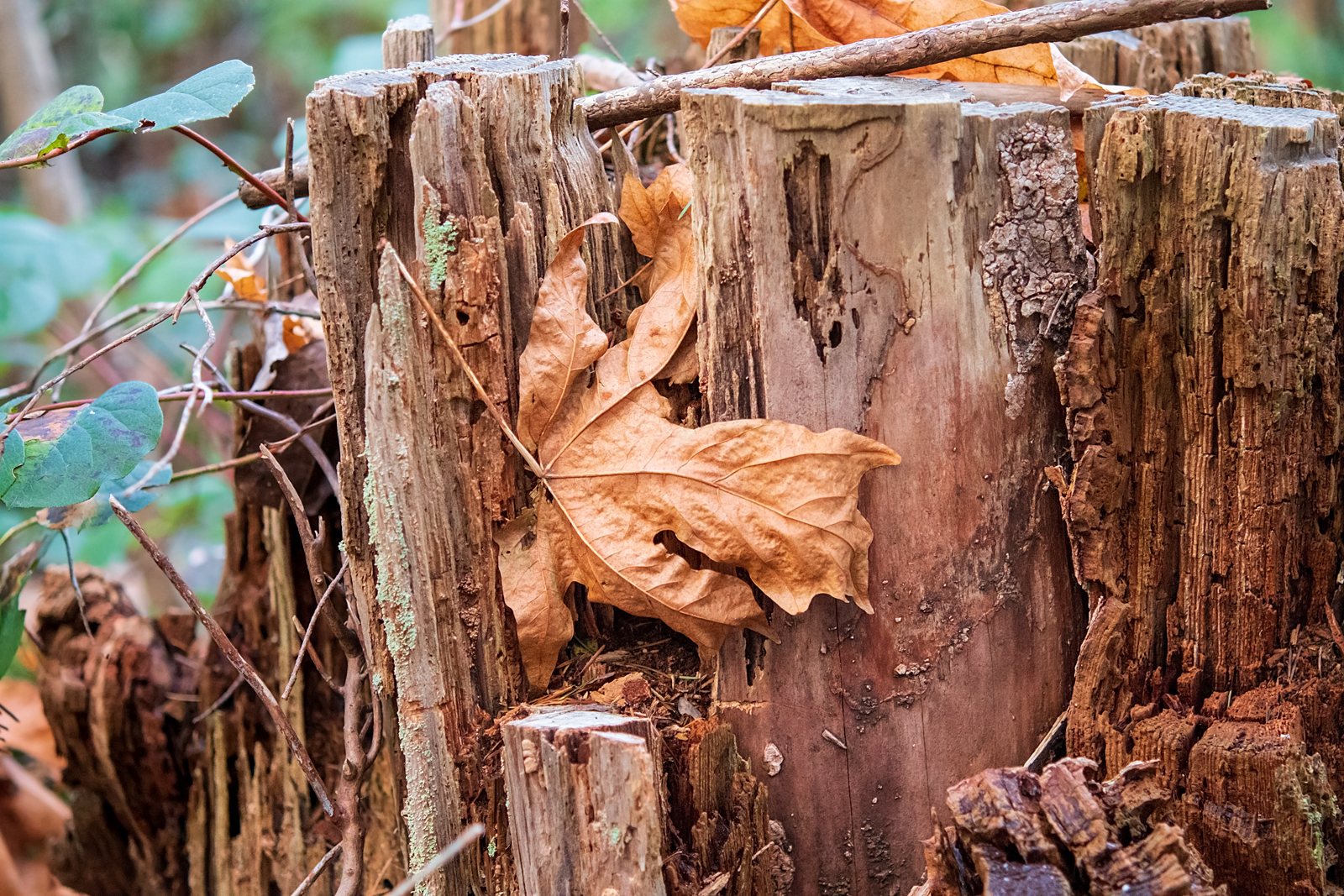
The outer bark and the layers of live wood have mostly rotted away, exposing the solid heartwood. Salal has rooted in the old wood, lichens grow on the outer edges, spiders and their prey hide in the many cracks. And big-leaf maple leaves rest on their trip to join the rotting mulch on the ground beneath.

Down underneath, invisible in the soil, the roots still form part of the living earth, the fungi, the inter-connected roots of the forest, still serving as conduits for liquid and nutrients.

Life goes on. And on.

~~~~~~~~~~~~~~~~~~~~~~~~~~~~~~~~
Otro tronco, éste cortado y desbaratándose, pero que sigue como soporte de su comunidad.

Foto: un tronco cortado bajito.

La corteza y las capas de madera activa se han pudrido en gran parte, dejando a la luz la madera del corazón, el duramen, todavía en firme. El arbusto nativo, salal, Gaultheria shallon, ha penetrado la madera con sus raices, en la superficies exteriores crecen líquenes, arañas y su presa se esconden en las múltiples grietas. Y encima, hojas del arce de hoja grande descansan camino a unirse a sus hermanos descomponiéndose hasta tornarse abono, en el suelo.

Y más abajo, debajo del suelo, invisibles, las raices siguen formando parte de la tierra viva, los hongos, las raices entrelazadas del bosque; todavía sirven para conducir el agua y los nutrientes que lleva.

La vida sigue. Y sigue ...


Monday, January 31, 2022

Reading list - forests

I've been reading a series of books on forests, starting with a Christmas gift, "Entangled Life: How Fungi Make Our Worlds, Change Our Minds & Shape Our Futures", by Merlin Sheldrake, dipping into a book on algae, re-reading sections of "Gathering Moss", by Robin Wall Kimmerer, and then two books by David George Haskell, "The Forest Unseen: A Year's Watch in Nature" and "The Songs of Trees: Stories from Nature's Great Connectors". Great books, all.

We know how lichen joins two or more organisms from different kingdoms; algae, fungi, and bacteria. Now, Haskell's books take us one step farther, showing how a tree is really a compound organism, not precisely in the same manner as the lichens, but being joined by fungi that twine around and through and inside the roots, fungi that are as essential to the trees' well-being as the trees are to the fungi. From there he goes on to show the networks that the tree, the insects, the birds, the air and rain and even us are all part of.

Worth reading, all of these. And they have answered some of my questions, and given me some more to ponder. I love new questions!

Douglas-fir, Miracle Beach.

~~~~~~~~~~~~~~~~~~~~~

He estado leyendo una serie de libros en relación con los bosques, empezando con uno que fue un regalo de Navidad, sobre los hongos, "Entangled Life: How Fungi Make Our Worlds, Change Our Minds & Shape Our Futures", por Merlin Sheldrake, viendo secciones de un libro sobre las algas, volviendo a leer capítulos de "Gathering Moss", por Robin Wall Kimmerer, y luego dos libros por David George Haskell, "The Forest Unseen: A Year's Watch in Nature" y "The Songs of Trees: Stories from Nature's Great Connectors". ¡Muy buenos libros, todos!

Sabemos como es que los líquenes combinan dos o más organismos de reinos distintos, o sea, las algas, los hongos, y las bacterias. Ahora, los libros de Haskell nos lleva un paso más adelante, mostrando como un árbol tambien resulta ser un organismo compuesto. No ciertamente por el mismo estilo que los líquenes, pero siendo unido a hongos que se enredan alrededor, por en medio, y hasta adentro de las raices. Estos hongos son tan esenciales a la vida del árbol como lo es el árbol mismo a los hongos. De allí sigue mostrando las redes de vida que incluyen el árbol, los insectos, los pájaros, el aire y la lluvia, e incluso hasta nosotros.

Valió la pena leer estos todos. Y han contestado algunas de mis preguntas, y han sugerido preguntas nuevas para considerar. ¡Me encantan preguntas nuevas!


Thursday, July 15, 2021

Leaky

Many small injuries cause trees to ooze sap, usually in small quantities. This one, though, is weeping from top to bottom.

A cascade of white, sticky sap.

I'm wondering what caused this; a major injury far above, too far for me to see it? A flock of enthusiastic sapsuckers, making holes all the way down?

Poor tree doesn't look happy!

~~~~~~~~~~~~~~~~~~~~~~~~~~

Muchas veces una trauma pequeña les hace llorar savia a los árboles. Normalmente, se limita a la región del daño hecho. Pero este pobre árbol llora desde arriba entre las ramas, hasta la raiz.

Me pregunto que lo habrá causado; ¿una herida grande, allá arriba entre las ramas, fuera del alcance de mi vista? ¿O una bandada de pájaros chupasavias, haciendo sus pocitos a todo el largo del tronco?

El pobre árbol parece estar triste.


Sunday, January 31, 2021

Tall trees and falling snow.

These are the last of the snow day photos. First, at Oyster Bay where the rain had washed the snow away already, but a few flakes were falling still.

"My" tree; I've taken umpteen photos of it, from my usual parking spot in Oyster Bay. This one, in B&W; it was that kind of afternoon.

On the Elk Falls trail, an hour later.

It was no longer snowing at Elk Falls, but every few minutes, a purely localized shower of snow fell from the upper branches. There's one here, just to the right of centre.

And on to other things: this afternoon, I found some amazing slime molds. Photos tomorrow.

~~~~~~~~~~~~~~~~~~~~~

Estas son las últimas fotos del día de la nieve. La primera fue en Oyster Bay, donde la lluvia ya había lavado toda la nieve de los árboles, aunque todavía caían algunos copitos. El árbol es el que veo al llegar al estacionamiento, y ya he sacado muchas fotos, en todas las estaciones del año.

La segunda foto fue tomada una hora más tarde en el sendero hacia las cataratas. Ya no nevaba, pero frecuentemente la nieve detenida en las ramas superiores se caía, haciendo nevadas muy localizadas. En la foto, cae del árbol en el centro; mira al lado derecho.

Terminamos con la nieve, y ahora, cambio de tema. Hoy en la tarde, encontré unos organismos maravillosos; para mañana habrá fotos.

Friday, June 26, 2020

Biodiverse

This is the meadow at Oyster Bay Shoreline Park. It is a protected area; the sign towards the centre warns people to stay off. I stick to the few paths across and around it, or sometimes take one careful step to the side to dodge people coming the other way or to take a photo of a plant.

Looking towards the ocean, from beneath the old apple tree.

At this time of year, the main plants growing here are the yellow gold stars, red sorrel, wild strawberries, hare's foot clover, assorted dune grasses, and yarrow (all those white flowers, but some are pink.) Later, the yellow flowers will be gumweed; now, at the end of June, the plants bear small green, sticky buds.

Around the edges, various wild fruit trees and shrubs border the evergreen belt. Yesterday I found and ate a handful of huckleberries, the first of the year. There are wild cherries, a few escaped apple trees, saskatoons, hawthorns, blackberries (native and imported), wild roses and ocean spray, salal and kinnikinnick. The trees are maple, Douglas fir, hemlock, cottonwood and alder.

Wild rose, Rosa nutkana

And under everything, in the woods and in the meadow, a crispy blanket of moss and lichens.

Overhead, there are birds and bugs. Bees, flies, butterflies. Swallows and crows and gulls and eagles. Purple martins. A kingfisher, sometimes. Assorted peeps down on the shore (to the left here). Ducks and Canada geese at high tide, or crossing overhead. Chickadees and juncos and, of course, sparrows.

Very tiny grasshopper. I couldn't see him once he settled down, so I just pointed the camera in his general direction.

And every time I visit, it has changed. So I keep going back.

Maple "wings".

~~~~~~~~~~~~

Este es el campo protegido en Oyster Bay. Un caminito lo cruza; otros siguen los bordes. Pero en el area central se prohibe entrar, para dejar crecer la vegetación natural; hay algunas plantas que se ven raramente en otras partes.

Hice una lista de las plantas que se ven hoy en el campo. Hay fresas silvestres, estrellitas de oro, acederilla, hierba de goma, rosas silvestres, perejil bravío, poaceas de las dunas, tréboles. En el bosque alrededor, árboles frutales nativos e importados; manzano, cerezo, rosa silvestre, moras, y muchos otros. Muchas de estas plantas no tienen nombre en español, pero las voy a estar presentando una por una en los días que vienen.

Y siempre hay pájaros; golondrinas, gaviotas, águilas, cuervos, patos, gansos, gorriones, juncos, carboneros, y muchos más. Y abejas y mariposas, claro.

Y cada que visito, algo ha cambiado. Así que vuelvo frecuentemente.

La tercera foto es un saltamontes muy pequeñito. Cuando se aterrizó ya no lo podía ver, así que no más apunté la cámara en la dirección hacia donde saltaba. La cámara ve lo que mis ojos no alcanzan.

La cuarta foto son semillas de maple madurando en el árbol. Cuando estén listas, caerán pero dando vueltas con el viento como si tuvieran alitas. Así no caen directamente bajo el  árbol progenitor.


Saturday, November 02, 2019

Green, white, yellow, brown: the colours of trees

Back to the remainder of the stored photos before I start on this week's mushrooms.

Trees I have been watching.

From the Campbell River Museum window. February, 2017.

Baby pine, Tyee Spit, The beginning of January, before the snow.

Tree and contrail, Tyee Spit. January, a couple of weeks before the snow.

York Road, a couple of weeks earlier.

Back to Tyee Spit. October.

Path to the Eve River, July. Hot, dry season.

Glorious cottonwoods, Oyster Bay, last week.

Monday, April 15, 2019

Leafing out

A couple of trees in a vacant lot between the highway and the river.

New leaves and, I think, catkins.

Twin trees.

I have to confess, I erased a mess of industrial buildings and trucks in the background of this pair of trees; they were distracting from what I was looking at, the trees themselves. From the first photo, I deleted only an intrusive Home Depot sign.

Friday, April 12, 2019

Beware of the trees!

Before all the new leaves cover them, I stopped to look at bare logs and tree roots along the Myrt Thompson trail and found them a bit worrisome.

Tangled roots at the river's edge. The water frequently covers this spot, washing out the silt, leaving the roots a couple of feet above ground.

Shades of Old Man Willow! This tree has captured an unfortunate hiker.

Another capture. "Oh, woe, woe, woe! I've been swallowed by this log and I can't get out!"

Snag. Looks vicious. May bite.


Sunday, March 10, 2019

Tall

The forest at Miracle Beach is mostly Douglas-fir, with a mixture of Western hemlock, Sitka spruce, and Big-leaf maple, and the ubiquitous red alder. It is second-growth forest; it has been logged off once, and once(that we know about; we are newcomers in tree years)  ravaged by fire, so most of the trees are relatively young, but a few of the older Douglas-firs are still standing.

These are tall trees; a mature Douglas-fir can be as much as 100 metres high, at least here on the coast. Inland, they are shorter.

In comparison, the Western hemlock grows normally to 50 metres, occasionally to 60.

I took a series of photos of one tree, and stacked them. I don't know how tall these ones are; the trunks are less than one metre in diameter. A normal width for a fully mature tree could be almost 3 metres.

Foreshortened from my viewpoint at its foot.

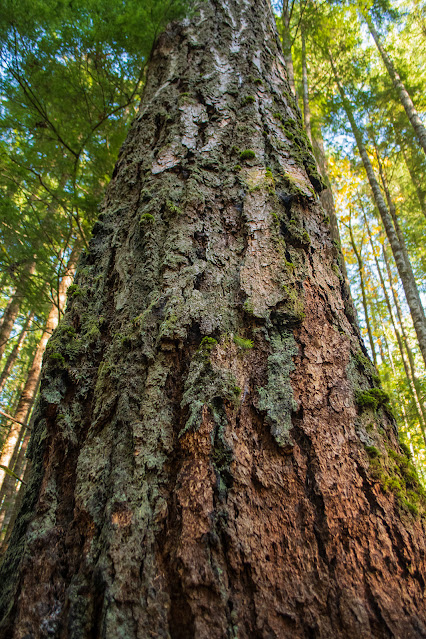
The trunk of an older Douglas-fir is branch-free for most of its length, with the foliage in a clump at the top. The bark is thick and deeply grooved. Look for the burl towards the bottom on this tree.

Looking  straight up from the same general area.


Wednesday, December 05, 2018

Just two trees

I keep taking photos of this same pair of trees at Oyster Bay.

December 13, 2016. Around noon.

Dec 20, 2016. Same time, darker day.

January 2, 2017. Snow on the trees now. And an eagle.

June 16. 2017. Mid-summer, 7 PM

October 22, 2017. 3 PM

May 19, 2018. 8 PM, near sundown.

November 28, 2018. 2:30 PM. Sundown is at 4:30 these days. A couple of dozen crows had just left, while I was unpacking the camera.

Except for the leaves coming and going and changing colour, these two haven't changed much from the first to the last photo, but it looks like the young forest at their feet has grown quite a bit.


Monday, November 26, 2018

Better late than never

I was running late. I didn't get started out for my Sunday afternoon drive (in the rain) until shortly after four. And by then, it was so dark that the colours had leached out of the trees. I set out with the camera, anyhow. I could at least watch tree silhouettes. And maybe see some wildlife, a deer or two, maybe.

Alder against the sky. 4:41 PM The camera sees more light than I do.

Chutes and ladders. And a pair of trees. 4:45. Quinsam Coal Barge Terminal

Crooked tree. 4:46

Looking out over Menzies Bay. 4:52 The bit of colour in the foreground was from my headlights.

As for wildlife, I saw four eagles, and a pair of moths in my headlights. No deer.

But Chia was waiting for me at home, and she's sort of wild.

Chia and her shadows. 10:15.

They're promising us rain for the entire week. I need to get some rain gear.

A Skywatch post.

Monday, November 12, 2018

Tree bones

Wind, salt, rain, blowing sand. Give them time, and they peel the thick bark off trees, snap off the branches, sandpaper the roots. Add a bit of moss and lichen and strew the resulting fantastic shapes all along the shore line and across the dunes. Ma Nature's modern art gallery.

Log, needles, lichen. And a sort of bird shape.

Standing statuettes, the innards of branch attachments. This wood seems to be tougher, more resistant to rot than the rest of the tree.

Log end and Big-headed sedge, turned yellow with the cold weather.

New tree, old tree, young tree.

Grandaddy stump, Saratoga Beach

Powered By Blogger