Showing posts with label books. Show all posts

Monday, January 31, 2022

Reading list - forests

I've been reading a series of books on forests, starting with a Christmas gift, "Entangled Life: How Fungi Make Our Worlds, Change Our Minds & Shape Our Futures", by Merlin Sheldrake, dipping into a book on algae, re-reading sections of "Gathering Moss", by Robin Wall Kimmerer, and then two books by David George Haskell, "The Forest Unseen: A Year's Watch in Nature" and "The Songs of Trees: Stories from Nature's Great Connectors". Great books, all.

We know how lichen joins two or more organisms from different kingdoms; algae, fungi, and bacteria. Now, Haskell's books take us one step farther, showing how a tree is really a compound organism, not precisely in the same manner as the lichens, but being joined by fungi that twine around and through and inside the roots, fungi that are as essential to the trees' well-being as the trees are to the fungi. From there he goes on to show the networks that the tree, the insects, the birds, the air and rain and even us are all part of.

Worth reading, all of these. And they have answered some of my questions, and given me some more to ponder. I love new questions!

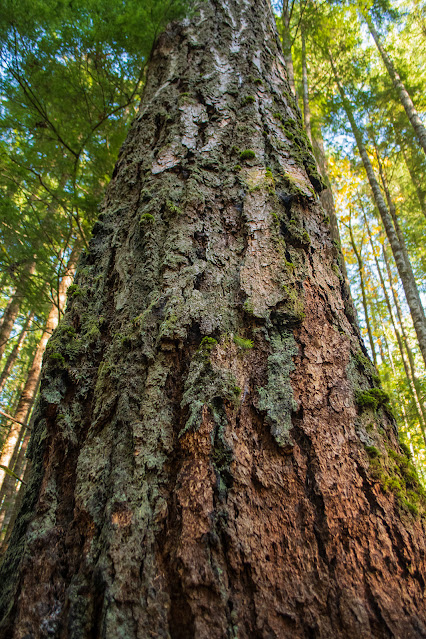
Douglas-fir, Miracle Beach.

~~~~~~~~~~~~~~~~~~~~~

He estado leyendo una serie de libros en relación con los bosques, empezando con uno que fue un regalo de Navidad, sobre los hongos, "Entangled Life: How Fungi Make Our Worlds, Change Our Minds & Shape Our Futures", por Merlin Sheldrake, viendo secciones de un libro sobre las algas, volviendo a leer capítulos de "Gathering Moss", por Robin Wall Kimmerer, y luego dos libros por David George Haskell, "The Forest Unseen: A Year's Watch in Nature" y "The Songs of Trees: Stories from Nature's Great Connectors". ¡Muy buenos libros, todos!

Sabemos como es que los líquenes combinan dos o más organismos de reinos distintos, o sea, las algas, los hongos, y las bacterias. Ahora, los libros de Haskell nos lleva un paso más adelante, mostrando como un árbol tambien resulta ser un organismo compuesto. No ciertamente por el mismo estilo que los líquenes, pero siendo unido a hongos que se enredan alrededor, por en medio, y hasta adentro de las raices. Estos hongos son tan esenciales a la vida del árbol como lo es el árbol mismo a los hongos. De allí sigue mostrando las redes de vida que incluyen el árbol, los insectos, los pájaros, el aire y la lluvia, e incluso hasta nosotros.

Valió la pena leer estos todos. Y han contestado algunas de mis preguntas, y han sugerido preguntas nuevas para considerar. ¡Me encantan preguntas nuevas!


Friday, January 31, 2014

Shortest beach visit ever

We hadn't planned on going to the beach; we were out hunting down a second-hand bookstore. But the one in Ladner closed in November, the one in White Rock some time before. Does no-one read old books anymore?

So we went on down the White Rock hill to the beach, where the tide was higher than I ever remember seeing it. It was raining, slightly, enough to wet the camera lens but not much more. But we were dressed for indoor pursuits, and we stood shivering in the parking lot watching the gulls for only a few minutes. Enough. We went back to town for tea and coffee.

Fat brown gull, not minding the damp

I sometimes wonder; gulls and ducks and other shorebirds keep themselves so comfy and warm, all bundled up in layers of feathers from the top of the head to the tip of the tail, but then let their legs and feet stick out totally unprotected into the cold. Don't they feel the contrast? Why don't they hunker down, like, for example, a chicken, or even a sparrow, wrapping their legs in that feather quilt?

Nature is weird.

Friday, March 01, 2013

Feeding time in the tank

My aquarium "how-to" bookshelf holds only three books, which I re-read frequently, and which all give conflicting information. Living things are like that; almost any rule about dealing with it has exceptions. So I read a chapter in one book, the related chapter in another, then go commune with my critters. They have their own ideas.

The books:

  • The Conscientious Marine Aquarist. 1998. Very good, very detailed, well written. Most of it is not relevant to what I'm doing, though; the author's interest lies in the tropics, and the exotic species, whether or not they live together in the wild.
  • The Saltwater Aquarium Handbook. 1991, 2000 edition. Much smaller. Good info on equipment, skimpy on invertebrates. Emphasis on purchased specimens, warm water animals, exotics.
  • And the Marine Aquarium Guide. DeGraaf, 1973. Out of print. Dense. Very technical; a lot of chemistry and detailed engineering. A variety of methods and their explanation; choose your own. Extremely helpful, even though I followed none of the methods described; at least I know what to aim at, what to watch for.

And of course, there is plenty of information, usually contradictory, on the web. Reef aquarists forums are helpful. Here's a sampling:


And then, there's the local aquarium store. Which usually doesn't carry what I've seen discussions of, and I have to wing it. Still, they sold me my tank and filters, and 20 kilos of sea salt for aquariums; that's what has kept my critters happy this winter. And they sold me the hermit food.

Hairy hermit, with his breakfast of Crab Cuisine.

So, what do my guests order from the menu?

The hermits love the Crab Cuisine, even though it was not specifically designed for underwater hermits. It sinks nicely to the bottom, but after a bit of nibbling, it tends to crumble and float away. Val, the burrowing anemone, grabs pieces that float by, but eats them slowly. After a while, the hermits, having finished their serving, go prospecting in the anemone mouth for leftovers, which the anemone yields up without a whimper.

The crab (I only have one at the moment) can't do this. He loves the CC. He grabs a piece and runs off to hide in his latest burrow to eat in peace. Later, he may approach the anemone, but the venomous tentacles drive him off, and he gets to sit looking at that tempting chunk of food until a hermit walks in and takes it, right under his nose.

In a Chinese grocery store, I bought a bag of dried minnows, intended for human consumption. Nothing but fish and salt, the label said; it would be safe. I flake a half minnow into the water now and then; everybody is pleased: the crab, the hermit, the anemones, and any polychaete worms hiding in the sand. It does foul the water, though, so I like to offer it just before a water change.

Another Chinese food store, recently: I found a bag of dried shrimp, very tiny baby shrimp. Opening the bag at home, I realized that they were only partially dried, and still soft, so they're in the freezer. And this is dessert! As I drop a piece in front of one hermit, all the animals with legs start running in his direction. Fights break out, unusual in hermits. The largest grainy hand, the absolute pacifist, even attacked my finger. The crab abandons his hiding place to grab at the shrimp, and the hermits fight back. I drop more tiny pieces, a quarter shrimp at a time, scattered around, to break up the fights.

Some of the hermits take their prize and climb to the top of the eelgrass or a stalk from a kelp holdfast, where no-one can sneak up on them. Others just stand their ground, tugging away at another hermit's catch.

Nassa, hurrying.

And a minute later, the Nassa snails appear, as if from nowhere, heading purposefully towards the biggest chunk of shrimp. They will stay with it until there's nothing left.

Val, on a normal day. (No shrimp.)

What of the anemone? The books say (two of them) to offer a small piece of shrimp, touching the tentacles with it. Another book says to blend the shrimp, turn off the pump, and spray the anemone with the shrimp paste. I didn't get around to that, because an entire shrimp escaped my fingers in the tank, and floated past the burrowing anemone. Instantly, a tentacle lashed out, snared the shrimp, and crammed it into her mouth. The whole shrimp. And it vanished.

Val swelled up to her full size, column as high and as wide as I've ever seen it, tentacles waving enthusiastically. (Did you ever see an enthusiastic anemone? I have.)

I've fed the tiny orange striped anemones baby-sized bites. They're slower to grab the food, but when they do, they don't let go.

Val really doesn't need feeding. She manages quite well on her own. I saw her snatch a swimming amphipod.  And recently the crab molted. The old molt floated by, and Val grabbed it. It was wider than she is, and all legs and carapace. Never mind, she swallowed it, slowly, one leg at a time. The next day, she regurgitated the polished carcase.

And she had positioned herself under the pump. I didn't notice, but a fair-sized periwinkle snail was on the side, and when I went to remove the pump for cleaning, the snail let go and dropped. Right into Val's mouth. I quickly got my handy chopstick and tried to flick the snail out; no way! She closed right down, tight, a green ball with a pursed mouth, and the snail hidden away inside. Sorry, little snail.

The next afternoon, one of the hermits was wearing the newly cleaned periwinkle shell. Life goes on.


Monday, January 07, 2013

Rambling post, with lost monkey

It's been a bookish couple of days. I finished the Terry Pratchett book my grand-daughter brought me, got a few hours sleep, and then we went to one of our favourite second-hand book stores, Renaissance Books, where I bought another DiscWorld book. Thief of Time. I had forgotten reading it, until I was half-way through the first chapter, but these are always re-readable and thought-provoking; I finished it last night.

On that same outing, we dropped into Black Bond Books at the mall, where I picked up a good Rocks and Minerals guide; the one we had here was so old that the price on the cover was 60 cents (1955). Today's version cost me 15 times that.

And then I spent the better part of my so-called "sleeping" hours reading that. I learned a few things I should have realized years ago; I'll be writing about them soon.

And now, where was I before I got side-tracked?

Boundary Bay, while it wasn't actually raining. Besides fog and peeps, there were also (back on shore) mushrooms and other delights:

Cladonia lichen on rotting fence.

Same fence, same species, but in a different stage. Leafy cladonia.

On a wet driftwood log, there were three pink mushrooms. I can't remember seeing these before.

Next log over. Orange jelly balls. I haven't noticed those little greyish buttons on the lights streak just above them. I wonder if they're another stage in the orange jelly life, or something else altogether. So many mysteries in the 'shroom families!

Not a mushroom. This little guy was sitting damply on a blackened stump by the roadside. I hope his owner found him before he turned moldy.

And another mystery: about Blogger and photos. I resize all the photos to the same size and pixels per inch before I load them to Blogspot. Sometimes when I click on the photo, it takes me to a copy the same size as the blog post display. Sometimes, it gives me a humongous pixel-by-pixel photo, and sometimes about three-quarters of a screen. Deleting the photo and re-loading sometimes helps, but not always. In this post, I get all three sizes out of identically-sized photos, even though I re-loaded two of the smaller samples. Why? Does anyone understand this?

Or maybe it only happens on my computer. Does it work that way on yours?


Saturday, January 05, 2013

The trouble with books of short stories ...

. . . is that at the end of each, you turn the page and there's another tantalizing title. And it's a short piece, so you may as well read it, too.

A granddaughter dropped in this afternoon with a Christmas present; Terry Pratchett's latest book, A Blink of the Screen. It's a collection of his short fiction, starting with a story written (and published) when he was 13, and continuing to the present time.

The topics range from sci-fi (virtual reality and time travel) to evolving chickens, to the national anthem of the city of Ankh-Morpork, and include another Granny Weatherwax story (Granny wearing pink?). Plus three sections of art by Josh Kirby, who did many of the covers for the DiscWorld series.

I've been reading all evening. Even did my cooking and dishes with the book propped on the counter.

Now, if you'll excuse me, there are still 42 pages left to read. See you tomorrow!

Monday, May 09, 2011

A working Mother's Day

We have spent the weekend carrying Laurie's books, bookcases and display cabinets (for antiques and Laurie's carvings) downstairs and setting them up again. The antiques were already down here, packed in boxes that take up a third of my bedroom. They'll get unpacked gradually, over the next few weeks.

The books: sci-fi, history, science, philosophy, art, classics, poetry ... All read, some re-read. Books come, books go, resold or lent or passed on, but the total stays more or less the same; somewhere around 4000. That's a lot of books! It will take us weeks to get them all unpacked and on their proper shelves.

(Here's a (copyrighted) photo of an art installation using 4000 books. 13 feet by 7 1/2 feet by the height of a book. Some of Laurie's art books and dictionaries were quite a bit bigger.)

We had help; willing kids and grandkids, plus two great grandkids to provide entertainment throughout. I couldn't ask for a better Mother's Day gift!

I'll be back to regular blogging tomorrow.

Tuesday, June 16, 2009

More critters from the dishpan

Dispan aquarium #2; previous post, #1, here.

The anemones, as promised.

On the White Rock beach, at low tide, Laurie found a piece of kelp in the waves. A blob of a pinkish, jelly-like substance stuck to it. I popped it in my bag of goodies and brought it home to the dishpan.


Freezer bags, White Rock beach

After a while in calm water, it contracted into a neat ball, spit out several mouthfuls of sand, rested a bit more, ...


... and opened up into a luscious pink and white flower.


It's an anenome, maybe the short plumose anemone, Metridium senile. It even has a cloned baby!


See the little one at its foot?

Another piece of kelp bears several smaller anemones, barely half a centimetre wide at the most. The white circles are baby barnacles, hard at work fishing for plankton; with the naked eye, I can see the merest hint of vibration at their mouths.


Peach gelatin anemone. (My name for it.)


Floating in a clump of fine threads of a green algae, I discovered this tiny white anemone. Or is it a jellyfish? It doesn't move about; just hangs there in the water, on its side. When I touch the seaweed around it, it closes up into a little ball.

I have spent hours leafing through my Marine Life of the Pacific Northwest, trying to tentatively identify this, and the next critter, with no luck. As the book says,
"More than 500 cnidarian species live in the Pacific Northwest."
And only 114 of them ended up in the encyclopedia. So I'm forced to invent my own names*, to use until I find the correct ones.

A problem with looking at these tentacled animals is that as soon as you get too close, quite a few of them close up shop. Sometimes even the shadow of the camera is enough. Touch them or take them out of the water, ditto. The only way to see them opened is to sneak up from the dark side, slowly, without disturbing their water.

This mini-critter is attached to a kelp blade. It looks rather like a small anemone encrusted in sand, except for those strange tentacles that curl around to make little loops.


Waving lassos; I'll call it the cowboy anemone.

And on that same kelp, this glassy, 1/2 cm tall fan stands motionless. Out of water, it collapses limply against the kelp, and becomes almost invisible. I think it may be a bryozoan, the Parasol, maybe.


Caulibugula californica?

The encyclopedia says about the Parasol,
"... apparently prefers low-current, often silty locales. ... Would it be noticed in high-current locales that are so often densely packed with life?"
I would answer, "No, not even at its full-grown size (3.5 cm). It's only visible when the light catches it just right.

Oddly, although it is so tiny, so glassy, so delicate, it is also tough. I have moved that piece of kelp around many times, piled it in a bowl to change the water, half-buried it in sand ... As soon as the kelp is freed, the Parasol pops right up again, with all its feathery branches intact.

Still more to come: isopods, snails, clams, and another worm.

*If the authors of the encyclopedia can do this (p.14), so can I.

.

Friday, April 24, 2009

These books you must -- must -- see!

I'm passing on a link from BugGirl's Blog: she found
"... this lovely artwork from BiblioOdyssey. It’s from a Ukiyo-e book from the late 1700’s."
There are 3 books; Insects, Shells, and Birds; and well over 100 paintings, each with its associated poem and translation.


There is even a bagworm page!*

This link takes you directly to the online museum exhibit. (You have Flash, right?)
"OMG is it beautiful." says BugGirl.
*Bagworm poem:
On a pitch-dark night
when one can't even guess
which way is East or West
the bagworm hides his lust
in a cloak of invisibility.
It wouldn't apply to Canadian bagworms, would it?

.

Monday, March 02, 2009

Three handy books

When I come home from the beach with photos or samples of unfamiliar animals or plants, I head, first of all, to my old trusty "Kozloff". (This is a solid paperback with the unwieldy title of "Seashore Life of Puget Sound, the Strait of Georgia, and the San Juan Archipelago", by Eugene N. Kozloff. "Kozloff" is easier to remember.) I have linked to its page on Amazon from here, many times.

My copy is from 1973, and the book has since been updated, with new photos and text. My older version doesn't include newer invasives, such as the Asian mud snails, but otherwise, it is, so far, the best hard-copy guide I have found.


Yellowlegs on Crescent Beach. Greater or lesser? I can never tell.

Some time ago, in a second-hand bookstore, Laurie picked up a copy of "Pacific Seashores - A Guide to Intertidal Ecology", by Thomas Carefoot. (I'm sort of glad he didn't list the place names in the title.) It's another oldie, from 1978, 200+ pages, 8 1/2" by 11". At the time, I glanced through it, but didn't see anything really relevant to the questions I was asking at the time; the book got shuffled to the bottom of a stack.

This past week, while I read and re-read Kozloff, Googled and bookmarked, trying to ID the latest batch of photos, Laurie dug out "Seashores" for me. And this time, it was just what I needed.

Carefoot looks at the "pattern of distribution of plants and animals on the shore, ... the ways they got there, and ... the(ir) myriad interactions ...", focussing mainly on rocky shores. Whereas Kozloff divided his subject matter by type of location (muddy, rocky, docks, etc.), Carefoot looks at it in the context of activity; water movement, predation, grazing, cultivation, and so on. (He refers to an even older version of Kozloff, by the way.)

Leafing through the pages on grazing and predation, intriguing phrases jump out at me:
  1. "Tooth wear in the sea urchin,"
  2. "Thais (that's Nucella, in modern nomenclature), the schemer,"
  3. "... worst of all is a prey that bites back."
  4. "... the cockle quite literally erupts from the sand and makes away with great leaping movements."
I kept getting side-tracked by these grabbers. But I found what I was looking for, a detailed description, with good, clear diagrams, of the whelks' method of eating mussels and barnacles.

I will be using the book consistently from now on.


Curlew and the regulars, Crescent Beach.

And then, yesterday afternoon, in Chapters, Laurie found me another book. This one is "Marine Life of the Pacific Northwest - A Photographic Encyclopedia of Invertebrates, Seaweeds and Selected Fishes", by Andy Lamb and Bernard P. Hanby, published in 2005. (Another mouthful, but it was all essential information.)

Wow!
  • 1400 species, with 1700 beautiful, clear photographs, 25 years' worth. Hanby is a talented photographer; some species can be ID'd on the basis of the photos alone.
  • Three separate, sensible ways to find what you're looking for.
  • Clear descriptions, located beside the photos. (If you've ever leafed back and forth through a book looking for "Illustration # 11 on Plate V", keeping your finger in the page where the relevant text is, dropping your bookmarks on the floor half the time, you'll appreciate this.)
  • Precise locations of photos, also with the photo. Habitat, depth, alternate names ... it's all there, and accessible at a glance.
Again, Wow!


Crows, White Rock beach.

And there are egg cases and egg masses pictured, sometimes, with their parents. Very helpful. On the lugworm, referring to those transparent sacs we found at Boundary Bay, and finally ID'd as Arenicola and, I thought, A. pacifica, Lamb writes,
"... the discovery of suspicious-looking, tongue-shaped, gelatinous, stalked egg masses ... in Boundary Bay ... may also prove to be those of the Pacific green lugworm, Arenicola crustata."
Wonderful! In my first browsing, I discovered several other organisms that I recognized but hadn't been able to identify before. And I think I can find here the egg cases that I found on eelgrass.

One thing I really liked about this encyclopedia; the authors are not afraid to say, "We don't know." For example, a worm:
"NE18. The identity of this subtidal white ribbon worm may never be known ..."
And a listing of 24 unidentified sponges, included in "appreciation and enjoyment of the wide variety of species ...", along with encouragement to "keep your eyes open." Because there is still so much to be learned.

I could go on. But I won't; I've got to get back to my browsing.


Yellowlegs, Crescent Beach.

The encyclopedia ends with a section on selected vertebrates, mostly fish active in the intertidal zone. But the last three entries are the Wandering Garter Snake, because it "routinely visits the beach to prey on intertidal creatures ...", then Homo sapiens "intertidalus" and Homo sapiens "subaqueous". The Beachcomber and the Scuba diver, respectively.

(There's a good review in Diver Magazine.)

.

Tuesday, February 03, 2009

A tasty stew

I promised you stone soup. Blog-style stone soup.

Years back, my parents travelled the US and Canada in an UltraVan. Periodically, they met with other UltraVan owners at rallying points. (The rallies are still ongoing.) One of the traditions was that on the final evening, each Van owner contributed his/her/their canned goods to the UltraVan Stew. Soup, meat, veg, chili, beans, spices: it all went in one pot. Stone Soup, in other words. Mom said it was always good. (I might not be so positive, but at least it was nutritious.)

So, for today, I'll contribute my stone and a veg,


Rose weevil, last summer.

... and then stir in these goodies from the web:

First: the carnivals, posted, and to come.

The Other 95%: Circus of the Spineless #35: Regeneration, Renewal, Reinvigoration It's back! At long last, we have a host, Kevin Zelnio! And the first installment of the reborn CotS is a winner. Thanks, Kevin.

Festival of the Trees is up at Treeblog. A poetic post, with a bark rubbing, to boot. As well as all the great links.

I and the Bird will be up in a couple of days at Vickie Henderson Art. (You still have a few hours to get a post in to her; today's the final day for submissions.)

I have posts in those three, but not in the next ones. Maybe another time.

Ecstathy: Carnival Of the Elitist Bastards IX: Keepin' yer wits about ye Pirate edition. This one's just plain fun. As well as being dead serious.

Carnival of the Blue #21 « The Oyster’s Garter In verse. Or doggerel. (Sorry, Miriam.) Good ocean-related links. I liked the cuttlefish story and poem.

Great Backyard Bird Count — Great Backyard Bird Count And this is coming up in less than two weeks; February 13 -16. Are you in? I am.

Then there's Blogroll Amnesty Day; the idea is to link to 5 smaller blogs. I don't know about size, so here are 5 that I've found recently, and added to my GoogleReader:

Jehuite This one is in Spanish. The wild vegetation of Mexico. Beautiful photography, some "exotic" plants, some old familiar ones.

The ScienceBlogs Book Club : Bonk, by Mary Roach: Friday Weird Science has found its Patron Saint A two-fer. The Book Club blog, and the link to this book. I have read Stiff, by Mary Roach, and loved it, so this is on my list of must-buys. A warning, though; it is not to the taste of many people. If dead bodies make you squeamish, give it a pass.

The Book of Barely Imagined Beings. Science, with great photos, and interesting posts. Like "Earthworms save planet".

MMmmm…That’s Good Grub* « Drawing The Motmot An artists climbs to the top of the Amazon rainforest to paint, in this post.

Tyto Tony. "Life in a tropical Queensland wetlands". Beautiful bird photography.

And 6: (I can't count.) Wild Light. Photography using only natural light. Astoundingly gorgeous!

And even more goodies for the soup:

A natural history of Runswick Bay: Lugworms. For Wren.

Sunrise, sunset, daylight in a graph. I posted this a year ago, and it keeps turning up in my Sitemeter. I am surprised every time.

And because it was Groundhog's Day yesterday, and I missed it, here's Hugh's story: Momma Vole.

And a last bit of greenery (and reddery):


The weevil again, delicately tiptoeing through a thornfield.

.

Monday, January 19, 2009

All the flowers are dying

No, this is not a post on the weather, nor about flowers. It's the title of the book that occupied all my afternoon and evening.

I picked up a copy of Lawrence Block's "All the Flowers are Dying", (possibly the last of the Matthew Scudder series) and made the mistake of opening it at lunch. I couldn't put it down until I had finished it. And it's now 3:30 in the morning.

So the post I had planned will have to wait until tomorrow.
.

Friday, May 09, 2008

On Spiders and their diet restrictions

I've been reading the book Laurie found me in MacLeod's Books, "Spiders", by W. S. Bristowe.


Unidentified spider found this morning. He's been in a fight and lost 2 legs. One was still on the table.

Bristowe has a chatty, non-technical style, easy to read, but often surprising. I'm in the middle of reading his discussion of the complex relationships between the insect-eating spiders and their not-so-hapless prey.
What happens when a spider tastes an insect with a disagreeable flavour? Often the chemo-tactic ('taste' by touch) sense leads to rejection without biting, but where a spider has bitten an insect with an unpleasant flavour it staggers clumsily to the edge of its web and is 'sick'. Fluid oozes from its mouth and this is rubbed away vigorously against a twig or leaf.

...

... if the aphid gets caught in a spider's web, fluid oozes from the cornicles without any caressing. The spider which gets this fluid on its mouth, or even the tips of its legs, shows immediate signs of discomfort. Often it is 'sick'. In consequence, few spiders will eat an aphid.
I'll have to watch for that!

And this:
Next we come to the hard chitinous armour possessed by some beetles, bugs and mites. ... many an impulsive spider, including most of the hunters, will retire after one clash of fang against chitin, ... The strongest armour is found on beetles and beetle-mites (Oribatidae) which have no unpleasant flavour to save them. Like the distasteful moths they lie still when attacked, but they draw in their legs tightly against their bodies so as to be out of harm's way.
Which brings me to a couple of photos I took today. I found a new carpet beetle, just coming in my door. Not a behaviour I encourage; he's in a plastic bag now. I wasted some time trying to get a good photo of his face, without much luck, but I have a couple that illustrate Bristowe's point.


Here's the carpet beetle. Blurry, but you can see the mouth parts. I wanted the eyes, too.

When he's really upset, he plays dead. And look what he does with all his varied appendages:


That's his underside. Legs folded and tucked into slots, chin down, mouth parts rolled into a ball; even the knobbed antennae are flattened against the body. There's nothing there for a spider to grab or sink a fang into.

Funny what you discover about one creature, by reading about another!

One more photo, this one a bit more artistic. Another of Hollick's 19th-century drawings from the book.


Xysticus lanio C.L.K. Male.
.

Friday, May 02, 2008

Three book day

We went into Vancouver today, to meet a friend for lunch at the Art Gallery. (The art was not to our taste today, but the food was. The food always is.)


Mirrored building, blending into the old city below, the clouds above.

Afterwards, we walked a few blocks to our favourite used books place, MacLeod's Books. I was tired, and sat in a comfortable chair browsing old Edgar Allan Poe stories and Jane Austen titles; I finally dozed off over a book Laurie brought me. He has more stamina, and a good half-hour later came to rouse me with four more books in hand, three classics for him, and another for me.

He had found me a copy of "Rats, Lice and History", by Hans Zinsser (1934), a book I had once owned but had somehow misplaced. Or lent, which amounts to the same thing.

The book is a "biography" of typhus, examining its pre-history, its assorted hosts, its effects on world affairs, its place in the family of diseases that plague humankind. Not to the taste of all, but one of the classics of modern bacteriology. And related with a wry humour;
The louse was not always the dependent, parasitic creature that cannot live away from its host. There were once free and liberty-loving lice, who could look other insects in their multifaceted eyes and bid them smile when they called them "louse."


Cleaning up an old façade.

The first book he had found for me was "Spiders", by W.S. Bristowe. He was, according to Wikipedia, "an English naturalist, a prolific and popular scientific writer and authority on spiders." The book I have was published in 1947, and has only 30 pages of text (a short, but fascinating, essay); the rest of the book is taken up by 24 plates of hand-painted spiders, done by an A.T. Hollick in 1867-70 and not published at that time.

Here is one of the plates:


Caption reads, "Philodromus fallax Sund. Female." The smaller drawing, I think, represents the actual size of the spider. On the page it is 2 cm, at the widest stretch.

And from the essay, here is a sample quote from the first page:
Not so Topsell. (17th century) Hear what beauty he discerned in a House Spider: 'The skin of it is so soft, smooth, polished and neat, that she precedes the softest skin'd Mayds, and the daintiest and most beautiful Strumpets ... she hath fingers that the most gallant Virgins desire to have theirs like them, long, slender, round, of exact feeling, that there is no man, nor any creature, that can compare with her'.
But he doesn't spend too much time with ancient opinions; soon enough, he is testing spiders' stamina by making them run, then taking their pulse. And under one of his own drawings of spider fangs, he writes, "Imagine two million pairs of jaws in an acre field." Eep! It's almost enough to stop me walking barefoot in the grass!


In the centre of all the hustle, sharp edges, and construction mess, this pocket of calm.

One more book, this time a new one; in the evening, we went to the book launch party for Anne Murray's new Boundary Bay book, "Tracing Our Past". The first book, "A Nature Guide to Boundary Bay", was a valuable resource. This one promises to be even better. More on it later.

(Photos (except for the book plate) were quick snapshots as we walked from the Vancouver Art Gallery to the bookstore.)
.

Friday, April 25, 2008

Interlude: Books, read and unread.

My immune system has been overpowered once more; I've been felled by a meme.

Blame this one on Christopher, at Catalogue of Organisms. I'll let him explain it:
Supposedly, this is a list of the 106 top books that people have lying around at home because they think they should read them sometime but have never got around to reading. Needless to say, it's a list that is heavy on the "classics" and other pretentious wank. As John Wilkins did, I've bolded the books that I've read, and italicised the ones that I've started reading but never finished.
And I will follow suit. Bold, I've read. Italicised, I've started on.
  • Jonathan Strange & Mr Norrell
  • Anna Karenina
  • Crime and Punishment - I read this in Spanish when my Spanish was iffy at best. All I can remember of it is struggling with the dictionary.
  • Catch-22
  • One Hundred Years of Solitude
  • Wuthering Heights
  • The Silmarillion
  • Life of Pi : a novel
  • The Name of the Rose
  • Don Quixote - Read this one in Spanish. Started it in English, and gave up. It didn't "sound" right.
  • Moby Dick
  • Ulysses
  • Madame Bovary
  • The Odyssey In a kid's version, long ago, in English. In Spanish as an adult.
  • Pride and Prejudice
  • Jane Eyre
  • The Tale of Two Cities - I read this first when I was 12, and re-read it several times around that time. Much later, I started on it again, found it too artificially dramatic, and gave up.
  • The Brothers Karamazov - In Spanish, because it was required reading for my college Lit. class. Otherwise, I think I would have dropped it half-way.
  • Guns, Germs, and Steel: the fates of human societies
  • War and Peace - I read maybe the first three or four pages. Looked at the thickness of the book, imagined another 400 pages like the first, and put the book away.
  • Vanity Fair
  • The Time Traveler’s Wife
  • The Iliad
  • Emma
  • The Blind Assassin
  • The Kite Runner
  • Mrs. Dalloway
  • Great Expectations - My son loved this, so I read it. I was disappointed.
  • American Gods
  • A Heartbreaking Work of Staggering Genius
  • Atlas Shrugged
  • Reading Lolita in Tehran : a memoir in books
  • Memoirs of a Geisha
  • Middlesex
  • Quicksilver
  • Wicked : the life and times of the wicked witch of the West
  • The Canterbury tales - I read bits and pieces. The tale of the Wife of Bath, several times.
  • The Historian : a novel
  • A Portrait of the Artist as a Young Man
  • Love in the Time of Cholera
  • Brave New World - Twice.
  • The Fountainhead
  • Foucault’s Pendulum
  • Middlemarch
  • Frankenstein
  • The Count of Monte Cristo
  • Dracula
  • A Clockwork Orange
  • Anansi Boys
  • The Once and Future King - I think it's still on my shelves, unread.
  • The Grapes of Wrath
  • The Poisonwood Bible : a novel
  • 1984 - Several times.
  • Angels & Demons
  • The Inferno - Attempted it several times, always got sidetracked.
  • The Satanic Verses
  • Sense and Sensibility - It seems that I've read all the Jane Austens, some twice.
  • The Picture of Dorian Gray - English and Spanish. Wilde, writing in English, produced prose that translates as if it were meant for Spanish. Unusual, that.
  • Mansfield Park
  • One Flew Over the Cuckoo’s Nest
  • To the Lighthouse
  • Tess of the D’Urbervilles
  • Oliver Twist
  • Gulliver’s Travels - Another I've read several times.
  • Les Misérables
  • The Corrections
  • The Amazing Adventures of Kavalier and Clay
  • The Curious Incident of the Dog in the Night-Time
  • Dune - I always meant to re-read this, but never have. Yet. I followed up with Dune Messiah, was disappointed, and never read any of the others.
  • The Prince
  • The Sound and the Fury
  • Angela’s Ashes : a memoir
  • The God of Small Things
  • A People’s History of the United States : 1492-present
  • Cryptonomicon
  • Neverwhere
  • A Confederacy of Dunces
  • A Short History of Nearly Everything
  • Dubliners
  • The Unbearable Lightness of Being
  • Beloved
  • Slaughterhouse-five - I started this at a bad time, couldn't finish it. I should look it up again.
  • The Scarlet Letter
  • Eats, Shoots & Leaves
  • The Mists of Avalon
  • Oryx and Crake : a novel
  • Collapse : how societies choose to fail or succeed
  • Cloud Atlas
  • The Confusion
  • Lolita
  • Persuasion
  • Northanger Abbey
  • The Catcher in the Rye
  • On the Road
  • The Hunchback of Notre Dame
  • Freakonomics : a rogue economist explores the hidden side of everything
  • Zen and the Art of Motorcycle Maintenance : an inquiry into values
  • The Aeneid - Kid's version, in English, regular version, in Spanish.
  • Watership Down - Bits and pieces.
  • Gravity’s Rainbow
  • The Hobbit - What Christopher says explains some of the difficulties I have with Hobbit.
    "Problem is, Tolkein started on The Hobbit as a story for his kids before he realised the possibility of linking it into his "Elven lore" compositions. As a result, The Hobbit doesn't know whether it's supposed to be a light children's story or a serious piece of pseudo-mythology, and there's definite signs of strain."
    I loved the Lord of the Rings series, and re-read the whole series about once a year for a long time. I recently bought a new set; my old one was in tatters held together with duct tape.
  • In Cold Blood : a true account of a multiple murder and its consequences
  • White Teeth
  • Treasure Island - That, and Kidnapped, were frequent re-reads for a while.
  • David Copperfield
  • The Three Musketeers - In Spanish. Quite a lot of the vocabulary was still unfamiliar to me at the time; it added to the romance. Long ago and far away, it seemed. Good escape literature.
Some of the books on this list, I have never heard of. They would not qualify as books I "have lying around at home because (I) think (I) should read them sometime but have never got around to reading."

I do have others that would fit, though. A good shelf full. Someday, I'll sit down and read them. Or take them to my favourite second-hand book store and exchange them for ones that I will read.

No, I haven't seen any on screen.
.

Friday, March 21, 2008

That was fast!

I ordered a book. Monday evening. It was here Thursday morning. 2 working days. Even Canada Post cooperated. I'm in shock!

The story: Hugh, at Rock, Paper, Lizard, wrote a review, last Sunday, of the book, "A Nature Guide to Boundary Bay", by Anne Murray. I had seen it earlier, had intended to buy it, and forgotten; Hugh's post was a good reminder. I ordered it after supper on Monday, before I could forget again.

From the link on Hugh's post, to Nature Guides BC to place an order. Done. Confirmation from PayPal. And a couple of hours later, a note from Anne Murray, saying she would send the book immediately. She meant what she said; the book, in a hand-addressed envelope, was postmarked Tuesday, the very next day. And Canada Post took only 2 days to bring it here, a full 20 minutes drive away!

And I am very pleased with the book; good info, wide coverage, maps, photos, background, covering our regular stomping ground from north to south. But I'm not going to write a review; go read Hugh's; he covers it well.

One thing I miss, having been too long habituated to the web; the ability to highlight a word or phrase, left-click on 'Search Google for "whatever you wa..."', and have a whole page of info at your mousetip. Murray puts the first mention of any species in bold print, but rarely has a description. (This is not a failing of the book; she had to limit it to one volume, not a dozen.)

So I'll be reading through the book with my Audubon's Field Guide to North American Birds, Western Region, at my side. And the Field Guide to Insects and Spiders, Kozloff's "Seashore Life of the Northern Pacific Coast", and my latest acquisition, "Plants of Coastal British Columbia".

Anne Murray's book ties them all together quite tidily.

Another book ... Here, read Hugh's entire post:

A Biophysical Inventory and Evaluation of the Lulu Island Bog, Richmond, British Columbia


The long-anticipated Biophysical inventory of the Lulu Island Bog is now available online, here. (Large PDF file, may take a while.)

If you are interested in bog ecology, or the flora and fauna of southwestern British Columbia, you will find this a valuable resource.
Silly guy forgot to mention that he is the author of the chapter on birds.

This will be a handy extension of the Boundary Bay guide; it covers the bog area immediately to the north. (Burns Bog, just across the river, is in Anne Murray's book; it will be interesting to make a comparison as to species that cross that wide river barrier.)
.

Tuesday, January 29, 2008

Not Quite So "Weekly" Five

And not exactly "Five", either. A bunch of links, anyhow. Mostly intriguing photos, ones that made me think, this time.
  • Creek Running North; on nature photography. Down at the bottom, interesting shots of a coyote who has learned the rules of the road.

  • This, you must see! The Science of Bubble Rings. Dolphins make and play with the underwater equivalent of smoke rings. I watched the video 5 times. Via Zooillogix.

  • Also from Zooillogix, Parasites turn Ants into Berries. One of those amazing "inventions" that either elicit a "Wow!" or an "Ewwww!" Or both.

  • From Deep Sea News, a bi-coloured lobster. I thought, at first, that this was fake. A plastic lobster. But no, it's real; it grew that way. As McClain explains,
    "Because the two sides of lobster develop independently of each other an error can occur on one side and not the other."
  • Let's get involved! Here's a fun way; the Annual GBBC (Great Backyard Bird Count). Count the birds you see at any place of your choosing (N. America only; sorry.) for 15 minutes, and post your results. Here are their instructions:
    1. Plan to count birds for at least 15 minutes during February 15–18, 2008. Count birds at as many places and on as many days as you like—just keep a separate list of counts for each day and/or location.

    2. Count the greatest number of individuals of each species that you see together at any one time, and write it down. (You can get regional bird checklists here.)

    3. Enter your results through our web page.

    That's it! We'll look forward to receiving your counts.

    And there is a photo contest, as well. If you end up getting a great shot, consider entering it here.

A couple more, moving away from the photo albums:
  • This one is an entire blog; every post I've seen so far has been worth reading. Dot Earth. Today's entry is Earth is Us, introducing the term, "the Anthropocene epoch". Some other recent topics are wolves, whales, alternate energy, climate change, the Nano car, and those new fluorescent light bulbs.

  • And a book report: A germ's eye view of history. From Gene Expression, a review of "Plagues and Peoples". I have this book, and it's on my "To Be Read ASAP" list. I think I'll move it to the top.
    Long, long ago, I read Hans Zinsser's classic, "Rats, Lice, and History", which deals with the same topic; it gave me a whole new perspective on our heritage, one less focussed on VIPs, battles, and dates, and more on the real people whose joys and sorrows are ours. "Plagues and Peoples" will be a good reminder.


Double heron. An old photo, scanned. Queen Elizabeth Park, Vancouver.

Monday, February 26, 2007

3000 books ...

... were published yesterday. Video. About 2/3 of the way through.

Also noted: 1.5 exabites (New word for me; 1 exabite = 1 x 10 to the 18th power.) of new, unique information will be generated in the next year.


No wonder I can't keep up!

Thursday, February 15, 2007

Caught the Bug!

Bev, at Burning Silo, passes on an interesting meme about literature, music and art, and I couldn't resist filling in those blanks. I passed it on to Laurie, and he had his own list. So, here we go, two lists in one:

~~~~~~~~~~~~

Q: Name a book that you want to share so much that you keep giving copies away.

A: WW (me) --"Breaking Smith's Quarter Horse" by Paul St. Pierre. I lived in the area ("down the hill" in Bella Coola) for 8 years, so I've met Smith's twin, many a time. St. Pierre has it down pat.

Laurie -- Nobody reads the ones he would pass on. He names Shakespeare's sonnets, Palgrave's Golden Treasury and Hazlitt's Essays. And he gave me a copy of the Oxford Shorter Dictionary and went out and bought himself a new one. Does that count?

Q: Name a piece of music that changed the way you listen to music

A: WW -- The protest songs of Bob Dylan/Joan Baez, etc. I still hadn't developed a taste for classical (too much forced listening as a kid) and otherwise, I only knew hymns and 1950s pop, which were fine to sing and play but which didn't "relate" to anything in me. The protest songs spoke to my values.

Oh, and Mexican folk, especially the dances, as portrayed by Amalia Hernandez. That set my blood to racing!

Laurie -- Quote; "bloody umpteen". Every few minutes for the rest of the evening he came up with another one.

Q: Name a film you can watch again and again.

A: Both of us named "African Queen". Laurie added "Casablanca".

Q: Name a performer for whom you suspend all disbelief

A:WW -- none, whatsoever. I'm a born skeptic, I guess.

Laurie -- Peter O'Toole, in Lawrence of Arabia.

Q: Name a work of art you would like to live with.

A: WW -- Fragonard's "A Young Girl Reading". I live with a copy (ripped out of a Readers' Digest) that my son framed for me some 30 years ago.

Laurie -- Lives with art all the time. He collects antique Japanese porcelain and houses an ever-changing display case. Beautiful, unique pieces every one of them.

Q: Name a work of fiction that penetrated your real life

A: WW -- Several. As a young girl, the "Anne" series. I was Anne. (I didn't know why, back then; now I do.) The Bible. 'nuff said about that. Later, "The Cry and the Covenant", about Ignac Semmelweiss. And finally, the "Lord of the Rings" trilogy. Samwise became my hero; I saw in him the same strength I found in Semmelweiss. And no, I never saw the movie. Perhaps he is portrayed differently there.

Laurie -- A bit of history here. Laurie was a teenager when WWII broke out. He spent the war years as a private in India and SE Asia. Afterwards, while he was waiting to be demobbed, he had a chance to read. One book was Somerset Maugham's, "The Trembling of a Leaf"; Laurie says that it "opened his eyes to reality." Another was Chekov's short stories translated by Constance Garnett. Once back in England, he found Arnold Bennett's list of "Essential Reading" and worked his way through it.

Q: Name a punch line and/or a sight gag that always make you laugh.

A: WW -- Hard to say. I find life itself vastly entertaining. I laugh a lot. At all kinds of things.

Laurie -- He didn't know. But I mentioned one word, and he cracked up. Recently, he (and I for a couple of episodes) watched a 50-episode Korean soap/drama/epic/history, with subtitles, called "Emperor of the Sea". One of the characters, a Madame Jami, had a limited repertoire of expressions, "sly", "angry", "conniving", "superior" and occasionally "complacent". All I have to do to make Laurie laugh is imitate one of those expressions, or even say her name.

~~~~~~~~~~

Thanks, Bev. That was fun!
Powered By Blogger