Showing posts with label identifying mushrooms. Show all posts

Friday, October 31, 2025

Nothing but footprints

 Reading the descriptions of local bolete mushrooms in my guide book, I notice how similar they all are; "brown to black, convex to flat, sticky or slimy when moist (6/10), growing on the ground ..." All the photos, of perfect specimens, of course, are similar; a stalk, a wide, flattish cap, a solid mass of yellowish pores beneath. Identifying a particular mushroom depends on changeable details: how does it change as it ages? Does it stain when you touch or cut it? Or on cutting it and bringing it home to take a spore print. Mushroom websites ask for microscopic details: the shape of the pores, the spores, or chemical reactions.

I'm reluctant to cut or remove a mushroom from its site, remembering always the old advisory: "Take nothing but photos, leave nothing but footprints." I'm even careful about footprints. I do, occasionally, snap a brittle-gill, or bring home a leaf or two, but I don't feel comfortable about it. We humans do enough damage, as it is.

The other characteristic mentioned in the book, one that is easily determined, is the species of trees associated with the mushroom; oak, hemlock, 2-needle pines, etc. The museum mini-forest where these two boletes grow is a mix of Douglas-firs, big-leaf maples, and a few red alders, with evergreen ferns, Oregon grape, huckleberry and salal in the understory.  And moss, of course; moss is everywhere here.

Brown boletes,wet, but not especially slimy. Growing close to ground; pores hidden away. Could be a Zeller's bolete, Xerocomellus zelleri. 

But here's one already turned over. With slug nibbles.

Detail of pores.

This one seems to be growing out of the root.

Wet; it was still dripping leftover raindrops under the trees. With small big-leaf maple leaf.

It's still raining.

~~~~~~~~~~~

 Al estudiar las descripciones de los hongos boletales de esta región en mi libro guía, veo que todos son extremadamente parecidos el uno al otro; casi gemelos. Los sombreros son — de marrón a negro, convexos a planos, pegajosos o resbalosos cuando están húmedos (6/10), creciendo en el suelo ... — Todas las fotos del libro, todas de hongos en condición perfecta, claro, se ven iguales: un tallo, un sombrero ancho y algo plano, una masa de poros amarillentos en la superficie inferior. Para identificar algún hongo al nivel de su especie, hay que examinar detalles cambiadizos: como cambia el hongo al madurar, como se mancha al tocar o cortarlo. O hay que traer el hongo a casa y tomar una impresión de las esporas. Los sitios web dedicados a los hongos piden detalles microscópicos, la forma de los poros o de las esporas. O las reacciones químicas.

No me siento bien al quitar un hongo de su lugar; siempre tengo en mente el viejo consejo: "No te lleves nada aparte de fotos, no dejes nada más que las huellas de tus pies." Hasta tengo cuidado de no dejar huellas a menos que no puedo evitarlo. De vez en cuando sí rompo un hongo de agallas quebradizas, o me traigo a casa una que otra hoja, pero hasta con eso, me siento algo culpable. Nostros los humanos hacemos bastante daño ya; ¿porqué hacer más?

Otra característica de los hongos que menciona el libro, y esta sí se puede averigüar con facilidad, es la especie de los árboles que se hallan asociados con los hongos; por ejemplo, los robles, la tsuga, los pinos de 2-agujas. El bosquecito del museo donde crecen estos dos boletales consiste en una mezcla de abetos de Douglas, arces de hoja grande, y unos cuantos alisos rojos, con helechos perennes, las uvas de Oregon, huckleberry y salal (Vaccinium parvifolium y Gualtheria shallon) en el sotobosque. Y musgos, claro; siempre y dondequiera hay musgos.

  1. Boletales. Mojados, pero no muy resbalosos. Crecen tan cerca del suelo que no pude ver los poros. Puede ser un Xerocomellus zelleri.
  2. Este ya se había caído. Tiene mordidas de babosas.
  3. La forma de los poros.
  4. Este parece crecer en la raiz del árbol.
  5. Está mojado, como todo el bosque; todavía caían gotas de la lluvia matutina desde la copa de los árboles. Con una hojita de un arce de hojas grandes.
Y sigue lloviendo.


Wednesday, October 29, 2025

Not too bad.

"Since there is such a large number of mushroom species growing in the Northwest, most species are not readily identifiable." So says my guidebook, Common Mushrooms of the Northwest, in their introduction. But I insist on trying, at least. So far, with this batch from the museum lawns, I think I may have, possibly, tentatively, come fairly near an id for 5 out of 6. A lot of maybes, there. 

This orange mushroom grows on the old log base of the museum's 1916 donkey engine.

Here it is, in the same log, in 2020. It may be the Scaly Rustgill, Gymnopilus sapineus, Aka the "common and boring gymnopilus". Why? Nothing common nor boring about this beauty!

Cute LBMs (the Guide's classification; as close as you can get without a microscope.) Little Brown Mushroom.

I think these may be younger Laughing Gyms. Another of the Gymnopilus clan.

One of the Brittlegills, Russula sp. Rosy Russula, R. sanguinea, probably.

A polypore on a long-dead stump. Probably the Red-belted Polypore, Fomitopsis mounceae.

Yellow jelly. Orange jelly has a white basal attachment; Witches' Butter, a look-alike does not. Is that white stuff the basal attachment? On top? Or not?

Same stump; more yellow jelly.

On to the woods behind the museum.

~~~~~~~~~~~~~~~~~~
"Puesto que hay tantas especies de hongos que crecen aquí en el Noroeste, la mayoría de las especies no se pueden identificar facilmente." Así empieza mi libro guía, Common Mushrooms of the Northwest, en su prólogo. Pero tengo que atentarlo, por lo menos. Con este grupo de hongos del césped del museo, creo que posiblemente he logrado acercarme a una identificación aproximada en 5 de los 6 hongos. Siempre con cierta incertidumbre, claro.
  1. Este hongo anaranjado crece en uno de los troncos que forman la base del viejo (1916) burro de vapor que ahora reside al lado del museo.
  2. Aquí está en el mismo tronco, en el año 2020. Puede ser Gymnopilus sapineus, también conocido como el  "gymnopilus común y aburrido". ¿Porqué? ¡No hay nada común ni aburrido en esta belleza!
  3. Unos LBMs (hongos pequeños de color café) (así los nombra el Guía; lo mejor que se puede lograr sin microscopio.)
  4. Creo que estos son otros de los Gymnopilus sp., uno de los "gimnasios hilarantes". Más jóvenes que los del post anterior. 
  5. Uno de los "Hongos con Laminillas Quebradizas". Russula sp., probablemente R. sanguinea.
  6. Un poliporo en un tocón ya bien viejo. Probablemente Fomitopsis mounceae.
  7. Hongo gelatinoso amarillo. El llamado Gelatina Anaranjada se adhiere al sustrato con una base blanca. La "Mantequilla de Brujas", otro hongo casi idéntico no tiene esta base. Bueno;  esa materia blanca, ¿será esa base? ¿O no? Está encima, no abajo del hongo.
  8. Otra masa del mismo hongo.
Y sigo con los hongos del bosquecito.

Monday, October 27, 2025

Laughing Gym and Poison Pie?

First mushrooms of the season from the Oyster Bay little woods. All summer it was too dry, and I didn't see even one there. And now they're all over.

These are big mushrooms. I've tentatively identified them as "Laughing Gym", Gymnopilus ventricosus. It is reputed to be hallucinogenic.

They grow on logs and stumps.

Another big 'shroom. The Western Painted Bolete, Suillus lakei.

It stains easily, turning brown when touched. And it's bluish towards the bottom of the stalk.

These next three photos are of similar mushrooms. Or maybe they're all the same species. Hard to tell, really. Image searches turn up a long list of possibles; small, white, gilled mushrooms with flattish caps that change as they age. A poisonous Amanita sp. is among the look-alikes, as is the Poison Pie.

Unidentified. These ones are wet from the morning's rain.

Google image search defines these as "Poison Pie", Hebeloma crustuliniforme. They were slimy on top.

Another white "umbrella" mushroom.

I've posted all these to iNaturalist; so far, nobody has weighed in.

Next: on to the mushrooms from the museum, in two batches; lawn mushrooms and those I found in the museum 5 acre (2 hectares) forest.

~~~~~~~~~~~~~

Estos son los primeros hongos que veo desde el principio del verano en el bosquecito de Oyster Bay. En todo el verano no había ni uno. Ahora, ya que ha estado lloviendo, los hay por todas partes.

    1. Estos son hongos grandes. Creo que son los que llaman "Gimnasio hilarante (o que se rie)", Gymnopilus ventricosus. Tiene fama de ocasionar alucinaciones.

    2. Crecen en madera vieja, de troncos y tocones.

    3.Otro hongo grande; este es uno de los boletales, que tienen poros en vez de laminillas, el Boletal Pintado Occidental, Suillus lakei.

    4. Se mancha facilmente, volviéndose café al tocarlo. Y tiene un tinte azul en el extremo inferior del tallo.

Las tres fotos siguientes son de hongos muy similares. O puede ser que son todos de la misma especie; es difícil saber con certeza. Una búsqueda por imagen da como resultado una lista larga de honogs posibles; hongos pequeños, blancos, con laminillas y sombreros algo aplanados. Y que cambian de forma y otras características al envejecer. Entre ellos se nombra uno de los Amanita sp., que es venenoso, al igual como el muy parecido "Pastel venenoso".

    5. Sin identificación. Estos están mojados después de la lluvia matutina.

    6. Con la búsqueda por imagen de Google, repetida con información sobre el sitio, sale el "Pastel venenoso", Hebeloma crustuliniforme. Estos estaban algo gelatinosos.
   
    7. Otro, sin identificación. Otro de los típicos hongos en forma de paraguas.

He subido las fotos a iNaturalist, pero hasta ahora, nadie ha añadido alguna identificación.

Siguiente: los hongos que vi en el terreno del museo, en dos grupos; los que crecen en el césped, y los que encontré en el bosquecito (2 hectáreas) atrás del estacionamiento.


Tuesday, October 22, 2024

Just looking

Sometimes, tracking down the specific details of a mushroom's stipe, or the flakes on its cap, looking for an exact identification, I start to lose the awareness of its beauty. Look at these, from the Quinsam River trail; halfway identified at best, but aren't they gorgeous!

Delicate colours and fringed edges. On a mossy stump.

Coral mushrooms, Ramaria sp., maybe.

I think these are young specimens of the first ones above.

Violet caps. Mycena sp., possibly.

A cap like brown velvet. Maybe a bolete.

I touched them; they feel like velvet, too.

A mushroom identification page on Facebook asks for the mushroom to be pulled out of the soil, turned upside down to examine the gills or pores, split down the middle to see if the stipe is hollow ... I am reluctant to interfere to that extent; let them be.

(I did destroy several Russulas, looking at how their gills flake. And then felt guilty about it. Who am I to determine whether a wild thing lives or dies? At least, though, I replaced them in their original spot, gills facing downward so they can drop their spores for the next generation.)

~~~~~~~~~~~~~~~~~
A veces, al observar los detalles de un hongo, con el propósito de identificarlo con exactitud; por ejemplo, examinando la textura y forma del tallo, o de la superficie del sombrero, se me pierde la apreciación de su belleza. Miren estos que vi en la orilla del rio Quinsam, identificados solamente en parte, pero ¡verdad que son bellos!
  1. Honguitos con colores delicados y con los márgenes con flequillo.
  2. Hongo coral, tal vez Ramaria sp.
  3. Creo que estos son los mismos de la primera foto, pero muy nuevos.
  4. Sombreritos color violeta. Tal vez Mycena sp.
  5. El sombrero tiene la textura de terciopelo.
  6. Otro. Tal vez sea uno de los Boletus.
Un sitio en Facebook que se dedica a identificar los hongos recomienda arrancar el hongo del suelo, volverlo al revés para examinar las laminillas o los poros, partirlo por la mitad para ver si el tallo es sólido o vacío ... No me siento con derecho de imponerme de tal manera; me parece mejor dejarlos como los encuentro.

(Sí, destruí varios hongos Russula, examinado la manera de romperse de las laminillas. Pero después me sentí culpable; ¿quién soy yo, para determinar su un organismo salvaje viva o muera? Por lo menos, los volví a acomodar en el punto donde los encontré, con las laminillas abajo para que pudieran esparcir sus esporas para la próxima generación.)

Wednesday, September 18, 2024

Marbles in a net bag

Many of the common mushrooms I come across in our forests are Russulas; big white ones pushing up from underground, white with brown or red or purple skins on the caps, older 'shrooms going or gone black; mostly large, often half-eaten by slugs.

Probably Russula brevipes, the Stubby Brittlegill. They push up through the soil, carrying a load of duff.

Whatever colour they may be, there is one characteristic that makes them easy to identify, a trait that gives them their common English name: Brittlegills. Run a finger gently across the gills; they snap off, scattering little flakes. Of all the gilled mushrooms, only the Russulales (Russula and Lactarius sp.) break this way.

Russula, with gill flakes and broken stipe.

The stem is brittle, too. Bend it, just a little, and it snaps like a piece of chalk; it doesn't tear or twist.

Another mushroom, more gill flakes.

Why? It's all because of the shape of the cells. Most mushrooms are built of long, thread-like cells, or hyphae, so they intertwine and hold together like knitted fabric. The Brittlegills have round, "inflated" cells; a few hyphae hold them together; imagine marbles in a net bag. It doesn't take much to scatter them.

Cells of a Russula sp. Photo, Giancarlo Partacini

Thread-like cells of a typical agaric mushroom. (Photos from RussulalesNews)

Untouched, with a few snapped gills. A slug has made a pit in the cap.

This was a perfect, undamaged mushroom, but a gentle touch was enough to snap the stem.

The two mushrooms I picked to test the gills were sheltering banana slugs under the cap.

Slug and the broken stem of the mushroom.

I very carefully positioned the mushrooms where I had found them, leaving the slugs to eat in peace and privacy.

~~~~~~~~~~~~
Muchos de los hongos comunes que encuentro en los bosques son los hongos madroño, o sea, del género Russula; hongos blancos, grandes, que salen ya bien extendidos del suelo; hongos blancos con una capa de color rojo o café o morado encima del sombrero; hongos viejos que se están ennegreciendo, o que ya se han vuelto completamente negros; hongos grandes por lo general, frecuentemente ya desbaratados, habiendo servido de alimento de babosas.

Foto # 1: Un hongo madroño, probablemente Russula brevipes, el madroño breve. Estos salen del suelo llevando una carga de hojarasca encima.

De cualquier color que sean, todos los madroños se presentan con una característica en común, una característica que les ha dado su nombre en inglés: Brittlegills, o Laminillas Quebradizas. Pasa un dedo suavemente sobre las laminillas; no se doblan, sino que se rompen, esparciendo fragmentos que se han comparado con rebanadas de almendra. De todos los hongos con laminillas, solamente los Russula y sus primos los Lactarius se rompen de esta manera.

#2: Un hongo madroño de cabeza, mostrando los fragmentos de las laminillas. Y un pedazo del estipe.

El estipe también es quebradizo. Trata de doblarlo; se rompe como si fuera una barra de gis (tiza). Ni se tuerce ni se dobla.

#3: Otro madroño, más fragmentos de laminilla.
 
¿Y porqué pasa esto? Todo se basa en la geometría, en la forma de las células. La mayoría de los hongos se forman a base de células largas, parecidas a hilos, llamadas hifas. Estas se doblan y se entrelazan, de manera que forman una tela flexible. Las células de los madroños, en cambio, son redondas, pelotitas infladas. Unas pocas hifas las detiene en su sitio; imagínate canicas en una malla abierta. Facilmente se separan.

#4: Células de un madroño. (Foto de Giancarlo Partacini, tomada del sitio RussulalesNews.)
#5: Células de un hongo típico, este uno de los agaricales.
#6: Madroño; algunas de las laminillas se han quebrado. Una babosa ha estado comiendo el sombrero.
#7: Este era un hongo intacto, perfecto, pero un contacto leve fue suficiente para romper el estipe en la forma típica de estos hongos.
#8: Los dos hongos que coseché para hacer la prueba con las laminillas algergaban babosas debajo del sombrero. Después de sacar las fotos, volví a colocar los hongos en el sitio preciso donde los hallé, dejando a las babosas escondidas como antes.

Thursday, March 21, 2024

Oldie but goodie

Every now and then I come across these huge, messy, broken mushrooms. They're dark brown, sometimes almost black, almost shapeless, looking like stacked cow pies. And they hide in the darkest corners of the forest, where they blend in with crumbly, rotten wood, or the duff at the roots of old trees.

We came across a couple on top of a stump where trees have been felled, allowing sunlight to penetrate. And these still have kept their shape.

Old Dyers' polypore

Second stack.

And they are intact enough to show the bands of darker colour near the edges.

I've posted photos of a typical messy one, a couple of years ago:

Stacked cow pies.

I gave up trying to identify this one. Another one I found later, with yellow bands and all, I just called "shelf fungi".

Taken with flash. Without, I couldn't see the yellow.

I keep looking for unbroken examples and never seem to find any. But actually, I have, and didn't realize it; when I finally identified the latest ones as Dyer's polypores, Google came up with hundreds of photos. Except that mostly, this is not what they look like. Young, they're pale brown, with yellow or white edges and bands. I've probably seen them many times, thinking they were possibly turkey tails. Large turkey tails; Dyers' polypores grow up to 30 cm. across.

Here's a young specimen, found on iNaturalist, and found just south of here. iNaturalist has dozens of reports from local sites.

Image by sooillus, Creative Commons.
Young fruiting bodies are little more than yellowish, velvety blobs. (FungusFactFriday)
Here's a photo of a youngster, by Michael Kuo, on MushroomExpert.Com:

A yellowish, velvety blob.

These mushrooms are durable; the big, dark ones I've been finding are last year's fruiting bodies. 
When the mushroom first emerges, the entire surface is covered in velvety yellow tissue that stains brown immediately when touched. This is the mushroom’s actively growing surface. As a testament to this fact, the stains on the tissue don’t last long; within an hour or two bruised areas become bright yellow again as new growth covers up the injury (amazingly, this can happen even after a mushroom has been picked). (FungusFactFriday)
I'll try that on the next "yellowish, velvety blob" I find.

~~~~~~~~~~~~~~~
De vez en cuando encuentro unos hongos muy grandes, medio desbaratados, de color café oscuro hasta casi negro. A veces es difícil identificarlos como hongos; más bien parecen madera podrida. Y se esconden en los sitios más oscuros del bosque.

Encontramos dos encima de un tocón cerca de donde habían caído unos de los árboles, dejando entrar unos rayos de luz. Y éstos todavía se mantienen casi enteros.

Fotos:
1, 2. Phaeolus schweinitzii, el poliporo de los teñidores. Hasta preservan las bandas de color.

3. Hace dos años, subí esta foto de uno más típico. No pude identificarlo.

4. Luego encontré éste, y con el flash se veían las bandas amarillas. Hongo repisa, dije, sin saber la especie.

Siempre estoy buscando ejemplares enteros, sin encontrarlos. O así pensaba. Resulta que los he visto muchas veces, creyendo que eran "colas de pavo". Una vez que identifiqué estos últimos como 
Phaeolus schweinitzii, Google me dió cientos de fotos. Lo que pasa es que normalmente no se parecen a estas masas oscuras. Nuevos, son hongos de un color café claro o hasta crema, con bordes y bandas blancas y amarillas. 

5. Un poliporo de los teñidores joven; esta foto la encontré en iNaturalist, y es uno de docenas registrados muy cerca de aquí. 

6. "Los cuerpos fructíferos nuevos son apenas unas masas amarillentas, aterciopeladas." (FFF) Esta foto fue tomada por Michael Kuo, (MushroomExpert.com)

Los hongos no desaparecen al final de la temporada; los que están completamente cafés son los del año pasado.
Al principio, cuando el hongo apenas brota, toda la superficie está cubierta de terciopelo amarillo, el cual se vuelve café de inmediato al tocarlo. Esta es la superficie que está en crecimiento activo, lo que se puede comprobar viendo que las manchas en el tejido no duran; dentro de una o dos horas las areas entintadas vuelven a recuperar su color amarillo brillante, con tejido nuevo que cubre la parte dañada. (Sorprendentemente, esto puede ocurrir aun cuando el hongo ha sido cortado.) (FungusFactFriday)
Voy a hacer la prueba en el próximo "masa amarillenta, aterciopelada" que encuentro.

Monday, November 13, 2023

Bits and pieces

 I'm not very good at identifying mushrooms. I do try, but with only occasional success.

It's not that I'm new to this; I've been looking at mushrooms for decades. In the 1980s I was harvesting mushrooms for the table: pine mushrooms (Matsutake), which we sold, and ate the ones that got broken on the way down the mountainside; puffballs fried in butter, boletes (good in beefy stews if you can find ones not full of worms), shaggy manes (Coprinus comatus). I tried a local Russula; rubbery and tasteless, like chewing erasers in school. Or I can go back and back; Mom was a fan of Euell Gibbons, the wild-food enthusiast; puffballs were a favourite treat.

And some mushrooms are either so easily identified or so common in my neck of the woods, that I don't have to think twice. Red-belted polypores, the Rusty-gilled polypore, Turkey-tails, and the poisonous clan of the Amanitas. The Artist's Conk: when I was a child, many homes displayed one of these, with a scene painted on the underside. I have one that Laurie climbed a tree on Simon Fraser mountain to pick for me. I haven't painted it. Yet. There's the Cat's-tongue mushroom (aka Toothed Jelly Fungus: I love all these names!) and the tiny Birds' Nests, and the look-alike Witches' Butter and Orange Jelly. And the miniature Douglas-fir Collybia, which grows mostly from between the scales on Douglas-fir cones. And, I think, my favourite; the Lichen Agaric, both a mushroom and a lichen, looking like a delicate parasol.

But others? I look at them, take their photos, pay attention to their surroundings, and then pore through the guide books and websites, ending up saying, "Not this one. Nor this. Probably not that, either. Maybe, maybe ..."

But I find them all beautiful. And fascinating. So I keep trying.

I don't harvest them any more; our ecosystem is so fragile these days, what with the constant encroachment of human "civilization" and the changing climate, I leave them be, try not to damage them in any way.

On a friend's lawns a few blocks away, mushrooms sprout everywhere this time of year. Sometimes we find them entire and unblemished. But something, something, maybe a local bear, knocks many of them over, leaving shreds scattered about. A good opportunity to look at undersides and touch-test them, guilt-free.

White, straight, gills. And a smaller mushroom with gills visible through the traslucent cap.

Questions I ask when I get the chance to examine a mushroom from beneath:
Does it have gills? Or pores?
Are the gills crowded or loose? Do they go from the stem to the rim without a break?
Do they end at the stem or continue down it? Are they attached or separate from the stem?

Two pieces, as found. The cap is slightly moist, not quite sticky, not slimy.

Here, I get a look at the construction of the stalk. It is not hollow, but has a smoother inner section. I had read that the Russulas' stalks break cleanly, like chalk. I snapped this one. I'm not quite sure; the outer skin peels; the inner section snaps. I think it's probably a Russula.

Base of the stalk.

Is the stalk straight? Does it have a ring around the base, or under the cap? Is it smooth? Is the base enlarged?

A few steps away, I found this mushroom:

Not gills, but pores.

On our common shelf mushrooms, polypores, the pores are pinpricks or smaller. Boletes, or at least all the boletes I have looked at, have slightly larger pores. This one has large, wide-open pores.

Another piece, of a similar mushsroom.

This was all I found of this particular mushroom. It was that red colour, as shown. Probably the same species as the one above, just older.

And these were smaller, and intact.

Tan gilled mushroom. With fingertip for size.

Here the gills have long blades, stalk to rim, and other half blades, between them, along the rim.

A small group. Notice how the gills are separate from the top of the stalk.

And, as usual, I can't identify the species of these mushrooms. It doesn't matter, really. I'm not going to try to eat them. Leave that to the bears. And the slugs.

~~~~~~~~~~~~~~~
No tengo mucho éxito al tratar de identificar los hongos. Hago el intento, pero solamente de vez en cuando puedo nombrar alguno.

No es que me falte experiencia; he estado cosechando hongos desde hace décadas. Alrededor del año 1980 recogía hongos para la mesa: el hongo pino (Matsutake), los cuales vendíamos, y comíamos los que se rompían al bajarlos del cerro donde crecían; hongos polvera, fritos en mantequilla; los Boletus sp. (sabrosos en un guisado de carne de res, si se pueden encontrar algunos sin gusanos); hongo tinto (Coprinus comatus). Probé un Russula; sin sabor y con la textura de una goma como las que usas para borrar errores en la escuela. O puedo ir más atrás; mi mamá era aficionada del escritor Euell Gibbons, que escribía sobre los alimentos silvestres; nos preparaba antojitos de hongos polvera.

Y hay hongos que se pueden identificar muy facilmente, o que son tan comunes en la isla que no tengo ni que pensarlo; ya sé que son. El conk de cinturón rojo, Fomitopsis pinicola, el políporo de laminillas rojizos, Gloeophyllum saepiarium, los llamados Cola de Pavo, y el clan de los Amanita sp. tan tóxicos. El Conk del Artista; cuando era niña, en muchas casas veía estos, pintados con escenas típicas. Tengo uno que me bajó Laurie de un árbol en el cerro Simon Fraser; todavía no lo he pintado. Y hay el hongo Lengua de Gato (también llamado hongo de dientes gelatinosos: ¡me gustan estos nombres!) y los Nidos de Pájaro, tan pequeños, y los casi idénticos Mantequilla de Brujas y la Jalea Anaranjada. Y el honguito Collybia de Abeto de Douglas, que crece de entre las escamas en los conos que producen los abetos de Douglas. Y tal vez mi favorito, el Lichenomphalia umbellifera, tanto un líquen como un hongo, y que parece una sombrilla miniatura.

¿Pero los otros? Los miro, les saco unas fotos, me fijo en su ambiente, y luego busco en mis libros guía y en sitios web, y termino por decir — No es este. Ni este. Ni tampoco ese, creo. Puede ser ... tal vez...

Pero todos los encuentro hermosos. Y fascinantes.

Ya no cosecho hongos. Nuestro ecosistema estos dias es tan frágil, tan amenazado por nuestras construcciones, y por el cambio del clima; dejo todo en paz, tratando de no hacer daño.

En el césped de una amiga, los hongos aparecen por dondequiera en esta temporada del año. A veces los encontramos enteros, sin manchas. Pero algo, algún animal, tal vez un oso que anda por el rumbo tumba muchos, dejando pedacitos regados. Es una buena oportunidad para mirarlos con más detalle, sin culpa.

Fotos: 
  1. Carne blanca, con laminillas derechitas. También hay un honguito donde se ven las laminillas atravez del sombrero. Las preguntas que me hago cuando puedo examinar las laminillas: ¿Son laminillas, o poros? ¿Las laminillas; están apretadas o separadas? ¿Van desde el tallo hasta el borde del sombrero o no? ¿Terminan al llegar al tallo, o siguen bajando una pequeña distancia? ¿Están fijas o separadas del tallo?
  2. Dos pedazos, como los encontré. La superficie del sombrero es un poco húmeda, apenas pegajosa, pero no resbalosa. El tallo, cortado, no tiene hueco en el centro. Había leido que el tallo de las especies de Russula se rompen de golpe, como por ejemplo se rompe una ramita bien seca. Rompí este. No estoy segura, pero parece ser Russula; la carne se rompió limpiamente; solo la corteza se separó en tiras.
  3. Base del tallo. ¿El tallo, es derecho? ¿Tiene la base hinchada? ¿Tiene un anillo alrededor de la base, o debajo del sombrero?
  4. A una poca distancia, encontré este hongo tumbado. No tiene laminillas, sino poros. Los políporos locales tienen poros tan pequeños como el punto de un alfiler. Los boletus, por lo menos los que he examinado también tienen poros; los que he visto antes son, a lo más, como la cabeza de esos alfileres. Este hongo tiene poros grandes, bien abiertos.
  5. Otro pedazo, probablemente de la misma especie. Estaba de este color rojo intenso; tal vez sea más viejo.
  6. Honguitos tirados, estos con laminillas de dos tamaños; unas que van desde el tallo hasta el borde del sombrero, otras que se apegan nada más al borde.
  7. Un grupo. Se ven como las laminillas están separadas del tallo.
Y como es costumbre, no puedo identificar estos hongos con confianza. No importa, en verdad; no pienso comerlos. Eso lo puedo dejar a los osos. Y las babosas.

Tuesday, July 26, 2022

Pale Amanitas

It seems to be Amanita season. With the hot, dry weather, most fungi have gone into hiding; still there, underground, but waiting for rain before they push their fruiting bodies (what we know as mushrooms) out into the light again. Not the assorted Amanita species; even in open fields, bathed in sunlight, they're still to be found.

This one is in half-shade.

Most Amanitas, whether they're the Fly Amanita, the Panther, or most others, can be identified by two characteristics; the "warts" or "fly-specks", remnants of the universal veil it wore as a youngster; and the volva, the other end of the same veil, showing as a ragged cup at the bottom of the stalk. Often this can only be seen by digging into the duff at the base. The mushroom may also wear a skirt-like partial veil remnant further up the stalk, as in the photo above.

Warts, partial veil ring, and hints of the volva beneath.

Top view.

This is where it gets tricky: the poisonous Amanita, when still a button, disguises itself as a puffball, edible and delicious. Cut in half, the structure of stalk and cap appears; not a puffball.

This looked like a dusty puffball until I pulled away the moss around the base. And there's the volva.

I used to eat mushrooms I found in the wild, especially puffballs. Not any more; the whole Amanita tribe is extremely variable, and has often been mistaken for edible mushrooms. Better safe than sorry.

~~~~~~~~~~~~~~~~~~~~~~~~
Parece que ahora es la temporada de las Amanitas. Ahora que hace calor, y que ya no llueve, la mayoría de los hongos están escondidos bajo tierra, esperando a que vuelve el agua, cuando de vuelta sus cuerpos fructíferos — los que nosotros llamamos hongos, sin tomar en cuenta la mayor parte del hongo, que vive en la oscuridad — saltarán a la vista de nuevo.

Pero no se esconden las Amanita; siguen apareciendo aun en terrenos abiertos, expuestos a pleno sol.

Foto # 1: Amanita, en media sombra.

La mayoría de los Amanita spp., ya sea la muscaria (la matamoscas), la Pantera, o casi todas las otras, se pueden identificar por dos características: en primer lugar, los restos del velo universal que lo envolvía en su primera etapa de crecimiento; algunos dicen que parecen fragmentos de algodón; con la edad y la lluvia a veces desaparecen.

En la base del estipe aparece de nuevo este velo, ya en forma de una copita que envuelve la base. Muchas veces éste solamente se puede ver si se retrae la tierra alrededor de la base.

Y a veces, no siempre, también quedan fragmentos de un velo parcial, en forma de una falda alrededor del tallo, tal como se ve en las primeras dos fotos aquí.

Foto # 2: Las manchas, el velo parcial, y casi escondido, la volva.

Foto # 3: El mismo hongo, vista desde arriba.

Estos hongos, cuando apenas son botones, se pueden parecer a los hongos polveras. Y los Amanita son tóxicos, mientras que los hongos polveras se pueden comer y son deliciosos. Se ve la diferencia, cortándolos por la mitad; en el centro, si es Amanita, se ven los indicios del estipe y sombrero.
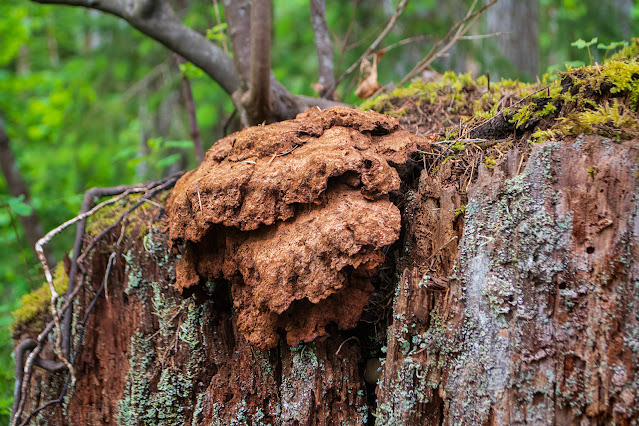
Foto # 4: Este botón parecía hongo polvera, con fragmentos de musgo, hasta que le quité el musgo que escondía el pie, destapando la volva.

Hace tiempo, yo comía muchos hongos salvajes, sobre todo los hongos polvera. Ya no: toda la tribu de los Amanita es variable, en forma y color, y muchas veces se ha confundido con hongos comestibles, con resultados a veces trágicos. Más vale prevenir ...


Powered By Blogger