Showing posts with label bark. Show all posts

Tuesday, January 24, 2023

Leaky

 And one more tree trunk.

Douglas-fir. Sap and lichens.

Trees leak sap when they're wounded or punctured, as when a sapsucker goes for a meal or a beetle digs an entry hole. Here, the dripped sap mingles with Cladonia spp. lichens, tiny leafy lichens that look like dust lichens from a small distance.

~~~~~~~~~~~~~~~~~~~~~~~~~~~~~~~~
Y uno más ...

Foto: un abeto de Dougla con savia y líquenes. Los árboles exuden savia cuando están heridos o agujereados, como por ejemplo cuando un chupasavias busca su comida, o cuando un escarabajo hace un portal de entrada. Aquí, la savia escurrida se mezcla con líquenes Cladonia, los cuales son líquenes foliosos tan pequeños que a poca distancia parecen ser líquenes de polvo.


Saturday, November 12, 2022

Things that make me happy

 My photo files keep filling up with one-offs; photos I will use "later". I try to organize them, but end up with too many categories, each with one or two photos in the folder. Looking at the mess today, I came up with a general label for the whole shebang: Things that Make Me Happy. And then it all made sense.

So here is a first installment from that file, in no particular order.

Cornus kousa.

Behind the museum, I found this tree. The ground was covered with fallen fruit; a few remained here on the branches. One of the dogwoods, probably Kousa dogwood.

Frozen sponge, Oyster Bay.

Lichen-covered trees. Alongside the Campbell River.

Mango tree.

I read that you could get mango pits to sprout, and I tried it out. These are the first ones that grew. The new leaves are pink, but turn green later on.

Pinkish mushroom, in the museum lawn.

Mountain ash bark.

A blue-eyed amphipod in my tank.

Tomorrow, another batch.

~~~~~~~~~~~~~~~~~~~~~~~~~
Mi archivo de fotos está lleno de fotos solitarias, fotos que voy a usar "más tarde, algún dia". Y las trato de organizar, pero caen en tantas distintas categorías que al fin tengo docenas de carpetas, cada una con una o dos fotos. Viéndolas otra vez hoy, se me ocurrió un título que se puede aplicar a todas: Cosas que me hacen feliz. Y con eso, se dice todo.

Pues aquí viene la primera parte de las fotos de la carpeta "Cosas que me hacen feliz", escogidas al azar.
  1. Atrás del museo encontré este árbol. El suelo estaba cubierto de estas frutitasEs bien machucadas pero algunas quedaban entre las ramas. Es un árbol de cornejo, probablemente Cornus kousa.
  2. Esponja congelada, uno de nuestros invertebrados intramareales, depositado en la playa por las olas.
  3. Árboles cubiertos de líquenes, al lado del rio.
  4. Un mango. Había leído que se pueden cultivar en casa, e hice la prueba. Estos son los primeros brotes. Las hojas nuevas son color de rosa, pero pronto se vuelven verdes.
  5. Un honguito color de rosa, en el césped del museo.
  6. La corteza de un árbol "ceniza de montaña", Sorbus spp.
  7. Un anfípodo con ojos azules en mi acuario.
Más, mañana.


Friday, July 22, 2022

Caves in bark

Three dead trees standing together are pock-marked, top to bottom, by small caves, pinhole-sized to a few inches across. And each cave has a floor of fine sawdust.

Ant housing development?

Zooming in. Caves behind caves.

Cave or tunnel entrance?

I've visited the trees several times, looking for residents. What I've found, so far, I'll post tomorrow.

~~~~~~~~~~~~~~~~~~~~~~~~~~~~~

Tres árboles muertos al lado del rio llevan una serie de cuevas chicas, desde unos milimetros hasta tal vez 10 cm de diámetro. Y cada cuevita tiene su piso cubierto de un aserrín fino.

Fotos: las cuevitas, rodeados de musgo.

He vuelto varias veces a este grupo de troncos, tratando de descubrir quienes son los arquitectos y los residentes de las cuevas. Mañana subo fotos de lo que he encontrado hasta ahora.

Tuesday, July 19, 2022

Rugged old wood

I've been looking at old tree trunks a lot lately. Just the trunks, live or sort of dead, the bark, the ravages of a long life, and the holes made by assorted critters. And some of the critters. Zooming in from a distance, to face to face, to with my nose in a hole and passers-by on the trail looking at me strangely.

Starting off at a decent distance: here are some trees from the slopes over Elk Falls. These are still green at the top.

Douglas fir. The bark develops deep fissures as it ages.

A closer look.

Holding down the slope.

Coming in closer. Lumps and cracks and mossy accents.

Reaching for the light.

Tomorrow; more bark.

~~~~~~~~~~~~~~~~~~~~~~~~~~

He estado observando los troncos de árboles viejos en estos dias. Limitándome a los troncos, la corteza vieja, las cicatrices que han dejado los años, las cavidades hechas por una variedad de animales. Y por fin, algunos de esos animalitos. Empecé a una distancia normal, acercándome cada vez más, viendo la corteza cara a cara,  y por fin con la nariz casi metida en los hoyos, y con los que pasaban en el sendero mirándome curiosamente. Ni modo.

Empezando con las fotos sacadas a una distancia normal: unos de los abetos de Douglas antiguos que viven en el bosque arriba de las cataratas Elk.

Mañana sigo con otras cortezas.

Sunday, January 09, 2022

Baikie Island walk

The promised rain never came. The snow still lies deep on my street; there's ice on the driveway.  So the snow photos will continue.
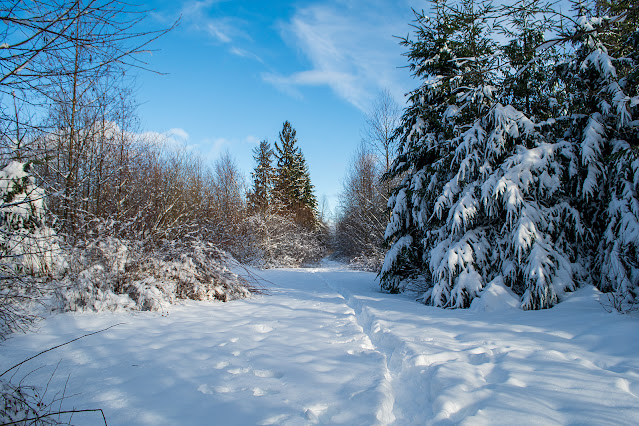
Baikie Island trail

The trail to the tip of Baikie Island is usually fairly busy, mostly with dog walkers. I go there hoping for birds (kingfishers, maybe?) and mushrooms, which grow thickly along the side trails.

No-one went down the side trails this week. But several people had stomped out this path down the main road, one boot-sole wide, a foot deep. Here and there a dog had bounded off into the snow, then bounced back; once a line of round, deep holes crossed the path coming from the bush, disappearing between the trees on the far side. A deer maybe; not a dog. Dogs come back to their owners.

I didn't go to the tip of the island, as I usually do. Snow had brought down small trees and bushes up ahead, almost completely blocking the trail. I turned back and took the winding path through the woods beside the slough.
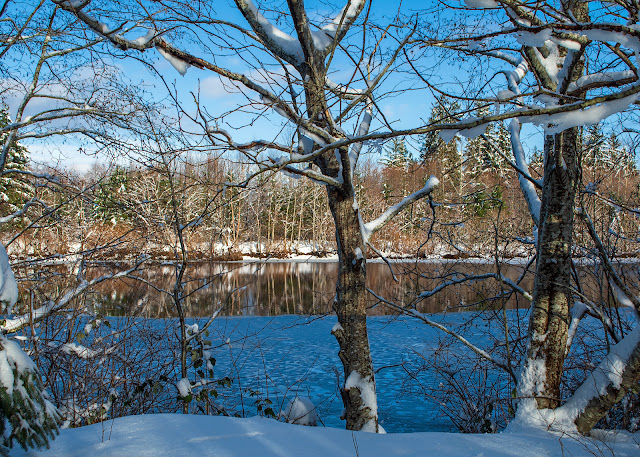
Layers: shady snow bank, leafless hedge of trees and shrubs, snow on mud, mirror water, and scrubby bush beyond.

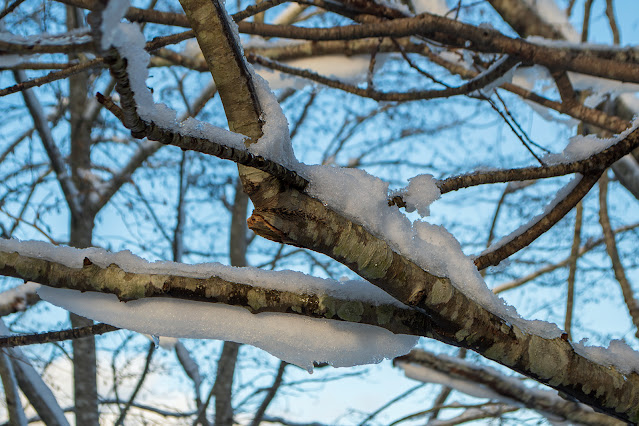
Bark pattern, and snow

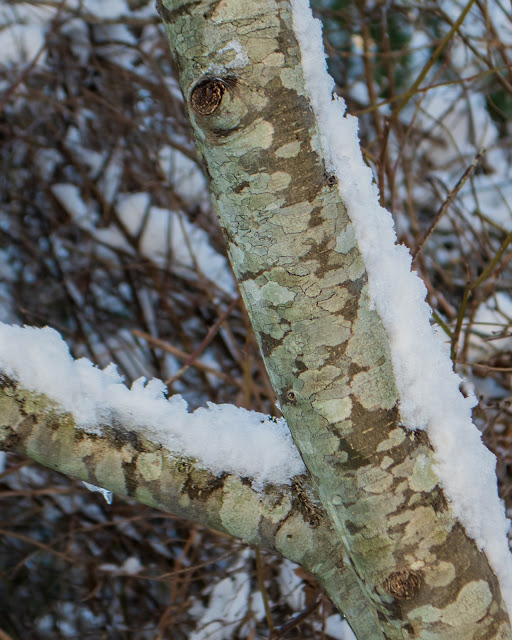
More snow and bark

I'm not sure what tree this is; without leaves and catkins or cones, I'm at a loss. I'll look at them again in the spring.
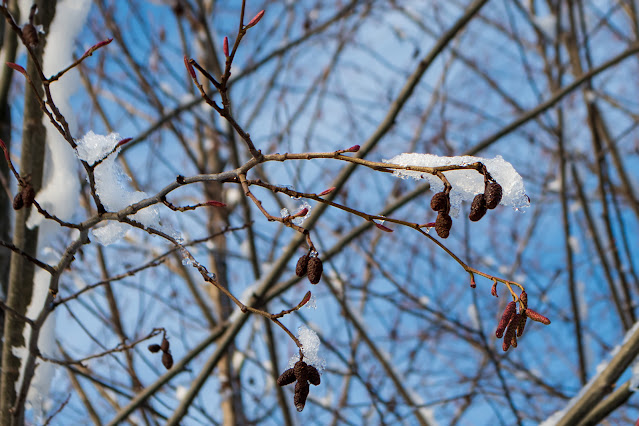
Alder catkins and cones, and the red buds waiting for warmer weather.

~~~~~~~~~~~~~~~~~~~~~~~~~~~~~

Bueno, la lluvia prometida nunca llegó. La máquina quitanieves no ha pasado por mi calle; la entrada está bajo una capa de hielo. Seguirán las fotos de escenas nevadas.

Primera foto: Sendero principal de la isla Baikie.

Este camino que se dirige al extremo de la isla casi siempre tiene varias personas, muchos llevando a pasear a sus perros. Yo voy esperando ver pájaros (tal vez, si tengo suerte, un martín pescador) o hongos, los cuales crecen en gran número en los senderos laterales.

Pero esta semana, nadie se atrevió a buscar los senderos entre el bosque. Pero varias personas habían hecho este caminito, pisoteando la nieve para hacer una zanjita, apenas el ancho de una bota, y 30 cm. de hondo. En algunos sitios, un perro había salido de la zanja, saltando sobre la nieve, regresando pronto a donde su dueño. Una vez, una linea de hoyos redondos salió del bosque, cruzó el camino, y desapareció entre los árboles del otro lado. Un venado, será; los perros siempre regresan.

No llegué al final de la isla, como acostumbro; la nieve había tumbado unos arbolitos y arbustos, obstruyendo el paso. Regresé al estacionamiento y tomé el senderito que serpentea entre el bosque al lado del pantano.

Segunda foto: el pantano, la nieve en sombra, y nieve sobre lodo.

Tercera y cuarta fotos: la corteza de un árbol bajo la nieve.

No puedo identificar este árbol sin la ayuda de hojas o candelillas o conos. Tendré que poner atención en la primavera.

Quinta foto: Candelillas y conos de aliso, y los botones rojos que esperan a que los dias estén más calientitas.

Sunday, March 10, 2019

Tall

The forest at Miracle Beach is mostly Douglas-fir, with a mixture of Western hemlock, Sitka spruce, and Big-leaf maple, and the ubiquitous red alder. It is second-growth forest; it has been logged off once, and once(that we know about; we are newcomers in tree years)  ravaged by fire, so most of the trees are relatively young, but a few of the older Douglas-firs are still standing.

These are tall trees; a mature Douglas-fir can be as much as 100 metres high, at least here on the coast. Inland, they are shorter.

In comparison, the Western hemlock grows normally to 50 metres, occasionally to 60.

I took a series of photos of one tree, and stacked them. I don't know how tall these ones are; the trunks are less than one metre in diameter. A normal width for a fully mature tree could be almost 3 metres.

Foreshortened from my viewpoint at its foot.

The trunk of an older Douglas-fir is branch-free for most of its length, with the foliage in a clump at the top. The bark is thick and deeply grooved. Look for the burl towards the bottom on this tree.

Looking  straight up from the same general area.


Wednesday, November 15, 2017

Abstract art, with wormholes.

On the shore in the rain, among the driftwood, I found this piece of bark. Just the one piece, about six inches long. The colour stood out on the wet beach, a bright orange, looking almost artificial, as if it were painted.

The inner bark of the red alder is reddish brown, and weathers to a bright orange-red.

 A red or orange dye was made from the bark to color red cedar bark and to make fishnets invisible to fish. (Native Plants, PNW)


Thursday, April 27, 2017

Bark and lichen

Because I like the textures.

Deeply grooved bark on an old maple tree

Campbell River museum, again.

Friday, November 13, 2015

Coffee break

I stopped for coffee in a beach shack with a plank and plywood lean-to for shelter from the weather. In spite of the sunshine, the wind was chilly, and there was a roaring fire in an airtight stove in the lean-to; every seat was taken.  I took my coffee and walked down the shore, scrambling over piles of driftwood and rolling stones, holding a camera and a hot coffee cup.

Loose rocks, with tiny snails that I tried not to step on.

And there are snails here, too. Click for the full size view.

Critter art. A sunrise over the water and hills, carved by mining beetles. 

Green-eyed monster, trapped in a log jam.

The coffee was good, too.

Sunday, January 29, 2012

Runes and Rounds

Seen at Crescent Beach:

Lichen circle. 

Several of the rocks had these, from about the size of a loonie to a hand-width. If you look closely at the full-size photo, you'll find individual cups as well, just starting out. I'm always amazed at these seemingly fragile things that eat away hard rock.

The yellow spots are another cup lichen.


Beetle tunnels on the inside of a piece of bark. They remind me of Nordic runes.


Wednesday, February 11, 2009

Questions, questions, and a sowbug graveyard

I don't know enough about trees. With the leaves on, and a bit of help, I can usually recognize the more common ones. Without leaves, I'm struggling. It doesn't help that here in the lower mainland, the climate is so mild, and the gardeners so enthusiastic, that many of the trees around the homes and businesses are imported or hybridised. Even in the greenbelts, the newcomers are taking root. (See Huckleberry Days, for example.)

I take a photo of some bark, bring home a leaf or two, and compare them with my books. Sometimes, I find them right away, and there is no doubt about them. At others, well, is this bark like that, or like that? Or maybe like this one from China? Do the leaves match? Almost? Not at all?

This evening I got out all my tree books and leafed through them, looking for the latest find. No luck, at all.


What is this? It's a deciduous tree, not terribly big. There were no catkins nor budding leaves yet.


The other side of the same trunk. Elephant skin. Are these younger branches, coming up from below?


In a couple of spots where the bark has separated from the trunk, this red mass shows up. Is it the inner bark, or some fungus or slime?

Far too many questions.

Inside the trunk, we found a mini-habitat:

At several points around the trunk, where it seems that a branch must have broken off some time ago, there are deep holes.


The young branches have grown up around this one.

I blew my photos up to full size and took inventory. The wood at the top had a crumbly look to it; I could see worm tracks here and there. There may be a few woodpecker holes, but not many. (Compare it to Seabrooke's woodpecker tree.)

In the puddle at the bottom; dead leaves, a few twigs, some rectangular whitish things, and an earthworm (I think). Above that, in the damp; slimy green algae, looking uncannily like sea lettuce. Up at the top where it's dry; white slime (parchment, crust, dry rot?). And between the algae and the puddle; a few sowbug carcasses. They looked like spider frass; while we were at the tree, I looked for webs or spiders, but none were visible.


Another view of the same hole. See the sowbug graveyard?


Not the same hole. This one is dryer, and full of dead sowbugs. The edges of the plates are white, making the bugs look striped, possibly because of a fungal growth.

Those are the first sowbugs, dead or alive, I've seen around here since the cold weather started. Under the bark, though, no matter how it snows and blows, there is a modicum of warmth and moisture for assorted insect, worm and spider life.

On a tree a few feet away, moss and lichen grew. Different chemistry, different organisms. But there are probably sowbugs in the crevices there, too. And spiders. There are always spiders.


Leaf lichen and tiny moss.


.
Powered By Blogger