Showing posts with label red alder. Show all posts

Monday, February 16, 2026

Reaching to the sky

Yesterday I noticed the new pink catkins on the alders. Spring is on its way.

Celebrating the bare branches of deciduous trees; they'll be clothed soon enough.

Snakehead Lake, Feb. 14.

A tall alder. January, somewhere north, on Hwy. 19


Maple, Big Tree Creek.

McIvor Lake.

Alders. Looking over Seymour Narrows

A Skywatch post.
~~~~~~~~~~~~
Ayer vi las candelillas color de rosa nuevas de los alisos rojos. Un aviso: pronto llegará la primavera.

Estas fotos celebran las ramas desnudas invernales de los árboles de hoja caduca.
  1. El lago Snakehead, el 14 de febrero.
  2. Un aliso rojo grande. Carretera #19.
  3. Un arce de hoja grande. Big Tree Creek.
  4. En el lago McIvor.
  5. Alisos rojos en el Estrecho Seymour.

Saturday, January 10, 2026

Tide-blasted log

When we think about annual tree rings, we usually remember the circles seen on the cut end of a log. Like these, for example;

Bark, cadmium, sapwood, heartwood. Ignore the polypores.

On the "outside" of Tyee Spit, where the currents roar down from Seymour Narrows, reaching up to 20 knots (37 km/h), scouring the shore so that no barnacles can grow on its stones, so that the only seaweed is the occasional castaway, here today, swept away tomorrow, I found another way to look at these annual growth rings. A log lying at the top of the high tide line, exposed to wind, rain, and those twice-daily racing tides, has been peeled, stripping off one layer after another, as you would peel an onion.

Each layer of sapwood has peeled off separately. It hasn't had time to rot away; the colours are still fresh.

A closer look. The "hairs" are part of the wood. This was a red alder, in life.

~~~~~~~~~~~~~~

Cuando pensamos en los anillos de crecimiento anuales que vemos en los árboles, casi siemtpre los imaginamos como los círculos que vemos en el extremo cortado de un tronco. Como por ejemplo, este:

    Foto: un tronco cortado, mostrando esos círculos.

En la orilla de la lengua de tierra Tyee, donde las corrientes mareales se precipitan, saliendo del estrecho Seymour, alcanzando una velocidad de hasta 20 nudos (37 km/h), puliendo la playa de manera que ningún bálano pueda establecerse sobre las piedras, de manera que las únicas algas marinas son fragmentos rotos detenidos por un momento antes de perderse; aquí descubrí otra manera de observar esos anillos de crecimiento. Un tronco depositado en el extremo superior de la zona intermareal, expuesto al viento, a la lluvia, y, dos veces a diario, a esas mareas aceleradas, ha sido pelado como pelarías una cebolla, quitando una capa de la madera tras otra.

  1. Cada capa de la albura se ha removido por separado. No ha tenido el tiempo necesario para pudrirse y los colores siguen vivos.
  2. Viendo más de cerca. Los "pelos" son parte de la madera. Este tronco fue, en vida, un aliso rojo.

Monday, April 14, 2025

Along the trail

I walked down to Roberts Lake, mostly looking for mushrooms, but also snapping photos of anything that caught my eye. The forest here, brown and green, tall evergreens over a carpet of moss and evergreen ferns, is dimly lit, but here and there gaps overhead permit rays of sunlight to penetrate. Along the lower edges of the forest, facing the lake, more sunlight makes the moss glow and permits the growth of flowering shrubs, salmonberry, thimbleberry, and flowering currant. Here, bees and robins take advantage of a warm day.

Forest floor near the lake. Here, the sun shines. Small glowing leaves are huckleberry.

Farther away from the lake, one narrow ray of sunlight illuminates an evergreen fern.

Bridge over the creek. The lighted area straight ahead is on the trail back up the hill.

Tracery of alder branches against the sky at lakeside. There are still no leaves visible.

Moss on a stump. Electrified cats-tail, Pseudisothecium stoloniferum.

A bee zips from one salmonberry flower to the next.

At the edge of the parking lot, a robin stands, listening for worms.

~~~~~~~~~~~~~~~~
Bajé por el sendero que nos lleva al lago Roberts. Buscaba hongos, pero también sacaba fotos de cualquier cosa que me llamaba la atención. El bosque en este sitio, en tonos de café y verde, se compone de árboles de hoja perenne dando sombra a una alfombra de musgos y helechos perennes. La luz del sol apenas penetra aquí, pero donde se abren espacios allá arriba entre las copas de los árboles, algunos rayos de sol logran colarse. Cerca del lago hay más luz, y el musgo brilla; aquí la luz permite crecer los arbustos de salmonberry (Rubus spectabilis), thimbleberry (Rubus parviflorus), y grosella roja.  Aquí, también, las abejas y los petirrojos se aprovechan de un dia con sol.
  1. El sotobosque cerca del lago, donde el sol logra penetrar. Las hojas pequeñas, como lucecitas, son de arándano rojo.
  2. No tan cerca del lago, un rayo solitario de luz ilumina unas frondas de helecho.
  3. Puente que cruza el riachuelo donde entra al lago. El espacio iluminado en la distancia es parte del sendero que sube hacia la carretera.
  4. Ramas de aliso rojo contra el cielo al borde del lago. Todavía no aparecen hojas.
  5. Liquen Pseudisothecium stoloniferum, aquí conocido como "cola de gato electrificada".
  6. Una abeja se acerca a una flor de salmonberry.
  7. Y al lado del estacionamiento, un petirrojo se detiene, escuchando el ruidito de una lombriz bajo la tierra.

Sunday, March 16, 2025

In the pink

Looking at red alder catkins:

Dangling pollen-producing catkins.

Early in the spring, the winter-grey red alder trees, seen from a distance, take on a pinkish glow. Move in close; the colour comes from the tiny flowers arranged in dangling clusters; catkins blooming before the leaves appear.

Male and female catkins.

The male catkins are up to 15 cm. long; dozens of red-rimmed flowers producing copious amounts of pollen; if you shake a branch at this time of year, they release a cloud of yellow dust. 

Female catkins are tiny; in this photo, they're those brownish cones with pink bracts. These will develop into small, brown seed cones that will stay on the tree for the rest of the year.
 
Looking up at a tree full of catkins against a cloudy sky with the afternoon sun trying to break through.

There are no leaves yet on this tree; all those dangly bits are catkins. 

~~~~~~~~~~~~

Estamos en la temporada cuando los amentos (candelillas) de los alisos rojos están más en evidencia.

En los primeros meses del año, los alisos rojos que hace poco estaban sin color, ahora, vistos desde alguna distancia, estrenan un tinto rojizo. Acércate; el color se debe a las flores miniaturas que cuelgan en racimos; los amentos floreciendo antes de que salgan las hojas.

Los amentos masculinos miden hasta 15 cm. de largo, y contienen docenas de flores con pétalos rojos. Estas producen grandes cantidades de polen; si sacudes una rama en este mes, soltará una nube de polvo amarillo. 

Los amentos femeninos son pequeños; en estas fotos son esos conos color café y con brácteas color de rosa. Estos se convertirán en conos chicos, marrones y permanecerán en el árbol todo el año.
  1. Amentos colgantes, en la temporada de producir polen.
  2. Amentos femeninos a la izquierda, los masculinos a la derecha.
  3. Mirando un aliso contra el cielo; el sol de la tarde trata de penetrar las nubes. Todavía no hay hojas; todos los objetos colgantes son los amentos.

Monday, February 24, 2025

Rocks, river, duck

That said, this island surrounds me with beauty; so healing!. Here, views seen in a brief stop while I was looking for lichens along the river bank; the exit from the narrow gorge:

Campbell River, coming out into the open. With bufflehead. The sign reads, "Warning", and then (unreadable from here) a notice about a siren announcing sudden volume changes. The flow can go quickly from a usual 80 cubic metres per second to 128 m³/s. Retreat to higher ground!

A wider view, with the Canyonview bridge far above. A long staircase leads up the hill to cross it and access a trail going along the far side of the river.

Ghostly trees on the far side of the river at this point. Red alders, bearing their spring-blooming brownish pink catkins and last winter's cones.

And I climbed those stairs again. Views from up top, tomorrow.

~~~~~~~~~~~
Esta isla me rodea de belleza. Esto es lo que vi cuando me detuve un momento durante una búsqueda de líquenes cerca del rio.
  1. El rio Campbell sale del cañón. Con un porrón coronado. El letrero lee —AVISO — y luego (esto apenas se puede leer a esta distancia) una advertencia; el corriente puede aumentarse súbitamente, pasando del acostumbrado 80 metros cúbicos por segundo a unos 128 m³/s en poco tiempo. ¡Retírense a un sitio fuera de su alcance!
  2. Una vista más amplia, incluyendo el puente "Vista del Cañón". Una escalera larga sube por la ladera a la izquierda, para cruzar el puente y seguir un sendero que sube el cerro al otro lado del rio.
  3. Árboles blanqueados al lado opuesto del rio. Son alisos rojos, y llevan los amentos de esta primavera, color café con tonos de rosa, y algunos de las piñitas del año pasado.
Y luego subí la escalera. La vista desde arriba, la dejo para mañana.


Friday, January 10, 2025

Branches, not quite bare

The hydrangea outside my kitchen window is all over new buds. A sign of early spring, maybe, or just a response to the warm weather; it may be a mistake, if we end up with winter weather later this month.

The red alders are wearing their red catkins, too. They started producing them last November, and a bit (or a lot) of freezing weather won't phase them.

Red alder, Alnus rubra, January 2025.

The male alder flowers are the long, reddish catkins. Female catkins are smaller, and oval-shaped, greenish when they're new. Both male and female catkins appear before the leaves, but the males will drop off once pollination is finished. The female catkins will develop into small, brown cones; these stay on the tree over the winter. About now, the seeds will be dropping from between the scales of these cones. The first beginnings of pinkish leaf buds are showing at the tips of the branches.

Snag with eagle. No buds on this tree, but there's lichen.

Big-leaf maple. No leaves, no buds, no catkins yet.

~~~~~~~~~~~~~~~
Hay botones nuevos en la hortensia en frente de mi casa. ¿Señal de primavera, tal vez? ¿Una respuesta al clima que este año, hasta ahora, ha pasado por alto el invierno? ¿O un error que se pagará si es que veamos temperaturas de invierno más tarde?

Los alisos rojos ahora estrenan sus candelillas rojizas. Las empezaron a producir en noviembre, y no les espanta el frio, aunque todo se congele.
  1. Rama de aliso rojo, Alnus rubra, ahora en enero, 2025. Las candelillas machas son largas y rojas. Las candelillas hembras son más chicas, redondeadas, verdes cuando están nuevecitas. Tanto las candelillas machas como las hembras salen antes de que aparezcan las hojas, pero las candelillas machas se caerán una vez terminada la temporada de polinización. Las candelillas hembras formarán pequeñas piñas; estas permanecen en el árbol durante todo el invierno, y ahora las semillas están escapando de entre las escamas. Y se ven en la punta de las ramas los primeros brotes rojizos de las hojas.
  2. El árbol estará muerto, pero lleva vida; el águila y los líquenes que cubren las ramas.
  3. Un arce de hoja grande. Este árbol todavía no muestra señas de hojas, ni sus botones, ni las candelillas que aparecerán más tarde.


Friday, February 09, 2024

Scrambled bar code lichens

 A nicely decorated alder. With a label. Can you read it?

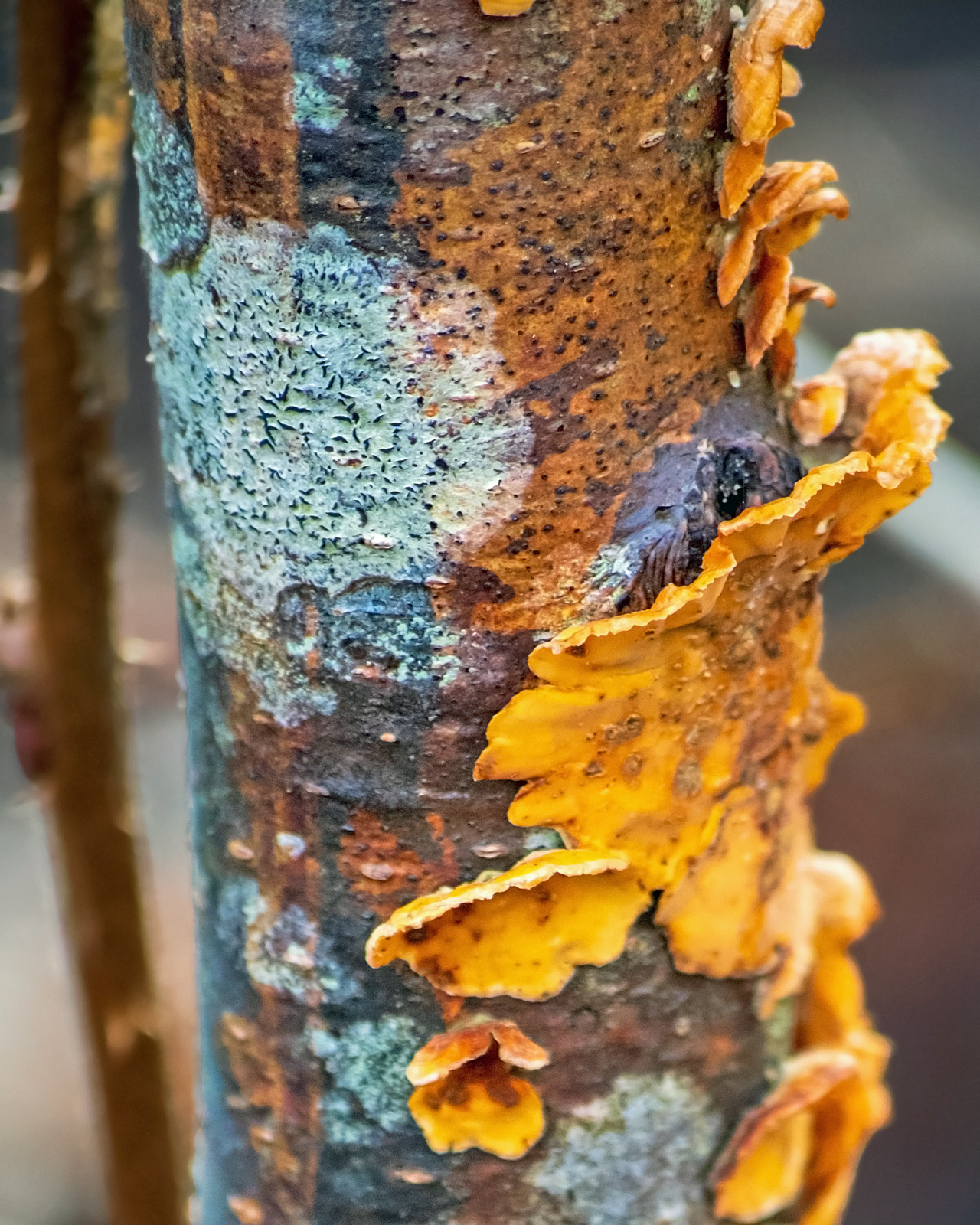
Orangey-yellow mushrooms and script lichen. The trunk is about 10 cm. across.

The script lichen is probably Graphis scripta, which is very common, especially on alders. The "pencil marks" are the fruiting bodies. I'm not sure what species the mushrooms are; they grew from the ground up to the tip of the tree. I liked how they plaster themselves to the trunk before levelling off to make the shelf.

~~~~~~~~~~~

Aquí tenemos un aliso adornado como para darle color al bosque invernal. Y tiene su etiqueta. ¿La puedes leer?

Foto: tronco de aliso con hongos amarillos y un liquen gráfico. El tronco mide unos 10 cm. de diámetro.

El liquen gráfico probablemente será Graphis scripta, el cual es muy común aquí, creciendo especialmente en los alisos. Las "letras" son los cuerpos fructíferos. Y no pude identificar el hongo, que está creciendo desde el pie hasta la copa (muerta) del árbol. Me llamó la atención la manera que tienen de aplastarse contra la corteza antes de doblarse para formar la repisa.


Wednesday, January 24, 2024

Shades of grey. And red.

 It was one of our trademark grey days; the sky and the water light greys, the colours leached out of everything else. I went to Baikie Island, thinking there may have been still some snow on the ground to add a bit of light, but it had all melted into the layer of soggy leaves.

Grey, grey, grey. With hints of brown, and then ...

View from the bridge to the island.

Bufflehead female, making waves.

Alder branches bearing catkins made a tracery of black against the grey sky. From a metre or two away, though, their reds were visible; a promise of pink masses lining the shores. Soon.

Red alder catkins. Even the new stems and buds are red.

~~~~~~~~~~~~~~
Era uno de esos dias grises, tan comunes en la isla; el cielo y el agua pintados de gris claro, los colores de todo lo demás perdidos. Fui a la isla Baikie, pensando que tal vez habría todavía algo de nieve en el suelo, para reflejar un poco de luz, pero toda la nieve se había derretido, mezclándose con la capa de hojas viejas y empapadas.

Gris, gris, gris. Con algunos recuerdos de café oscuro. Y luego ...

  1. Vista desde el puente que da a la isla.
  2. Un porrón coronado hembra, creando olas.
  3. Y los alisos rojos hacían un encaje de ramas negras contra el gris del cielo. Pero de cerca, desde una distancia de uno o dos metros, se distinguía el color rojo de sus candelillas, una promesa de nubes color de rosa que cubrirán los bordes de los rios y carreteras en pocas semanas. Hasta los tallos y botones nuevos son rojos.

Thursday, January 18, 2024

Tree lace and defiant catkins

It snowed all night. It wouldn't last; the cold snap is over, and the temperature now hovers above zero. I hurried out to take photos before the rain washes it all away.

Nameless creek and lacy deciduous woods.

Grasses, dried and fresh, on the edge of a shallow beaver pond. More on this later.

Hummocks of moss on an old log.

Snow on a hanging weed tip. Over the ice on the beaver pond.

Freeze us! Cover us with snow! See if we care!

I had to laugh. Snow or no snow, whatever the weather, the alders are busy preparing for spring, waving their catkins and cones defiantly against the sky. The flowers start to form in December, and will be in full bloom next month, painting the alder thickets pink. And the cones have been dropping seeds all along.

Lichens and snow on a fence rail.

There's a trail there! Crossing the dunes at Oyster Bay.

And it's snowing again, briskly. We're at 2°C, with a drop to zero forecast for tonight. Maybe the snow will stay around for a bit.

~~~~~~~~~~~~~~~
Toda la noche caía la nieve. No iba a durar; ya pasó la ola de frio y la temperatura ya anda en los números positivos. Salí a sacar fotos antes de que la lluvia se la llevara.
  1. Un riachuelo sin nombre, rodeado de encaje tejido por los alisos rojos.
  2. Pastos, secos y frescos, al borde de una lagunita de castores.
  3. Montículos de musgos sobre un troncón viejo.
  4. Nieve encima de las flores secas de una hierba. En el fondo, hielo en la superficie de la lagunilla de castores.
  5. ¡Cúbrennos de nieve! ¡Congélennos! ¿Y qué? Me hizo reir esto. Caiga nieve o no, sea lo que sea la temperatura, los alisos rojos siguen sus preparativos para la primavera, alzando sus candelillas y piñas desafiantes contra el cielo. Las flores (en las candelillas) empezaron a formarse en diciembre y florecerán en febrero, pintando las ramas de un color rosa oscuro. Las piñas en todo este tiempo han estado esparciendo sus semillas.
  6. Líquenes y nieve sobre una valla.
  7. Aquí hay un sendero. ¿Lo ves? Ruta que cruza las dunas hacia Oyster Bay.
Y de vuelta está nevando, algo fuerte. Estamos en 2 grados sobre cero, pero dicen que bajará a cero esta noche. Tal vez dure la nieve por un tiempecito.


Thursday, April 02, 2020

On mossy trunks

Some more tree trunks to wonder about:

These are beside the Ripple Rock trail.

Douglas fir

The forest is deep and shady here. Most of the Douglas fir trunks have a good crop of moss, and the lower branches are lightly furred, with a different, dangly, hairy moss.

But, among them are the alders:

Red alder
The alders have bare trunks, but the branches are heavily laden with a moss that looks (from ground level) like the Douglas fir trunk moss.

Red alder trunk and branches.

Why?

~~~~~~~~~~~~~~~~~

Ya que estoy mirando los troncos de árboles, aquí hay otro misterio. En un bosque al norte de la ciudad, en camino a Ripple Rock, los abetos de Douglas llevan una capa gruesa de musgo en el tronco, y en las ramas, otro musgo, más delicado, como pelos colgantes.

En el mismo bosque, los alisos rojos no traen musgo en el tronco, pero las ramas están cubiertas del musgo que crece en los abetos.

¿Porqué?

Friday, January 31, 2020

Four and twenty

... blackbirds perched in two trees.

Alders and crows, Oyster Bay.

(A forgotten photo, just re-discovered tonight.)

Veinticuatro cuervos, en un par de alisos rojos en Oyster Bay. Una foto olvidada, descubierto esta noche.

Saturday, January 04, 2020

Pine siskins

What do tiny birds like pine siskins do when it blows and storms? In the gap between rainstorms, I passed a red alder, loaded down with catkins and busy pine siskins.

18 pine siskins on this half of the tree.

I haven't seen these little birds for some time. They travel in flocks, swarming over a tree or shrub for a few minutes, then going on to another. They don't have a fixed route, seemingly choosing their next feeding spot on a whim. They arrived at this tree just as I passed; by the time I'd taken a few photos they were on to another, one tree at a time.

They are mainly seed eaters, foraging for any small seeds from a large variety of plants, dandelions to pine trees, also taking insects where they find them. On this tree, they're mainly focusing on the tiny cones, although one was checking out a catkin. They would find seeds in the cones, and maybe an insect or two in the catkins.

Pine Siskins are fairly common, but their numbers can be difficult to estimate due to the large and hard-to-predict movements they make each year. Partners in Flight estimates that populations have declined by 80% since 1970. ... The Pine Siskin rates a 10 out of 20 on the Continental Concern Score and is considered a Common Bird in Steep Decline. Domestic cats, red squirrels, hawks, jays, and crows can prey on adult birds or on their eggs or young. ... Pine Siskins' fondness for mineral deposits can lure them onto dangerously busy roadways salted to melt ice and snow. Loss of habitat from forest-clearing may be balanced by new commercially planted coniferous forests, and by the Pine Siskin’s willingness to nest in shrubs and ornamental trees. (from Cornell Lab of Ornithology)

Bits of yellow cheer

Wednesday, April 10, 2019

Early leaves

Green is bursting out all over. I walked down the Myrt Thompson trail, that follows a spit of land in the middle of the Campbell River down to the estuary.

The river breaks itself into several channels here. Low water today: sometimes it covers those grassy banks. I think the new leaves on the right are elderberry. They put out large leaves very quickly. A couple of black specks on the far shore (on the left) are a pair of eagles.

Red alder leaves and overwintering cones.

Willow catkins and baby leaves.

Looking downriver, out to the ocean and Quadra Island. And more new green leaves.

Tuesday, February 12, 2019

On the wet forest floor

A few leftover photos from Canyonview Trail.

Layered fallen leaves on an upside-down fern frond. Fern, Bigleaf Maple, Red alder, Bigleaf Maple (3) and Red alder on top. As found. On a foundation of decomposed leaves and ferns plastered on a stump.

Licorice fern on a downed branch. I lifted the branch and found that it has entirely decomposed; all that is left is the moss and the fern rhizomes, still holding the shape of the branch. 

Oregon beaked moss on a stump.

It's snowing again. Third day in a row. Winter is finally here!

Thursday, November 29, 2018

Ground cover, after the rains

Crossing an unused picnic area at Oyster Bay, I almost stepped on the remains of a mushroom, bedded on soaked leaves.

Red alder and cottonwood leaves, half a gilled mushroom. I couldn't find the stalk.

Directly under the cottonwood trees, walking on their dropped leaves released a sweet, fruity aroma, with overtones of cinnamon. I had to stop and just breathe.

Friday, March 30, 2018

Red catkins

In Japan (and our Vancouver, too) the cherry blossoms are turning the parks and streets pink. Here, it's red alder. The pink is darker, a bit greyed, as befits our understated colour scheme, but a stand of red alder in the distance is definitely pink this month.

Because the spring catkins are out.

Male and female red alder catkins

The long, red catkins are the males. Female catkins are tiny and rigid. They will develop into hard cones, about 1/2 inch long; these will stay on the tree until next spring.

Roadside alders, March 2016. Near Keta Lake.

More catkins. The male flowers grow in drooping clusters of from 4 to 6 catkins at the ends of branches.


Powered By Blogger