Showing posts with label McIvor Lake. Show all posts

Monday, February 16, 2026

Reaching to the sky

Yesterday I noticed the new pink catkins on the alders. Spring is on its way.

Celebrating the bare branches of deciduous trees; they'll be clothed soon enough.

Snakehead Lake, Feb. 14.

A tall alder. January, somewhere north, on Hwy. 19


Maple, Big Tree Creek.

McIvor Lake.

Alders. Looking over Seymour Narrows

A Skywatch post.
~~~~~~~~~~~~
Ayer vi las candelillas color de rosa nuevas de los alisos rojos. Un aviso: pronto llegará la primavera.

Estas fotos celebran las ramas desnudas invernales de los árboles de hoja caduca.
  1. El lago Snakehead, el 14 de febrero.
  2. Un aliso rojo grande. Carretera #19.
  3. Un arce de hoja grande. Big Tree Creek.
  4. En el lago McIvor.
  5. Alisos rojos en el Estrecho Seymour.

Meetup on the rocks

The story continues ...

This will be more about people and our pursuits than about the world around us. Or maybe not.

When I arrived at the bottom of the rock outcrop, I was surprised to find 5 pickups parked in "my" spot. I managed to squeeze my little car in between two of them. I figured that the owners must be down at the lake; early and cold for a picnic, but we're hardy folks; I've joined a happy crowd eating hot dogs and roasting marshmallows around a campfire in the pouring rain before.

But no. As I started up the trail, a man came down over the rock. Said good morning, smiled, took one of the trucks away. Looks like I'm not the only one fascinated by these mossy rocks.

I climbed to the very top of the rock; I'd stopped before a few metres lower down. And from the top, now, I  saw a narrow trail heading down behind the rock into the bush. A couple of dozen steps, then it turned and was hidden behind salal bushes. I had to check it out.

At the turn, I stopped. The trail led to a narrow break in the rock above, a steep gap filled with loose rocks, with water trickling down between them. After a rain, it would be a tiny waterfall. Climbable? Would those rocks slide underfoot? I wasn't sure.

Safer than it looks.

Then another man came over the top of the next rock, heading for that gap. I stood and watched while he negotiated the drop. Larger than I, heavier he was, (and younger, of course) but most of the rocks stayed put under his feet. Maybe I'd risk the climb.

"What's up there?" I asked him.

"Rocks, a trail goes off into the bush ..." He didn't offer any other information. He went on down the trail I'd followed.

I went up, holding onto salal and a sapling for support. Up above, there was another wide slope, smooth rock under its coat of moss. Water ran through the moss, just deep enough to leak into my shoes. I kept on going. So still, so green! On my right, more rocks loomed overhead.

Top of the third rock. But look closely. Do you see it?

A trail led off to left, down into the bush, but I went on up the slope, over the moss. Up and around another rock, higher up. Another, very faint trail appeared. Around and up, and there were more rocks to climb. But it looked like it was going to rain any minute; I turned and went back down. Another day, in a drier season.

Why is it, I've often wondered, that people find it so compelling to build driftwood shelters or even "rooms" on the beach? We're builders by nature, it seems. And here it shows up again; here at the top of these rocks, with very little material to work with, with no easy access to the chosen site, someone just had to make a roof.

Wouldn't keep out the rain.

Coming down, on the far side of the mossy slope (wouldn't want to miss something by taking the same route down), I heard voices overhead. Looked up; on top of another rock a group of kids and parents, several families' worth, were driving remote-controlled vehicles; trucks and jeeps, all-terrain "crawlers". They were climbing "impossible" rocks, struggling but conquering. I stood and watched for a while,  then went on down.

(Did you see the truck in the second photo above? Must have attempted a slope beyond its capabilities.)

The rocky gap going down was easier than I had thought. I had been worried about that; going down is always harder than climbing up. At least there were people there above me, in case I ran into trouble. But it was fine, only one stone moved underfoot, and the salal is tough.

I was below, picking up stones and examining them, when the crowd came down, driving their crawlers as they came. "Looks like a lot of fun," I said to one guy carrying his daughter's truck now that they were near the bottom.

"More fun than that!" he said.

As I got into my car, a few minutes later, the group, still busy arranging kids and crawlers in their pickups, waved at me. "Bye!" someone called. It started to rain as I reached the highway.

One more rock top.

I didn't know what to call these vehicles; bigger than kids' toys, tougher, versatile. I looked them up, and found a YouTube video. Fascinating! Go look! 

~~~~~~~~~~~~~

Sigue el relato ...

Esto tratará más de la gente y de nuestros pasatiempos que del mundo alrededor nuestro. O tal vez no.

Cuando llegué al pie de la roca en la ladera sobre el lago, me sorprendió encontrar 5 camionetas estacionados en "mi" lugar. Logré insertar mi cochecito entre dos de ellos. Creía que los dueños estarían allá abajo en la playa; es algo temprano, un poco frio para hacer picnic, pero somos aguantadores; recuerdo haber comido hot dogs y malvaviscos tostados con un grupo de gente feliz alrededor de una fogata durante una lluvia fuerte.

Pero no. Cuando entraba al sendero, un hombre bajaba desde la roca. Me saludó, sonrió, y se llevó una de las camionetas. Parece que no soy la única persona a quien le fascinan estas rocas cubiertas de musgo.

Subí esta vez a la cima de la roca; antes, me había detenido unos pocos metros más abajo. Y ahora, visible solamente desde la cima, apareció un senderito angosto que bajaba tras la roca, perdiéndose después de unos cuantos pasos entre los arbustos de salal. Tuve que investigar, claro.

Cuando llegué a la primera vuelta, me detuve. El sendero llevaba al pie de una roca con una brecha angosta, llena de piedras sueltas; un chorrito de agua bajaba entre las piedras. Después de una lluvia sería una catarata miniatura. ¿Se podría trepar sobre esas piedras? ¿No se moverían al pisarlas? No me daban confianza.

    1. Más seguro que lo que parece.

Otro hombre llegó, cruzando desde las rocas allá arriba; se dirigía hacia la brecha. Esperé mientras descendía. Estaba más grande, más pesado que yo, (más joven, también) pero casi todas las piedras se mantuvieron firmes bajo su peso. Tal vez me atrevería a subir.

"¿Qué hay allá arriba? le pregunté.

"Piedras. Un camino que entra al bosque ..." No ofreció más información. Bajó por el sendero por donde yo había venido.

Subí, sosteniéndome con unas ramas de salal y un arbolito. Arriba, había otra roca inclinada, roca lisa cubierta de musgo. Entre el musgo, agua corría; me llenó los zapatos. Seguí adelante. ¡Tan callado, tan verde!  A mi derecha, otras rocas formaban una pared alta.

    2. La tercera roca. Pero mira; ¿ves que más hay?

Un sendero se dirigía hacia la izquierda, bajando al bosque, pero yo seguí cruzando la roca, sobre el musgo. Subí, di la vuelta a otra roca, más alta. Apareció otro sendero, apenas marcado. Una vuelta más,  y otras rocas, subiendo, subiendo ... Pero parecía que iba a llover en cualquier momento; regresé, bajando. Será para otro dia, en una temporada más seca.

¿Porqué será, me he preguntado muchas veces, que la gente lo encuentra tan necesario construir estructuras, hasta "cabañitas" hechas de madera flotante en las playas? Parece que somos constuctores por naturaleza. Y aquí se ve otra vez; aquí sobre estas rocas, con tan poca madera a la mano, sin acceso fácil al sitio; sin embargo alguien a la fuerza decidió construirse un techo.

    3. Pero se le va a colar la lluvia.

Bajando, del lado opuesto del sitio (no hay que volver sobre la misma ruta; no sabes lo que puedes perder) oí voces allá arriba. Miré; encima de otra roca alta, un grupo de niños con sus padres, varias familias, operaban "crawlers", vehículos todoterreno controlados por radio. Camiones y "jeeps" subiendo y bajando sobre inclinaciones imposibles; con trabajos en las rocas más grandes, pero se las arreglaban. Me quedé observando por un rato, luego seguí con la bajada.

(¿Viste la camioneta en la segunda foto arriba? Habrá atentado subir algo demasiado inclinado.)

Bajar por la brecha no era tan difícil como había temido. Me estaba preocupando; siempre es más fácil subir que bajar. Por lo menos, con gente allá arriba, tendría ayuda si tuviera problemas. Pero todo estaba bien; una sola piedra se me arrimó, y el salal provee sostén seguro. Un arbusto bastante fuerte.

Estaba allá abajo, recogiendo y examinando piedras, cuando bajaron, con sus vehículos por adelante. "Parece ser muy divertido," le  dije a un hombre que cargaba la camioneta de su hija ahora que llegaban al pie del cerro.

"Más divertido que eso!" contestó.

Unos minutos más tarde, cuando me subía al coche, el grupo, todavía distribuyendo niños y vehículos entre las camionetas, me despidió con sonrisas y saludos de mano. Cuando llegaba a la carretera, empezó a llover.

    4. Otra roca.

No sabía como se llamarían estos vehículos; más grandes que juguetes de niños, más fuertes, flexibles. Los busqué y encontré un video de YouTube. ¡Fascinante! ¡Míralo! 

Sunday, February 15, 2026

Green fossils, black buttons

I had to go back.

Around the rock above McIvor Lake, lying scattered on the moss, loose on the surface, I found many stones; little broken slabs, flat pieces, as if they'd been chipped off the main rock. Winter weathering, maybe? Ice does that.

I picked up a few pieces. Greyish, greenish stone; one was full of raised  bubbles of whitish stone. Quartz.

As found, with a Douglas-fir cone for the size.

A closer look.

I brought this stone home and took photos of those bubbles.

Looks like a few have popped out. Maybe they're still in the original rock face.

Kitty sculpture?

The brown and green stone is soft, easily scratched with any metal. (I tried with an old copper coin: 3 on the Mohs Hardness Scale; steel is 5.5, diamond 10. I didn't try scratching it with a diamond; I don't have one.) The white bubbles wouldn't take a mark; quartz is 7 on the scale, harder than my steel file.

I've been digging into the green stone with my file; it comes up as a fine, green powder, soft to touch, not gritty. I posted photos to the Facebook group, Geology of Vancouver Island (So helpful!) and they tell me I have "fossils of a Calcareous Algae. It is quite common in the Cretaceous sandstones found on Vancouver Island." (Thank you!)

So I had to go back. To see if the whole inside of that huge rock was crumbly and bubbly and green. So I picked up and turned over dozens of other pieces. Some were green, some were crumbly, some had bubbles, some had squiggles. No two alike.

This one is brown and scratchable, but it has hard, green intrusions.

Whitish on one side, hard, and boring grey on the other, and full of white squiggles in the centre.

And there was more to see!

A black "button" lichen. Possibly  Sunken Button Lichen, Buellia spuria. Although there are several almost identical.

Zooming in.  A white lichen with black fruiting bodies. Black lines separate individual lichens.

And there was yet more. I'll leave that for tomorrow.

~~~~~~~~~~~~~~~~~~

Tuve que regresar.

Alrededor de la roca en la ladera arriba del lago McIvor, regadas dondequiera sobre el musgo, sueltas, encontré muchas piedras: piezas rotas, planas, que parecían haberse separados de la roca madre. ¿Por la acción del hielo, posiblemente? Suele romper rocas grandes.

Recogí algunas piedras. Eran de color gris, o casi verde; una estaba llena de burbujas blancas de otra piedra. Cuarzo.

    1. Como la encontré. Con un cono de abeto de Douglas para dar el tamaño.

    2. Acercándome.

Me traje esta piedra a casa para examinarla y sacar más fotos.

    3. Las "burbujas". Parece que algunas han dejado nada más el hueco donde estaban. Tal vez se encuentran todavía encrustadas en la roca madre.

    4. ¿Una escultura de un gatito?

La piedra de color café o verde se marca facilmente, raspándola con cualquier objeto metálico.  (Hice  la prueba con una moneda de cobre mexicana — 50c, 1997, 92% cobre —  que tiene un valor de 3 en la escala de Mohs; el acero es 5.5, el diamante 10. No la probé con un diamante, que no tengo.) Las "burbujas" blancas no se pudieron marcar, ni con una lija de acero (6). El cuarzo tiene un valor de 7.

He estado excavando la piedra verde con mi lija; produce un polvo fino, verde, suave al tacto, no arenoso. Subí fotos al grupo Facebook, Geology of Vancouver Island y me dicen que tengo "fósiles  de un Alga Calcárea. Es muy común en las piedras arenosas cretácicas que se hallan en la Isla Vancouver." (¡Muchas gracias!)

Así que tuve que regresar. Para ver si toda esa roca grande estaba friable y verde y llena de burbujas por dentro. Así que recojí docenas de otras piedritas.  Algunas verdes, algunas friables, algunas con burbujas, algunas con garabatos. No hay dos iguales.

    5. Esta es friable y de color café, pero incluye fragmentos duros, verdes.

    6. Blanquisco de un lado, duro y gris del otro, y con garabatos blancos en el centro.

¡Y había más!

    7.  Un liquen "botón" negro. Posiblemente sea el Botón Hundido, Buellia spuria. Pero hay varios casi idénticos.

    8. Zoom. Es un liquen blanco con cuerpos fructíferos negros. Lineas negras marcan las orillas de líquenes particulares.

Y todavía hay más. Pero eso lo dejo para mañana.


Friday, February 13, 2026

Shining hill

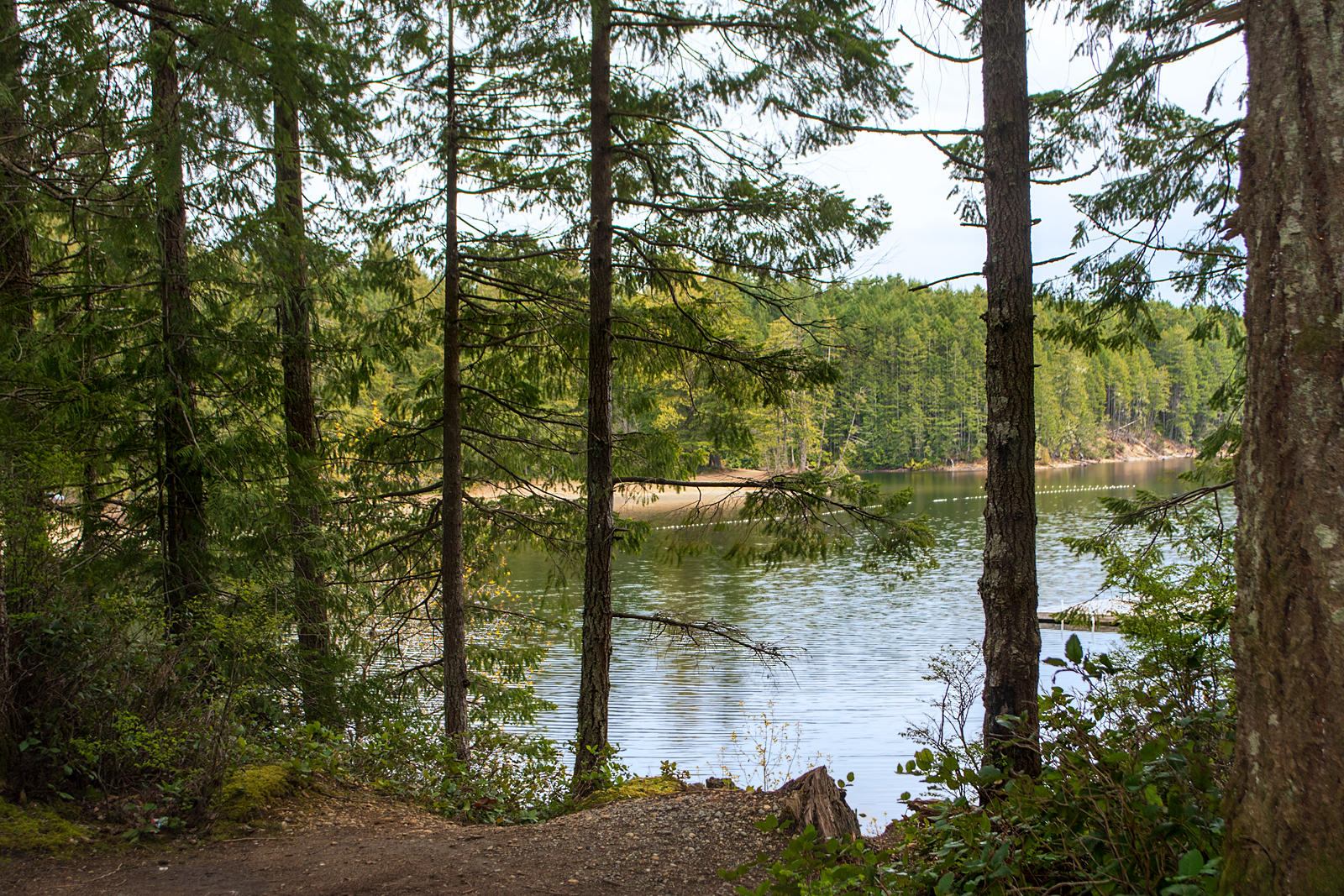
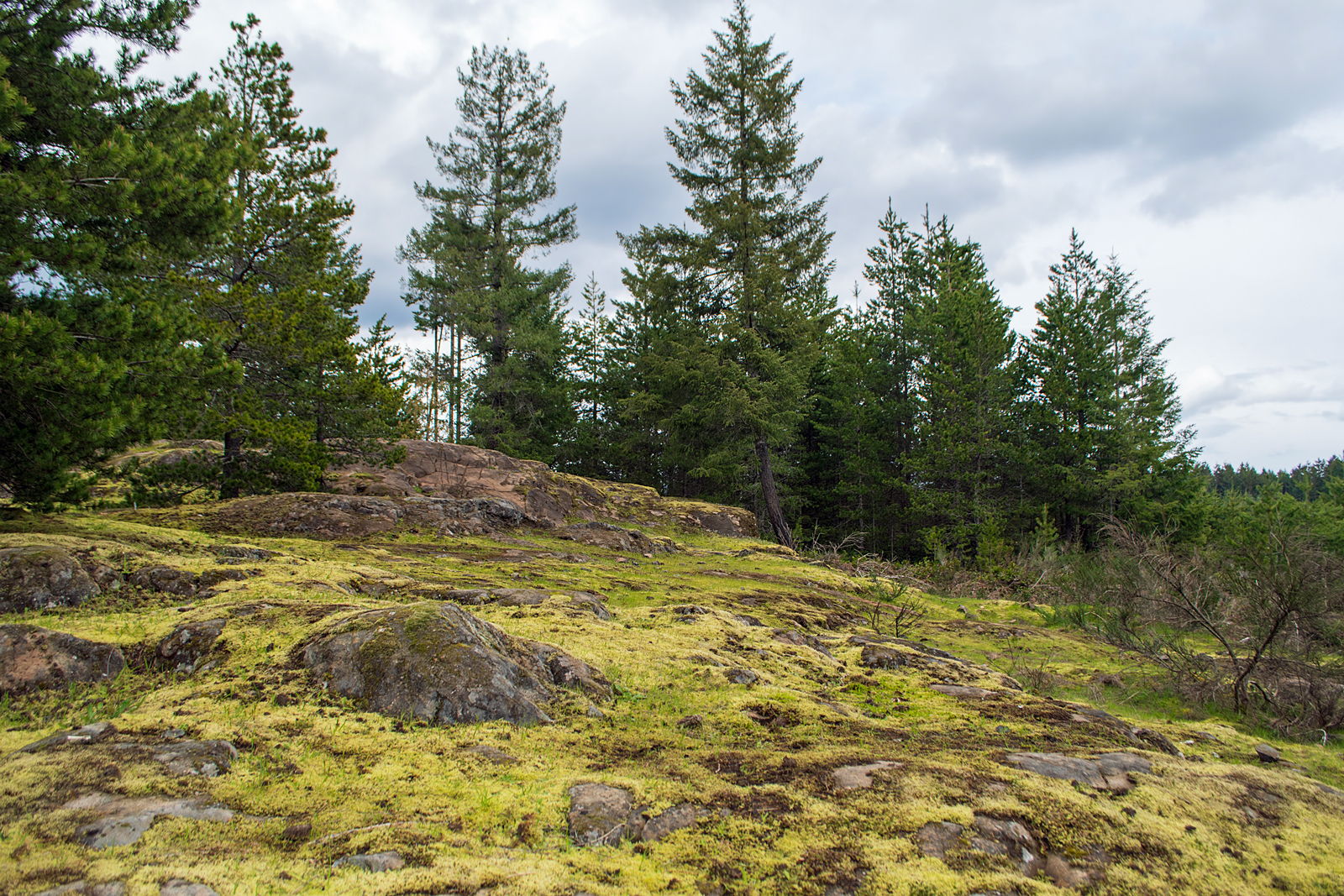
Along the road circling McIvor Lake to the north, on the lake side, here and there glimpses of pale blue or grey glimmer through the dark forest; the water below. On the north, the upper side, there are patches of bright yellow-green behind the trees. Near the highway, the forest thins out, and the shining hill beckons.

The bright green is a thin coating of wet moss on rock.

Top of the rock, too polished for the moss to gain a foothold.

On the way back down; a few trees and then the lake.

Where the edges of the rock provide shelter, a few other plants grow. The round leaves are Shepherd's Cress, Teesdalia nudicaulis. They will have tiny white flowers later on.

Broken face of a rock outcropping.

Pine tree, puddle, dried grass, lichen.

Next: a stone snapped off these rocks.

~~~~~~~~~~~~~~~~~~
A lo largo del camino que pasa al norte del lago McIvor, donde el bosque denso lo permite, se puede ver el brillo gris o a veces azul del agua; al otro lado, en la ladera, a veces aparece tras los árboles una luz de color verde amarillento. Cerca de la carretera, el bosque se ha reducido a una hilera de abetos, y se nos presenta un cerrito brillante.
  1. El color se debe a una capa delgada de musgos mojados sobre la roca.
  2. La parte superior de la roca, pulida por las lluvias, no ofrece grietas donde el musgo puede establecerse.
  3. Bajando hacia el camino, se ven el bosque y el lago allá abajo.
  4. Donde los bordes de las rocas protegen del viento, crecen otras plantas. Estas hojitas redondas son de Teesdalia nudicaulis. Más tarde producirán florecitas blancas.
  5. Textura de una de las rocas.
  6. Pino, charco, pasto seco, liquen.
Para mañana; una piedra que se ha separado de estas rocas.


Thursday, February 12, 2026

On a shady sidehill

McIvor Lake is essentially an extension of the Upper Campbell Lake, cutting away from the main flow to the ocean. Slow water; the lake has several wide, sandy beaches, very popular in mid-summer. At this time of year, it's almost deserted. The road winds along the hillside around the lake, a narrow tunnel between overhanging evergreens.

I skipped the beaches, and followed a narrow trail above the shore. It ran up, then down, then up again, always steeply, coming down repeatedly almost to the water's edge, then climbing halfway up to the road again. On one tiny beachlet, a couple of people had set up chairs, were contemplating the view; I passed them going and coming. Otherwise, I had the trail to myself.

The ground here is covered, mostly, with low salal bushes. Overhead the trees hid the sky; below me, on the lake side of the trail, they hid the lake. At eye level on the upper side: trunks. Licheny, mossy trunks.

Hypogymnia sp.: H. enteromorpha, I think.

This looks like the mushroom "Chaga", Inonotus obliquus, but Chaga only grows on birch, never on conifers. I can't find a look-alike.

A large, mossy burl. Many of the trees along this shore are "burly".

Burl formation is typically a result of some form of stress such as an injury or a viral or fungal infection. (Wikipedia)

Moss and three lichens. Hypogymnia again, a rag lichen, and a "custard tart" lichen, possibly one of the Fuscopannaria.

Two lichens and bark patterns.

Next: on the rocks.

~~~~~~~~~~~~~~~~~~

El lago McIvor Lake es un brazo del lago Upper Campbell Lake, un remanso tranquilo separado de la corriente que baja hacia el mar. Agua lenta; hay varias playas anchas, arenosas, muy frecuentadas en el verano. Ahora en el invierno, quedan casi abandonas. El camino serpentea en la ladera, dando la vuelta al lago, un túnel angosto sombreado por coníferas.

En esta visita, pasando por alto las playas, seguí un senderito que sube y baja en medio del bosque,  siguiendo el contorno del lago, bajando repetidas veces casi hasta la orilla, y volviendo a internarse a medio bosque. En una playa miniatura, una pareja descansaban en sillas portátiles, mirando el agua; no vi a nadie más.

El suelo aquí se cubre principalmente de arbustos bajos de salal (Gualtheria shallon). Arriba, los árboles escondían el cielo; abajo, escondían el lago. Al nivel de mis ojos estaban los troncos. Troncos cubiertos de líquenes y musgos.

    1. Hypogymnia enteromorpha,  creo.

    2. Esto se parece a un hongo, Inonotus obliquus, pero ese hongo crece solamente en los abedules (Betula sp.) nunca en los árboles coníferos. No he podido encontrar algo idéntico.

    3. Un lobanillo grande, cubierto de musgos.

Un ... lobanillo​ es un abultamiento redondeado formado en el tronco o las ramas de un árbol ... resultado de alguna perturbación sufrida ... Puede ser causada por una lesión a través de la que se introducen en la planta los microorganismos que generan el crecimiento desordenado de las fibras leñosas. (Wikipedia)

    4. Musgos y tres líquenes; otros de los Hypogymnia sp., un liquen "trapo viejo", y uno que yo he llamado "pastelitos de caramelo". Posiblemente sean uno de los Fuscopannaria.

    5. Dos líquenes y corteza.


Saturday, May 14, 2022

Burly

Near the edge of a parking lot beside McIvor Lake, two young trees are growing burls.

Swollen trunk

The second tree. Inset: the tip of a branch.

A burl is a response to some injury, whether bacterial or insect damage, or a broken branch. Like scar tissue, but wooden. It's protective; it doesn't harm the tree.

Once damaged, the cambium cells continually to produce abnormal xylem, resulting in burls which enlarge throughout the life of the tree. (US Forest Service)

Although burls grow into weird shapes and sizes on trees that otherwise look normal, a burl itself is not diseased or contagious. (OrganicPlantCare)

Branch tip of the second tree. Douglas fir, I think.

Glimpse of the lake. Hints of burl formation on one trunk.

~~~~~~~~~~~~~~~~~~~~~~~~
Al lado de uno de los estacionamientos en el lago McIvor, dos árboles tienen nudos en el tronco.

Fotos #1 y #2: los nudos.

Estos son la respuesta del árbol a alguna trauma, sea de bacteria, o de insectos, congelamiento o una rama cortada o rota. Es como una cicatriz, pero hecho de madera. No le hace daño al árbol en absoluto sino que sirve de protección.

Una vez dañadas, las células del cadmio continüan produciendo xilema anormal, formando nudos que aumentan en tamaño durante la vida del árbol. (Del Servicio Forestal, EUA)

Aunque los nudos llegan a tener formas y tamaños extraños en árboles que, de otra manera parecen normales, el nudo en sí no es patológico ni contagioso. (OrganicPlantCare)
Foto # 3: una rama del segundo árbol. Creo que es un abeto de Douglas.

Foto #4: una vista al lago. Parece que se están formando nudos en uno de esos troncos.


Friday, May 13, 2022

On a wet side hill

 After a short break, I'm back looking at things found on the shore and mossy rock outcroppings beside McIvor Lake last week.

The weather was changeable, going from rain to watery sunshine back to rain. The moss was soaking wet; walking on it almost felt like wading. My shoes were soon full of water.

Sort of a trail crossing the rocks in the rain. Maybe a deer trail.

Salal grows well on rocky slopes. And on slippery hills, where the wet moss slides away under your feet, it's a life-saver. The stems are extremely strong, the roots grip the rock; I hold onto one as a support; they never give way, they never break. Fresh evergreen ferns are helpful, too. Tree branches are iffy; they do break suddenly; more than once I've ended up sliding down a slope on my back. Not when there's salal within reach.

Down on the flat, sunshine percolates through the trees.

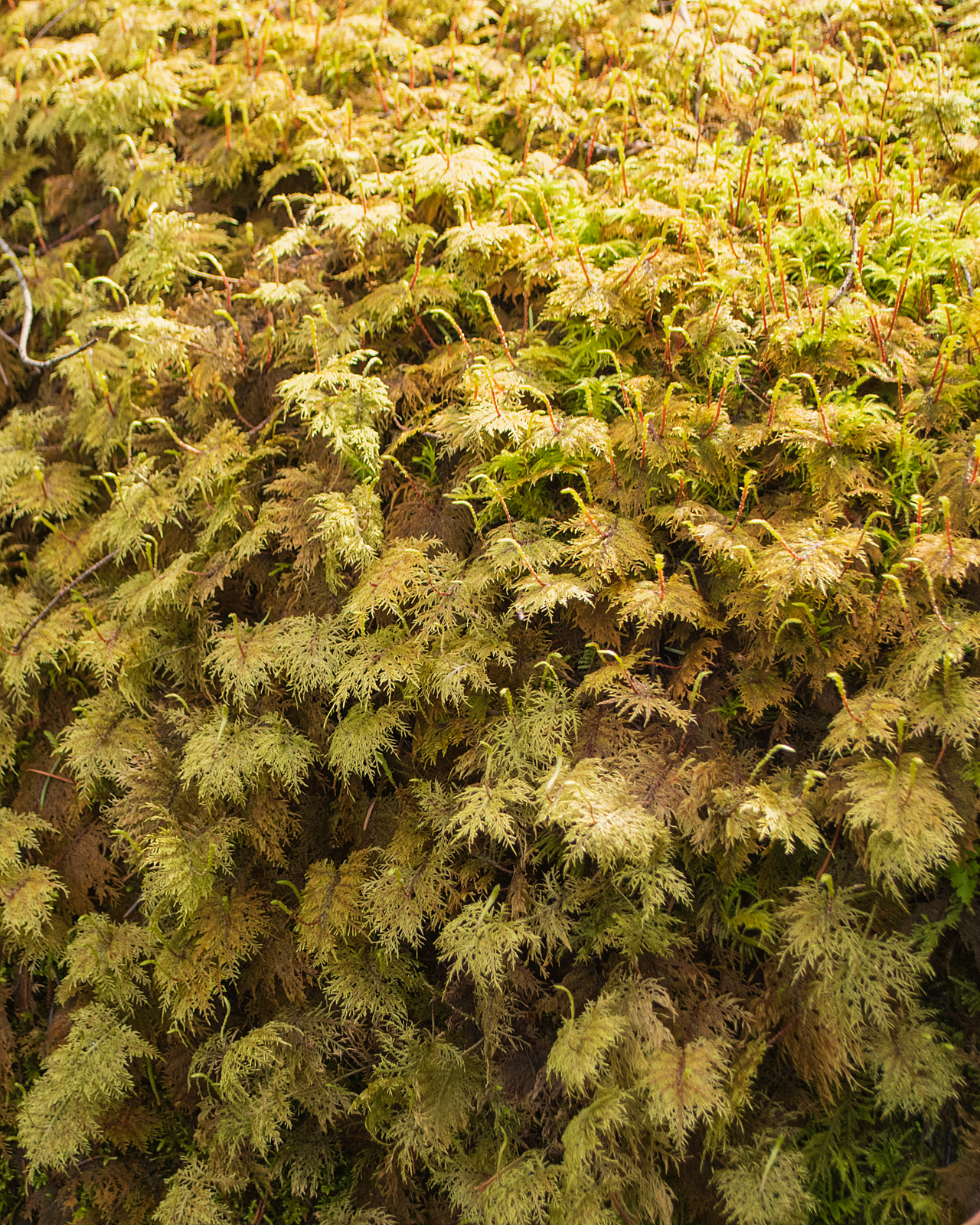
Step moss, Hylocomium splendens, with this year's new "steps" sprouting from the older leaves. Growing on rock.

I just noticed, in my guide book, that, "the age of step moss may be estimated by counting its annual "steps." I'll have to dig one out to try that. 

One of the bone lichens, I think.

Slugs love mushrooms. It looks like they've been feasting on these.

Fungi on the end of a cut log. Red-belted polypore and some unidentified dark brown ones.

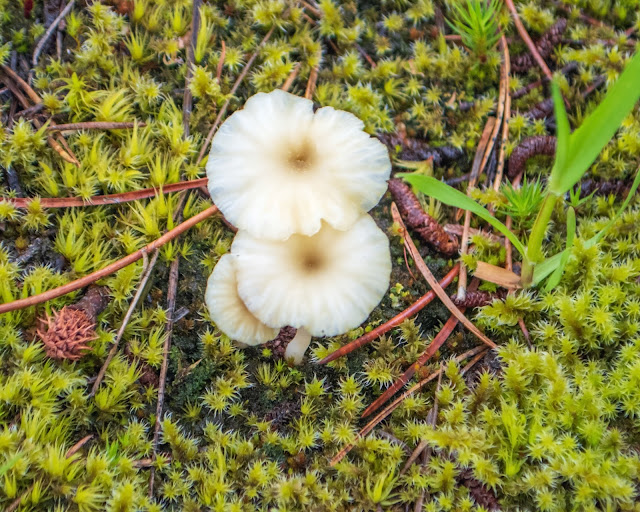
Lichen agaric mushrooms, Lichenomphalia umbellifera.

These mushrooms, with their always-associated green algae, grow on rotted wood. Here, on the rocky outcrop, they are growing on shreds of well-aged wood near the edge of the treed area.

~~~~~~~~~~~~~~~~~~~~~~
Después de un descanso corto, de vuelta estoy mirando lo que encontré en una caminata sobre las rocas cubiertas de musgo al lado del lago McIvor.

El clima de ese dia iba de lluvia a sol y de vuelta a lluvia. El musgo estaba empapado; caminar sobre las rocas se sentía como si vadeara en la playa. Pronto tenía los zapatos llenos de agua.

Foto: Un sendero poco marcado (tal vez un sendero de venados) sobre el afloramiento de rocas.

El "salal", Gaultheria shallon, crece bien en terreno rocoso. Y en los cerros donde el musgo se desliza bajo mis pies es un salvavidas. Los tallos son muy fuertes, las raices se adhieren bien a su sustrato. Yo agarro un tallo mientras bajo o subo; nunca me fallan, nunca se rompen. Los helechos de hoja perenne también sirven, si son frescos. La ramas de los árboles no tanto; a veces se rompen de repente; más de una vez he terminando bajando un declive sobre las espaldas. Pero nunca, si hay salal a la mano.

Foto: en el terreno plano al pie del cerro. El sol se cuela entre los troncos.

Foto #3: el musgo "de escaleras", Hylocomium splendens, con las nuevas hojas anuales saltando sobre las del año pasado.

Acabo de ver esto en mi libro guía: "La edad del musgo "step" se puede estimar contando los "escalones" anuales." Tendré que arrancar uno para ver esto.

Foto #4: Un liquen, tal vez uno de los líquenes "huesudos".

Foto #5: A las babosas les encanta la pulpa de los hongos. Se nota que aquí han estado cenando.

#6: Hongos en un troncón cortado. El poliporo de cinta roja, y unos que no pude identificar.

#7: Los honguitos de liquen, Lichenomphalia umbellifera. Estos, con su alga asociada, crecen sobre madera podrida. Aquí, entre las rocas, están establecidos en madera tan podrida que ha formado una capa ligera entre el musgo y la roca.

Tuesday, May 10, 2022

Rock sprinkles

On the west bank of McIvor Lake, a small lake, part of the complex of lakes where the Upper Campbell Lake breaks up, eventually emptying into the Campbell River, the terrain rises steeply, with large outcroppings of moss-covered rock. And the moss is sprinkled with tiny white flowers, of different species, but all tiny, all white.

One of the rock outcroppings

A section of the rock, with its fringe of flowers, top and bottom.

Getting closer; the line of flowers on the top.

And flowers near the base.

These flowers are similar, and I haven't been able to identify them, but notice the ripening pods, or siliques; the flowers at the top of the rock have long, erect siliques, and the lower ones have oval siliques.

There were others, much smaller, pinhead-size.

Google map of the lake complex.

~~~~~~~~~~~~~~~~~~~~~~~~~~~~~~~~~~
En la ribera al oeste del lago McIvor, que es un laguito que forma parte del complejo de lagos, donde el lago grande, Upper Campbell, se fragmenta, bajando hacia el rio Campbell, el terreno sube por grandes afloramientos de roca, todos cubiertos de musgo. Y ese musgo está salpicado con florecitas blancas, de varias especies, pero todas blancas, todas pequeñitas.

Fotos:
  1. Uno de esos afloramientos.
  2. Llegando a la cima se ve una roca con su círculo de flores, encima y al pie de la roca.
  3. Acercándonos aun más, mirando la hilera de flores encima de esa roca.
  4. Y un grupo de flores al pie de una roca.
Las flores se parecen entre sí, y no las he podido identificar. Pero fíjate en los frutos casi listos; estos se llaman silicuas. Las de las flores encima de la roca son largas; las de las otras tienen una forma ovalada.

Había también otras, más chicas aun, el tamaño de la cabeza de un alfiler.

Y una mapa del complejo de lagos, bajando al rio.


Wednesday, July 12, 2017

McIvor Lake

On a hot, hot weekend, what better place to be?

Hot sand, cool water.

Irrationally, I somehow feel guilty, just to be here, while the rest of BC burns.

McIvor Lake is really just the tail end of Campbell Lake.


Powered By Blogger