After a short break, I'm back looking at things found on the shore and mossy rock outcroppings beside McIvor Lake last week.
The weather was changeable, going from rain to watery sunshine back to rain. The moss was soaking wet; walking on it almost felt like wading. My shoes were soon full of water.
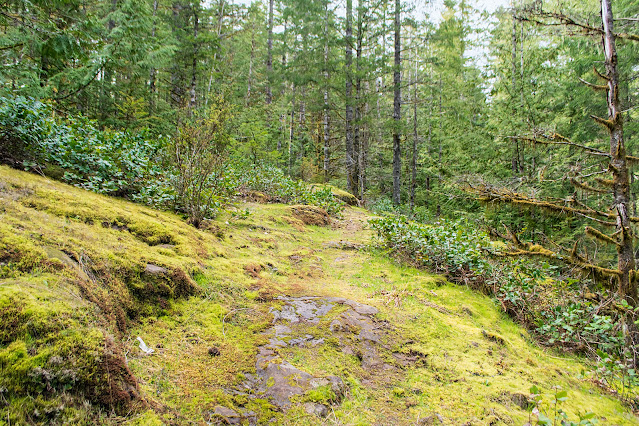 |
Sort of a trail crossing the rocks in the rain. Maybe a deer trail.
|
Salal grows well on rocky slopes. And on slippery hills, where the wet moss slides away under your feet, it's a life-saver. The stems are extremely strong, the roots grip the rock; I hold onto one as a support; they never give way, they never break. Fresh evergreen ferns are helpful, too. Tree branches are iffy; they do break suddenly; more than once I've ended up sliding down a slope on my back. Not when there's salal within reach.
 |
| Down on the flat, sunshine percolates through the trees. |
 |
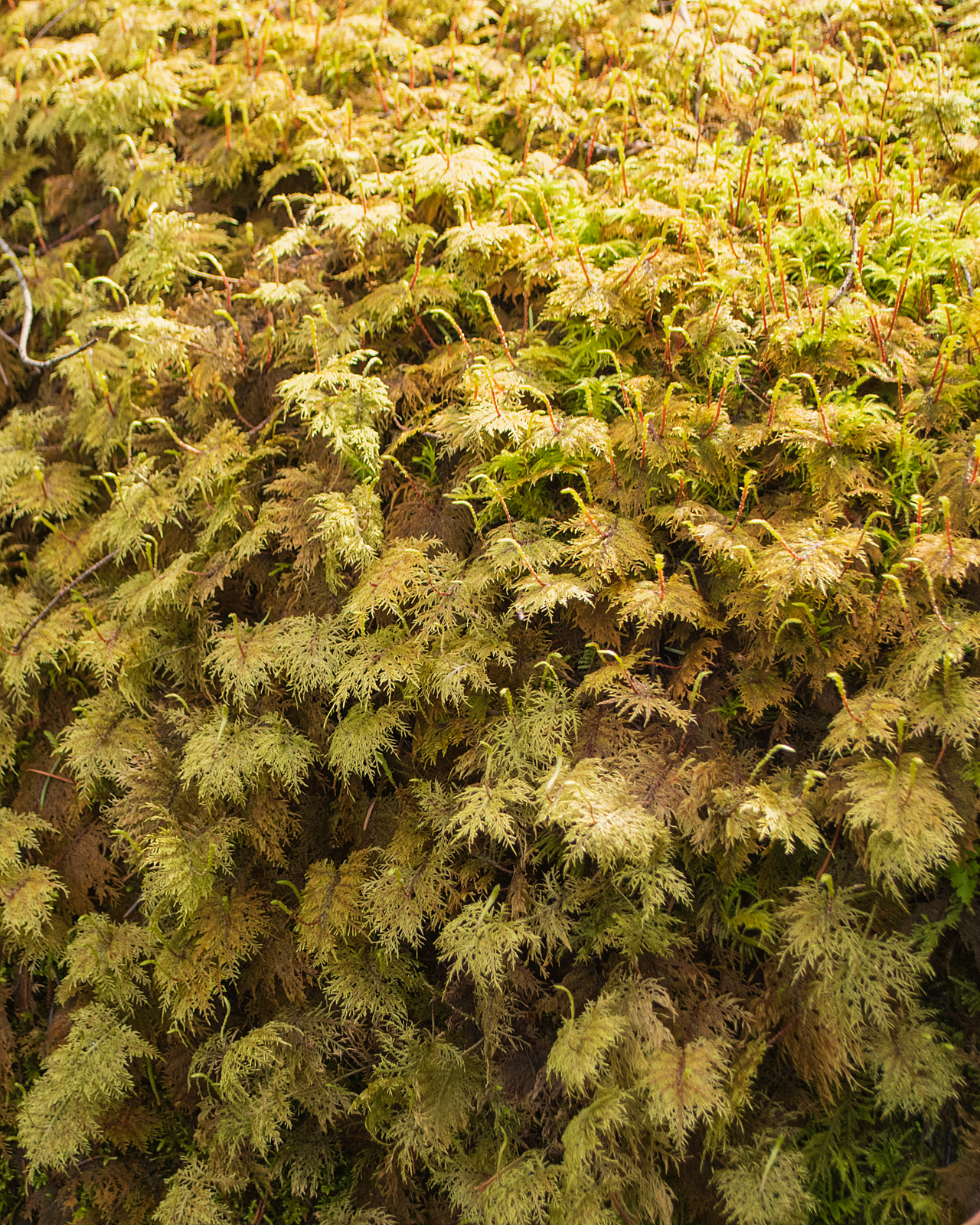
| Step moss, Hylocomium splendens, with this year's new "steps" sprouting from the older leaves. Growing on rock. |
I just noticed, in my
guide book, that, "the age of step moss may be estimated by counting its annual "steps." I'll have to dig one out to try that.
~~~~~~~~~~~~~~~~~~~~~~
Después de un descanso corto, de vuelta estoy mirando lo que encontré en una caminata sobre las rocas cubiertas de musgo al lado del lago McIvor.
El clima de ese dia iba de lluvia a sol y de vuelta a lluvia. El musgo estaba empapado; caminar sobre las rocas se sentía como si vadeara en la playa. Pronto tenía los zapatos llenos de agua.
Foto: Un sendero poco marcado (tal vez un sendero de venados) sobre el afloramiento de rocas.
El "salal", Gaultheria shallon, crece bien en terreno rocoso. Y en los cerros donde el musgo se desliza bajo mis pies es un salvavidas. Los tallos son muy fuertes, las raices se adhieren bien a su sustrato. Yo agarro un tallo mientras bajo o subo; nunca me fallan, nunca se rompen. Los helechos de hoja perenne también sirven, si son frescos. La ramas de los árboles no tanto; a veces se rompen de repente; más de una vez he terminando bajando un declive sobre las espaldas. Pero nunca, si hay salal a la mano.
Foto: en el terreno plano al pie del cerro. El sol se cuela entre los troncos.
Foto #3: el musgo "de escaleras", Hylocomium splendens, con las nuevas hojas anuales saltando sobre las del año pasado.
Acabo de ver esto en mi libro guía: "La edad del musgo "step" se puede estimar contando los "escalones" anuales." Tendré que arrancar uno para ver esto.
Foto #4: Un liquen, tal vez uno de los líquenes "huesudos".
Foto #5: A las babosas les encanta la pulpa de los hongos. Se nota que aquí han estado cenando.
#6: Hongos en un troncón cortado. El poliporo de cinta roja, y unos que no pude identificar.
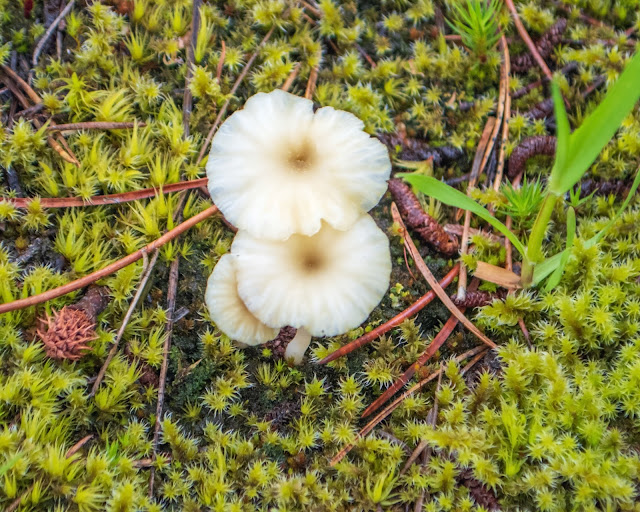
#7: Los honguitos de liquen, Lichenomphalia umbellifera. Estos, con su alga asociada, crecen sobre madera podrida. Aquí, entre las rocas, están establecidos en madera tan podrida que ha formado una capa ligera entre el musgo y la roca.