Showing posts with label rock outcropping. Show all posts

Monday, February 16, 2026

Meetup on the rocks

The story continues ...

This will be more about people and our pursuits than about the world around us. Or maybe not.

When I arrived at the bottom of the rock outcrop, I was surprised to find 5 pickups parked in "my" spot. I managed to squeeze my little car in between two of them. I figured that the owners must be down at the lake; early and cold for a picnic, but we're hardy folks; I've joined a happy crowd eating hot dogs and roasting marshmallows around a campfire in the pouring rain before.

But no. As I started up the trail, a man came down over the rock. Said good morning, smiled, took one of the trucks away. Looks like I'm not the only one fascinated by these mossy rocks.

I climbed to the very top of the rock; I'd stopped before a few metres lower down. And from the top, now, I  saw a narrow trail heading down behind the rock into the bush. A couple of dozen steps, then it turned and was hidden behind salal bushes. I had to check it out.

At the turn, I stopped. The trail led to a narrow break in the rock above, a steep gap filled with loose rocks, with water trickling down between them. After a rain, it would be a tiny waterfall. Climbable? Would those rocks slide underfoot? I wasn't sure.

Safer than it looks.

Then another man came over the top of the next rock, heading for that gap. I stood and watched while he negotiated the drop. Larger than I, heavier he was, (and younger, of course) but most of the rocks stayed put under his feet. Maybe I'd risk the climb.

"What's up there?" I asked him.

"Rocks, a trail goes off into the bush ..." He didn't offer any other information. He went on down the trail I'd followed.

I went up, holding onto salal and a sapling for support. Up above, there was another wide slope, smooth rock under its coat of moss. Water ran through the moss, just deep enough to leak into my shoes. I kept on going. So still, so green! On my right, more rocks loomed overhead.

Top of the third rock. But look closely. Do you see it?

A trail led off to left, down into the bush, but I went on up the slope, over the moss. Up and around another rock, higher up. Another, very faint trail appeared. Around and up, and there were more rocks to climb. But it looked like it was going to rain any minute; I turned and went back down. Another day, in a drier season.

Why is it, I've often wondered, that people find it so compelling to build driftwood shelters or even "rooms" on the beach? We're builders by nature, it seems. And here it shows up again; here at the top of these rocks, with very little material to work with, with no easy access to the chosen site, someone just had to make a roof.

Wouldn't keep out the rain.

Coming down, on the far side of the mossy slope (wouldn't want to miss something by taking the same route down), I heard voices overhead. Looked up; on top of another rock a group of kids and parents, several families' worth, were driving remote-controlled vehicles; trucks and jeeps, all-terrain "crawlers". They were climbing "impossible" rocks, struggling but conquering. I stood and watched for a while,  then went on down.

(Did you see the truck in the second photo above? Must have attempted a slope beyond its capabilities.)

The rocky gap going down was easier than I had thought. I had been worried about that; going down is always harder than climbing up. At least there were people there above me, in case I ran into trouble. But it was fine, only one stone moved underfoot, and the salal is tough.

I was below, picking up stones and examining them, when the crowd came down, driving their crawlers as they came. "Looks like a lot of fun," I said to one guy carrying his daughter's truck now that they were near the bottom.

"More fun than that!" he said.

As I got into my car, a few minutes later, the group, still busy arranging kids and crawlers in their pickups, waved at me. "Bye!" someone called. It started to rain as I reached the highway.

One more rock top.

I didn't know what to call these vehicles; bigger than kids' toys, tougher, versatile. I looked them up, and found a YouTube video. Fascinating! Go look! 

~~~~~~~~~~~~~

Sigue el relato ...

Esto tratará más de la gente y de nuestros pasatiempos que del mundo alrededor nuestro. O tal vez no.

Cuando llegué al pie de la roca en la ladera sobre el lago, me sorprendió encontrar 5 camionetas estacionados en "mi" lugar. Logré insertar mi cochecito entre dos de ellos. Creía que los dueños estarían allá abajo en la playa; es algo temprano, un poco frio para hacer picnic, pero somos aguantadores; recuerdo haber comido hot dogs y malvaviscos tostados con un grupo de gente feliz alrededor de una fogata durante una lluvia fuerte.

Pero no. Cuando entraba al sendero, un hombre bajaba desde la roca. Me saludó, sonrió, y se llevó una de las camionetas. Parece que no soy la única persona a quien le fascinan estas rocas cubiertas de musgo.

Subí esta vez a la cima de la roca; antes, me había detenido unos pocos metros más abajo. Y ahora, visible solamente desde la cima, apareció un senderito angosto que bajaba tras la roca, perdiéndose después de unos cuantos pasos entre los arbustos de salal. Tuve que investigar, claro.

Cuando llegué a la primera vuelta, me detuve. El sendero llevaba al pie de una roca con una brecha angosta, llena de piedras sueltas; un chorrito de agua bajaba entre las piedras. Después de una lluvia sería una catarata miniatura. ¿Se podría trepar sobre esas piedras? ¿No se moverían al pisarlas? No me daban confianza.

    1. Más seguro que lo que parece.

Otro hombre llegó, cruzando desde las rocas allá arriba; se dirigía hacia la brecha. Esperé mientras descendía. Estaba más grande, más pesado que yo, (más joven, también) pero casi todas las piedras se mantuvieron firmes bajo su peso. Tal vez me atrevería a subir.

"¿Qué hay allá arriba? le pregunté.

"Piedras. Un camino que entra al bosque ..." No ofreció más información. Bajó por el sendero por donde yo había venido.

Subí, sosteniéndome con unas ramas de salal y un arbolito. Arriba, había otra roca inclinada, roca lisa cubierta de musgo. Entre el musgo, agua corría; me llenó los zapatos. Seguí adelante. ¡Tan callado, tan verde!  A mi derecha, otras rocas formaban una pared alta.

    2. La tercera roca. Pero mira; ¿ves que más hay?

Un sendero se dirigía hacia la izquierda, bajando al bosque, pero yo seguí cruzando la roca, sobre el musgo. Subí, di la vuelta a otra roca, más alta. Apareció otro sendero, apenas marcado. Una vuelta más,  y otras rocas, subiendo, subiendo ... Pero parecía que iba a llover en cualquier momento; regresé, bajando. Será para otro dia, en una temporada más seca.

¿Porqué será, me he preguntado muchas veces, que la gente lo encuentra tan necesario construir estructuras, hasta "cabañitas" hechas de madera flotante en las playas? Parece que somos constuctores por naturaleza. Y aquí se ve otra vez; aquí sobre estas rocas, con tan poca madera a la mano, sin acceso fácil al sitio; sin embargo alguien a la fuerza decidió construirse un techo.

    3. Pero se le va a colar la lluvia.

Bajando, del lado opuesto del sitio (no hay que volver sobre la misma ruta; no sabes lo que puedes perder) oí voces allá arriba. Miré; encima de otra roca alta, un grupo de niños con sus padres, varias familias, operaban "crawlers", vehículos todoterreno controlados por radio. Camiones y "jeeps" subiendo y bajando sobre inclinaciones imposibles; con trabajos en las rocas más grandes, pero se las arreglaban. Me quedé observando por un rato, luego seguí con la bajada.

(¿Viste la camioneta en la segunda foto arriba? Habrá atentado subir algo demasiado inclinado.)

Bajar por la brecha no era tan difícil como había temido. Me estaba preocupando; siempre es más fácil subir que bajar. Por lo menos, con gente allá arriba, tendría ayuda si tuviera problemas. Pero todo estaba bien; una sola piedra se me arrimó, y el salal provee sostén seguro. Un arbusto bastante fuerte.

Estaba allá abajo, recogiendo y examinando piedras, cuando bajaron, con sus vehículos por adelante. "Parece ser muy divertido," le  dije a un hombre que cargaba la camioneta de su hija ahora que llegaban al pie del cerro.

"Más divertido que eso!" contestó.

Unos minutos más tarde, cuando me subía al coche, el grupo, todavía distribuyendo niños y vehículos entre las camionetas, me despidió con sonrisas y saludos de mano. Cuando llegaba a la carretera, empezó a llover.

    4. Otra roca.

No sabía como se llamarían estos vehículos; más grandes que juguetes de niños, más fuertes, flexibles. Los busqué y encontré un video de YouTube. ¡Fascinante! ¡Míralo! 

Sunday, February 15, 2026

Green fossils, black buttons

I had to go back.

Around the rock above McIvor Lake, lying scattered on the moss, loose on the surface, I found many stones; little broken slabs, flat pieces, as if they'd been chipped off the main rock. Winter weathering, maybe? Ice does that.

I picked up a few pieces. Greyish, greenish stone; one was full of raised  bubbles of whitish stone. Quartz.

As found, with a Douglas-fir cone for the size.

A closer look.

I brought this stone home and took photos of those bubbles.

Looks like a few have popped out. Maybe they're still in the original rock face.

Kitty sculpture?

The brown and green stone is soft, easily scratched with any metal. (I tried with an old copper coin: 3 on the Mohs Hardness Scale; steel is 5.5, diamond 10. I didn't try scratching it with a diamond; I don't have one.) The white bubbles wouldn't take a mark; quartz is 7 on the scale, harder than my steel file.

I've been digging into the green stone with my file; it comes up as a fine, green powder, soft to touch, not gritty. I posted photos to the Facebook group, Geology of Vancouver Island (So helpful!) and they tell me I have "fossils of a Calcareous Algae. It is quite common in the Cretaceous sandstones found on Vancouver Island." (Thank you!)

So I had to go back. To see if the whole inside of that huge rock was crumbly and bubbly and green. So I picked up and turned over dozens of other pieces. Some were green, some were crumbly, some had bubbles, some had squiggles. No two alike.

This one is brown and scratchable, but it has hard, green intrusions.

Whitish on one side, hard, and boring grey on the other, and full of white squiggles in the centre.

And there was more to see!

A black "button" lichen. Possibly  Sunken Button Lichen, Buellia spuria. Although there are several almost identical.

Zooming in.  A white lichen with black fruiting bodies. Black lines separate individual lichens.

And there was yet more. I'll leave that for tomorrow.

~~~~~~~~~~~~~~~~~~

Tuve que regresar.

Alrededor de la roca en la ladera arriba del lago McIvor, regadas dondequiera sobre el musgo, sueltas, encontré muchas piedras: piezas rotas, planas, que parecían haberse separados de la roca madre. ¿Por la acción del hielo, posiblemente? Suele romper rocas grandes.

Recogí algunas piedras. Eran de color gris, o casi verde; una estaba llena de burbujas blancas de otra piedra. Cuarzo.

    1. Como la encontré. Con un cono de abeto de Douglas para dar el tamaño.

    2. Acercándome.

Me traje esta piedra a casa para examinarla y sacar más fotos.

    3. Las "burbujas". Parece que algunas han dejado nada más el hueco donde estaban. Tal vez se encuentran todavía encrustadas en la roca madre.

    4. ¿Una escultura de un gatito?

La piedra de color café o verde se marca facilmente, raspándola con cualquier objeto metálico.  (Hice  la prueba con una moneda de cobre mexicana — 50c, 1997, 92% cobre —  que tiene un valor de 3 en la escala de Mohs; el acero es 5.5, el diamante 10. No la probé con un diamante, que no tengo.) Las "burbujas" blancas no se pudieron marcar, ni con una lija de acero (6). El cuarzo tiene un valor de 7.

He estado excavando la piedra verde con mi lija; produce un polvo fino, verde, suave al tacto, no arenoso. Subí fotos al grupo Facebook, Geology of Vancouver Island y me dicen que tengo "fósiles  de un Alga Calcárea. Es muy común en las piedras arenosas cretácicas que se hallan en la Isla Vancouver." (¡Muchas gracias!)

Así que tuve que regresar. Para ver si toda esa roca grande estaba friable y verde y llena de burbujas por dentro. Así que recojí docenas de otras piedritas.  Algunas verdes, algunas friables, algunas con burbujas, algunas con garabatos. No hay dos iguales.

    5. Esta es friable y de color café, pero incluye fragmentos duros, verdes.

    6. Blanquisco de un lado, duro y gris del otro, y con garabatos blancos en el centro.

¡Y había más!

    7.  Un liquen "botón" negro. Posiblemente sea el Botón Hundido, Buellia spuria. Pero hay varios casi idénticos.

    8. Zoom. Es un liquen blanco con cuerpos fructíferos negros. Lineas negras marcan las orillas de líquenes particulares.

Y todavía hay más. Pero eso lo dejo para mañana.


Tuesday, January 17, 2023

Painted by rain

On the way home from the beaver pond, I stopped in at a favourite summer sit spot.  A short distance off the highway, there's a faint trail going down to a wide rock outcropping covered, in summer, with dry, crunchy, brownish moss. A good place to sit in the sunshine, listening to the wind in the evergreens, watching the dragonflies zipping back and forth. There must be a creek, or a small pool, down there by the roots of the trees. In spots, where the rock is cracked, saskatoons and huckleberries grow. Single stems of grasses poke up through the moss, waving their heads. I sit until the sun starts to burn, then climb the hill again to the bustle and hurry of the highway and the town.

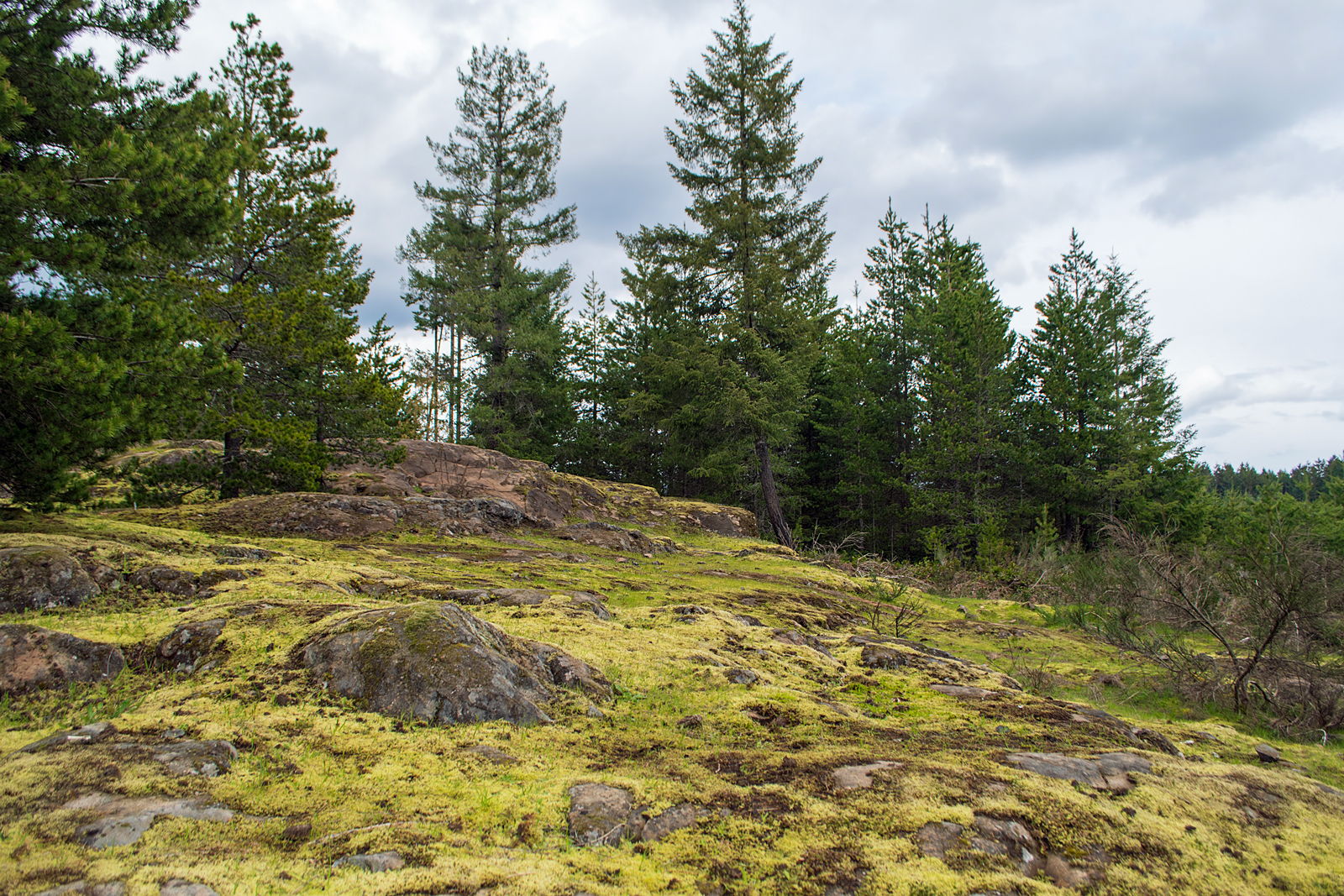
No sitting this time. After two weeks of rain, the moss is soaked; my shoes are soon wet. And now it has changed colour to a bright, almost neon yellow-green.

Top of the rock.

I was looking for mushrooms; all that rain surely must have encouraged them. And yes, I found them. They're all over, in that photo above, but so small they can't be seen at any distance. I had to get my knees wet to get photos.

4 mushrooms here. Do you see the fourth?

I stopped to take photos of lichen on a few stumps, but now it was raining again, and I was hurrying.

Lichens, mainly Cladonia sp., and moss.

On my way back up the hill, I turned to check out the weather; was that clear sky over there? Well, sort of.

Mostly grey, mostly wet.

Back at the highway a bit of the rock, where the road crews cut through to build the highway, shows how thin that layer of moss is. Just a layer of bright paint, a fingertip deep.

The rock is too solid, mostly, even here where construction has cracked it, for the trees to get a good footing.

The pale yellowish lines in the trees behind the rock are where the recent storms broke the trees, splitting the wood as the top fell.

~~~~~~~~~~~~~~~~~~~~~~~~~~~~~~~~~~~~~~~~`

En camino a casa después de visitar la laguna de los castores, me detuve en un sitio donde me acostumbro tomar el sol en el verano. A poca distancia de la carretera, hay un senderito, apenas marcado, que baja hasta un afloramiento rocoso cubierto, en el verano, con una capa de musgo seco, crujiente, de color café claro. Es un buen lugar para sentarme, allí en el sol, escuchando el murmullo de la brisa entre las ramas, mirando las libélulas que van y vienen; debe haber un riachuelo o un pocito de agua en el arroyo. En sitios donde la roca está agrietada, crecen los saskatún y los arándanos rojos (huckleberries). Tallos de gramíneas se erigen sobre el musgo, agitando sus cabezas. Yo me quedo sentada hasta que el sol me empieza a quemar, y luego subo el camino otra vez, hacia el apuro y ruido de la carretera y el pueblo.

No me pude sentar esta vez. Después de dos semanas de lluvia, el musgo está empapado; en poco tiempo mis zapatos también lo estaban. Y ahora el musgo ha cambiado de color; es un verde/amarillo fuerte, casi fluorescente.

Foto #1: Parte del afloramiento con su musgo amarillo.

Buscaba hongos; por cierto, con toda esa lluvia los debe haber. Y sí; en abundancia, pero tan pequeños que no se ven sin agacharse. Me tuve que mojar las rodillas para verlos de cerca.

Foto #2: Cuatro honguitos. ¿Puedes ver el cuarto?

#3: Me detuve a sacar fotos de troncos con líquenes, pero ya estaba lloviendo de nuevo, y me estaba apurando. Aquí, un tronco con líquenes, principalmente Cladonia spp. y musgos.

#4: Subiendo por el camino, me di vuelta para mirar el cielo: ¿iba a seguir lloviendo, o no? Había un poquitito de cielo azul.

#5: Al llegar a la carretera, hay un corte en la roca, hecha para pasar la carretera, y muestra cuan delgada es la capa de musgos. Un baño de pintura apenas, de la profundidad de la primera articulación de uno de mis dedos. La roca es tan sólida, aun aquí donde las constructoras de carreteras la rompieron, que los árboles todavía no han logrado establecerse. Las lineas amarillas entre los árboles atrás de la roca son troncos pelados donde las tormentas recientes los rompieron.


Tuesday, May 10, 2022

Rock sprinkles

On the west bank of McIvor Lake, a small lake, part of the complex of lakes where the Upper Campbell Lake breaks up, eventually emptying into the Campbell River, the terrain rises steeply, with large outcroppings of moss-covered rock. And the moss is sprinkled with tiny white flowers, of different species, but all tiny, all white.

One of the rock outcroppings

A section of the rock, with its fringe of flowers, top and bottom.

Getting closer; the line of flowers on the top.

And flowers near the base.

These flowers are similar, and I haven't been able to identify them, but notice the ripening pods, or siliques; the flowers at the top of the rock have long, erect siliques, and the lower ones have oval siliques.

There were others, much smaller, pinhead-size.

Google map of the lake complex.

~~~~~~~~~~~~~~~~~~~~~~~~~~~~~~~~~~
En la ribera al oeste del lago McIvor, que es un laguito que forma parte del complejo de lagos, donde el lago grande, Upper Campbell, se fragmenta, bajando hacia el rio Campbell, el terreno sube por grandes afloramientos de roca, todos cubiertos de musgo. Y ese musgo está salpicado con florecitas blancas, de varias especies, pero todas blancas, todas pequeñitas.

Fotos:
  1. Uno de esos afloramientos.
  2. Llegando a la cima se ve una roca con su círculo de flores, encima y al pie de la roca.
  3. Acercándonos aun más, mirando la hilera de flores encima de esa roca.
  4. Y un grupo de flores al pie de una roca.
Las flores se parecen entre sí, y no las he podido identificar. Pero fíjate en los frutos casi listos; estos se llaman silicuas. Las de las flores encima de la roca son largas; las de las otras tienen una forma ovalada.

Había también otras, más chicas aun, el tamaño de la cabeza de un alfiler.

Y una mapa del complejo de lagos, bajando al rio.


Powered By Blogger