Showing posts with label bufflehead. Show all posts

Tuesday, March 31, 2026

In the woods, on the water, in the grass

Birds everywhere! Saturday, I walked down Baikie Island, then stopped in briefly at Brown's Bay. So many birds out enjoying the sunshine! Yesterday, Tyee Spit; more birds. Here's the first installment.

Chestnut-backed chickadee, Poecile rufescens. This is the only chickadee found on the island.

Canada geese and a mallard couple resting in a backwater.

Mallard male and Bufflehead female.

More Canada geese, at Brown's Bay.

Distant bufflehead female. The females are recognizable, even at a distance, by the white cheek spot. (Goldeneye males have one, too, but they're larger and dramatically coloured.)

Common merganser couple, Brown's Bay.

Robin, Brown's Bay.

And a shy Song Sparrow. Tyee Spit.

I missed a couple of Towhees hopping through the understory, too fast for me, some juncos ... Other birds tomorrow.

~~~~~~~~~~~~~

¡Pájaros por todas partes! El sábado, di la vuelta a la isla Baikie, y luego pasé por Brown's Bay. ¡Tantos pájaros había, disfrutando de los rayos solares! Y ayer, fui a Tyee Spit, donde vi otros tantos. Estos son algunos de ellos.

  1. Carbonero dorsicastaño, Poecile rufescens. Este es el único carbonero que se encuentra en la isla Vancouver.
  2. Gansos canadienses, Branta canadensis, y una pareja de patos ánades,  Anas platyrhynchos.
  3. Un pato ánade macho, y una porrón coronado, Bucephala albeola, hembra.
  4. Otros gansos canadienses, en Brown's Bay.
  5. Una Bucephala albeola hembra. Las hembras se pueden distinguir facilmente, aun a una distancia, por el círculo blanco que tienen en el cachete. (Los machos de las especies Bucephala islandica y B. clangula también tienen manchas blancas en la cara, pero estos pájaros son más grandes y sus colores son algo dramáticos.)
  6. Una pareja de serretas grandes, Merus merganser. Brown's Bay.
  7. Petirrojo, Brown's Bay.
  8. Y un gorrión cantor, Melospiza melodia. Tyee Spit.
Se me escaparon unos toquíes y juncos que saltaban en el sotobosque. Y para mañana, hay otros pájaros.

Sunday, January 04, 2026

While it was still 2025

Last morning of the year, on the estuary. Just birds, the mallards sleeping while the tide is high, the rest busy diving for eats.

Mallards and green-winged teals.

A female mallard. The rumpled water is where a teal just went under to grab a bite.

Another sleepy mallard.

Buffleheads. Active divers after anything that moves underwater.

In the distance, a pair of cormorants, fishing. They spent as much or more time underwater as on the surface. And a little Goldeneye; she will roll over stones underwater to find her prey.

One more post in the offing for 2025, then, finally, 2026, with today's skies and elk.

~~~~~~~~~~~~
Fue la última mañana del año 2025; en el estuario, las aves acuáticas se ocupaban según sus costumbres; los patos ánades durmiendo durante la marea alta, las demás buscando su desayuno sumergido.
  1. Ánades reales y Cercetas comunes.
  2. Una ánade real hembra. el agua agitada es donde una cerceta se acaba de sumergir buscando algún invertebrado acuático o un bocado de hierba.
  3. Otra ánade real dormida.
  4. Porrones coronados. Buceadores muy activos; comen cualquier cosa que se mueve debajo del agua.
  5. Y algo lejos, una pareja de cormoranes pescando. Pasaban tanto tiempo sumergidos que en la superficie. Y una pequeña Porrón hembra (Bucephala sp.); estos pájaros buceadores voltean piedritas en el fondo, buscando invertebrados.
Me queda un grupo de fotos de 2025, y luego, por fin, empiezo el año 2026 con vistas del cielo de hoy y algunos alces.


Monday, February 24, 2025

Rocks, river, duck

That said, this island surrounds me with beauty; so healing!. Here, views seen in a brief stop while I was looking for lichens along the river bank; the exit from the narrow gorge:

Campbell River, coming out into the open. With bufflehead. The sign reads, "Warning", and then (unreadable from here) a notice about a siren announcing sudden volume changes. The flow can go quickly from a usual 80 cubic metres per second to 128 m³/s. Retreat to higher ground!

A wider view, with the Canyonview bridge far above. A long staircase leads up the hill to cross it and access a trail going along the far side of the river.

Ghostly trees on the far side of the river at this point. Red alders, bearing their spring-blooming brownish pink catkins and last winter's cones.

And I climbed those stairs again. Views from up top, tomorrow.

~~~~~~~~~~~
Esta isla me rodea de belleza. Esto es lo que vi cuando me detuve un momento durante una búsqueda de líquenes cerca del rio.
  1. El rio Campbell sale del cañón. Con un porrón coronado. El letrero lee —AVISO — y luego (esto apenas se puede leer a esta distancia) una advertencia; el corriente puede aumentarse súbitamente, pasando del acostumbrado 80 metros cúbicos por segundo a unos 128 m³/s en poco tiempo. ¡Retírense a un sitio fuera de su alcance!
  2. Una vista más amplia, incluyendo el puente "Vista del Cañón". Una escalera larga sube por la ladera a la izquierda, para cruzar el puente y seguir un sendero que sube el cerro al otro lado del rio.
  3. Árboles blanqueados al lado opuesto del rio. Son alisos rojos, y llevan los amentos de esta primavera, color café con tonos de rosa, y algunos de las piñitas del año pasado.
Y luego subí la escalera. La vista desde arriba, la dejo para mañana.


Tuesday, January 07, 2025

Buffleheads. Just buffleheads.

On an afternoon painted in greys and blacks, a few buffleheads carry out the theme. On the water surrounding Baikie Island.

Making circles.

Double header

These are females: the males have a large white patch on the back of the head, a white body, and large white patches on the black wings. The female's wing patch is just a small square.

Another two, getting airborne.

Running on water

Single white patches on the wings identify them as females.

Two and their reflections.

~~~~~~~~~~~~~~
En una tarde pintada en tonos de gris y negro, estos patos moñudos (porrones coronados, Bucephala albeola) siguen con el programa.
  1. Dos hembras, haciendo círculos en el agua.
  2. Una sola, reflejada. Estas son hembras; los machos tienen un gran parche blanco en la zona posterior de la cabeza; el cuerpo es blanco, y tienen grandes zonas blancas en las alas negras. La zona blanca en las alas de la hembra es una marca pequeña.
  3. Otra hembra, corriendo en el agua durante el despegue.
  4. Despegadas.
  5. Dos hembras volando, y sus reflejos.


Wednesday, January 24, 2024

Shades of grey. And red.

 It was one of our trademark grey days; the sky and the water light greys, the colours leached out of everything else. I went to Baikie Island, thinking there may have been still some snow on the ground to add a bit of light, but it had all melted into the layer of soggy leaves.

Grey, grey, grey. With hints of brown, and then ...

View from the bridge to the island.

Bufflehead female, making waves.

Alder branches bearing catkins made a tracery of black against the grey sky. From a metre or two away, though, their reds were visible; a promise of pink masses lining the shores. Soon.

Red alder catkins. Even the new stems and buds are red.

~~~~~~~~~~~~~~
Era uno de esos dias grises, tan comunes en la isla; el cielo y el agua pintados de gris claro, los colores de todo lo demás perdidos. Fui a la isla Baikie, pensando que tal vez habría todavía algo de nieve en el suelo, para reflejar un poco de luz, pero toda la nieve se había derretido, mezclándose con la capa de hojas viejas y empapadas.

Gris, gris, gris. Con algunos recuerdos de café oscuro. Y luego ...

  1. Vista desde el puente que da a la isla.
  2. Un porrón coronado hembra, creando olas.
  3. Y los alisos rojos hacían un encaje de ramas negras contra el gris del cielo. Pero de cerca, desde una distancia de uno o dos metros, se distinguía el color rojo de sus candelillas, una promesa de nubes color de rosa que cubrirán los bordes de los rios y carreteras en pocas semanas. Hasta los tallos y botones nuevos son rojos.

Sunday, January 07, 2024

On a winter beach

The north end of Miracle Beach, where it joins the outlet of Black Creek, is mostly flat, fine sand and small, rounded stones, held down by seashore salt-grass, suited to the changeable water, now fresh as the creek washes the area, now salt as the tide covers it all. At low tide, there are the tufts of salt-grass to walk on, with shallow puddles between them, and, near the high tide line, a layer of shredded seaweeds, fresh and bright, deposited by the recent storms.

A large kelp crab. Dead, not a molt, but still very fresh.

Sieve kelp, Agarum clathratum.

This is a subtidal brown alga that grows to over a metre tall, blade and stipe. By the time it ends up on the upper beach, it comes in bits and pieces. This large section included a bit of the central rib.

Turkish towel, Chondracanthus exasperatus. Very faded already.

Another large, subtidal seaweed that turns up on the beach in shreds. Feels like a towel, they say, but it is not a fabric-softened towel fresh out of your dryer; more like the dish scrubber I use on pots and pans. Those little pointed projections are tough.

Gull and salt-grass, Distichlis spicata.

And these weren't strictly on the beach, but just offshore, diving for food in the shallow water.

Buffleheads, Bucephala albeola, three males and one more subdued female.

Buffleheads eat aquatic invertebrates that they find in the intertidal zone, such as crabs and snails, so they swim close to shore, taking short dives; where you saw them go down, they'll come up again. (Not like the loon, offshore, going down here, coming up a long time later, and far away.)

~~~~~~~~~~~~~~
El extremo norte de Miracle Beach, donde se une al estuario de Black Creek, es una playa aplanada, de arenas finas y piedritas redondeadas, todo fijado en su lugar por las hierbas halófilas Distichlis spicata, adaptadas a la salinidad variable, ahora agua fresca cuando las cubre el rio, ahora en agua salada cuando sube la marea. A marea baja, se puede caminar allí, pisando los montoncitos de grama salada; alrededor, el agua llega a unos pocos centímetros de profundidad. En la zona más alta, hay una capa de algas marinas deshechas, arrancadas de sus sitios en el fondo y depositadas aquí por las tempestades de invierno.

Fotos:
  1. Cangrejo de algas del norte, Pugettia producta. Muerto pero recientemente, totalmente entero.
  2. Quelpo coladera, Agarum clathratum. Este es un alga que crece en la zona submareal. Llega a alcanzar más de un metro, contando el estipe y las frondas. Ya cuando llega a la playa, está desbaratada. Este pedazo grande llevaba algo de la espina central.
  3. Toalla turca, Chondracanthus exasperatus, ya perdiendo su color rojo fuerte. Esta es otra alga submareal que llega a la playa hecha pedazos. Se siente como una toalla, dicen, pero no es una toalla suave, recién salida de tu secadora de ropa; más bien es como el estropajo con que limpio los sartenes. Esos puntitos son fuertes.
  4. Una gaviota y la grama salada.
  5. Y estos últimos no estaban exactamente en la playa, pero cerca. Los patos porrones coronados (aquí tres machos, y una hembra) comen animales invertebrados que viven en la zona intermareal, como por ejemplo, los cangrejos y los caracoles marinos. Nadan cerca de la playa, haciendo buceos cortos; donde los viste desaparecer, allí subirán a la superficie y muy pronto. (No como lo hacen los colimbos, que se sumergen lejos de la playa, y luego aparecen mucho más tarde y bien lejos, donde menos los esperas.)


Thursday, April 06, 2023

Little ducks all in a row

 Fourteen buffleheads:

Five males, with their nine female followers.

And nine buffleheads:

10 seconds later.

And next, there were none. But patience is the key; soon they all popped up, one after the other. And then went down again. Up, and down again.

And all the while, they stayed in line, and the line advanced, straight as an arrow heading for the entrance to the lagoon. Underwater or on top of it, the speed never slacked, their approximate relative positions held true, a white-crowned male in front (not seen in the second photo; he's underwater), 4 little females bringing up the rear.

~~~~~~~~~~~~~~~~
Catorce porrones coronados:
Fotos:
  1. Los catorce; cinco porrones machos, y nueve seguidoras.
  2. 10 segundos más tarde, hay nueve.
Y después de unos segundos, no había ni uno. Pero, ¡paciencia! En un minuto, todos aparecieron de nuevo, uno tras otro. Y luego se sumergieron otra vez. Y subieron a la superficie. Y luego desaparecieron, y asi iban.

Y siempre se mantuvieron en fila, y el desfile avanzaba, derecho como una flecha, apuntada hacia la boca de la laguna. Estuvieran bajo el agua o encima, no cambiaba su velocidad, y sus lugares en la fila se preservaban, con un macho con su corona blanca en frente, — no se ve en la segunda foto porque está sumergido — y cuatro hembras en la cola.


Thursday, December 01, 2022

When the rain stopped

 A couple more photos from Lake Hoomak. Just because I liked them.

Mist and reflections and a lone bufflehead drawing a V on still water.

Raindrops on branches.

~~~~~~~~~~~~~~~~~~~~~~~
Dos más fotos del lago Hoomak, cuando no llovía. No más porque me gustan. Neblina, reflejos, un porrón coronado pintando lineas en agua tranquila, gotas de lluvia en ramas casi sin hojas.


Friday, March 25, 2022

Bouncing birds

A mixed flock of waterfowl were diving off-shore among choppy waves. The main flock was harlequin ducks; a bit beyond them buffleheads and  common mergansers and a few mallards joined in the fun. As long as I stayed still, sitting on a rock well back, they came in close to the shore, where the low tide left their favourite morsels close to the surface.

Harlequin ducks. The males are the bright coloured ones.

A harlequin pair, taking a break.

Common mergansers. The female is brown, the male showy.

As seen by the big camera, which doesn't zoom well.

The buffleheads were too bouncy, too fast; the only photo I kept of them went instead to "The Worst Bird Photographs Ever" on Facebook.

~~~~~~~~~~~~~~~~~~~~~~~~~~~~~~

Una bandada mixta de pájaros buceadores nadaban cerca de la playa entre olas agitadas. En su mayoría eran patos arlequines; un poco mar adentro les acompañaban porrones coronados y serretas grandes. Por un rato, algunos patos de collar se les arrimaron. Mientras que yo me quedaba quieta sentada en una roca a alguna distancia, se acercaban a bucear donde la marea baja dejaba expuestos sus bocados favoritos.

Fotos: patos arlequines, y (foto # 3) serretas grandes. Los porrones brincaban sobre las alas demasiado; la única foto que guardé de ellos, la mandé al grupo en Facebook dedicado a "Los Peores Fotos de Pájaros "


Wednesday, February 09, 2022

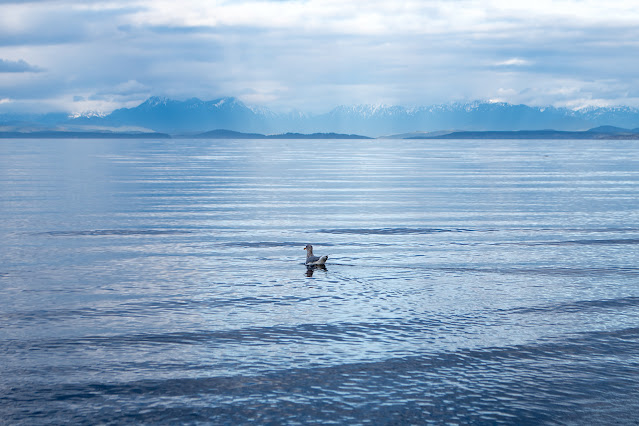
Calm in pale blues

 Calm, bright water, and a few birds:

Light falling from the clouds

A couple of buffleheads, caught between dives.

Male bufflehead and his harem?

Mini-waves, ankle-deep to a gull.

Gull on stripy water.

~~~~~~~~~~~~~~~~~~~~~~~~~~~~

El agua era tranquilo, de azul claro, la luz brillante. Y había algunos pájaros.

Fotos:
  1. Una gaviota y luz que cae desde las nubes
  2. Una pareja de porrones coronados (Bucephala albeola)
  3. ¿Un porrón coronado macho y su harén?
  4. Una gaviota con alas que apenas le llegan al tobillo.
  5. Una gaviota en agua rayada.

Wednesday, March 01, 2017

Groupies and a murder

This flock of buffleheads was fishing in the Baikie Island lagoon. I took several photos, from different vantage points; in each one, almost all of the females were following along in the wake of the lone male.

Popular guy.

And overhead, there was a minor murder.

About one tenth of the murder, heading west for the evening. As they do.

These were crows; even if I hadn't seen them, their voices were clear. "Caw, caw, caw, caw!" But in the photo, with the afternoon sunlight shining sideways on them, they gleam, so that they look partly white.

Sunday, January 15, 2017

Distant birds

Birds are warm-bodied. Warmer than we are; the average temperature of a bird is around 40 degrees Celsius (105 Fahrenheit). Ours is around 37.

So, while I'm shivering on the beach, bundled up in layers and fleeces, double socks and gloves, I marvel at them, resting placidly in icy water, sleeping or chattering among themselves, as if the water around them weren't 40 degrees colder than their bare feet.

That's a trick even better than flying!

Looks warm. It isn't.

A small flock of wigeons

Wigeons, goldeneyes, and buffleheads, mostly in pairs.

Black-bellied plover, non-breeding plumage. I think. I like their fan tails. (Click for full size.)

I tracked this small flock down the beach. Each time I got within range, they lifted off and moved a few hundred metres further along the shore. And when I got to this point, I didn't even see the second flock, which waited until I reached the logs to startle me by taking off in a great hurry.

An earlier photo. One peep, not one of the flock, slightly fatter, sat on the rock until all the rest of the birds were well away. Mitlenatch Island gleams in the background; the sun seems to hit it more than it does us.


Tuesday, November 22, 2016

Ducks in the distance

I must confess; sometimes, briefly, I envy those people down on the shore with their foot-long (or more) lenses attached to their cameras, and their sturdy tripods to hold up those lenses, too heavy for human hands. Because they can point that equipment at a bird that we can all barely see, press the shutter button, and record the gleam in the bird's eye, while I'm still squinting into the light, wondering if that circle on the water was made by a diving duck or a loon.

Briefly. Then I look at the lenses: heavy. And the tripods: heavy and awkward. And am glad that I can be more flexible, and that my back doesn't ache, even if my birds are dots on the slough.

Woodhus Slough, with buffleheads and mallards.

Bufflehead female, off Tyee Spit, with tree shadows.

Coming closer: Barrow's Goldeneye female, by Tyee Spit airplane dock.

A few minutes after I saw the Goldeneye, I was on my knees at an old log, taking photos of lichen and miniature polypores. Do that with your foot-long lens, will you?

Powered By Blogger