Showing posts with label cormorants. Show all posts

Sunday, January 04, 2026

While it was still 2025

Last morning of the year, on the estuary. Just birds, the mallards sleeping while the tide is high, the rest busy diving for eats.

Mallards and green-winged teals.

A female mallard. The rumpled water is where a teal just went under to grab a bite.

Another sleepy mallard.

Buffleheads. Active divers after anything that moves underwater.

In the distance, a pair of cormorants, fishing. They spent as much or more time underwater as on the surface. And a little Goldeneye; she will roll over stones underwater to find her prey.

One more post in the offing for 2025, then, finally, 2026, with today's skies and elk.

~~~~~~~~~~~~
Fue la última mañana del año 2025; en el estuario, las aves acuáticas se ocupaban según sus costumbres; los patos ánades durmiendo durante la marea alta, las demás buscando su desayuno sumergido.
  1. Ánades reales y Cercetas comunes.
  2. Una ánade real hembra. el agua agitada es donde una cerceta se acaba de sumergir buscando algún invertebrado acuático o un bocado de hierba.
  3. Otra ánade real dormida.
  4. Porrones coronados. Buceadores muy activos; comen cualquier cosa que se mueve debajo del agua.
  5. Y algo lejos, una pareja de cormoranes pescando. Pasaban tanto tiempo sumergidos que en la superficie. Y una pequeña Porrón hembra (Bucephala sp.); estos pájaros buceadores voltean piedritas en el fondo, buscando invertebrados.
Me queda un grupo de fotos de 2025, y luego, por fin, empiezo el año 2026 con vistas del cielo de hoy y algunos alces.


Wednesday, June 25, 2025

Quiet afternoon on the Spit

20°C. A pleasant change from the heat. The afternoon sky was overcast; a droplet of rain fell at intervals, a warning; don't go too far without protection for the camera. I risked it, and did the circuit of Tyee Spit, jacket-free.

Light over the island. Looking beyond the estuary to the town.

From the bird blind, I watched a long while. There were no mallards; the females are probably in the grass on the far side, tending their broods, while the males are in exile until their molted feathers grow in; wouldn't want to be seen without those glorious green and purple heads! Overhead, swallows darted about, eating mosquitos, I hope. An eagle flew by, a few crows.

The tide was coming in smoothly, with no wind, the water, in the shallows of the estuary, was smooth, mirroring the shore grasses. In deeper water, many fish were jumping, creating small circles, overlapping circles. I stood with elbows supported on the rails, finger on the shutter button, trying to catch a fish in the air. Got one!

Still water, and a jumping fish.

Looking the other way, the light was better for seeing fish. They were all small; rainbow trout, I think. I was surprised not to see any seals out fishing; maybe that's why the fish were celebrating.

Two jumpers imported from two other photos. One caught completely out of the water.

On the far side of the spit, out in the salt chuck, a flock of harlequin ducks were diving for goodies.

21 ducks, 10 male, 11 females. One, at least, was underwater.

And further down the spit, on an old half-sunken tank that the cormorants have claimed as their own, there was this mass of black bird flesh:

Why do they all sit in such un-birdy positions? And all jammed together? I count 20; hard to tell.

The rain held off until I got home and got out the hose to water my garden.

A Skywatch post.

~~~~~~~~~~~~~~~
20°C. Un cambio agradable, sin el calor del fin de semana. El cielo estaba nublada, y de vez en cuando caía una gotita solitaria de lluvia, una advertencia: no salgas sin llevar alguna protección para la cámara. Me arriesgué y le di la vuelta de la lengua de tierra Tyee, sin chaqueta.

Desde el puesto para observación de aves, me quedé mirando un buen tiempo. No había ningún pato ánade; las hembras probablemente están escondidas entre la hieba al otro lado del estuario, cuidando su cría, y los machos están exiliados hasta que las plumas que perdieron en la muda anual vuelven a crecer; ¡no querrán aparecer en público sin esas cabezas brillantes, verdes y púrpuras! En el cielo, las golondrinas volaban, comiendo mosquitos. Vi un águila, unos cuantos cuervos.

Venía subiendo la marea, sin ondular la superficie, y el agua cerca de las orillas parecía espejo. Más hacia el centro del estuario, saltaban gran cantidad de pececitos, dibujando círculos de olas pequeñas que se cruzaban. Me detuve con los codos sostenidos firmes sobre el pasamanos, con el dedo en el obturador de la cámara, tratando de capturar un pez fuera del agua. Lo logré, pero salió como una mancha blanca.

Mirando en dirección opuesta, la luz era mejor, y salieron algunas fotos con peces visibles. Todos eran chiquitos. Creo que son truchas. Me sorprendió no ver ninguna foca tras los pescados; puede ser por eso que las truchas estaban jugando.

Del lado opuesto de la lengua de tierra, en agua salada, agua de mar, una bandada de pato arlequines buceaban, buscando su cena. Y más adelante, en un tanque viejo, medio hundido, que los cormoranes han tomado como propiedad privada, se veía una cantidad de bultos emplumados negros.

  1. Viendo hacia el lado opuesto del estuario. Hasta ahora, nubes sin lluvia.
  2. Aguas quietas y un pececito saltando.
  3. Varios peces, dos importados desde otras fotos. Capturé uno completamente fuera del agua.
  4. Patos arlequín, y el salpicón donde hace un instante hubo otro pato.
  5. 21 patos, 10 machos, 11 hembras. Hay por lo menos uno más bajo la superficie.
  6. Tanque con los cormoranes. ¿Porqué tienen que tomar posturas tan torcidas?  Creo que hay 20 cormoranes.
No empezó a llover hasta que llegué a casa y saqué la manguera para regar el jardín.

Un post de Skywatch.

Thursday, December 19, 2024

Almost looks summery

 It stopped raining. The sun came out. The clouds overhead evaporated. Amazing!

I went to walk along the shore near our Big Rock.

Big Rock, little rocks.

Big Rock is a boulder 10 metres high. I searched for a weight, couldn't find even an estimate, so I calculated my own, rounding off numbers; counting it as a sphere 30 ft. in diameter, probably granite (175 pounds per cu. ft.) gives me 6,3000,000 pounds, or 3,150 tons. Or about 3,000 little cars like mine.

Cell phone photo. Tip of Quadra Island.

Looking south to Willow Point.

This is a newly-"improved" (paved, fenced) walk along the central shoreline of Campbell River. Two new additions were these driftwood birds on their nests.

Loon. I don't know who built it.

Spiky eagle.

Real, live birds were not so co-operative, and mostly far away.

Harlequin ducks, two males, one female.

And Cormorant Rock. Their usual perching place, well off-shore.

Oh, and it's raining again.

A Skywatch post.

~~~~~~~~~~~~~~
Dejó de llover. Salió el sol. Las nubes se evaporaron. ¡Maravilla!

Fui a caminar en el paseo cerca de nuestra Roca Grande.
  1. La roca, mirando hacia el sur, sobre el Estrecho de Georgia. La nombrada Roca Grande, un bloque errático glacial, mide 10 metros de altura (o diámetro, también). Se me ocurrió preguntar cuanto pesa, pero no pude hallar ni un peso aproximado. Hice mis propios cálculos: contándola como una esfera de 30 pies (porque la densidad me la dieron en estas medidas) de diámetro, probablemente de roca granítica, que pesa 175 libras por pie cuadrado, lo que me da 6.300.000 libras, o 3.150 toneladas. O el equivalente de unos 3.000 ejemplares de mi cochecito.
  2. Foto por la celular; la isla Quadra.
  3. Willow Point, hacia el sur.
  4. Este paseo lo han "mejorado" recientemente, pavimentándolo, erigiendo bardas. Añadieron dos esculturas hechas de madera flotante. Este colimbo cuida su nido, también hecho de madera y cuerdas de los barcos pesqueros.
  5. Una águila de madera flotante. No pude encontrar el nombre del creador.
  6. Los pájaros vivos todos estaban muy lejos de la playa. Estos son patos arlequines; dos machos y una hembra.
  7. Y los cormoranes en la roca donde pasan los dias.
Y está lloviendo otra vez. Como era de esperar.

Un poste de Skywatch.

Tuesday, May 28, 2024

Good enough

The sun came out. I decided to go down to Tyee Spit, see what's blooming now, look for birds in the estuary, find new mushrooms in the grass, but I had a couple of errands to run first. And then the rain came pelting down, great, fat drops on my windshield. BC weather! So I came home and looked up leftover photos of the Spit instead.

Turbine Otter coming in for a landing in the estuary. Another misty day, August, 2016. 

The grassy tip of the Spit. March 30, this year. I deleted a couple of walkers.

Looking north towards the entrance to Seymour Narrows. Last December.

A pair of cormorants, January, this year.

Forecast for tomorrow: rain. What else?

Skywatch post.

~~~~~~~~~~~~~~
Salió el sol. Decidí ir a Tyee Spit, para ver que flores están abiertas ahora, para mirar los pájaros que nadan y vuelan sobre el estuario, para buscar honguitos en el césped. Pero tenía unos mandados que hacer primero, y hecho esto, empezó a llover, grandes gotas gordas bombardeando mi parabrisas. ¡Este clima isleño! Total, regresé a casa y busqué el sitio entre mis fotos olvidadas.
  1. Una avioneta "Otter Turbine", al punto de hacer contacto en el estuario. Agosto de 2016.
  2. El césped donde busco hongos. Borré un par de caminantes de la foto. 30 de marzo, de este año.
  3. Mirando hacia el norte y la entrada de Seymour Narrows (el Estrecho de Seymour). Diciembre, 2023.
  4. Un par de cormoranes. Enero, 2024.
El pronóstico para mañana: lluvia, claro.

Un post de Skywatch: Haz clic para ver cielos de esta semana alrededor del globo.

Friday, January 05, 2024

Not a duck in sight

 So that's what they did before we strung electric wires for them.

I had always thought that these birds, barely seen as smudges on the rocks with my naked eye, were ducks. The camera, with my new lens, revealed them to be pigeons. At low tide, these rocks are high and dry, and the pigeons are elsewhere. On wires, of course.

Pigeons at high tide, catching a few rays on a chilly day.

Zooming in.

And the cormorants' usual spot. This rock is below the low tide mark.

~~~~~~~~~~~~~~~
El misterio se resuelve: esto es lo que hacían las palomas antes de que les hicimos cables eléctricos.

Yo siempre había creído que estos pájaros, que apenas eran unos puntos borrosos a simple vista, eran patos. La cámara, equipada con mi lente nueva, vió que eran palomas. Cuando la marea está baja, estas rocas están fuera del agua, y las palomas se han regresado a los alambres.
  1. Dos rocas con sus palomas y un par de gaviotas, tomando el sol en una tarde helada.
  2. Más de cerca.
  3. Y atrás, la roca donde siempre se juntan los comoranes. Esta roca siempre queda en el agua.


Monday, March 13, 2023

Lazy birding

Stiff and sore from too much squinting at the computer screen, too cold (maybe too lazy), once I got outside, to face a long walk in the woods or on the windy shore, I chose instead to drive around in circles, south, north, east, looking for birds to watch from the car. 

Like these:

Cormorants on a float

I see these sitting on the float every time I drive by, always too far for a good look, so I go on by. Not this time. Taken from the car window.

UPDATE: These are Brandt's cormorants. They're in breeding plumage and have the blue skin patch on their throat (the gular pouch). The one just behind the metal circle has inflated his pouch; in the next photo I took, it had shrunk.

No birds.

I've seen flocks of trumpeter swans and Canada geese in this field before. Yesterday, there were none. Not even a stray crow. Drive on!

I was watching the treetops as I drove, searching for eagles. None to be seen; they're all probably down at the shore for the herring spawn.

Marching pigeon

At Tyee Spit, I finally found my birds. (And got out of the car, briefly.) I love the colours on this pigeon!

A crow eating my cat food crumbs, quietly.

Gull, being quiet. Between screeches.

Mallard female, Tyee Spit, showing off her so-blue speculum.

And this was not a bird, but I found it at the bird blind so it belongs here, right?

The first pussywillows I've seen this spring. Begging to be petted!

And there was a whole flock of mallards. About them, tomorrow.

~~~~~~~~~~~~~
Estaba tiesa y adolorida por pasar demasiado tiempo doblada en frente de la computadora. Y cuando salí de la casa, hacía frio, no me daba ganas de caminar en el bosque o al lado del mar donde el viento trae hielo. (Y tal vez se podría decir que sentía un poco de flojera.) Decidí, pues, manejar en círculos, buscando pájaros que podría ver y fotografiar desde el coche.

Fotos:
  1. Como estos cormoranes. Siempre los veo al pasar, pero están tan lejos que no me detengo. Ahora sí. Son comoranes de Brandt, en plumaje nupcial, y la piel de la garganta es de un azul vívido. El que está atrás del círculo de metal acaba de inflar esta piel, llamada la bolsa gular.
  2. Campo sin pájaros. En otras ocasiones, he visto aquí los gansos de Canadá, y grupos de cisnes trompeteros. Esta vez, ni uno había. Ni siquiera un cuervito. ¡Adelante! Iba viendo las copas de los árboles, esperando ver águilas. Nada. Creo que todos están en las playas, para aprovechar el desove de los arenques.
  3. Y en Tyee Spit, encontré bandadas de pájaros. Entre ellos, esta palomita con sus colores tan vivos. (Aquí me atreví a salir del coche.)
  4. Un cuervo comiendo mis migajas de comida seca de gato. En silencio, pues estamos en Zona Tranquila.
  5. Y una gaviota, en silencio momentario. En un minuto va a estar gritando de nuevo.
  6. Una pata "mallard" (ánade azulón), mostrando su espéculo azul.
  7. Y esto no es pájaro, pero lo vi en el puesto de observación de aves; cabe entre los aves, ¿no?
Y hubo una bandada grande de patos "mallard", que dejo para mañana.


Thursday, February 09, 2023

Close enough

Low tide, a bit of sunshine, just enough wind to create white-edged waves, masses of white clouds. A good day for a walk on the shore.

All the above, and some rocks. And a gull.

More rocks, including two glacial erratics.

Looking at the photos, I'm surprised at how far away those erratics seem to be. It only took 20 minutes walking to reach the closest point of land to that furthest rock. It's all a matter of perspective.

From this point, it seemed to me that there was something moving on top of that first erratic. I could never get close, since it was, even at low tide, far out in the water. I did manage to get close enough for the camera:

An otter, resting on top of the rock.

He was having a bit of trouble making himself comfortable. He turned and lay flat, stood up again, checked an itchy spot, settled down again to look at the horizon ...

On all fours

Grooming

That feels better.

And then he rolled himself into a tight ball and went to sleep. I walked on, to look at that second erratic; I could see black bird shapes. 10 minutes later, I was as close as I was going to get.

Half a dozen cormorants.

Zooming in. I love those glossy blue-greens!

When I passed the otter's rock on my way back, he was gone.

A Skywatch post

~~~~~~~~~~~~~~~~
La marea baja, un poco de sol, suficiente viento como para coronar las olas con espuma blanca, cúmulos de nubes blancas: todo lo hacía un buen dia para caminar en la playa.

Foto #1: Todo eso, y rocas. Con una gaviota.

#2: Y más rocas, incluyendo dos bloques erráticos.

Mirando las fotos, me sorprendió cuan distantes parecen estar esos bloques erráticos. Desde este punto, de donde saqué la foto, me tomó solamente 20 minutos para llegar al punto en la playa más cerca de ese bloque en la distancia. Todo es una cosa de la perspectiva.

Desde este punto, me parecía que algo se movía encima del primer bloque. No pude acercarme mucho, ya que, aun a marea baja, la roca estaba a una buena distancia entre el agua. Pero llegué suficientemente cerca para que la cámara pudiera alcanzar a sacar fotos.

#3: Una nutria, tomando el sol encima de la roca.

Parecía que se le hacía difícil acomodarse. Dió unas vueltas y se acostó, se volvió a levantar, atendió a un poco de comezón, se sentó otra vez para mirar el horizonte ...

#4: En cuatro patas.
#5: Buscando las pulgas.
#6: Ahora se siente mejor.

Y luego se hizo una bolita y se durmió. Yo seguí caminando, para mirar mejor ese segundo bloque errático; se podrían ver encima formas negras como de pájaro. En 10 minutos, estaba tan cerca como pude.

#7: Media docena de cormoranes.
#8: Haciendo zoom. ¡Me encantan esos verdes lustrosos!

Cuando pasé por el bloque de la nutria, camino de regreso, ya se había ido.

Un post de Skywatch

Tuesday, February 21, 2017

Excuses

Early morning: joined Trumpeter swan counters, walked 3+ km. Saw California sea lions swimming up the channel. On the way home, saw cormorants by the shore. Went home, grabbed camera, went to stalk cormorants down the beach until they flew away. Saw raft of sea lions, 20 or more; chased them up the channel on foot and by car. Drove to pier, walked to end, hoping to see the lions arrive. Beat them, waited. No sea lions, but saw a grebe.

Came home, booted up, fell asleep at the computer. Heading out again in a bit.

So no post today.

Well, maybe one photo.

Thatched acorn barnacles, Oyster Bay.

Friday, May 27, 2016

Rock face punctuation

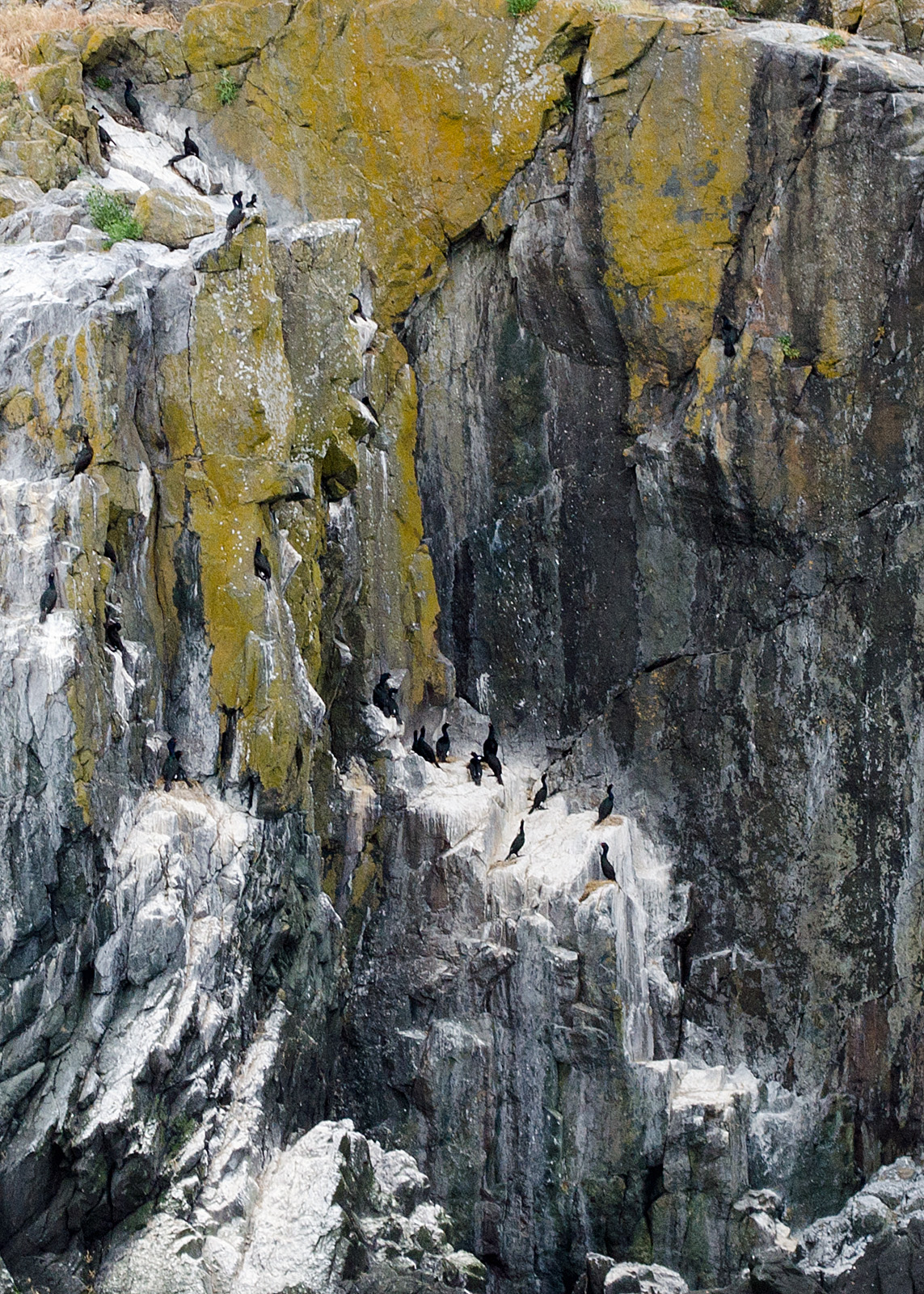
The southern coast of Mitlenatch Island is all high basaltic cliffs, streaked white by cormorant guano, painted along the upper edges with a yellow lichen that feeds on the guano. Along the top and sheer sides of the rock walls, hundreds of cormorants make their nests. From our viewpoint, down in the dinghy at a good 50 metres offshore, they seemed like punctuation marks; exclamation points emphasizing the verticalness of the rock face.

Distant view

We came in closer. The cormorants are still mere specks.

Pelagic cormorants, some with nests.

The pelagic cormorants are the smaller of the two cormorants we saw. They are a glossy black, sometimes iridescent when the light is right. In breeding plumage (like now) they have a small red patch on the throat, and two small feather crests on the head, hard to see at this distance. Breeding adults also have a large white flank patch, and these are visible, even in these small photos.

The nests here are visible as yellowish brown spots beneath some of the cormorants.

Zoomed and cropped photo. Besides the obvious nesting site, look more closely at the sheer walls. These birds nest on bumps that seem only big enough to hold their feet.

Moving on down the coast. Pelagics crowded together in the centre. On the top of the hill to the left, double-crested cormorants have their nests.

More pelagics. The white patches are visible, and with the photo at full size, a bit of the iridescence is apparent.

Skimpy nests. It's a wonder the eggs don't roll off with the merest gust of wind. But the chicks here are at least safe from predators.

Here, the only cormorants with nests are the couple of pairs part way down the cliff face, on tiny ledges. (Click for full size view.) The ones on top are nestless. On the left three juveniles are a lighter colour.

Double-crested cormorants, with their much bigger nests.

The double-crested cormorant is a larger bird than the pelagic. They are a dull black, but have a large orange or yellow throat patch, visible even from this distance without a zoom lens. In breeding season, they develop a double feather crest, larger than that of the pelagics. In this photo (click) I can see it, barely, on three or maybe four of them.

Pelagics again. A few red patches visible.

As we left the cormorants behind on our circuit of the island, we came upon the sea lions. Next.

(8th in a series of 9 Mitlenatch Island posts. #1, #2, #3, #4. #5. #6, #7.)
Powered By Blogger