Showing posts with label pigeons. Show all posts

Friday, January 05, 2024

Not a duck in sight

 So that's what they did before we strung electric wires for them.

I had always thought that these birds, barely seen as smudges on the rocks with my naked eye, were ducks. The camera, with my new lens, revealed them to be pigeons. At low tide, these rocks are high and dry, and the pigeons are elsewhere. On wires, of course.

Pigeons at high tide, catching a few rays on a chilly day.

Zooming in.

And the cormorants' usual spot. This rock is below the low tide mark.

~~~~~~~~~~~~~~~
El misterio se resuelve: esto es lo que hacían las palomas antes de que les hicimos cables eléctricos.

Yo siempre había creído que estos pájaros, que apenas eran unos puntos borrosos a simple vista, eran patos. La cámara, equipada con mi lente nueva, vió que eran palomas. Cuando la marea está baja, estas rocas están fuera del agua, y las palomas se han regresado a los alambres.
  1. Dos rocas con sus palomas y un par de gaviotas, tomando el sol en una tarde helada.
  2. Más de cerca.
  3. Y atrás, la roca donde siempre se juntan los comoranes. Esta roca siempre queda en el agua.


Tuesday, November 28, 2023

Birds on wires

 How did pigeons ever manage before humans made electric wires for them?

Watching the sun go down. Mostly.

Starlings are second-class citizens; they have to be content with the lower wires.

And they watch everything. The sun can take care of itself.

Handsome little birdies.

A Skywatch post. 

~~~~~~~~~~~~~~~

¿Cómo se las arreglaban las palomas antes de que los humanos les hicimos cables eléctricos de donde pueden observar mientras el sol se pone?

Foto: 

  1. alambre, cielo, y una fila de palomas mirando (casi todos) hacia el oeste.
  2. Los estorninos, parece que no se merecen sitio en el cable superior.
  3. Viendo más de cerca. Son pajaritos guapos.


Wednesday, February 01, 2017

Valentine's Day coming up

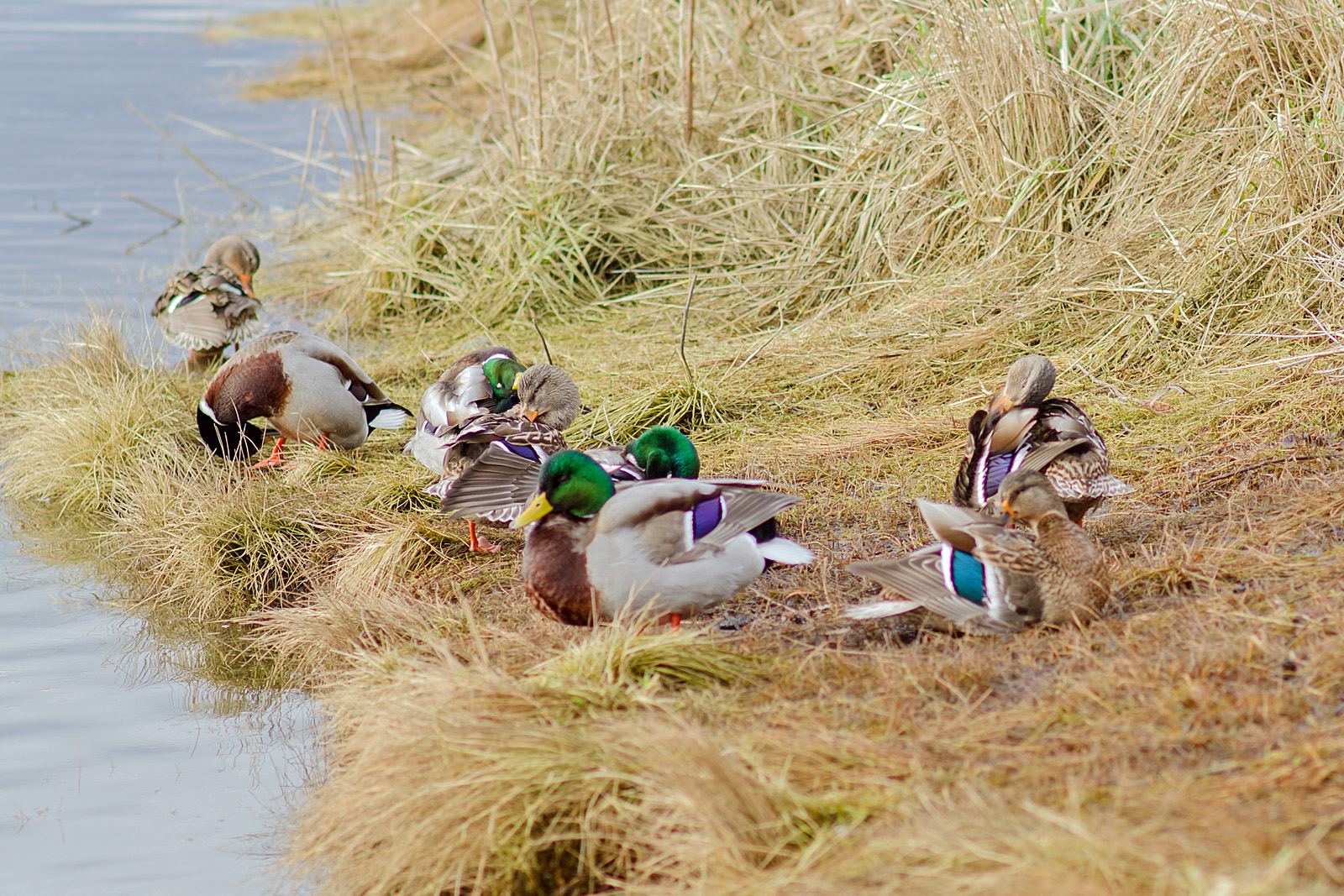
At this time of year, our birds are decked out in their brightest, showiest colours, getting ready for the spring parties. These were hanging out at the Campbell River estuary.

Mallards resplendent in green, purple, turquoise and chestnut, busily grooming. Gotta look good!

Quieter tones; female wigeons. The male shows off with a bright green stripe down the side of his face.

Mallards pair off in the fall.

A couple of female mallards, hiding their blue/turquoise speculums.

Goldeneye in the distance. I like the stripy water.

Red-breasted merganser, with her spiked hairdo. Her mate will have a dark green head and red eyes. Both their bills are orangey red; here, the colour is too dark to be seen against the light.

Up in the parking lot, the pigeons were hanging out, the males strutting, puffing out their chests: "Look at me! Me! I'm coo-coo-cool!"

Iridescent purple and green scarf, grey wings.

No two pigeons are alike. This one has an interesting wing pattern.

Suddenly, the whole flock takes off at once with a rustle and clap of wings, flies around and around swiftly, then peacefully settles a few metres away from the starting point.

Sunday, August 05, 2012

Reifel Island sampler

Vacation coming up! If all goes as planned, we'll be leaving for a week in Campbell River early Tuesday morning. We're halfway packed, most of our errands run, food ready, reservations made. And here I am, trying to clear my desktop for all the photos we'll be taking, and I'm soooo far behind.

The 27th of last month, we were in Reifel Island. It was a great day; hardly anyone about, and the two- and many-legged residents were happily going about their business. I even saw a tiny, furry, flattish mouse-sized critter. Not a mouse, a shrew, mole, something of that sort; he was gone before I got a good look.

What else? Here, in no particular order, are some birds, some bugs, some plants:

An X of pigeons.

Wood duck female

Thistle going to seed

Twin berry. I like those red frilly "collars".

Patient heron

Green Douglas fir cones. Those little white blobs on the twig at lower left are balls of fluff. I noticed them on the needles of our Douglas firs at home, too. Must investigate.

The dock is really red this year.

Little daisies and a blue, blue fly

Having heard the rustle of a goody bag, the geese come from the far side of the pond, queueing up on the way.

Quiet trails and a lonely bench; sleepy ducks and a strolling sandhill crane

Sandhill tail feathers, each one different.

A mound of mini-daisies

Bee or bee mimic? Coated with snowy thistle pollen.

Thistles without bees.

There are too many for one post; I'll post the other half shortly.


Saturday, January 22, 2011

Waiting for the sun

I'm tied up with work and a deadline for a couple of days.

Here's a fine morning a week ago.

Dawn, with pigeon and wires.
Now, back to the grindstone ...

A Skywatch post

Thursday, November 18, 2010

Pigeons over the bay

Boundary Bay, February 2010:


How they love complicated group manoeuvres in the sunlight!

A Skywatch post.

Thursday, April 15, 2010

"This place has such good vibrations, dear!"

Pigeons nest in the strangest places.


Happy home under the SkyTrain tracks. Where the train rumbles overhead every 10 minutes, 20/7.

Wednesday, October 21, 2009

Abundance of riches

The tide is still high in the afternoons at the White Rock beach, so we decided to vary our routine, and walk down the pier, keeping our feet dry for once.

We got a bit side-tracked; as we pulled into the parking lot, I noticed a sign; Museum Book Sale. We can never resist books. We spent half of our paid parking time filling a bag; great books, $2.00 each. Among others, I picked up a 1938 book on invertebrates, full of meticulously drawn illustrations. I'll probably end up using some of them on the blog. (The sale is on for the rest of this week; if you're in the area, drop in.)

So, as it turned out, we barely had time for a quick walk down the pier and back. (Except that I dawdled on the way back, taking close-ups of a friendly gull; Laurie ended up waiting for me beside the parking lot.)

It's a good time of year to be at the pier. The winter birds are back, swimming or resting in large flocks; we saw wigeons, assorted ducks, western grebes, surf scoters, and, I think, a few greater scaup, as well as the usual gulls, geese, crows and pigeons. The light, bright sunlight low in the sky, was against us. Mostly, we were seeing silhouettes:


Mostly surf scoters. And a sailboat.


Surf scoters, all male. Come to think of it, I saw no females.


The obligatory gull.


Mad dash for a few crumbs.

At the end of the pier, the dock was deserted, save for a couple of lines to crab traps. We crawled shamelessly around the pilings, Laurie balancing on precarious, bouncing boards, to see the life underneath us:


Short plumose anemones (Metridium senile) and a pale pinkish seaweed.


Another view of the seaweed.


Anemones and large black-legged barnacles. (Semibalanus cariosus)

Along the stone breakwater, gulls perched, mostly looking out to sea, and pigeons sunned themselves. I watched one disappear down a crack between the rocks; immediately a chorus of coo-coos burst out. A handy nesting site, safe and dry.


And a final treat; a sea lion surfaced beside the boats. I missed him, but Laurie saw him twice.


He seems to be smiling. Who wouldn't on such a good day?

Gull close-ups tomorrow.
.

Monday, August 31, 2009

It's warm, it's dry, it's protected: it's perfect!

A local store has taken steps to keep birds away ...


... without much success.

The next edition of Circus of the Spineless will be up here tomorrow night. And let's extend the deadline for submissions; how about sometime around 9 PM, my time (Pacific) tomorrow. Just e-mail me with a link at wanderinweeta AT gmail DOT com. Join the fun!
.

Friday, June 26, 2009

Of feathers and milk

A year ago last February, we happened to walk under this pier and look up. The pigeons were nesting already. I was wondering, last week, how many there would be now, as summer approaches.


Crescent Beach pier


The underside of the pier, with nests.

Just as before, each crossbeam held at least one nest, or at least a few pieces of weed and straw to simulate a nest. Do chicks never fall out of bed?


Two chicks, two adults.

This June, they're probably well into their second brood of the year, and the squabs (pigeon chicks) are quite large already, but still only partially feathered. (Most of these are probably about three weeks old; compare with the set of photographs at the bottom of the Wikipedia page.) I love the yellow "Mohawks" they are wearing.


Feeding baby.

I watched the parent feeding her chick for some time. (S)he doesn't come and go, each time with fresh food, as some other birds do (chickadees, for example). She sat there the whole time. Every minute or so, she would close her eyes and open her mouth, and the chick would reach in for a fresh mouthful of milk and mush. She must have been regurgitating a cropful, bit by bit.
Crop milk bears little resemblance to mammalian milk, being a semi-solid substance somewhat like pale yellow cottage cheese. It is extremely high in protein and fat and contains more of it than cow or human milk. Both male and female adult birds produce crop milk and share in the feeding and care of the young. ...
Pigeon's milk begins to be produced a couple of days before the eggs are due to hatch. The parents may cease to eat at this point in order to be able to provide the squabs (baby pigeons and doves) with milk uncontaminated by seeds, which the very young squabs would be unable to digest. The baby squabs are fed on pure crop milk for the first week or so of life. After this the parents begin to introduce a proportion of adult food, softened by spending time in the moist conditions of the adult crop, into the mix fed to the squabs, until by the end of the second week they are being fed entirely on softened adult food. (Wikipedia)


Almost grown up.


Curly yellow feathers.

This pair, one brown and one white, were smaller and fluffier than the adults, but seem to be completely feathered already.


Feral (city) pigeons breed several times a year, at any season, although they prefer the warmer months. They incubate a clutch of two eggs from 15 to 19 days, on a swing shift:
Parents continuously incubate eggs for about 18 days, females from late afternoon to mid-morning, males from mid-morning to late afternoon. (The Kansas School Naturalist)
The squabs, once hatched, are ready to leave the nest in a month, But the female may have already laid the next clutch of eggs over a week before; the half-grown squabs share the nest with them. The male takes over most of the feeding during this time.

Conscientious, hard-working parents. And they don't even look frazzled!

.
Powered By Blogger