Showing posts with label wigeons. Show all posts

Friday, October 30, 2026

Lazy afternoon

The sun was warm, the wind was cool, salt-scented. Wavelets whispered on the rocks. A flock of peeps flew by, peeping loudly. In the distance a mixed flock of shorebirds idled, some on the rocks, sleeping or preening; wigeons and mallards in the water nibbled on shredded sea lettuce. When I walked towards them, ever so slowly, all the gulls and turnstones pulled up stakes and moved farther away. So I gave up and sat on a log; the gulls went back to sleep.

Gulls, black turnstones, and a pair of wigeons.

More wigeons. Males have the white cap and the wide green stripe on the back of their heads.

A wigeon couple.

Gull and turnstone showing off their wings.

A line of beakless gulls.

Gulls sleep with their beaks tucked under their back feathers. And at least one eye open most of the time. Sleeping in a flock is a safety measure; some of the gulls will be alert at any given moment. In this group, the gull on the far left is awake. If I come any closer, or if an eagle flies overhead, he'll wake up the whole flock.

~~~~~~~~~~~~~~~~~~~~~
Una tarde tranquila. La brisa estaba fresca y olía a sal; en mi espalda sentía el calorcito del sol. Una bandada de pajaritos playeros pasaron volando, emitiendo sus silbidos característicos. Cuando volvieron a sentarse el único sonido era el susurro de olas que se rompían en las rocas. En la distancia, un grupo mixto de pájaros descansaban, algunos durmiendo o acicalándose, otros, en el agua comiendo lechuga marina. Cuando me acerqué, caminando despacito, las gaviotas y los vuelvepiedras se alejaron otro tanto. Busqué un tronco seco y me senté; las gaviotas se volvieron a dormir.

  1. Gaviotas, vuelvepiedras negros (Arenaria melanocephala), y una pareja de silbones (Mareca americana).
  2. Silbones. Los machos tienen la cabeza blanca, con la franja verde atrás del ojo.
  3. Una pareja de silbones.
  4. Una gaviota y un vuelvepiedras estirando las alas.
  5. Una hilera de gaviotas sin picos.
Las gaviotas duermen con los picos escondidos bajo las plumas de la espalda. Y por lo general tienen uno o los dos ojos abiertos. Dormir en bandada es una medida para su seguridad; algunas de las gaviotas del grupo estarán alertas en cualquier momento. En esta bandada, la gaviota a la izquierda está despierta. Si yo me acercara un poco (o si pasa volando un águila), esta gaviota despertará a todas las demás.

Saturday, February 08, 2025

When the mud freezes

Oyster Bay fills a shallow curve in the coastline, with the deepest part of the curve protected by an ancient rock-and-scuttled-ships breakwater. Over time, currents have brought in sand and stones (!), creating a spit that encloses a lagoon, a mud flat at the lowest tides. This area is a favourite resting and feeding for a variety of shorebirds and waterfowl. Around the edges, salt-tolerant marsh plants have taken root; samphire and silver burweed where the water covers them at high tide; tall grasses and gumweed on the higher areas, subject to salt spray but out of the intertidal zone.

Google maps image.

This week, much of that lagoon froze over.

View from atop the dike. Cracked, snowy ice covers the plants just out of reach of the tidewater. The shallower area of the lagoon is frozen over. Off to the left are old pilings supporting purple martin nest boxes.

In a small area of still-liquid water, ducks wait out the low tide. They're mostly wigeons at the moment; there's a mallard or two. Sandpipers, usually found at the foot of the dike, poke at the mud near the spit.

The remains of century-old docks near the dike, where the sandpipers usually hang out.

It is still snowing, and although daytime temperatures have hovered above freezing, nights are cold. Driving past, I saw a heron standing on a rock surrounded by ice, the fish he hunts in shallow water now safe under a hard window.

~~~~~~~~~~~
Oyster Bay forma una curva en la costa; la parte más amplia está protegida por un viejo rompeolas hecho de piedras y barcos hundidos. Con el tiempo, las corrientes han traido arena y hasta piedras para construir una lengua de tierra que encierra una laguna, más bien un pantano invadido dos veces a diaro por la marea. Este sitio atrae una variedad de aves acuáticas y playeras. Alrededor, donde la marea alta las cubre, plantas halófilas (que toleran la salinidad) se han establecido; Salicornia depressa y  Ambrosia chamissonis; donde no les llega la marea, pero sí reciben agua salada llevada por el viento, crecen pastos altos y Grindelia integrifolia con sus flores amarillas.

Esta semana, gran parte de esa laguna se congeló.
  1. Mapa de Google.
  2. La vista desde el dique. Hielo cubierto de nieve, en planchas rotas, cubre las plantas de la zona fuera del alcance de la marea. La laguna, donde el agua es de poca profundidad, está congelada. A la izquierda se ven los pilotes con los nidos para las golondrinas purpúreas.
  3. Donde el agua sigue en forma líquida, patos esperan el regreso de la marea. Por el momento la mayoría son silbones; hay uno que otro pato ánade. Correlimos, que generalmente se encuentran al pie del dique, ahora buscan entre el lodo cerca de la lengua de tierra.
  4. Los restos de pilotes de un muelle de hace un siglo, atrapados por el hielo. Los correlimos acostumbran congregar aquí. Hoy no.
Y sigue nevando, aunque la temperatura a mediodia llega a subir hasta más de 0°. De noche,  regresa el frio. Pasando, vi una garza azul parada en una roca rodeada de hielo; los peces que caza ahora están protegidos bajo una capa transparente. 

Sunday, January 26, 2025

Mud lovers

Back to more local wanderings; a couple of photos of distant birds in Oyster Bay, those birds that to the naked eye squinting from the closest vantage point, on the dike overlooking the inner circle of the bay, are just tiny black shapes against silvery water. Or silvery mud; those will be peeps, also evident because they are all running, all the time, barely pausing to take a quick peck at the mud underfoot. The camera works better than binoculars; in the photos, the birds aren't moving, although they may be standing on their heads.

Wigeons, calmly paddling along, one eating seaweed. The males have the showy green stripe on the head. Pintails, mostly head down, tails up, beaks foraging in the mud below, males with the creamy bellies, females bedecked in patches of brown and cream. The water here is only a few inches deep.

Sandpipers, probably semipalmated. This was about 1/4 of the flock running along where the water turns to mud.

~~~~~~~~~~~~
Regresando a sitios más cerca de casa: aquí hay dos fotos de pájaros en la distancia, en Oyster Bay; esos pájaros que a mis ojos sin ayuda, viéndolos desde donde más me puedo acercar, encima del dique que bordea el círculo interior de la bahía, esos pájaros que parecen nada más que formas pequeñitas negras sobre el agua plateada. O sobre el lodo, también plateado; esos serán correlimos, creo, con más razón porque nunca dejan de correr; hasta para comer pican rápidamente en el lodo, entre paso y paso. 

La cámara me sirve mejor que los binoculares; en las fotos, los pájaros no se mueven, aunque a veces están parados de cabeza.
  1. Silbones, nadando tranquilamente; una está comiendo algas marinas. Los machos tienen la raya verde en la cabeza. Los otros patos son ánades rabudos, Anas acuta; casi todos con las colas en alto, los picos explorando el lodo al fondo. Los machos tienen el abdomen gris claro, y las hembras llevan un diseño de parches cafés sobre crema. El agua en este lugar tiene apenas unos pocos centímetros de profundidad.
  2. Correlimos, probablemente Calidris pusilla. Esto era aproximadamente un cuarto de la bandada que corrían a lo largo de la orilla, donde el agua se vuelve lodo.


Monday, December 02, 2024

Trumpeters!

 Trumpeter swans! With a zillion or so mallards and wigeons. And potatoes.

Cygnus buccinator. 

More tomorrow; couldn't wait to post at least the first photo.

~~~~~~~~~~~
¡Cisnes trompeteros! Con patos; ánades reales y silbones americanos. Y papas.

Primera foto; las demás las dejo para mañana.


Thursday, November 14, 2024

Patience pays off

It was a good afternoon for birds at Oyster Bay. The birds, of course, were hiding or hopping (juncos) or flying, and/or a long, long way away, but the sun was shining and I was wearing my winter jacket; I was in no hurry. I sat on a couple of benches and a log, and waited.

So I even caught a junco between hops.

Junco in the old apple tree. With lichens.

A towhee watched me from the centre of a patch of wild roses, now leafless, and decorated with bright red rose hips. I sat, he sat; I kept waiting for him to come out from behind the branches. He kept waiting for me to leave. I gave up first.

All puffed out for the cold.

I took two photos 30 seconds apart, the one above with the pocket point and shoot, the next with the Nikon. Same bird, same lighting, same distance, same processing at home; different results.

That same junco. Here, his eyes are redder, his orange belly darker.

Wigeons. Three males.

The flock. The males have the green curve on their heads; females have brown heads.

Ducks and ancient pilings and brown water.

A sparrow trying to hide among the rose hips. Not looking happy about me.

Seen but not caught on camera: crows, a diving loon, a scurrying wren, umpteen mallards, circling peeps, calling as they flew, gulls in the air, on pilings, on distant rocks. One dropped a clam on the rocks a few metres in front of me.

~~~~~~~~~~~~~~

Era un buen dia para estar viendo pájaros en Oyster Bay. Los pájaros, claro, se estaban escondiendo, o estaban dando saltitos (los juncos), o volaban, o si no, estaban bien lejos. Pero había dejado de llover y salió el sol, y yo llevaba mi chaqueta de invierno; no tenía prisa. Me senté en un banco, en otro, en un tronco en la playa, y esperé.

Así que hasta capturé un junco en un momento en que dejó de dar saltos.

  1. El junco en el viejo manzano.
  2. Este Pipilo maculatus me observaba desde el centro de un grupo de rosales silvestres, ahora sin hojas y decoradas con escaramujos, sus frutos rojos. Yo me quedé sentada; el se quedó sentado; yo esperaba a que saliera de detrás de las ramas, el esperaba a que yo me fuera. El fue vencedor.
  3. Saqué estas dos fotos una tras otra, una 30 segundos después de la primera. La primera fue con mi cámara de bolsillo, la segunda con el Nikon. La misma luz, el mismo sitio, la misma distancia, procesadas en casa igualmente, pero las fotos son muy distintas. En la segunda se ven sus ojos de rojo fuerte.
  4. Tres patos Anas americana, machos.
  5. Una bandada de estos patos. Los machos tienen la marca verde en la cabeza; la cabeza de las hembras es color marrón o gris.
  6. Otros patos (Patos reales, hembras, probablemente) y pilotes antiguos, en agua color de café.
  7. Un gorrión tratando de esconderse entre las ramas y los escaramujos. No parece estar contento.
Vistos, pero sin fotos: cuervos, un colimbo buceando, un trogloditido (chochín) que corría entre los troncos en la playa, gran número de patos reales, aves playeras "peeps" llamando mientras volaban en círculos, gaviotas en el aire, en los pilotes, en las rocas. Una dejó caer una almeja sobre las rocas para romperla, a apenas unos metros de donde yo caminaba.

Sunday, January 21, 2024

Specks on the water

The tide was high, and the tidal lagoon at Oyster Bay was full of birds. Near the shore where I stood, a flock of pintails and wigeons, the pintails up-ending themselves in search of underwater goodies. On the far side of the purple martin nest poles, empty now in the winter, mallards. Against the light, I could see them as blotches, with specks of green; their showy heads. On the sand of the leg now enclosing the lagoon, barely visible as running specks, peeps, probably sandpipers. Beyond that, more mallards and a white dusting of gulls. And then, over the snowy shore, a flight of ducks, speeding Vs against the clouds.

All that I saw, but the camera saw the warm brown heads and the feather patterns of nearby pintails, which my eyes couldn't quite make out.

Pintail females. Plain heads, intricately patterned bodies.

A couple of males. Anas acuta; the name, acuta, as well as the English name, pintail, refers to the  long, pointed tail of the breeding males.

The nearest corner of the lagoon. Mostly pintails in this group.

And I counted 9 eagles on the way home. I probably missed some; I do have to keep an eye on the road.

~~~~~~~~~~~~~~~
A marea alta, la laguna mareal de Oyster Bay se llenó de pájaros. Cerca del dique de donde yo les observaba, una bandada de ánades rabudos, Anas acuta, con algunos silbones americanos, los rabudos parándose de cabeza en busca de bocadillos bajo el agua. Al otro lado de los postes con nidos para golondrinas purpúreas (vacíos ahora en invierno), ánades reales: contra la luz, los veía como formas oscuras con manchas verdes, sus cabezas brillantes. Sobre la arena de la lengua de tierra que ahora casi encierra la laguna, apenas visibles, puntitos en movimiento; aves playeras, probablemente Calidris sp. Más allá, otros ánades reales, y una salpicadura blanca de gaviotas. Luego, la tierra bajo nieve y en el cielo un vuelo de patos haciendo Vs contra las nubes.

Todo eso vi, pero la cámara además vió las cabezas de color café y el plumaje de los rabudos cercanos, lo que mis ojos no alcanzaban a descifrar.
  1. Dos hembras.
  2. Dos machos. El nombre científico, A. acuta, se refiere a la cola larga, puntiaguda de los machos en la temporada de apareamiento.
  3. La esquina más cercana de la laguna. Principalmente eran ánades rabudos en este grupo.
Y camino a casa conté 9 águilas. Se me habrán escapado algunos; no hay que dejar de mirar la carretera.

Sunday, October 10, 2021

Waterfowl in the rain

One thing about a blustery, rainy day; there are fewer people along the shore throwing sticks for their dogs. And so the waterfowl that usually congregate 'way over there on the islets or out beyond the rocks come in close to shore to feed on waterlogged grasses and the critters that live among them.

This is offset by the rush of camera carriers to get out of the rain.

From the bridge to the bird blind on Tyee Spit: mallards, wigeons,, and a few smaller ducks.

Canada geese, hurrying away as soon as I stepped onto the bridge.

From the bird blind, windy, but at least not raining inside. Gulls, and 'way over in the distance, a loon with just the head above water.

It was a quick walk, quick shots, trying to keep the camera dry in flying raindrops. Back in the car, a few gulls watched me from the lawn.

He has a stern, judgemental look about him, doesn't he? A "Go home! It's our day!" sort of look.

"Don't let me detain you!"

"Scram!"

Okay. I struggled out of my dripping jacket, dried off the camera, and went home.

~~~~~~~~~~~~~~~~~~~~~~~~~
Una cosa de un dia de lluvia y vientos: no hay casi nadie en la playa or el borde del río aventando palos al agua para entretener a sus perros. Y resulta que las aves acuáticas que normalmente se juntan allá a lo lejos, entre las islitas, o allá tras las rocas, ahora se arriman a la costa para comer la hierba y los animalitos que allí viven.

Esto, claro, pierde un poco de su atractivo por la necesidad de mantener secas las cámaras.

Fotos:
  1. Desde el puente que da al puesto de observación en Tyee Spit, hubo una bandada de ánades reales, mezclados con silbones y uno que otro pato más pequeño.
  2. Gansos canadienses, apurándose para escapar en cuanto puse pie en el puente.
  3. El estuario en la lluvia, con gaviotas, y lejos, apenas asomando la cabeza fuera del agua, un colimbo. Esto desde el puesto de observación; por lo menos no llovía adentro, aunque el viento era cruel.
  4. Y regresando al coche, aprisa con la chaqueta empapada y la cámara salpicada, aun escondida como la traía bajo la chaqueta, me esperaban unas gaviotas, no muy contentas con la visita. Este trae una cara como si dijera — ¿Qué haces aquí? ¡Este no es tu dia!
  5. — Bueno, ya te puedes ir.
  6. —¡Ya vete!
Pues sequé la cámara, me quité la chamarra, y me fui a casa.

Saturday, February 13, 2021

Mixed flocks

 The wind was icy, the sky and sea grey. But the bay was hosting a party.

Oyster Bay, mostly wigeons.

Wigeons.

Wigeons and pintails and a running sandpiper

And a line-up of long-billed dowitchers.

I saw a couple of green-winged teals and a distant merganser. Worth the frozen fingers!

~~~~~~~~~~~~~~~~~~~~
El viento era helado; el cielo y el mar se habían pintado de gris. Pero en la bahía, se hacía fiesta.

Fotos: Oyster Bay, con muchos silbones (Anas americana), 4 silbones, más silbones, con ánades de cola larga (Anas acuta) y una lavandera (Calidris mauri) corriendo, y finalmente, una bandada de agujetas (Limnodromus scolopaceus).

Además, vi un par de cercetas (Anas crecca) y, un poco lejos, una serreta (Mergus merganser). ¡Bien valió congelarme los dedos y la nariz!


Monday, January 21, 2019

Blue

A blue morph snow goose. I don't think I've seen one before, except maybe (probably) in the middle of one of those flocks of thousands of honking, flapping, swarming whites. This one was feeding peacefully on the lawn at Tyee Spit.

The paler geese are probably juvenile whites.

Sharing the lawn, eclipsed by the showier geese, three wigeons watch me.

Thursday, January 10, 2019

January greys

Another grey, windy, wet day, with half-hearted attempts at sunshine.Gulls and eagles were soaring high above; they do love the wind!

And below, bouncing waves, and bouncing wigeons.

The white line of surf is all that shows of the breakwater at high tide. Rotary Beach.

Gull, taking a one-footed break atop a purple martin nest post.


Thursday, November 22, 2018

Troubled water

It had been raining earlier, but now all that was left was a heavy cloud cover, shot with filtered sunbeams. I went down to the shore to see if I could get a photo of the dying light.

There was no wind, but the waves were high. They pounded the shore, rolling stones and logs.

A ways out, a flock of wigeons were resting, rising and falling with the waves. They were too far away to see clearly, except as a sprinkling of black dots.

I walked for an hour on the beach, listening to the roar and rumble of the stones, splashed with spray when a big wave came too close to my narrow path. As I returned to the car, I noticed a small flock of wigeons that had ventured closer to shore, close enough to be caught by the breaking waves.

They like sheltered water. They're asking for trouble here.

Wave coming.

Uh - oh!

Walking on water?

Wigeons in a blender

Flee!

"And we're outta here!"


Thursday, April 12, 2018

As close as I'm permitted to get

Sea, rocks, sky. And distant wigeons.

Too far away to see, except as a fluttering arrow. But the pattern of whites* on wings and rumps identifies them as American wigeons. 

A gull watches me. One step closer, she says, and I'm outta here.

* There's an interesting article and available guides that help with waterfowl id, even at a distance, using the patterns of white markings. I followed the link from the CornellLab bird id website. "Where's the White?"   I will be ordering one, or maybe two.

Wednesday, February 01, 2017

Valentine's Day coming up

At this time of year, our birds are decked out in their brightest, showiest colours, getting ready for the spring parties. These were hanging out at the Campbell River estuary.

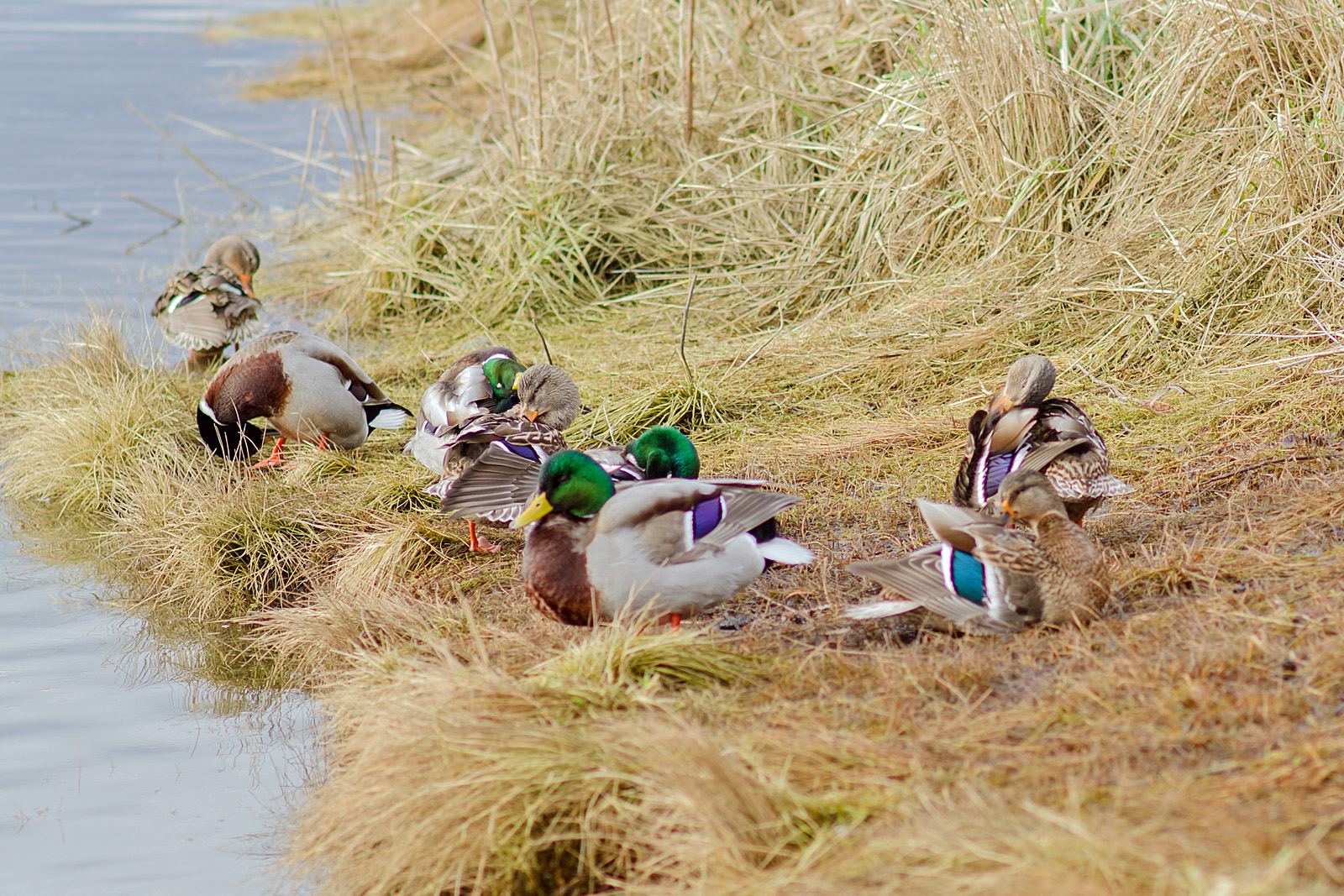
Mallards resplendent in green, purple, turquoise and chestnut, busily grooming. Gotta look good!

Quieter tones; female wigeons. The male shows off with a bright green stripe down the side of his face.

Mallards pair off in the fall.

A couple of female mallards, hiding their blue/turquoise speculums.

Goldeneye in the distance. I like the stripy water.

Red-breasted merganser, with her spiked hairdo. Her mate will have a dark green head and red eyes. Both their bills are orangey red; here, the colour is too dark to be seen against the light.

Up in the parking lot, the pigeons were hanging out, the males strutting, puffing out their chests: "Look at me! Me! I'm coo-coo-cool!"

Iridescent purple and green scarf, grey wings.

No two pigeons are alike. This one has an interesting wing pattern.

Suddenly, the whole flock takes off at once with a rustle and clap of wings, flies around and around swiftly, then peacefully settles a few metres away from the starting point.

Powered By Blogger