Showing posts with label bird identification. Show all posts

Thursday, April 12, 2018

As close as I'm permitted to get

Sea, rocks, sky. And distant wigeons.

Too far away to see, except as a fluttering arrow. But the pattern of whites* on wings and rumps identifies them as American wigeons

A gull watches me. One step closer, she says, and I'm outta here.

* There's an interesting article and available guides that help with waterfowl id, even at a distance, using the patterns of white markings. I followed the link from the CornellLab bird id website. "Where's the White?"   I will be ordering one, or maybe two.

Friday, March 31, 2017

Pure white

The gleaming white flanks of Common Goldeneye males dazzle, even at a distance, even on a dull day, even on my pocket Sony.

Two males.

Two seconds later. One male and a ripple.


Monday, February 20, 2017

Lousy birding

I am a lousy birder. I love to watch them; I attempt, mostly unproductively, to photograph them; and I can't tell them apart without a book in hand. Oh, gulls are gulls, peeps are peeps, lbbs are lbbs. And bald eagles are bald eagles; those I know, even when they're a speck on the horizon. And I can find a coot halfway across the marsh in a flock of mallards. But a peep dashing about on a tide flat, or chasing the waves? They're peeps. No-name brand peeps.

So I take photos and compare them, point by point, against the photos in my bird book, and then against Cornell's All About Birds descriptions. "Ah," I say, "so those were sanderlings!"

But next time, against an impossible background, with little brown specks fleeing me and my camera, I can't distinguish them again. Just peeps.

These, after having gone through the slow process of identification, I think are black turnstones.

Black turnstones, Oyster Bay. They've seen me before I saw them, and are already running away.

And they're off!

A turnstone against the brown and black mud of Oyster Bay is a different bird altogether than a turnstone in the air. On the ground, they blend in, except for the flash of white belly. In flight, they show a dramatic white/brown/black pattern.

Zooming in, with the background faded out.

Bold wing pattern visible in flight, produced by white feathers at the base of the leading edge of the wing, a white wing stripe, and a white lower back.
White tail with black terminal band. (Cornell)

The black terminal band on the tail is visible while they're on foot; flying, the white tail is longer, and shows as a white terminal band.

Location helps for id purposes; the black turnstones are supposed to prefer noisy beaches.

In winter, found along high-energy rocky shorelines, on beaches near rocky coasts, and on jetties and piers. (Cornell)

Oyster Bay is anything but high-energy, but just across the rock breakwater, waves pound the stones. And in here, in the lagoon at low tide, they find a banquet prepared with their favourite treats: barnacles, mussels, crustaceans, with a side dressing of rotting plant material. Once the water comes back, they'll go back to the open coast, leaving the bay to the mallards, geese, and wigeons.

Saturday, May 26, 2012

What duck is this?

After a week of rain, the sun finally chased away the clouds. Beach day! At Centennial Beach, the tide was out past the border marker and still retreating; kids flew kites and dug enormous holes, adults toasted themselves on the sand or walked and walked and walked; so did we.

But first, we stopped at the duck pond to watch 9 baby ducklings learning to dive. While we took far too many photos to sort in one evening, a pair of oddball ducks arrived to sit on the banks.

Drab ducks, at first sight. I thought they were both females, until I looked closer.

They match the descriptions of gadwalls in my guides, but not the photos. And the male has a few extra decorations.

Medium-sized, rather plain dabbling duck with white belly, steep forehead, yellow feet, white patch in speculum. MALE: Mostly plain, variegated grey with back plumes, puffy head shape, dark bill, black rump, undertail ... (Description from Birds of Southwestern British Columbia.)

The Audubon field guide adds, "... only duck with white speculum having black outer and inner margins. Breeding plumage of male is gray with contrasting black stern and brown forewing. Female ... yellowish bill; has white speculum like male.

From Cornell's All About Birds, I learn that, "No other dabbling duck has a small square white patch at base of wings. All other dabblers that have a black rear end have white just in front of it." And, "white patch on wing, may be hidden."

The male. White belly, black rear end, brown forewing, back plumes, variegated grey. In descriptions but not on duck; steep forhead; this one is more sloped, like a mallard's. Not in descriptions; dark bill has yellow edges. Brown patch on forewing has three white spots. Blotchy ring pattern around neck. The neck seems longer than any of the photos in the three guides.

The pair, showing white speculums.

So we're not sure of this one; is the male a mallard/gadwall hybrid? Those mallards do make life difficult!

The gadwall does not appear in my Birds of Vancouver and the Lower Mainland, although the other guides include the Delta in their range.

Tomorrow; those 9 ducklings.


Friday, March 12, 2010

Chilled LBBs. (So were we!)

Maybe the birds were too cold to move. The wind was bitter, and in mid-afternoon, it was hailing, too. Even the ducks were quiet. It's not often that happens on Reifel Island.

Whatever the reason, last Monday was one of the best birding days we've seen; even the sparrows preferred to huddle near the feeders, allowing us to move in close with the cameras. We came home with a nice collection of little brown bird photos. Let's see if I can get the identification right this time:


A male House Sparrow, fluffed out for warmth. Masked, with a black bill and bib. The female is a dusky brownish-gray; her bill is yellowish.


Second male, beside the feeder. Red-wing blackbird behind him.


The pussy-willows are budding. And, of course, the blackberries are getting a head start on everything else.


Lanky Fox Sparrow, on the remains of last year's blackberry canes. The slaty head, rusty tail, and the two-toned beak are characteristic, as is the chain-link fence pattern of the breast. (Thanks again, Seabrooke!)


I think this is the same Fox, showing off his yellow rump.


A fairly un-cooperative Golden-crowned sparrow. Mostly, he faced the other way. Easy to identify, though; he has the nice yellow spot on his head.


I am not sure what this is. With the sharp bill and heavy patterning, I would venture Pine Siskin. The males have yellow edges on the wings and tail feathers, but the females are mostly brown and grey.


The sharply-pointed, dark beak, big black feet, and the pattern say, "Pine Siskin", but the tail doesn't look as deeply notched as it should be.

*Update: Fiona, in the comments, suggests female Redwinged Blackbird. I think she's right; the tail fits. The birds looked smaller than a redwing, but that's probably just my eyes. Thanks, Fiona!


A baby so early? Soft, undifferentiated feathers, all fluffed out. This one and his sibling sat on adjacent branches, looking miserable. They aren't used to this weather; it's been summery up until last weekend.


A grey, grey day. The green is moss or blackberry leaves. In the summer, the sparrows will almost completely disappear into the blackberry thicket.

There! I've done my best to identify these few LBBs. I hope I've got them sorted out, but would really appreciate any corrections.

So much to learn! And there are still all the seasonal changes, and the juveniles to study. What fun!

Monday, January 18, 2010

Pie filling wigeons and school-teacher mallards

It happens every time; we start out to visit Reifel Island Bird Sanctuary, then dawdle on the way, stopping at every eagle tree and bit of swamp. We slow to a crawl for herons in ditches, snow geese 'way across the fields, hawks in pursuit of a meal.

Eventually, we get there.

We were greeted at the gate by the customary mallard free-loaders; this time, several yellow-headed wigeons were with them.


Yes, yellow. Sunny, lemony yellow.

There were several with bright yellow heads and faces (not canary yellow, a bit muted, more like sunlight on old gold); others had a variety of shades, from pale butter up to lemon pie filling yellows. The heads were thin, flattened like a fish head; they bulged to a possible crest at the back. We had never seen any like this before. They don't match the American wigeon, nor the Eurasian (a dark brown head); the winter plumage of the American may be pale, but not yellow. I did find one photo with a golden head, but in full summer colour, and with a nicely rounded head.


This is what we expect in a winter wigeon.

We spent more time with the mallards than we usually do, trying to get at least one decent, unblurry, unobstructed photo of a yellow-head. Not a simple feat, in that mad scramble for handouts! When a toddler arrived to feed the ducks, father and bag of bird seed in tow, we moved on. We'll try another day.

Along the paths, we met fewer wigeons, more mallards. They came running or swimming (making great Vs in the water) if I so much as rustled the paper of the seed bag.


Faithful followers. And Laurie.


Mallard pair. She is a very pale variant. Hybrid, maybe?


Standard-issue male mallard. Green head, blue speculum, orange feet, yellow bill, white neck ring. But check out the mottled bib. Not the usual.


Joined by another "normal" male. With a spinning head and a brown neck scarf. What is he doing?

In one of the pools, this duck was paddling alone.


Unidentified black and white.

I can't find this one in the books. White bib, dark brown body and wings, a puff of white at the back of the head, yellow mottled beak, and a white streak behind the eye. No blue speculum, but the white edging that usually borders the blue is still there*.

It's probably another of the many mallard hybrids and "Manky Mallards". (Pure mallard, but weird; crested mallards? Mallards with 1950s schoolteacherish buns? A purple-headed mallard? Really, really purple? That's weird.) I've checked those out, too; Charlie at 10,000 Birds has a good selection, with explanations. Here's one that's similar to ours; a "Manky", "Swedish-type" mallard.

What do you think?

*I thought the absence of a blue speculum meant that it couldn't be a mallard, but it seems that mallards obey no rules.
  

Sunday, May 24, 2009

Very bad, very blurry, wonderful photos

I'm not very good with binoculars. I get lost; I go branch to branch on the tree where I just saw that bird, always on the wrong branch. And when I find the target and start to zoom in on it, my hand shakes and ... I begin again.

Once I discovered the auto-focus mode of my first digital camera, the bins got left at home. Now I zoom in, watching the whole scene on my screen, then halfway depress the shutter button, and -- Aha! A cormorant! Or another crow having an argument with an eagle!

Sometimes, though, I zoom as far as the camera will go, focus, and say, "I don't know. A seagull, maybe. Or a fishing boat float?" If I'm curious enough, I'll take the photo anyway, and see if I can clear it up at home.

I delete zillions of photos of unidentifiable birds. Or maybe fishing boat floats.

And occasionally, I discover a bird I had seen, and yet not seen. A lifer, even. This past week, there were two. And one that didn't show up.

Far away, at water's edge off Semiahmoo Reserve, (White Rock area), we saw a line of black and white specks; they turned out to be (probably) Caspian terns. First time I'd seen these and knew it.


Sterna caspia


They are definitely terns, but conceivably could be another species. The Caspians are occasional visitors to this area, are about the size of a medium seagull, have a black cap and large red bill. The photo in my Audubon Field Guide shows black legs; other terns have orange legs. And the Caspian has a slight crest on the head; in my photo, the "caps" often seem peaked towards the back. The Audubon's photo shows a black tip on the bill, but the write-up does not mention it. I can't see one on any of these birds.

At the western end of the White Rock beach, near Kwomais Point, three bumps slept on a rock. They turned out to be Harlequin ducks.


Harlequins, two males and one female.

At this distance, the colours (slate blue and chestnut) are almost gone, but we identified them by the white markings; the faces are hidden under the wings, but the strong "V" at the neck is plainly visible, as is the bold stripe across the shoulder area. Another first for me.

By the way, their Latin name is Histrionicus histrionicus. Meaning a double show-off?
The Harlequin Duck takes its name from Arlecchino, Harlequin in French, a colourfully dressed character in Commedia dell'arte. The species name comes from the Latin word "histrio", "actor". Wikipedia
This next was not a stranger, nor a surprise; we heard him calling long before we saw him. But all we could see was a silhouette against the sky. A very odd silhouette.


A kingfisher, Ceryle alcyon.


Bad hair day.

And last, a sparrow. Another silhouette, lightened up and cleared of a rainbow effect from shooting directly into the sunlight. He was singing so beautifully that he deserved his 15 minutes of fame.


He can stand in for the flock of swallows we were trying to photograph. Impossible! They were in a narrow ravine, cutting down the cliff by Kwomais point, and had made burrows in a tall clay cliff. We could see the holes that they went into and out of, the swallows swooping around, up, down, across the ravine, zipping into the holes again. It was a good place for them; protected, out of reach of all but the most ambitious teenagers (who had carved their initials into the lower part of the cliff), and, with a trickling stream at the bottom, home to a cloud of gnats.

We took many photos of the cliff face. No swallows appeared in them, not even shadows of swallows. And the nest holes were indistinguishable from the dents and flakes on the wall.

.

Friday, January 23, 2009

Mute swans and a not-so-mute heron

I love mallards. They're beautiful birds, and funny, too. Even when there are hundreds of them, all quacking at once. Even when they mob me for a few seeds, and I have to push them aside with my feet to walk. Even when I have to inch my car through the parking lot, and they don't see the need to move until the front fender almost touches them. (They remind me of range cattle in the Chilcotin, that way.)

But after you've taken a couple dozen photos of mallards, the cameras get clogged with green head feathers; they crave variety. And on this last visit to Reifel Island, that's what they got. We saw so many different birds that I haven't been able to even sort through all the photos until tonight. And there are too many for one blog post.

May as well get going:


Eagle's nest in the mist.

The fun started even before we got to the bird sanctuary. At the bridge to Westham Island, we parked and walked over (and back). The fog limited our vision to the near at hand:


River's mouth

On the Ladner side, Laurie checked out the eagles' nest we saw last year; one eagle was standing guard. At the river's edge there is a marshy area, enclosed by a log breakwater. A white goose dabbled in the mud there.

It always amazes me how they stay so bright and shiny, digging through all that goop.


Nice clean goose.


Double-crested Cormorants lined up on the breakwater.


Western Grebes, downstream.


One of a pair of Mute Swans. More unspottable white.

We drove on. Passing the last farm before the entrance to Reifel, we stopped again, to watch a heron in the ditch, and startled a hawk. I managed to get a photo, very tiny, very misty:


I think it's a Harrier.

We had interrupted its dinner.


More white feathers, still bright in spite of the situation.

Another hawk was in the trees nearby. I don't know what this is. The more I search through my books, the more confused I get. They don't even look the same from one book to the next, let alone from one time of year, age, or sex to the next. Help!


Sitting raptor. At least that much I know.

On to the heron:


Through the branches.

He wasn't in the mood for photos. Laurie got a bit too close, and the heron took off with the loudest, angriest, harshest, longest "Graaaaaaak!" I had ever heard. Sorry this next photo is blurred; I was laughing too hard to hold steady. If you look closely, you can see his open beak.


"Graaaaak!"


Another heron, standing one-legged, looking like an old woman in a shawl.

Next: we finally get to the starting point.
.

Tuesday, August 05, 2008

Flight patterns

My desk faces the window. Often I look up from what I'm doing, and reach for the camera; the birds are doing something. In the evening, when work and play is done for the day, we sit again, facing the window, or on the patio. We get in a fair bit of birdwatching. No life list entries, no exotic species, just our everyday lbbs.


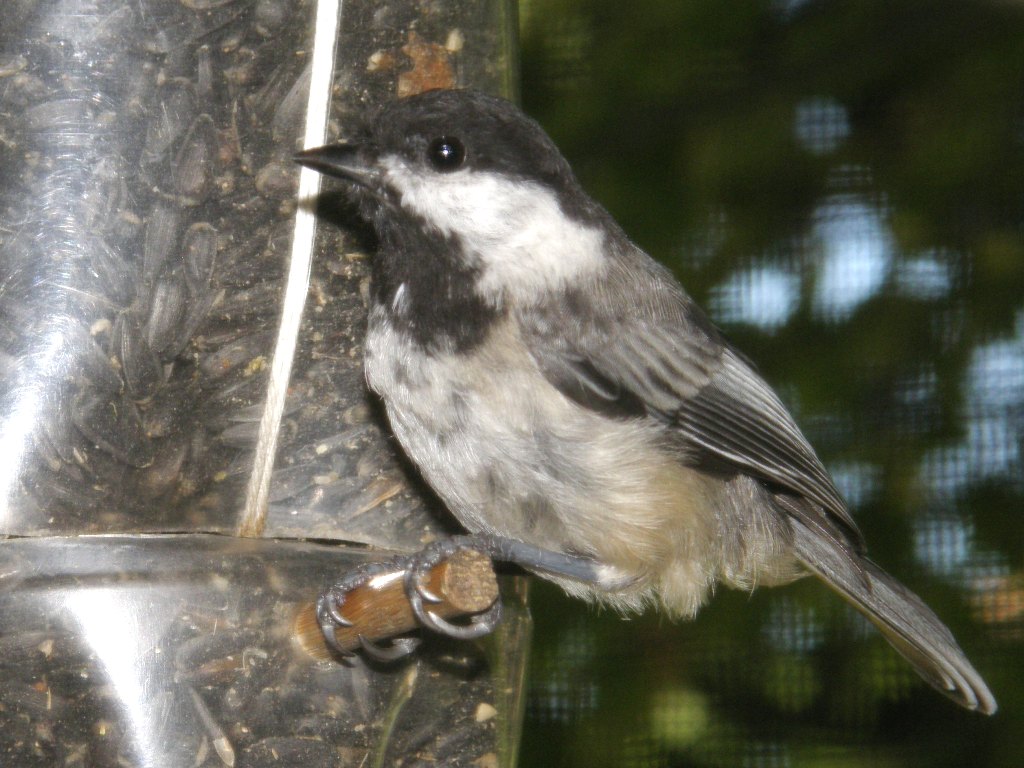
Chickadee, on the other side of the screen.

The current residents of my garden are a family or two of chickadees, another of white-crowned sparrows, some twenty-odd other sparrows, house finches, a couple of nuthatches, robins and the occasional crow. And I've been paying attention to their flight styles.

I think a map might help:


This is the relevant part of my yard, the spot where we sit to watch the birds. The chickadees, the finches, and the nutchatches use the hanging feeder. The sparrows come down to the paved area to get seeds. The robins and crows stick to the lawn area. And all but the robins and crows use the bird bath, also on the paved area, and dry themselves off in the rhododendron.

The chickadees fly in from the evergreens to the maple, where they sit a minute before dropping down to the feeder. They snatch a seed and skip back to the maple, or to the hedge, working at the seed until they get it open. They go back to the feeder several times, taking turns with the other chickadees in the group, then head back to the evergreens.

When they fly the longer distance, they dip and rise in the air, about once every metre, as if they were swinging from a series of vines, Tarzan-style. Even against a strong light, and at a distance, they are identifiable by this bumpy ride.

For short hops, like from the maple to the feeder, they fly direct, with the barest hint of a dip and rise. Between branches, they jump, barely opening their wings.

The nuthatch is much more business-like; he flies like an arrow, straight from the evergreens to the feeder, gets his seed quickly and zips back into the depths of the trees, also in a straight line, without a pause. He is travelling fast. I have never seen one take his time, or stay to talk with another nuthatch.

A couple of years ago, Laurie and I watched a pair near Chase. We noticed that they never go back in the same direction that they came in, and that they always disappear into a different tree than the previous time. We were guessing that this behaviour may help disguise their nest holes, or their stashes of seeds.

The house finches fly from the evergreens to the maple or to the rhododendron, following a more or less straight line. From there, they proceed to the feeder, stay on its perch for a while, then head back to the evergreens. There, they perch on an outside branch to survey the area, then flit back into the trees and out of sight. For bathing, they flit from branch to branch in the rhodo, checking out the availability of the bath, before dropping down.

The sparrows drift in, together, like leaves blown by the wind, angling down towards the lawn, and skittering along a bit after they've landed. Then they fly in short, quick flights, in towards the pavement and the bird bath. On the ground, they hop from place to place, back and forth, hop-peck, hop-peck, hop-peck. When they're done, they blow away together again. (When starlings appear, they behave similarly, except that there are a lot more of them, and they don't come close to the house, or bathe.)

I don't remember seeing the robins fly. They land somewhere out of sight, then run along the lawn. Eventually, they run back out of sight; soon afterwards, I'll see one on the topmost branch of the highest of the evergreens.


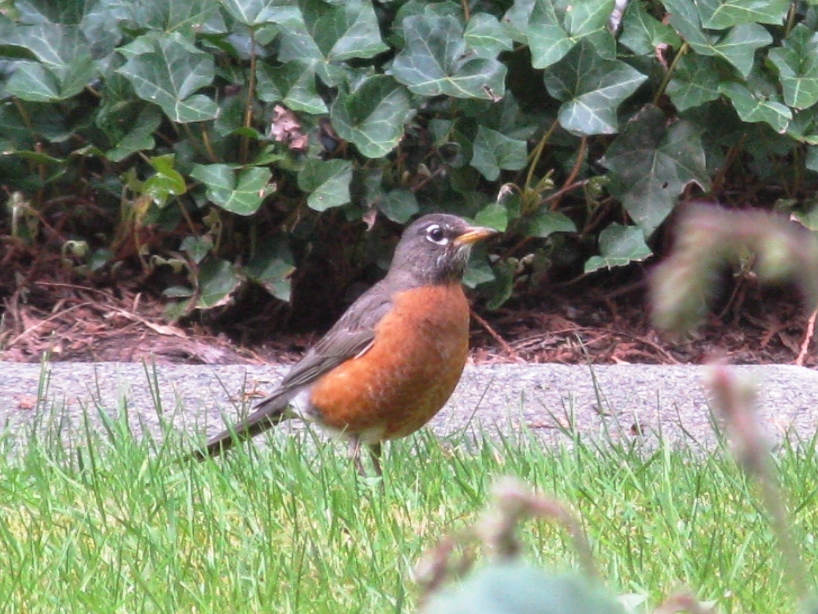
Robin, stopping to listen for worms.

Crows come in for an awkward landing on the lawn, usually squawking noisily as they come. They hop around for a minute scoping out the territory, see that there's nothing to scavenge, and leave.

And somewhere under the evergreens, a pair of flickers lurk. We rarely see them, but they call to us in the evenings.
.

Thursday, June 19, 2008

Daddy is a show-off

The redwinged blackbird is an easy bird to identify. At least the adult male is. Most of the time.


He's black, and he displays brilliant red patches on the wings. And he perches on the tallest cattails, singing at the top of his voice. "Konkeree! Konkeree!"

Of course, he's not always flashing those red patches. Then he's a plain black bird, smaller than a crow, usually bigger than a starling.


Waiting his turn at the feeder. At Reifel Island Migratory Bird Sanctuary.

And sometimes only the yellow edge of the patch is visible.


But still, pretty distinctive.

The rest of the family is not quite so easy.

First, the male arrives in the marsh alone, and sets up shop. About a month later, when the air is swarming with LBBs (Little Brown Birds), the female arrives, looking like all the others in a sensible drab outfit. She busies herself with nesting duties, somewhere hidden in the shelter of the cattails.

Just another LBB.


She is smaller than the male, not much bigger than a Fox sparrow. She wears a tidy brown coat, a cap with a whitish streak over the top (like the white-crowned sparrow's) and another over the eye (again, like many other LBBs'). Her underparts are whitish, heavily streaked with black or brown. If she's in the right position, you can see that the tail is notched in the centre.


But hey, she hangs out around the cattails. Near where her flashy mate is loudly proclaiming ownership. That's a give-away.

And then there are the kidlets.


I think this is a juvenile redwing. I could (easily) be wrong. Basically, they look like a paler version of the female.


And this is a young male, in his first spring. The red patch is still orange, with black spots. But when he grows up, he'll be the spitting image of his Daddy.
.
Powered By Blogger