Showing posts with label merganser. Show all posts

Thursday, March 11, 2021

The estuary and its birds

The Myrt Thompson trail travels down the centre of the Campbell River estuary, following a narrow spit and a series of islets connected by 5 bridges, ending where the river comes together and widens into a bay. There's still one island and the enclosing Tyee Spit before the river reaches the ocean. The islands are mostly mud flats, covered with long grasses, brown most of the year.

Birds love these flats and the quiet backwaters as the river wanders around the islands.

Mud flat, with great blue heron and sleepy mallards.

Twig and branch fence, common goldeneyes.

The Wei Wai Kum band, as part of their wetlands restoration project, is installing these alder branch fences (weirs) just offshore around the mud flats, to encourage the growth of native sedges and reduce erosion.
The barriers keep geese and inquisitive kayakers out of sensitive ecosystems. ... Introducing native plants was another part of the restoration project. Which explains the lush sedge grass (also known as carex grass), along the banks. Sedge grass not only prevents the river banks from receding but is also an excellent source of protein for bears, geese and ungulates in the area.
“The grass is especially important for bears to get their digestive systems rolling in the spring when they wake up from their hibernation,” ... (VancouverIslandFreeDaily)

Drawing Vs in shallow, grassy water.

The north shore is still heavily industrial. Here, a line of goldeneyes crosses the centre of the river.

A common merganser heading downstream, half hidden by ripple patterns.

~~~~~~~~~~~~
El sendero "Myrt Thompson" baja por el centro del estuario del rio Campbell, aprovechando una lengua de tierra angosta y luego una serie de islitas unidas por cinco puentecitos, y terminando donde los varios canales del rio se juntan para formar una bahía. Falta todavía una isla más y luego la lengua de tierra Tyee, antes de que el rio salga al estrecho del mar. Las islas son, por la mayor parte, pantanos cubiertos de pastos y juncias, de color café por gran parte del año.

Y siempre hay pájaros, en el pasto, bajando con la corriente del agua, o descansando en las aguas tranquilas entre islas.

Primera foto: un pantano, con una garza azul pescando, y varios patos mallard dormilones.

Segunda foto: porrones osculados y una cerca de ramas.

La tribu Wei Wai Kum, como parte de su proyecto de restauración de los humedales, está instalando estas cercas hechas de ramas de aliso alrededor de las islas y pantanos para estimular el crecimiento de juncias nativas y para reducir la erosión.

"Estas barreras mantienen alejados los gansos y kayakistas curiosos de los ecosistemas frágiles. ... Introducir plantas nativas tambien fue parte del proyecto de restauración. Esto explica las juncias (Carex) exuberantes a las márgenes del río. Las juncias no solo protege las márgenes contra la erosión, sino que tambien es una fuente excelente de proteína para los osos, los gansos, y los ungulados (venados, por ejemplo) del rumbo.—Esta hierba es especialmente importante para los osos cuando salen de la hibernación en la primavera, para poner su sistema digestiva en marcha." (Del periódico VancouverIslandFreeDaily)

Tercera foto: patos marcando "V's en agua de poca profundidad.

Cuarta foto: Hacia el norte del río, el terreno está ocupada por industrias pesadas. Aquí una bandada de porrones cruza el centro del río.

Quinta foto: Una serreta grande, bajando por el río, casi escondida entre las ondulaciones del agua.

Thursday, December 03, 2020

Find the merganser

Passing a pile of logs on the shore, I saw a face in the pile and snapped a photo. At home, looking at the photo, it made me think of those old puzzles challenging us to find the hidden objects. Among those logs, I discovered another 10 faces. And one merganser duck. Here's the photo, unretouched: 

How many faces do you see?

~~~~~~~~~~~~~~~~~

Al pasar un grupo de troncos viejos en la playa, vi una cara y le saqué una foto. Al mirar la foto en casa, me hizo pensar en esos dibujos de antaño donde nos retaban a hallar las figuras escondidas. Entre estos troncos, descubrí otras 10 caras. Y un patito. Aquí está la foto, sin retocar. ¿Cuantas caras ves?

Thursday, January 16, 2020

Birding at a distance

It was a day for small birds, birds that usually are hidden behind the leaves. And for a few big birds, 'way off in the distance, so they were essentially little birds, according to my eyes and camera.

A kingfisher! Not only did he park not too far away, but he stayed there while I took enough photos to get one more or less in focus.

A young robin, all speckly.

Zooming in on him. It's 8 below zero, Celsius. How these tiny critters keep from freezing is a never-ending wonder. I'm wearing long johns, layers of warm clothes, gloves, a tuque and a hood and I'm still cold.

A little green-winged teal. Poor photo, but I'm glad I got it; I haven't seen one of these for several years.

A sparrow on the frozen path beside the river.

Usually the little brown birds flit around in the undergrowth; on this frozen afternoon, sparrows and robins and towhees came out to the path, where the sunshine sort of softened the frozen ground.

One of a flock of golden-crowned sparrows.

And the bigger birds, looking small:

Mallards sleeping in the sun. The white stuff on the island behind them is ice.

An eagle, as I usually see them; a white spot at the top of an evergreen.

Birds, birds, birds. All too far away. Right to left: a flying duck, a bufflehead, several small flocks of diving ducks, probably buffleheads, a Cessna, and an eagle. And what looks like two waiters on stilts carrying trays of goodies.

Photos I took that wouldn't even have qualified for the Worst Bird Photograph page: a V of honking Canada geese, towhees against the light, and a pair of diving common mergansers, another bird I haven't been seeing for some time.


Wednesday, February 01, 2017

Valentine's Day coming up

At this time of year, our birds are decked out in their brightest, showiest colours, getting ready for the spring parties. These were hanging out at the Campbell River estuary.

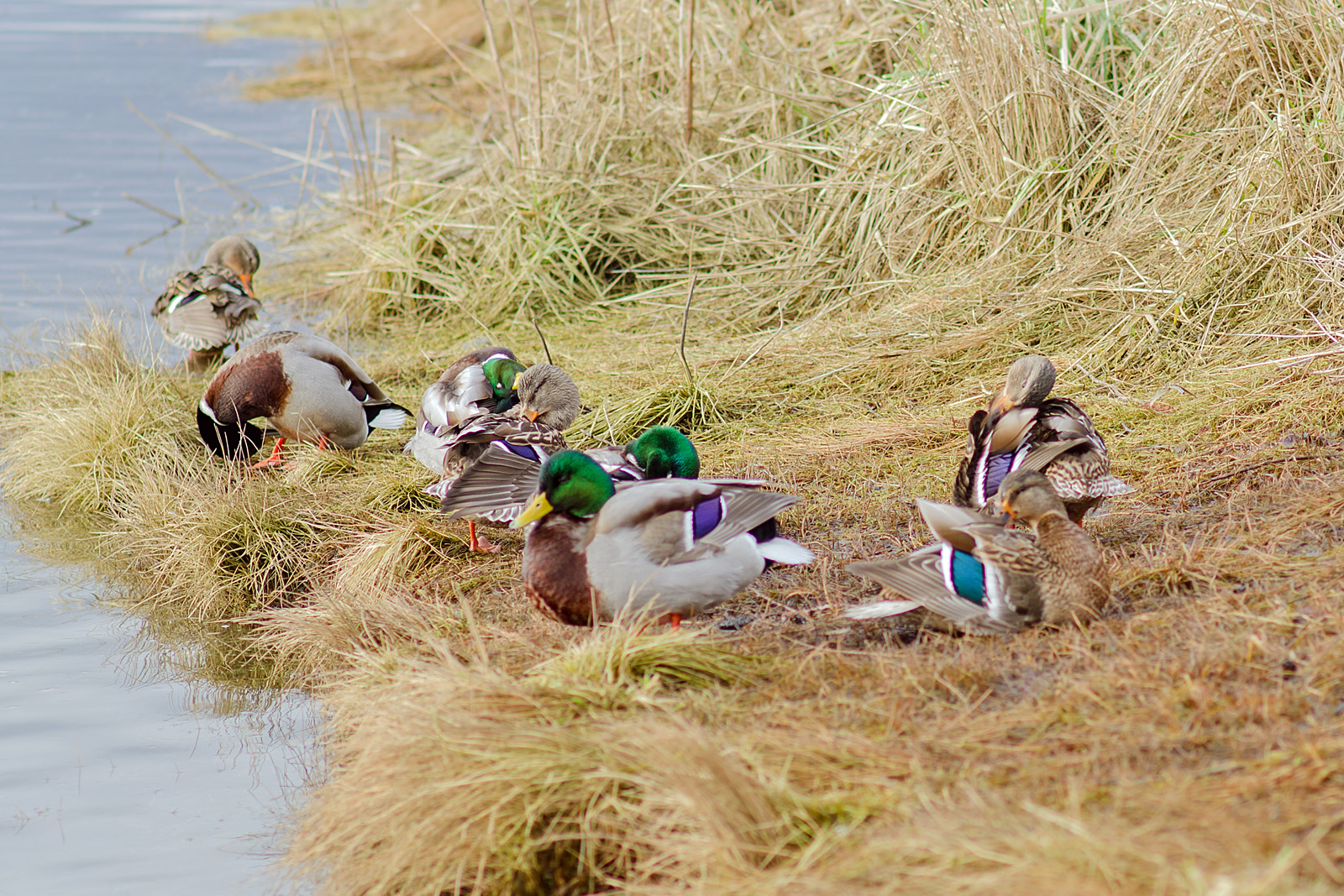
Mallards resplendent in green, purple, turquoise and chestnut, busily grooming. Gotta look good!

Quieter tones; female wigeons. The male shows off with a bright green stripe down the side of his face.

Mallards pair off in the fall.

A couple of female mallards, hiding their blue/turquoise speculums.

Goldeneye in the distance. I like the stripy water.

Red-breasted merganser, with her spiked hairdo. Her mate will have a dark green head and red eyes. Both their bills are orangey red; here, the colour is too dark to be seen against the light.

Up in the parking lot, the pigeons were hanging out, the males strutting, puffing out their chests: "Look at me! Me! I'm coo-coo-cool!"

Iridescent purple and green scarf, grey wings.

No two pigeons are alike. This one has an interesting wing pattern.

Suddenly, the whole flock takes off at once with a rustle and clap of wings, flies around and around swiftly, then peacefully settles a few metres away from the starting point.

Saturday, February 16, 2013

Fisher folk at Cougar Creek Park

. . . the feathered variety:

Distant merganser, with the sunlight catching her hairdo.

Offended heron. (Aren't they all, always?)

Cormorant, one of a pair, coming to check us out.

The cormorant and the mergansers are short-term visitors; the heron is a year-round resident. And the beavers are still busy, keeping the ponds deep and wide.

Tuesday, January 13, 2009

Dripping wet, but ...

... it wasn't raining. Not really, anyhow; the water in the air was just a Scotch mist. We took a chance on it not getting wetter, and went down to Cougar Creek Park.

It's a grey spot, in the winter; grey trees, grey water, grey skies, grey bridge. And black and white birds, mostly.


A drop of yellow in the willow, red in the canes. Hints of a future spring.

Last summer, we saw a cormorant here several times, and I was hoping it would stay. It did; today we saw three of them.


Double-crested cormorant. A fish-eater. Unexpected in such a small "lake".

These mergansers were here last spring, too.


Hooded merganser, male.

It's the beginning of breeding season, and they are wearing their most showy finery. This next photo is blurry, but I liked it because one of the males is strutting his stuff to impress a female (the one in the brown hairdo.)


"Look at me! See how white my breast is! How tall I am!"


Wigeon, on patterned water.

A spot of welcome colour.

And, of course, the mallards. A flock of them slept on the mud bank at the far end of the lagoon, a few wigeons among them. This one came over to see if I had any goodies. I didn't.


Far end of the lagoon, where Cougar Creek enters. That's the remains of an attempt at making a beaver dam at the curve; the beavers keep building it in different spots, and someone keeps tearing it up.


Protected tree. Felled anyhow. Its branches ended up at a new dam at the outlet.

The old heron was still there, still as grumpy as ever. He waited until I was a few metres away, with the camera ready, then dodged behind the bushes and flew to the far side. As usual.

Other than that, there were a few common merganser males. I didn't see any females. And the trees by the creek were full of little brown birds, assorted sizes. We identified bushtits, a small woodpecker, several robins. And sparrows, of course.


LBB, very cold.

The trail went on past the schoolyard, but our batteries were failing, and there wasn't a dry spot to change them. Tim Horton's time!


Path in the mist.

.

Monday, January 21, 2008

Cougar Creek Park is full of Mallards ...

... at any time of the year. But the first time we were there, in March of last year, we saw buffleheads, wood ducks, and widgeons, as well. By April, they were gone. So when we went for a short walk there, yesterday, I was hoping they'd be back.

Yes and no.

At the bottom end of the pond, where the creek exits, we found new building going on; a fair start on a beaver dam, already raising the water level of the pond. It's an ambitious project. All around the lake, trees have been cut, most of them dropped into the water, a few on land; some of these have already been cut into manageable sections.


Work in progress.

No sign of the busy beavers, though. At the upper end, a mass of sticks and trees may be the beginnings of a lodge. I'll be checking this out later on.


The resident heron allowed himself to be photographed from a distance. One step closer, and he took off. As usual.

The mallards were out in force, a great squawking mass mobbing a man feeding them on the opposite bank, then fanning out into the pond again when his bag was empty. And we saw a foursome of widgeons.


Three of the widgeons.

I was looking for buffleheads, so when I saw this white head, I jumped to the conclusion that I had found them. Until I looked more closely.


No white sides?


They're hooded mergansers, in breeding gear. Tiny, neat ducks, and the females have the cutest "hairdo" ever!


Pair, with reflections.

So: no buffleheads, no wood ducks. Maybe next time. But the hooded merganser females are a first for me. (I had seen males at a distance, I'm pretty sure. Although I thought they were buffleheads.)

Such a tiny park this is; a spot on the map surrounded by housing developments. But the birds love it. And so do we.
Powered By Blogger